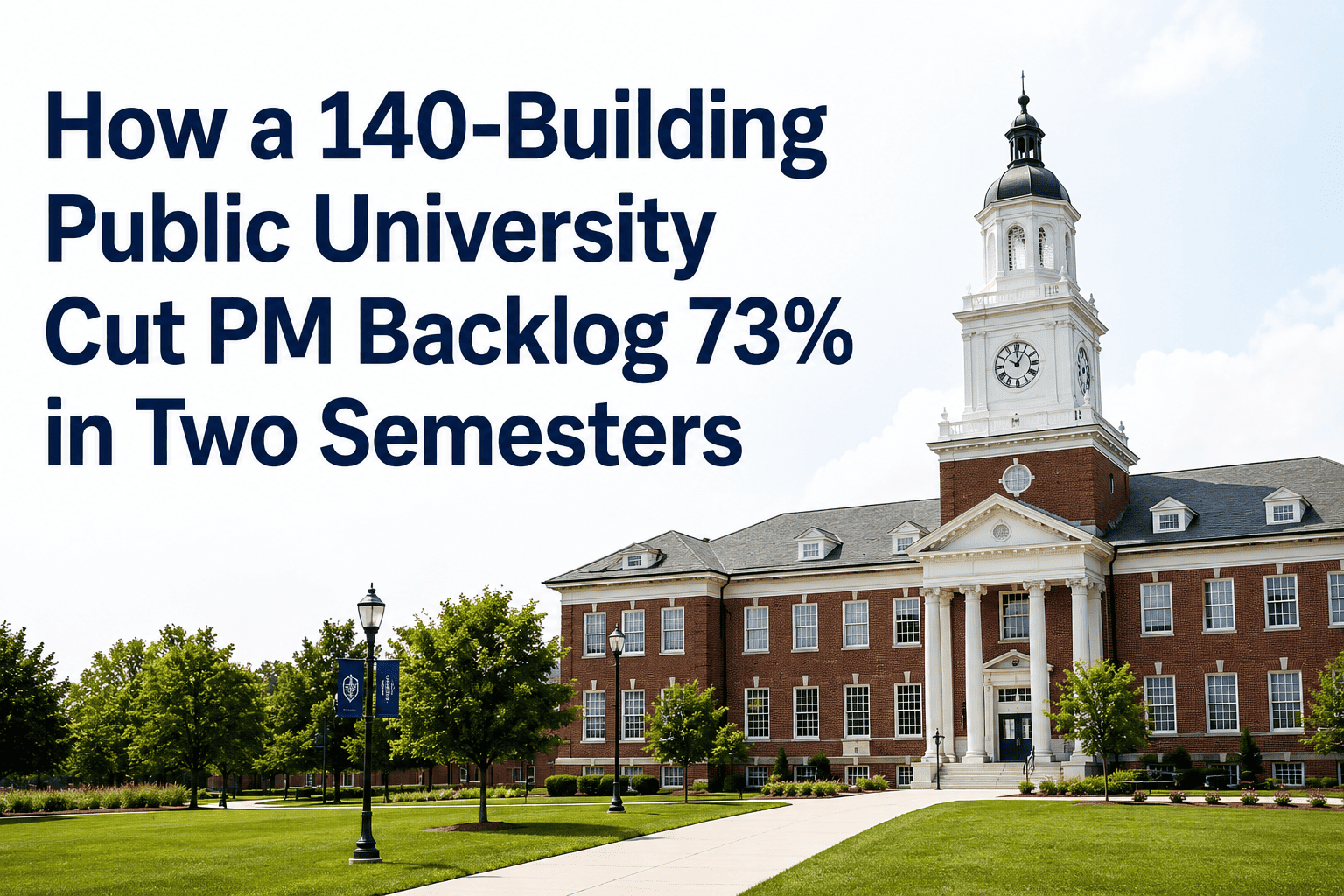
Managing preventive maintenance across 140 buildings is one of the most operationally complex challenges in higher education facilities management. When PM backlog swells semester after semester, deferred work compounds into equipment failures, compliance gaps, and budget overruns that no spreadsheet can fix. This case study documents how a large public university deployed Oxmaint's CMMS platform — including route optimization, crew-level dashboards, and automated work order scheduling — and cut its PM backlog by 73% across two academic semesters without adding headcount. If your institution is evaluating university CMMS solutions, Sign Up Free to see how building-level visibility transforms facilities operations. Already managing a similar backlog challenge? Book a Demo and walk through a live deployment scenario with a product specialist.
See how Oxmaint eliminates PM backlog at scale — built for multi-building campuses and public institutions.
The Challenge: 140 Buildings, One Overloaded Maintenance Team
6,200+
Open PM work orders entering the semester
47%
Of scheduled PMs missed due to routing inefficiency
140
Buildings managed by a single facilities operations team
Zero
Real-time visibility into individual crew PM completion rates
Before Oxmaint, the university's facilities team operated with paper-based PM schedules, disconnected spreadsheets per building zone, and no crew-level accountability. Technicians spent 20–30 minutes per shift reconciling which work orders were active across which buildings. Supervisors had no way to identify bottlenecks until work orders aged past 30 days. The result was a snowballing backlog that grew each semester, eroding asset reliability and increasing reactive maintenance costs. Equipment under deferred PM — chillers, AHUs, elevators, fire suppression systems — failed at three times the rate of assets on active PM schedules. The institution needed a CMMS platform built for multi-building campus operations, not a generic work order tool.
The Solution: Oxmaint CMMS with Route Optimization and Crew Dashboards
01
Automated PM Scheduling Across All 140 Buildings
Oxmaint's preventive maintenance engine imported the full asset register — 8,400+ assets across 140 buildings — and generated optimized PM schedules based on manufacturer intervals, regulatory compliance windows, and seasonal priority. Every work order was auto-assigned, auto-scheduled, and visible to crews in the mobile app before shift start.
02
Route Optimization for Multi-Building Technician Dispatch
The platform grouped same-building and adjacent-building work orders into optimized daily routes for each technician. Travel time between PM tasks dropped by an average of 34 minutes per shift — recapturing over 1,100 productive technician-hours per semester without adding staff.
03
Crew-Level Performance Dashboards
Supervisors accessed real-time dashboards showing PM completion rates by crew, building zone, and asset class. For the first time, facilities leadership could see which technicians were on track, which buildings were generating recurring missed PMs, and where scheduling adjustments were needed — in real time, not end-of-month reports.
04
Mobile Work Order Execution and Digital Sign-Off
Technicians completed PM checklists on mobile devices, capturing parts used, time on task, equipment condition notes, and photo documentation. Work orders closed in the field — eliminating the paper lag that previously caused 2–5 day reporting delays and data gaps in the asset history.
Implementation: From Backlog Crisis to Systematic PM in Two Semesters
| Phase |
Timeframe |
Action |
Outcome |
| Discovery & Import |
Weeks 1–3 |
Asset register import, PM interval mapping, crew structure setup in Oxmaint |
8,400 assets live in CMMS; baseline backlog quantified at 6,200 open PMs |
| Route Optimization Rollout |
Weeks 4–6 |
Route optimization activated across 18 technician assignments; mobile app deployed |
Daily travel time per crew reduced 34 min on average; first PM completion rate: 71% |
| Supervisor Dashboard Activation |
Weeks 6–8 |
Crew dashboards live; weekly backlog review cadence established with facilities leadership |
Building-level completion tracking active; 3 chronic backlog zones identified and re-routed |
| Semester 1 Close |
Month 5 |
Full PM cycle completed for high-priority assets; backlog triage underway for deferred work |
PM backlog reduced 41%; reactive work orders down 28% |
| Semester 2 Optimization |
Months 6–10 |
Schedule fine-tuning based on completion data; compliance PM prioritization for HVAC, fire, elevators |
PM backlog reduced 73% from baseline; PM completion rate reached 94% |
The deployment required no facilities headcount increase and no capital investment beyond the Oxmaint platform license. Technicians adopted the mobile app within the first week — the interface required no formal training sessions, only a 45-minute onboarding walkthrough per crew. Supervisors described the dashboard visibility as the single most operationally significant change in how the department ran. Book a Demo to see the university CMMS dashboard in a live product walkthrough.
Results: Two Semesters of Measured Operational Improvement
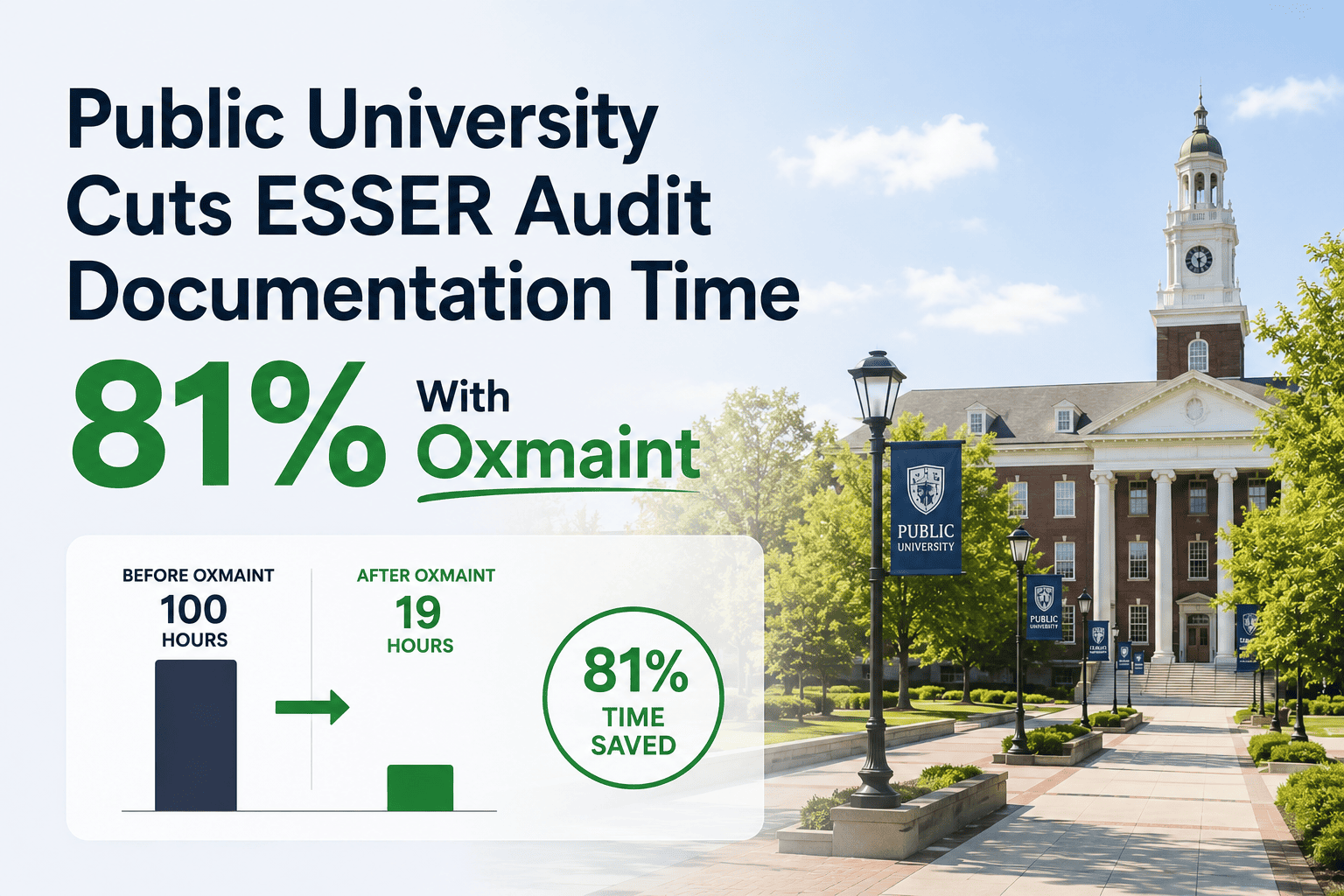
73%
Reduction in PM backlog
From 6,200 open work orders to fewer than 1,700 in two semesters
94%
PM completion rate
Up from 53% at baseline — highest in the institution's recorded history
34 min
Daily travel time saved per technician
Recovered 1,100+ productive hours per semester from route optimization alone
42%
Drop in reactive maintenance work orders
Assets on active PM schedules failed at significantly lower rates
$0
Additional headcount required
All improvement driven by route efficiency and scheduling intelligence
63%
Reduction in compliance PM delinquencies
Fire suppression, elevator, and HVAC compliance PMs fully current at semester end
Key Business Impact for Higher Education Facilities
Asset Longevity
Equipment on consistent PM schedules showed measurable life extension. The 42% reduction in reactive failures translated directly into deferred capital replacement costs across HVAC, electrical, and plumbing assets.
Compliance Confidence
Regulatory and life-safety PMs — previously tracked manually and frequently missed — were automatically flagged, prioritized, and completed on schedule. The institution entered each inspection cycle with full documentation in the CMMS.
Budget Predictability
With 73% less backlog and 94% PM completion, the facilities budget shifted from emergency reactive spending toward predictable, planned maintenance. Finance leadership gained reliable cost-per-building data for the first time.
Staff Utilization
Route optimization and pre-built daily work queues eliminated the unproductive time technicians spent planning their own routes or waiting for supervisor assignments. Crew capacity effectively increased without hiring.
"Before Oxmaint, our supervisors were flying blind. We knew the backlog was bad — we didn't know which buildings were the worst, which crews were falling behind, or where to reassign resources. The dashboard changed that in week one. By end of semester two, we had the cleanest PM record this department has seen in fifteen years."
— Director of Facilities Operations, Public Research University
Your campus PM backlog is measurable, manageable, and solvable.
Sign Up Free and deploy Oxmaint's route optimization across your top building clusters in under two weeks. Already have a deployment timeline in mind?
Book a Demo to scope a rollout plan with a higher education CMMS specialist.
Frequently Asked Questions
How long does it take to import a 140-building asset register into Oxmaint?
Most large campus deployments complete asset import, PM interval mapping, and crew setup within 2–3 weeks using Oxmaint's bulk import tools and onboarding support. Existing spreadsheet or legacy CMMS data transfers directly.
Does Oxmaint support compliance PM tracking for life-safety assets like elevators and fire suppression systems?
Yes. Compliance PMs can be assigned regulatory intervals, escalation rules, and mandatory sign-off requirements. The CMMS flags overdue compliance work orders separately from standard PMs so supervisors can prioritize them without manual tracking.
How does route optimization work for a multi-building campus layout?
Oxmaint groups open work orders by building proximity and technician assignment, generating daily route sequences that minimize travel time. Supervisors can adjust routes manually or let the system auto-optimize based on real-time work order volume and priority.
Can crew-level dashboards be restricted by role — so technicians only see their own work queues?
Yes. Role-based access controls ensure technicians see only their assigned work orders, while supervisors and facilities directors access aggregated crew and building-level performance data in the same platform.
What does it cost to deploy Oxmaint for a campus with 100–150 buildings?
Oxmaint is priced based on user count and module selection, making it one of the most cost-effective CMMS platforms for public higher education.
Book a Demo for a quote scoped to your campus size and feature requirements.
Does Oxmaint integrate with existing ERP or financial systems used by public universities?
Oxmaint supports integration with SAP and major accounting platforms. Work order cost data, parts consumption, and labor hours flow to financial systems automatically, enabling accurate per-building maintenance cost reporting without manual export.
Sign Up Free to explore integration options.
This university cut its PM backlog 73% in two semesters — with the same team, no capital investment, and a CMMS deployment completed in three weeks. Oxmaint's route optimization, crew dashboards, and automated PM scheduling give public university facilities teams the operational infrastructure to stop firefighting and start managing proactively.