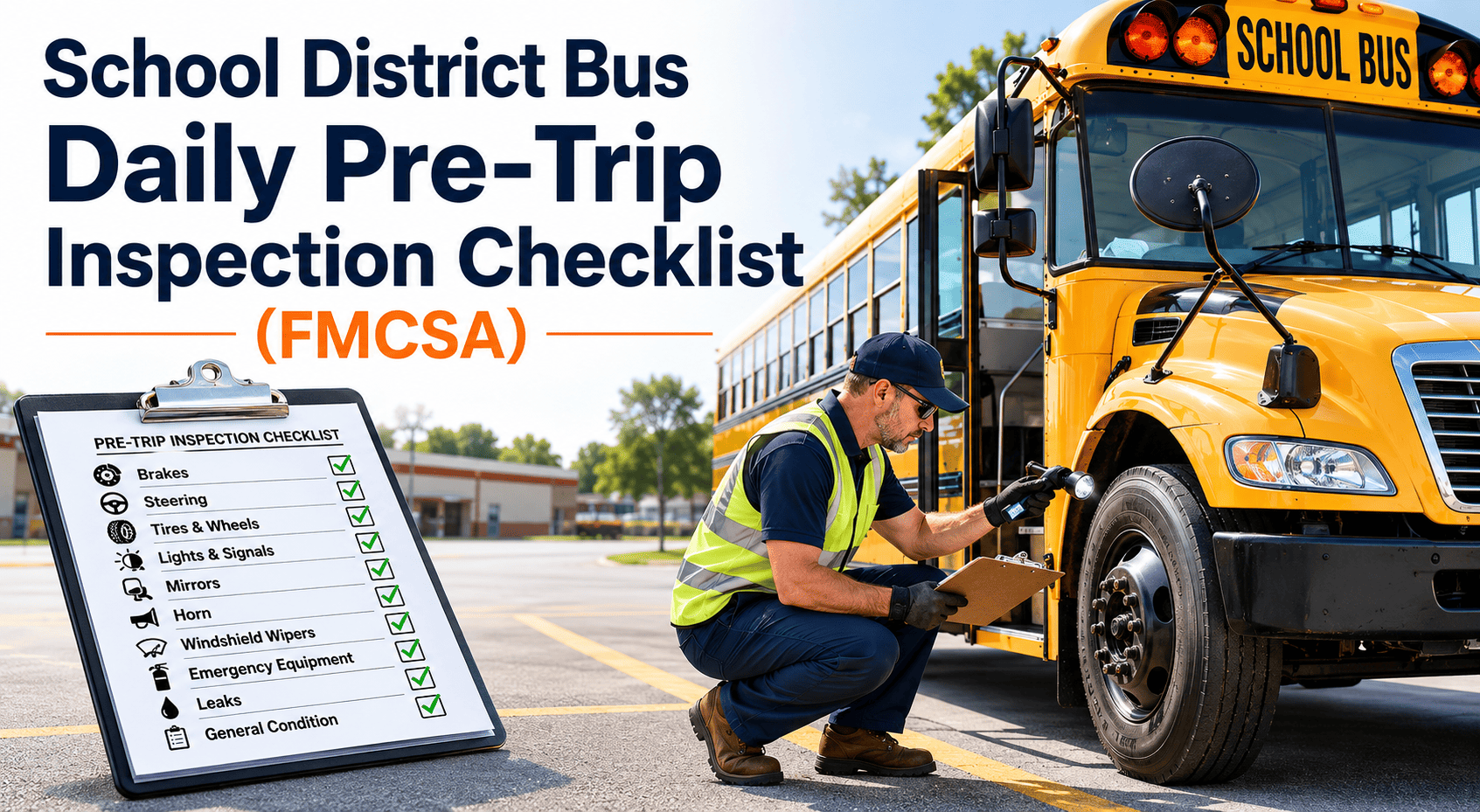
School District Bus Daily Pre-Trip Inspection Checklist (FMCSA)
By Stephen King on June 9, 2026
Every school morning, thousands of K-12 students depend on bus drivers who complete a thorough FMCSA-compliant daily pre-trip inspection before turning the ignition. Skipping steps — even once — can mean brake failure mid-route, missed CDL sign-off violations, or a DOT audit that shuts down your district fleet. Sign up free to digitize your school bus pre-trip logs with Oxmaint and keep every driver, route, and vehicle audit-ready. Districts using digital CMMS inspection workflows eliminate paper log gaps, auto-flag defects to fleet supervisors in real time, and book a demo to see how automated scheduling reduces CDL compliance risk. Whether you run 10 buses or 500 to replace clipboards with timestamped digital pre-trip records that satisfy FMCSA, state DOT, and district safety mandates. Oxmaint maps each checklist item to your vehicle asset, logs the driver signature, and defect-to-work-order automation in action. This checklist follows FMCSA 49 CFR 396.13 daily driver inspection requirements — adjust for your state's additional K-12 transportation mandates.
Keep every bus inspection timestamped, signed, and audit-ready.
How to Use: Check each item before departing. FMCSA 49 CFR 396.13 requires the driver to review the prior day's post-trip report and certify defects are corrected or not safety-affecting before operating. CDL driver signature is mandatory on completed logs.
Section 1: Engine Compartment & Fluid Levels
Check all fluids and visible engine components with the engine off. Fluid leaks under the bus or low levels that develop overnight are early indicators of failing seals, hoses, or cooling components.
Section 2: Air Brakes & Brake System
Air brake checks are FMCSA-required CDL pre-trip elements. A driver holding a CDL with an air brake endorsement must complete and document each test below. Failure of any air brake test is an immediate out-of-service condition.
Section 3: Lights, Signals & Mirrors
All lighting and signal systems must be fully operational before any student boards. School buses operate in low-light conditions during early morning and late afternoon routes. A single failed stop arm light or crossing gate is a reportable safety violation in most states.
Section 4: Doors, Emergency Exits & Child Safety Systems
K-12 school buses carry the most vulnerable passengers. All door systems, emergency exits, and child safety checks are non-negotiable before loading. Emergency exit failures discovered after an accident carry serious district liability.
Section 5: Tires, Wheels & Steering
Tire condition is the single most preventable cause of school bus roadside breakdowns. A blow-out at highway speed on a loaded school bus is a catastrophic event. Inspect every tire individually — do not walk past.
Section 6: Cab, Instruments & Driver Equipment
A well-organized driver cab ensures the driver can focus entirely on students and road conditions. Verify all instruments, required documents, and safety equipment are present and functional before departure.
Automate Pre-Trip Scheduling Across Your Entire Fleet
Oxmaint routes defect alerts to fleet supervisors instantly, auto-creates work orders, and keeps your FMCSA DVIRs timestamped and driver-signed. Sign up free or book a demo to see live fleet compliance dashboards.
Is a daily pre-trip inspection legally required for school bus drivers?
Yes. FMCSA 49 CFR 396.13 requires any CDL driver operating a commercial motor vehicle — including a school bus — to review the prior day's DVIR and complete a pre-trip inspection before each day's operation. State DOT requirements may add additional items specific to K-12 transportation.
What happens if a defect is found during the pre-trip inspection?
Any safety-affecting defect must be repaired and certified by a mechanic before the bus is operated with students. The driver documents the defect on the DVIR and notifies the fleet supervisor. Operating a bus with a known uncorrected defect is a FMCSA violation that can result in driver and district penalties.
How long should a school bus pre-trip inspection take?
A thorough FMCSA-compliant school bus pre-trip inspection takes 20–30 minutes for a trained CDL driver. Districts should schedule this time into driver shifts before first pick-up. A rushed or partial inspection is both a safety risk and a compliance gap.
How long must school bus pre-trip inspection records be kept?
FMCSA requires DVIRs to be retained for 3 months. Many state DOT and school district policies require longer retention — typically 1 year. Digital CMMS systems like Oxmaint store all inspection records with timestamps indefinitely and produce audit-ready reports on demand.
Can Oxmaint be used for school bus fleet pre-trip inspections?
Yes. Oxmaint supports digital pre-trip inspection forms with CDL driver sign-off, defect flagging, automatic work order creation, and fleet-wide compliance reporting. It is used by transportation departments to eliminate paper DVIRs and meet FMCSA and state school bus inspection requirements.
What is the FMCSA out-of-service criteria for school buses?
FMCSA and the Commercial Vehicle Safety Alliance (CVSA) publish North American Standard Out-of-Service Criteria. Key school bus triggers include: failed air brake test, brake adjustment out of limits, tires below minimum tread depth, inoperative required lights, and missing or non-functional emergency exits. Any out-of-service defect must be corrected before students board.
Replace Paper DVIRs with Digital School Bus Inspection Logs
Oxmaint gives your district real-time defect visibility, driver sign-off tracking, and automated work orders — built for K-12 transportation fleets managing FMCSA compliance at scale.