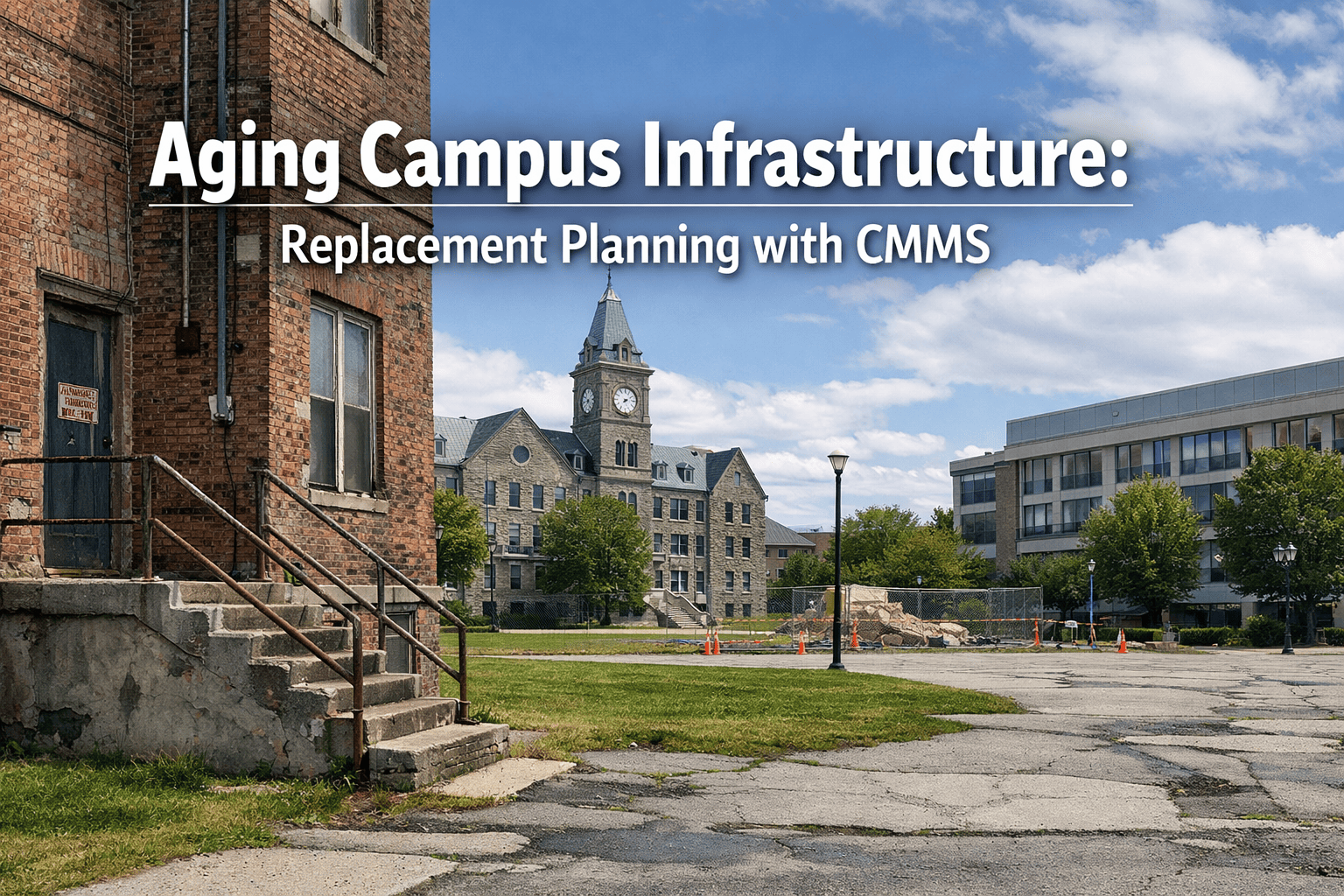
The average campus building in the United States was constructed in 1962 — making it 62 years old in 2024, with mechanical systems, electrical distribution, and plumbing infrastructure that may have been updated once or twice in that lifetime but has never been systematically replaced on a documented evidence-based schedule. The deferred maintenance backlog in US higher education exceeds $112 billion — not because institutions lack the intent to maintain their infrastructure, but because the capital planning process that should convert maintenance data into replacement roadmaps has historically been disconnected from the CMMS systems that contain the evidence base for those decisions. A facilities director who knows that a specific boiler has generated $84,000 in repair costs over the last four years, has a replacement cost of $120,000, and is operating 2 years past its manufacturer rated life has the data to make a replacement decision. A facilities director who knows only that "the boiler is old and has been giving us trouble" is making a capital argument that boards rarely fund ahead of competing priorities. CMMS asset lifecycle data is the evidence that converts anecdote into argument and argument into approved capital. Sign in to OxMaint to activate asset lifecycle analysis and replacement planning for your campus infrastructure portfolio, or book a demo to see how OxMaint builds the data foundation for campus replacement roadmaps that boards actually fund.
Campus Infrastructure Replacement Planning · Asset Lifecycle Analysis · CMMS Capital Data · OxMaint
$112 Billion in Deferred Maintenance. 62-Year-Old Average Campus Building. The Evidence to Break the Spiral Is Already in Your Maintenance Records. OxMaint Turns It Into a Replacement Roadmap.
OxMaint campus asset lifecycle analysis combines equipment age data, maintenance cost history, failure frequency trends, and manufacturer rated life records into the evidence-based replacement roadmaps that facilities directors need to make defensible capital arguments — and that boards need to see before approving the infrastructure investment that stops deferred maintenance from compounding.
62 yrs
average age of campus buildings in the United States — infrastructure built for a 50-year service life now operating 12 years past its design horizon
$112B
estimated deferred maintenance backlog in US higher education — the accumulated cost of infrastructure decisions not made in the decades when the replacement case was most affordable
3.2×
cost multiplier when deferred maintenance reaches critical condition — the financial penalty for each year a replacement decision is deferred past the optimal intervention point
3.2×
Deferred maintenance compounds at an average 3.2× cost multiplier — meaning a $120,000 boiler replacement deferred for five years past the optimal intervention point becomes a $384,000 emergency replacement plus collateral damage, contractor premium, and research or instruction disruption costs. The deferred maintenance spiral is not a funding problem at most institutions — it is a visibility and prioritisation problem. The maintenance data that would identify which equipment is approaching the 3.2× threshold already exists in the CMMS. OxMaint asset lifecycle analysis makes that data visible in the format boards can act on — showing not just that equipment is old, but specifically when replacement becomes more expensive than continued maintenance, and how much that cost delta grows with each year of further deferral.
Four Infrastructure Lifecycle Analysis Domains OxMaint Tracks
MECH — Mechanical Infrastructure
Chiller, Boiler, and HVAC Lifecycle Cost Analysis and Replacement Timing
Campus mechanical systems — central chillers, distributed boilers, air handling units, and cooling towers — represent the largest single component of the deferred maintenance backlog at most institutions because they are expensive to replace, expensive to operate when aging, and consequential to occupancy capability when they fail. The replacement case for a specific chiller is not made by stating its age — it is made by showing the board the cumulative maintenance cost over the last five years, the frequency trend of unplanned failures, the estimated cost of a catastrophic failure scenario versus planned replacement, and the year in which the cost curve crosses the replacement threshold. OxMaint mechanical asset lifecycle analysis extracts this data from the maintenance record and presents it in the cost-curve format that capital committees can evaluate against competing priorities.
Sign in to OxMaint to generate mechanical asset lifecycle analyses for your campus infrastructure portfolio.
Key Lifecycle Metrics OxMaint Calculates per Asset
Total lifetime maintenance cost — all work orders, parts, and contractor costs aggregated
Annual maintenance cost trend — year-over-year cost increase as equipment ages
Failure frequency trend — unplanned events per year increasing over asset life
Rated life remaining — years past manufacturer recommended replacement date
Replacement cost estimate — current RSMeans pricing for like-for-like or upgraded replacement
Deferred Maintenance Patterns OxMaint Data Identifies
Cost-curve crossover — point where annual maintenance exceeds annual replacement cost equivalent
Failure acceleration — unplanned event frequency doubling in consecutive years
Parts obsolescence risk — components no longer manufactured increasing repair lead time and cost
ELEC — Electrical Infrastructure
Electrical Distribution System Lifecycle Analysis and Capacity Planning
Campus electrical distribution infrastructure — medium-voltage switchgear, unit substation transformers, distribution boards, and main distribution frames — has design lives of 25 to 40 years and replacement costs that range from $200,000 for a distribution transformer to several million dollars for a main campus substation. The challenge with electrical infrastructure replacement planning is that the equipment often remains functionally operational well past its design life while its failure risk escalates significantly — the failure rate curve is not linear. OxMaint electrical infrastructure lifecycle analysis combines equipment age, thermal survey history, maintenance work order frequency, and remaining capacity margin data to produce the risk-adjusted replacement timeline that allows facilities directors to sequence electrical infrastructure replacement before failures occur rather than after. The replacement sequence optimised for risk reduction rather than age alone can substantially reduce the programme cost by avoiding emergency replacements that carry 2–4× premium costs.
Book a demo to see electrical infrastructure lifecycle analysis in OxMaint for campus capital planning.
Key Electrical Lifecycle Metrics OxMaint Tracks
Equipment installation year and manufacturer design life — remaining design life calculation
Thermal survey history — hot spot trend indicating developing insulation or connection failure
Capacity utilisation — current load as percentage of rated capacity, capacity margin trend
Maintenance event frequency — unplanned switching events and protective device operations
Electrical Aging Risks OxMaint Analysis Quantifies
Switchgear past design life — failure probability escalation after 30-year threshold
Capacity margin erosion — load growth reducing available margin toward breaker trip threshold
Parts obsolescence — components for pre-1990 switchgear no longer manufactured
PLMB — Plumbing and Water Systems
Plumbing Infrastructure Lifecycle and Campus-Wide Pipe Replacement Planning
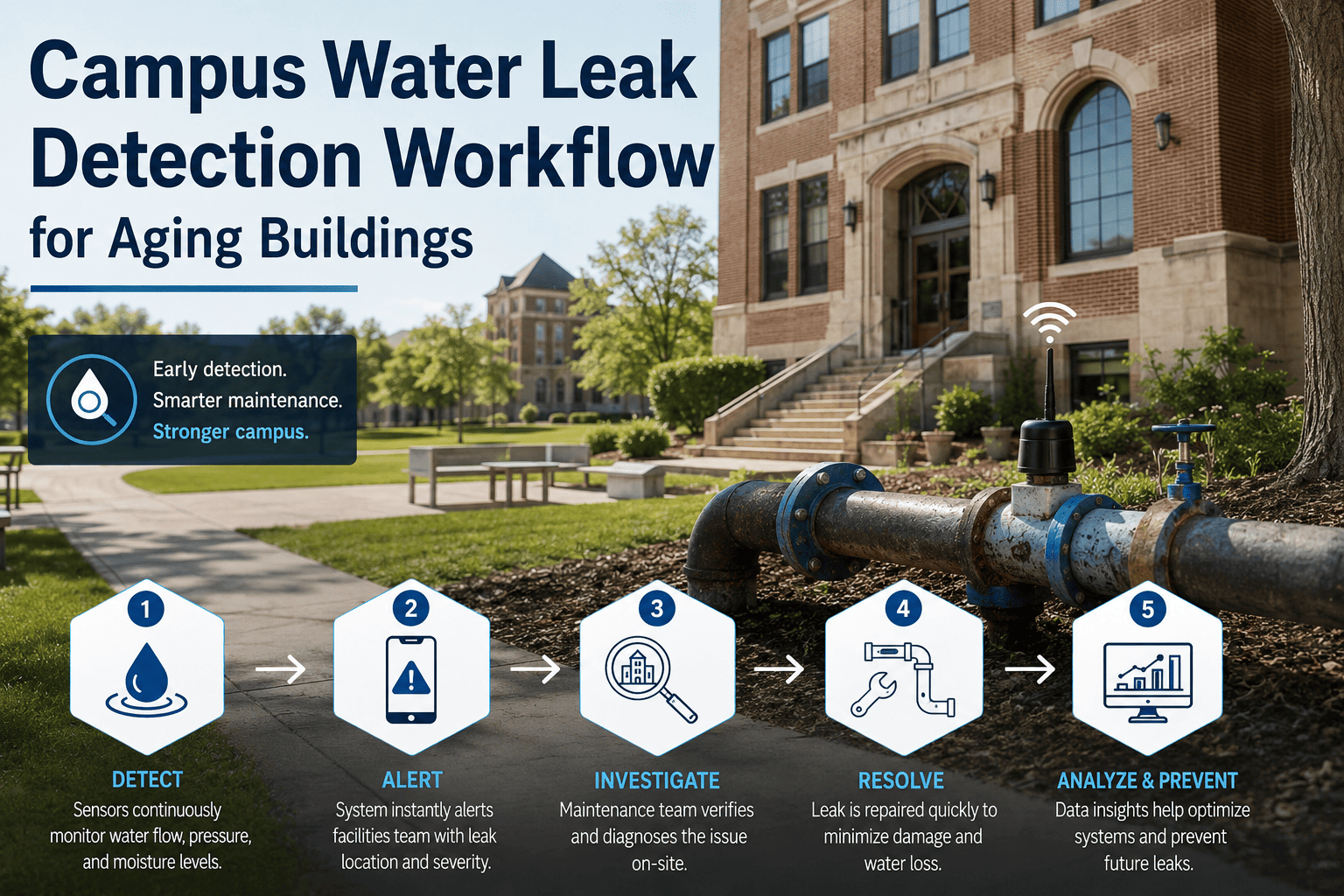
Campus plumbing systems present the most complex lifecycle analysis challenge because the asset — pipe — is typically not registered as individual equipment items, is not systematically inspected, and fails in ways that are invisible until a pipe joint fails and water appears somewhere it should not be. A 60-year-old campus with original galvanised steel domestic water distribution is not just a maintenance problem — it is a public health risk management obligation that requires a documented replacement programme supported by condition assessment data. OxMaint plumbing lifecycle analysis builds from water quality testing records, pipe condition inspection findings, failure event documentation, and building construction dates to create the campus-wide pipe infrastructure risk map that supports a phased replacement programme. The analysis identifies which buildings have the highest-risk plumbing infrastructure and quantifies the cost trajectory of continued repair versus planned replacement by building section.
Sign in to OxMaint to configure plumbing infrastructure lifecycle tracking for your campus buildings.
Key Plumbing Lifecycle Metrics OxMaint Tracks
Pipe material and installation year — corrosion timeline by material type and age
Failure event frequency — pipe joint, fitting, and valve failure events per building per year
Water quality trend — lead, copper, and bacterial contamination sampling results by building
Emergency repair cost cumulative — total leak and burst pipe repair cost by building section
Plumbing Aging Risks OxMaint Analysis Quantifies
Galvanic corrosion acceleration — failure rate doubling in dissimilar metal pipe sections
Lead leaching risk — older brass fittings contributing lead to water supply above action level
Cathodic protection exhaustion — underground steel pipe corrosion protection depleted
ENV — Building Envelope and Structure
Building Envelope Lifecycle Analysis and Roof-to-Foundation Replacement Sequencing
Campus building envelope components — roofing systems, windows, facade cladding, and expansion joints — have defined service lives that range from 15 years for a single-ply membrane roof to 50 years for masonry facade systems. When these components reach end of life, they do not just fail — they allow water infiltration that damages interior finishes, structural elements, and building systems in a cascading damage pattern that multiplies the original envelope replacement cost by the value of the collateral damage. OxMaint building envelope lifecycle analysis tracks roof installation dates and annual condition survey scores per building to produce the campus-wide roofing replacement programme ranked by risk of water infiltration damage — prioritising roofs that are approaching end of life in buildings with sensitive occupancies, research equipment, or significant interior asset values. The envelope analysis supports a 10-year capital programme that replaces roofs in sequence before, not after, they allow infiltration damage.
Book a demo to see building envelope lifecycle analysis in OxMaint for campus capital programme planning.
Key Envelope Lifecycle Metrics OxMaint Tracks
Roof system installation date and membrane type — remaining useful life calculation
Annual condition survey score — 1–5 rating trend over inspection history
Water infiltration event history — interior damage events linked to envelope condition
Collateral damage accumulation — interior repair costs caused by envelope failures
Envelope Aging Risks OxMaint Analysis Quantifies
Roof membrane failure before replacement — water infiltration into occupied research or lab space
Window seal failure — thermal performance degradation and interior condensation
Expansion joint failure — structural movement accommodation failure leading to cracking
OxMaint Campus CMMS · Infrastructure Replacement Planning
The Data to Stop the Deferred Maintenance Spiral Is Already in Your Maintenance Records. OxMaint Turns It Into the Capital Roadmap That Boards Can Fund.
Asset lifecycle cost curves. Failure frequency trends. Rated life analysis. Replacement timing optimisation. OxMaint converts maintenance history into evidence-based capital arguments.
Three Technologies That Power OxMaint Infrastructure Replacement Analysis
How OxMaint Converts Maintenance Records Into Capital Planning Evidence
Technology · AI Cost Modelling
Repair vs. Replace Cost Curve Analysis
OxMaint AI calculates the year-by-year repair cost trajectory for each asset class based on observed maintenance cost trends — projecting forward to identify the year when cumulative annual repair costs equal or exceed the annualised replacement cost equivalent. The cost crossover year is the evidence-based optimal replacement timing that facilities directors can present to boards as the quantified inflection point in the repair vs. replace decision.
Output: Year-by-year cost curve with crossover point per asset — board-presentable format
Technology · Digital Twin
10-Year Infrastructure Health Trajectory Modelling
OxMaint digital twin models project each campus infrastructure system's health trajectory over a 10-year horizon — estimating failure probability, maintenance cost, and operational impact for each year of the forecast period under current maintenance investment versus increased investment. The 10-year model allows capital planners to see the long-term cost of continued deferral and the compounding financial benefit of replacement at the optimal timing point.
Output: 10-year cost-of-deferral projection versus replacement investment comparison
Technology · Capital Report
Board-Ready Capital Priority Report Generation
OxMaint generates capital priority reports formatted for board of trustees presentation — ranking every infrastructure replacement need by risk score, cost trajectory, and optimal replacement timing, with the evidence basis clearly documented for each recommendation. Reports include asset-specific maintenance cost history, failure frequency data, and replacement cost estimates that allow board members to evaluate each capital request against quantified risk rather than anecdotal condition descriptions.
Output: Complete capital priority report for board presentation in under 15 minutes
Infrastructure Replacement Priority Register — Where Deferral Carries the Highest Cost
Critical — Replace This Year
Chillers Past Rated Life — Annual Cost Exceeding Replacement Equivalent
When a chiller's annual maintenance cost exceeds 15% of its replacement cost and it is operating past its manufacturer rated life, OxMaint flags it as immediate replacement priority. Continued operation past this threshold is more expensive annually than financing a replacement — the financial case is unambiguous.
Critical — Replace This Year
Roofs 2+ Years Past Membrane Life — Occupied Research Buildings
A roof membrane beyond its rated life in a building containing research equipment or research archives has a collateral damage risk that vastly exceeds the replacement cost. Every year of further deferral increases the probability of a water infiltration event that destroys irreplaceable research assets.
Critical — Replace This Year
Pre-1985 Electrical Switchgear — No Parts Availability
Electrical switchgear manufactured before 1985 is increasingly operating without parts availability for protective devices and bus components. When a failure occurs on equipment without available parts, the emergency replacement timeline can be 6–18 months — creating an extended outage that no campus can manage.
3-Year Capital Window
Boilers Approaching Rated Life — Failure Frequency Rising
Boilers within 3 years of rated life with an increasing failure frequency trend are on a predictable trajectory toward emergency replacement during heating season. OxMaint 10-year modelling identifies this window and supports capital programme inclusion before the failure forces a reactive response.
3-Year Capital Window
Original Galvanised Plumbing — Failure Event Rate Increasing
Buildings with original galvanised steel domestic water distribution showing increasing pipe failure events per year are approaching the phase of accelerating failure rate that characterises end-of-life galvanised systems. Phased replacement before the acceleration peak reduces total programme cost.
5-Year Capital Window
Window Systems at 30+ Years — Thermal and Seal Performance
Campus window systems at 30 or more years show increasing seal failure rates and thermal performance degradation that increases HVAC energy cost while worsening occupant comfort. The combined energy penalty and increasing seal repair cost supports capital programme inclusion in a 5-year window.
Campus Infrastructure Asset Lifecycle — OxMaint Replacement Timing by System Type
Documented Outcomes — Campuses Using OxMaint for Infrastructure Replacement Planning
$18M
additional capital secured in a single budget cycle by a university that presented OxMaint asset lifecycle cost-curve analysis to the board vs. prior narrative-only capital requests
40%
reduction in emergency replacement programme costs at campuses where OxMaint lifecycle analysis enables planned replacement at optimal timing rather than reactive emergency response
3.2×
average avoided cost multiplier when OxMaint lifecycle data supports capital approval at optimal replacement timing — before the deferred maintenance cost compounding takes effect
$112B
estimated US higher education deferred maintenance backlog — the accumulated cost of replacement decisions not made at the optimal timing point
62 yrs
average campus building age in the US — infrastructure now operating 12 years past its original 50-year design life in most cases
3.2×
average cost multiplier when deferred maintenance reaches critical condition — the financial penalty for each year of deferral past the optimal replacement point
15 min
time to generate a complete infrastructure replacement priority report for board presentation from OxMaint asset lifecycle data — vs. weeks for a consultant-produced capital study
The boiler that will cost you $380,000 in an emergency replacement next winter was a $120,000 planned replacement three years ago. The data showing that trajectory is in your maintenance records. OxMaint shows you the cost curve before you pass the crossover.
Asset lifecycle cost analysis. 10-year replacement roadmaps. Board-ready capital priority reports. OxMaint converts your maintenance history into the infrastructure replacement intelligence that stops deferred maintenance from compounding.
For 12 years I had been telling our board that we needed chiller plant investment, and for 12 years I got partial funding or deferral. The year I showed them the OxMaint cost-curve analysis — specifically the chart showing that our annual maintenance on those three chillers had exceeded the annualised replacement cost three years earlier and was accelerating — they approved the full programme in one meeting. The data was not new. The format that made it impossible to rationally defer was new.
— VP of Facilities and Campus Operations, Private University · Virginia · 12-year OxMaint capital planning programme · user since 2020
Frequently Asked Questions — Aging Campus Infrastructure Replacement Planning with CMMS
How does OxMaint calculate the repair vs. replace cost crossover year for campus equipment?
OxMaint analyses the annual maintenance cost trend for each asset class over its recorded history — fitting a cost escalation curve that projects forward to identify the year when cumulative annual maintenance costs equal the annualised replacement cost equivalent (replacement cost divided by expected service life years). The crossover year is the optimal replacement timing presented on the asset lifecycle chart.
Sign in to OxMaint to generate lifecycle cost analyses for your campus equipment.
How does OxMaint support a 10-year campus infrastructure replacement roadmap?
OxMaint generates a 10-year capital programme calendar that ranks all infrastructure replacement needs by risk-adjusted priority, groups replacements by budget year based on optimal timing analysis, and estimates programme cost using current RSMeans pricing or institution-provided cost data. The programme can be presented to the board as an evidence-based 10-year commitment rather than a year-by-year funding request.
Can OxMaint integrate with SAP or other ERP systems for capital programme cost tracking?
Yes. OxMaint pushes capital project cost estimates and approved replacement project records to SAP and most major ERP capital planning modules via API — enabling the finance team to track capital programme spend against OxMaint-generated replacement schedules without manual data reconciliation.
Book a demo to review ERP integration for capital planning data in OxMaint.
How does OxMaint generate replacement cost estimates for aging campus infrastructure?
OxMaint integrates RSMeans construction cost database pricing for common campus infrastructure asset types — applying regional cost factors and current year pricing to generate replacement cost estimates by equipment type and capacity. Institutions can also enter custom replacement cost estimates from local contractor quotes or historical project data, which OxMaint uses in place of RSMeans estimates for that asset class.
How does OxMaint handle campus infrastructure that has no maintenance history in the system?
For assets without maintenance history in OxMaint — typically equipment that predates the CMMS deployment — OxMaint uses asset class failure rate benchmarks and the equipment installation date to model initial lifecycle risk scores. As maintenance records accumulate, the model transitions from benchmark-based to history-based analysis, with the transition reflected in the confidence band on lifecycle projections.
The Evidence to Break Your Deferred Maintenance Spiral Is Already in Your Maintenance Records. OxMaint Turns It Into the Capital Roadmap Your Board Can Fund.
Asset lifecycle cost curves. Repair vs. replace crossover analysis. 10-year replacement roadmaps. Board-ready capital priority reports. OxMaint makes the case for infrastructure investment in the language that capital committees approve — quantified risk, not optimistic condition descriptions.