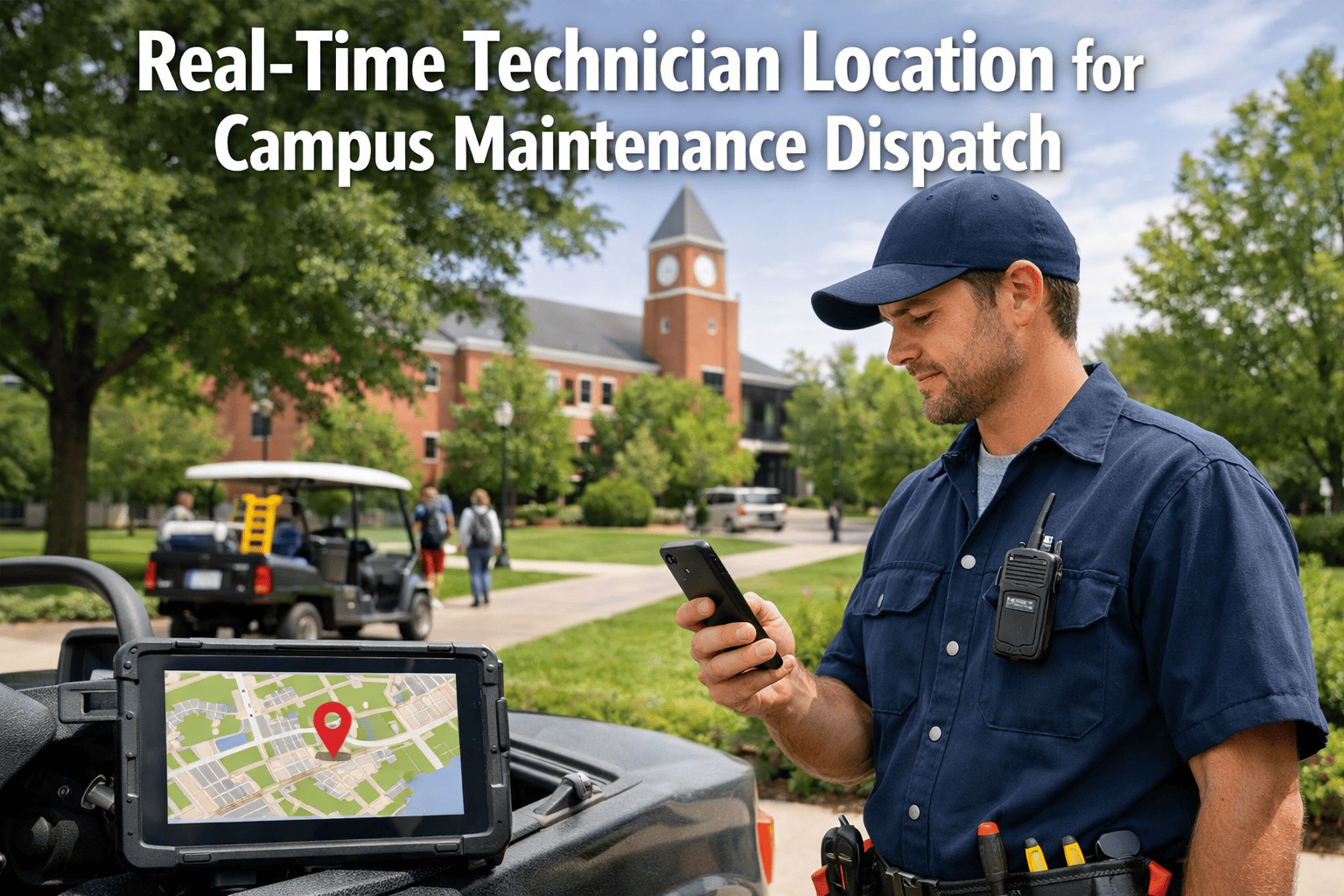
A facilities coordinator at a large public university spent forty minutes one Tuesday morning trying to locate a technician to respond to a reported elevator entrapment — calling three phones, radioing two zones, and finally discovering the technician was already in the adjacent building completing a routine PM. The response that should have been a three-minute dispatch took forty-three minutes because nobody knew where anyone was. Across a 200-acre campus with dozens of buildings, hundreds of maintenance tasks, and a staff of forty or fifty technicians moving continuously through mechanical rooms, rooftops, and utility corridors, dispatching without real-time location visibility is the operational equivalent of managing a fleet of delivery vehicles with no GPS. Every unnecessary cross-campus travel, every dispatch of the wrong technician while the right one is fifty meters away, and every response delay caused by radio tag-and-chase adds up to thousands of wasted hours per year and dozens of preventable incidents where response time was the difference between a contained problem and a building impact event. Sign in to OxMaint to activate real-time technician location tracking and GPS-enabled dispatch for your campus maintenance team, or book a demo to see how OxMaint shows live technician positions, current task assignments, and proximity-optimised dispatch recommendations across your entire campus in real time.
Real-Time Technician Location · GPS Campus Dispatch · Smart Maintenance Routing · OxMaint
Every Technician's Current Location. Every Open Work Order. Proximity-Optimised Dispatch in Real Time — Across Every Building, Zone, and Floor of Your Campus.
OxMaint GPS-enabled campus dispatch shows facilities coordinators the live location of every technician, their current task assignment, and their proximity to incoming work orders — reducing average dispatch response time from 43 minutes to under 8 minutes and eliminating the unnecessary cross-campus travel that consumes hours of technician time every day.
43 min → 8 min
average emergency dispatch response time reduction at campuses using OxMaint GPS-enabled dispatch vs. radio-and-call coordination without location visibility
2.1h
average daily technician time lost to unnecessary travel and suboptimal task sequencing without real-time location and proximity-based dispatch
200 acres
typical campus footprint where dispatching without GPS creates the same operational blind spot as a delivery company with no vehicle tracking
2.1h
The average campus maintenance technician loses 2.1 hours per day to unnecessary travel — dispatched to buildings they have just left, routed past work locations without stopping, and sent cross-campus for tasks that could have been assigned to a nearby technician who was not visible to the dispatcher. Multiply that by 40 technicians and you have 84 hours per day of recoverable productive maintenance capacity — approximately $3.2 million per year in labour that is currently consumed by navigation rather than maintenance. Real-time technician location tracking is not a surveillance tool — it is a dispatch optimisation platform that returns those 2.1 hours to productive maintenance work and allows campus facilities programmes to maintain more buildings with the same team.
Four Dispatch Optimisation Domains OxMaint GPS Tracking Enables
PROX — Proximity Dispatch
Proximity-Optimised Technician Assignment for New Work Orders
When a new emergency or priority work order enters the OxMaint queue, the coordinator currently faces a binary choice — dispatch the on-call technician regardless of where they are, or spend several minutes making calls to find who is closest. Neither approach is systematic, and both produce suboptimal dispatch decisions that extend response times. OxMaint proximity dispatch presents the coordinator with a ranked list of available technicians ordered by their current distance from the work order location — showing each technician's real-time map position, current task assignment, and estimated travel time to the new work order location. The coordinator makes an informed dispatch decision in seconds rather than minutes, and the dispatched technician receives the new work order on their mobile device while still en route. Elevator entrapments, water leaks, and power events that previously required 43 minutes to staff now receive a confirmed response in under 8 minutes from queue entry to technician in motion.
Sign in to OxMaint to activate proximity-based dispatch for your campus maintenance team.
Key Proximity Dispatch Data OxMaint Provides
Live technician map — real-time GPS position per technician on campus map
Distance ranking — technicians sorted by proximity to new work order location
Current task status — assigned task completion percentage per technician
Estimated travel time — calculated route time from current position to work order site
Skill match filter — proximity ranking filtered to show only qualified technicians
Dispatch Failures OxMaint Proximity Tracking Prevents
Wrong technician dispatched — closest available technician not identified without location data
Dispatch delay — 5–15 minutes of radio/phone coordination before assignment is made
Skill mismatch — available technician assigned to task requiring different certification
ROUTE — Route Optimisation
Zone-Based Task Sequencing and Travel Time Minimisation
Campus maintenance technicians assigned to daily PM task queues typically execute those tasks in the order they appear on the work order list — which is often not the order that minimises travel time across the campus geography. A technician who crosses campus three times to complete a task list that could have been executed in two building clusters has spent an hour in transit that could have been spent completing additional maintenance tasks. OxMaint route optimisation sequences each technician's daily task queue by geographic proximity — grouping tasks in the same building or campus zone before routing to the next zone, and recalculating the optimal remaining sequence dynamically when a new priority work order is inserted or a task takes longer than estimated. The result is a measurable reduction in daily technician travel time that translates directly into additional maintenance capacity.
Book a demo to see route optimisation in OxMaint for campus maintenance task sequencing.
Key Route Optimisation Features OxMaint Provides
Zone-based task clustering — tasks in same building grouped before routing to next zone
Dynamic re-sequencing — route updated when new priority work order is inserted mid-shift
Travel time estimation — route calculation from current GPS position to next task location
Completion prediction — estimated shift completion time based on remaining tasks and route
Route Failures OxMaint Optimisation Prevents
Unnecessary cross-campus travel — tasks sequenced by queue order rather than geography
Building revisit waste — returning to a building that was passed an hour earlier
Route disruption on priority insert — new task inserted without recalculating remaining sequence
RESP — Emergency Response
Life Safety and Emergency Work Order Response with GPS Technician Positioning
Elevator entrapments, water main breaks, power failures, and fire suppression activations require immediate technician response — and in a campus emergency, a three-minute advantage in technician assignment can be the difference between a contained event and an extended building impact. OxMaint emergency work order creation triggers an automatic proximity alert — immediately displaying all technicians within 500 metres of the emergency location with their current GPS position, distance, and estimated arrival time. The coordinator can confirm an assignment in under 30 seconds without making a single phone call, and the dispatched technician receives the emergency work order, building address, and specific location details on their mobile device before they have left their current task. Life safety response speed is the highest-consequence application of real-time technician location tracking on any campus.
Sign in to OxMaint to configure emergency proximity alerts for your campus maintenance team.
Key Emergency Response Features OxMaint Provides
Automatic proximity alert — nearest technicians identified within 5 seconds of emergency WO creation
One-tap dispatch — coordinator confirms assignment from proximity list without phone contact
Mobile emergency briefing — work order details delivered to technician device immediately on assignment
ETA tracking — real-time estimated arrival at emergency location from GPS position
Emergency Response Failures OxMaint Prevents
43-minute dispatch lag — radio-and-call coordination replacing GPS proximity assignment
Unknown technician position — dispatcher unable to identify nearest available responder
No ETA visibility — arriving technician's progress invisible until physical arrival confirmation
SUPER — Supervisor Visibility
Real-Time Supervisor Dashboard and Shift Activity Accountability
Campus maintenance supervisors managing large teams across dispersed campus geography face a fundamental visibility gap — they cannot be everywhere at once, and the alternative of calling technicians to verify location and task status consumes supervisor time that should be directed to work quality oversight. OxMaint supervisor dashboards show every technician's live GPS position, current assigned task, task completion status, and shift activity timeline — allowing supervisors to monitor team deployment, identify technicians who are stationary for extended periods at non-task locations, verify that assigned work orders are being completed at the correct locations, and identify productivity patterns that inform staffing and route planning decisions. The GPS activity record also provides an objective basis for performance discussions — replacing subjective observations with data-driven evidence of technician activity across the shift.
Book a demo to see the real-time supervisor GPS dashboard in OxMaint for campus maintenance teams.
Key Supervisor Dashboard Data OxMaint Provides
Live team map — all active technicians with GPS position and current task on campus map
Shift activity timeline — GPS movement and task completion record per technician per shift
Extended stationary alert — configurable alert when technician inactive at non-task location
Task-location verification — confirmation that work order completion was logged at correct GPS location
Supervisor Visibility Failures OxMaint Prevents
Invisible team deployment — supervisor unaware of actual technician positions across campus
Unverified task location — work order marked complete from incorrect GPS position
Productivity blind spot — extended non-productive periods undetectable without GPS tracking
OxMaint Campus CMMS · GPS Technician Location & Smart Dispatch
Every Technician Visible. Every Emergency Dispatched in Under 30 Seconds. Every Daily Route Optimised. Real-Time Location Intelligence Across Your Entire Campus.
OxMaint GPS-enabled dispatch eliminates the 43-minute radio-and-call response and the 2.1 hours of daily wasted travel — returning measurable maintenance capacity to a team that is already fully deployed.
Three Technologies That Power OxMaint Campus GPS Dispatch
How OxMaint Combines GPS, AI, and Mobile to Optimise Campus Maintenance Dispatch
Technology · GPS Positioning
Indoor and Outdoor Location Tracking — No Dead Zones
OxMaint location tracking uses mobile device GPS for outdoor campus positioning and Bluetooth beacon triangulation for indoor building location — providing floor-level accuracy in multi-storey buildings where GPS signal is unavailable. A technician in a basement mechanical room is as visible to the dispatcher as a technician on the main quad — campus building coverage eliminates the dead zones that make radio-based dispatching unreliable.
Coverage: Outdoor GPS + indoor BLE triangulation — full campus building coverage
Technology · AI Route AI
AI-Optimised Daily Task Sequencing
OxMaint AI analyses each technician's daily task list, their current location, campus building layout, and historical travel time data to generate the optimal task sequence that minimises travel time while respecting task priority constraints. When a new priority work order is inserted, the AI recalculates the remaining task sequence from the technician's current position — dynamically maintaining the optimal route throughout the shift rather than generating a static morning sequence.
Impact: 22% average reduction in daily technician travel time after AI route optimisation deployment
Technology · Digital Twin
Campus Map Integration with Building Asset Overlay
OxMaint integrates campus digital twin building maps with the technician location layer — displaying each work order location, open maintenance alert, and technician position simultaneously on a unified campus map. The dispatcher sees not just where technicians are but what assets and open work orders exist at each campus location — enabling dispatch decisions that optimise for both proximity and workload distribution across the entire visible campus.
Impact: Dispatcher decision time reduced from 5+ minutes to under 30 seconds per assignment
Campus Dispatch Risk Register — Where Location Visibility Delivers the Highest Value
Critical Impact
Elevator Entrapment Response
Elevator entrapment with a passenger inside requires the fastest possible technician response — and the passenger cannot be communicated with during a radio search for an available technician. GPS proximity dispatch identifies the nearest elevator-qualified technician in under 5 seconds and confirms assignment in under 30 seconds.
Critical Impact
Active Water Leak Containment
Water damage cost scales directly with response time. Every 10 minutes of unconstrained water flow adds significant remediation cost. GPS proximity dispatch gets the closest technician to the isolation valve in minutes — the difference between a damp ceiling tile and a structural water damage event.
Critical Impact
Life Safety System Fault Response
Fire alarm panel faults, emergency lighting failures, and sprinkler system alerts require immediate technician investigation — with campus safety holding a position at the affected building. GPS proximity dispatch closes the response window from 30+ minutes to under 10 minutes, freeing campus safety resources sooner.
High Value
Daily PM Route Efficiency
Route-optimised PM task sequencing returns the 2.1 hours of daily wasted travel to productive maintenance work — the equivalent of adding one full-time technician to a team of 40 without increasing headcount or budget.
High Value
Overtime Reduction Through Better Sequencing
Technicians whose routes are not optimised frequently end shifts with incomplete tasks that require overtime or next-day backlog accumulation. AI route optimisation ensures task sequencing maximises completion within the scheduled shift window.
High Value
Contractor Location Accountability
Contractor Location Accountability
Third-party contractors working on campus can be issued OxMaint tracking access — providing the same location visibility for contracted work as for in-house staff. Supervisor visibility of contractor presence at assigned work locations adds accountability that time-and-materials billing does not otherwise provide.
Campus Dispatch Performance — Before and After OxMaint GPS Tracking
Documented Outcomes — Campuses Using OxMaint GPS-Enabled Dispatch
81%
reduction in average emergency dispatch response time at campuses using OxMaint GPS proximity dispatch — from 43-minute average to under 8 minutes
$1.4M
annual recovered labour value at a 40-technician campus from 33% travel time reduction through OxMaint AI route optimisation and proximity-based dispatch
88%
daily task completion rate at campuses using OxMaint GPS-optimised routing — vs. 61% average without route optimisation and real-time task sequencing
2.1h
average daily technician travel waste without GPS dispatch — recoverable productive maintenance capacity currently lost to suboptimal routing
<30s
coordinator dispatch decision time with OxMaint GPS proximity ranking — vs. 5–15 minutes of radio and phone coordination without location visibility
200 ac
typical campus footprint — the geographic scale that makes GPS location tracking as essential for campus maintenance as for any logistics operation at the same scale
22%
average reduction in daily technician travel time from OxMaint AI task sequencing — the productivity gain available without adding a single team member
Your team of 40 technicians is losing 84 hours per day to unnecessary travel. OxMaint GPS dispatch returns those hours to productive maintenance work — without adding headcount or budget.
Real-time location visibility. Proximity-optimised dispatch. AI route sequencing. Supervisor dashboards. OxMaint makes every hour of your technician team count.
We had an elevator entrapment last fall. Before OxMaint GPS, that call would have gone to dispatch, dispatch would have radioed zone leads, zone leads would have called technicians, and we'd have had someone on site in 35 to 40 minutes. With OxMaint, the work order created an automatic proximity alert, I saw three technicians within 200 metres on the map, assigned the nearest one in under 20 seconds, and she was on site in under 4 minutes. The passenger was out of the elevator before the elevator company even called us back.
— Campus Facilities Coordinator, State University · Pennsylvania · 47 technicians tracked in OxMaint GPS dispatch · user since 2023
Frequently Asked Questions — Real-Time Technician Location and GPS Dispatch for Campus
How does OxMaint track technician location inside campus buildings where GPS is unavailable?
OxMaint uses Bluetooth Low Energy beacon triangulation for indoor positioning — providing floor-level accuracy inside multi-storey campus buildings, basement mechanical rooms, and underground utility areas where GPS signal is unavailable. Indoor beacons are installed at key building nodes during OxMaint deployment.
Sign in to OxMaint to review indoor positioning options for your campus buildings.
Does OxMaint GPS tracking require technicians to carry a dedicated device?
No. OxMaint location tracking runs on any iOS or Android smartphone — the same device technicians use for mobile work order management. There is no dedicated GPS tracker required. Location sharing is active when the OxMaint app is open during a shift and can be configured to pause outside of scheduled working hours for staff privacy.
How does OxMaint AI route optimisation handle emergency work orders inserted into a technician's existing task queue?
When a priority work order is inserted into an active technician's queue, OxMaint AI immediately recalculates the optimal sequence for all remaining tasks from the technician's current GPS position — placing the new priority task at the appropriate point in the route and re-optimising the remaining task order. The technician receives the updated task sequence on their mobile device without any coordinator action.
Book a demo to see dynamic route re-optimisation in OxMaint.
Can OxMaint GPS tracking be extended to third-party contractors working on campus?
Yes. Contractors can be issued temporary OxMaint tracking access for the duration of a project — providing supervisor visibility of contractor presence at assigned work locations, time-on-site confirmation, and work order completion logging. Contractor tracking access expires automatically at project completion without requiring any manual deactivation.
How does OxMaint address technician privacy concerns with GPS location tracking?
OxMaint GPS tracking is active only during scheduled shift hours — location sharing pauses automatically outside working hours, and technicians can see when their location is being shared. Historical GPS data is retained for the configurable period required for supervisor review and work order verification, then automatically purged. Location data access is restricted to authorised supervisors and coordinators through role-based permissions.
Your Campus Maintenance Team Is Working Hard. OxMaint GPS Dispatch Makes Sure That Work Is Happening Where It Is Needed Most — Not Where the Radio Happened to Reach.
Real-time technician location. Proximity-optimised emergency dispatch. AI route sequencing. Supervisor dashboards. OxMaint turns campus maintenance dispatch from a radio-tag guessing game into a precision coordination system that delivers measurable response time improvements every shift.