How AI-Powered Facility Analytics Help Schools Make Smarter Budget Decisions
By jamie lanister on March 25, 2026
A Facilities Director at a school district in Ohio presented her annual capital budget request to the board in February. She asked for $2.4 million. The board approved $900,000. The previous year, the district had spent $1.1 million on emergency equipment replacements — three HVAC units, two boilers, and a commercial refrigeration system — all reactive, all emergency-procured at above-market rates. None of them had been on the capital plan. None of them had shown failure indicators in any report. The Facilities Director had no data to argue with — she had a list of things that broke and a list of things she thought might break next. The board funded what they could verify. AI facility analytics in OxMaint turns maintenance history into failure predictions, cost forecasts, and capital plans that boards can evaluate as financial arguments — not facilities requests. Book a demo to see OxMaint's analytics module for K-12 districts.
OxMaint · AI Facility Analytics · K-12 Budget Intelligence
Turn Maintenance Data Into Budget Arguments That School Boards Approve.
AI-powered failure prediction, capital cost forecasting, energy optimisation analysis, and board-ready reporting — built from the maintenance history already in OxMaint. No new data collection. No new systems. Just intelligence from the data you already have.
of equipment failures predicted by AI 60+ days in advance when 12 months of maintenance history exists
3.2×
Return on PM investment — documented across K-12 districts using AI-prioritised maintenance programmes
18%
Average energy cost reduction when AI identifies underperforming HVAC systems before full failure
2 min
Time to generate a full board-ready capital forecast report from OxMaint analytics dashboard
Six AI Analytics Capabilities That Transform School Budget Decisions
The data required for intelligent school budget decisions already exists in every facilities team's work order history, equipment register, and energy bills. AI analytics structures this data into six capabilities that change the budget conversation — from "we need more money" to "here is the evidence of what it prevents and what it costs if we don't act." Start free and activate OxMaint's analytics dashboard today.
SIX AI ANALYTICS CAPABILITIES — BUILT INTO OXMAINT
Failure Prediction
AI analyses repair frequency, part replacement patterns, and age to score each asset's failure probability in the next 30, 60, and 90 days — so intervention happens before the breakdown, not after
Capital Forecasting
5-year replacement cost projection per asset — combining remaining useful life estimates, current replacement cost data, and historical cost escalation rates into a board-presentable capital plan
Energy Optimisation
Correlates HVAC maintenance status with energy consumption data to identify systems running inefficiently. Quantifies the energy cost premium of deferred maintenance in dollars — not just efficiency percentages
Repair vs Replace
When cumulative repair costs on an asset approach its replacement value, AI flags the economic crossover point — so the decision to replace is driven by data, not by the next breakdown
Workforce Analytics
Tracks technician productivity, PM completion rates, and work order backlog trends — identifying whether maintenance shortfalls are a scheduling problem, a staffing problem, or a prioritisation problem
Portfolio Benchmarking
Compares maintenance spend, PM completion rates, and asset condition scores across all buildings in the district — showing where each building sits relative to the portfolio average and national benchmarks
"I presented our 5-year capital forecast to the board in March — generated directly from OxMaint's analytics. It showed exactly which HVAC units would reach end of life in years 1, 2, and 3, with replacement cost estimates. The board approved the full capital request for the first time in seven years. They said it was the first time a facilities budget had looked like a financial plan rather than a wish list."
Director of Facilities
Pacific Northwest School District · 8 buildings · OxMaint user since 2022
The Four Budget Reports That Get School Board Approval
School board members evaluate facilities requests the same way they evaluate any other capital allocation — by risk, return, and evidence. Most facilities budget presentations fail not because the money isn't needed, but because the evidence isn't structured in financial terms. OxMaint's analytics generates four specific reports that reframe the maintenance budget as a financial investment case. Book a demo to see all four report formats.
BOARD-READY REPORTS — GENERATED FROM OXMAINT ANALYTICS
01
5-Year Capital Replacement Forecast
Every asset in the portfolio ranked by remaining useful life, current replacement cost, and failure probability score. Presented as a year-by-year capital requirement: "Year 1: $480K for 3 HVAC units and 1 boiler. Year 2: $220K for roof section B and kitchen refrigeration." The board sees a financial plan, not a maintenance request.
Asset age dataRepair cost historyAI failure probabilityMarket replacement costs
Highest impact
02
Deferred Maintenance Cost Escalation Report
Shows the current deferred maintenance backlog in dollars, the annual cost of carrying each deferred item (cost multiplier from $1 deferred to $4–5 at year 5), and the projected backlog growth if the current funding level is maintained. The board sees not funding maintenance as a financial decision with a documented cost, not a false saving.
Deferred work order valuesEngineering cost multipliers3-year backlog trend
Board persuader
03
Reactive vs Planned Maintenance Cost Premium
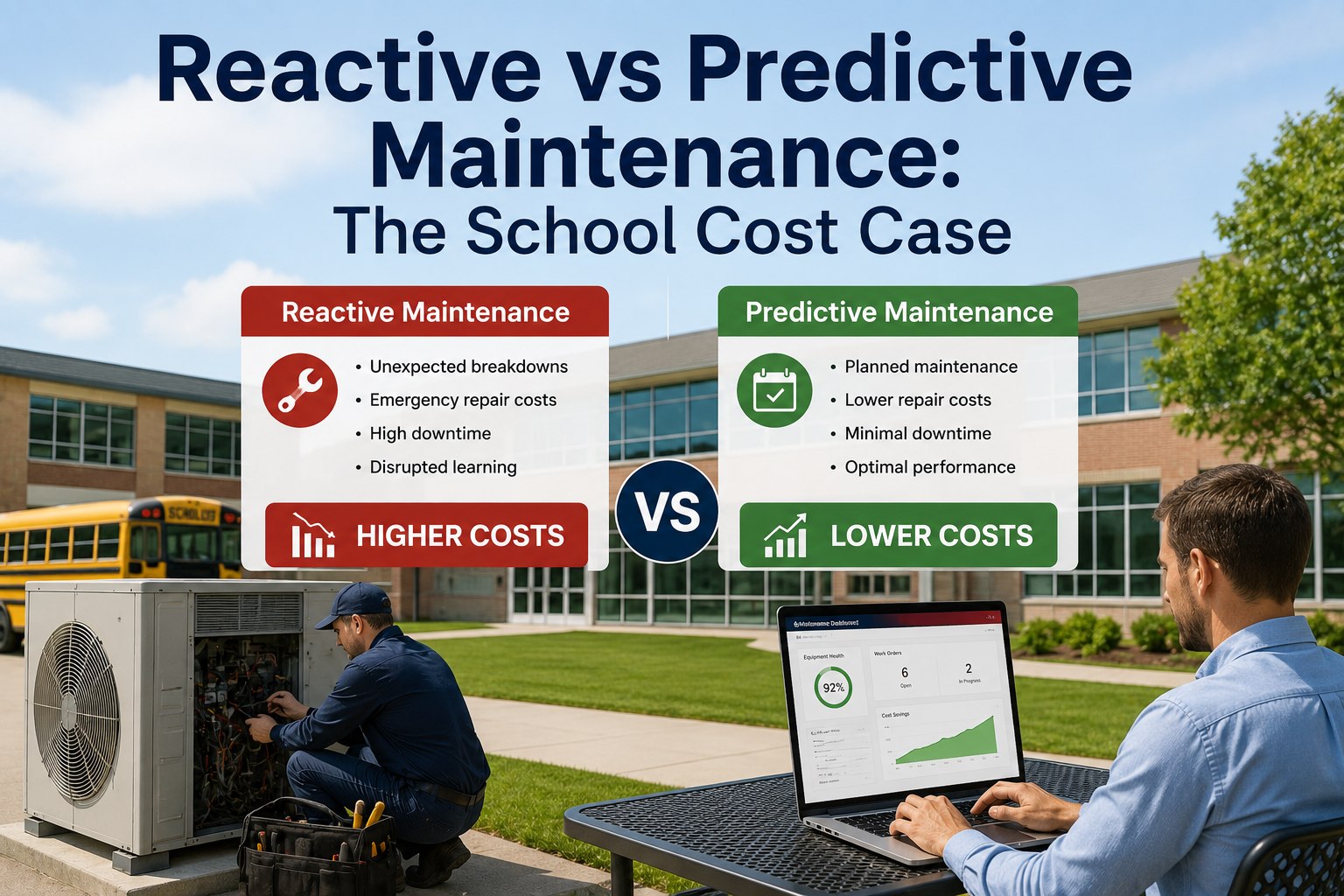
Calculates the dollar premium paid for reactive repairs vs equivalent planned maintenance across the prior 12 months. Emergency HVAC service call at $850 vs scheduled PM at $180 — the $670 premium multiplied across all reactive events. Typical result: $200K–$600K per year in avoidable premium cost. This number is the financial case for funding the PM programme.
Work order cost dataReactive/planned classificationEmergency call premiums
ROI proof
04
Energy-Maintenance Correlation Report
Correlates HVAC maintenance completion rates with utility bills by building. Buildings where PM compliance fell below 70% show measurable energy cost increases — typically 12–22% above the maintained baseline. The report presents energy waste in dollars per building per year, directly attributable to deferred HVAC maintenance. Energy savings alone often justify the entire PM budget.
PM completion ratesUtility cost data by buildingHVAC runtime sensor data
Energy case
Analytics Maturity: How OxMaint Data Gets Smarter Over Time
AI analytics accuracy improves with data depth. A district in its first year of OxMaint deployment gets work order tracking and basic cost reports. By year two, failure predictions activate. By year three, the capital forecast has three years of cost history and the AI model is running on real district data — not industry averages. OxMaint analytics compounds in value the longer it runs.
ANALYTICS MATURITY — WHAT OXMAINT DELIVERS BY DEPLOYMENT YEAR
Cost Visibility
Year 0
Low
Year 1+
Full
Cost per sq ft, spend by category, reactive/planned ratio — live from day one of deployment
Failure Prediction
Year 1
Basic
Year 2+
73% accuracy
12 months of repair history activates AI failure scoring — improves each year as patterns compound
Capital Forecast
Year 1
Indicative
Year 3+
Board-grade
3 years of actual repair cost history makes forecasts highly credible for board capital planning presentations
Energy Correlation
Year 1
Partial
Year 2+
Full correlation
Two full annual cycles needed to correlate maintenance events with seasonal energy patterns per building
Portfolio Benchmarking
Year 1
Internal
Year 2+
vs national data
Building-to-building comparison from day one; national K-12 benchmark comparison from year 2
Without Analytics vs With OxMaint Analytics
The difference between a school district that uses analytics and one that doesn't is not the quality of the facilities team — it is the quality of the evidence they can bring to budget conversations. OxMaint changes what is possible to know, and therefore what is possible to argue for.
BUDGET DECISION QUALITY — WITHOUT VS WITH OXMAINT ANALYTICS
Budget Decision
Without Analytics
With OxMaint Analytics
Which equipment will fail this year?
Guesswork or post-failure
AI failure probability score per asset
How much capital do we need in year 3?
Not known — reactive allocation
5-year cost forecast — per asset, per building
Are we spending more on reactive or planned?
Estimated from invoices
Live reactive/planned ratio — cost split tracked
Is deferred maintenance costing us more energy?
Suspected but unquantified
Energy cost premium per building in dollars
Which building needs the most investment?
Opinion or loudest complaint
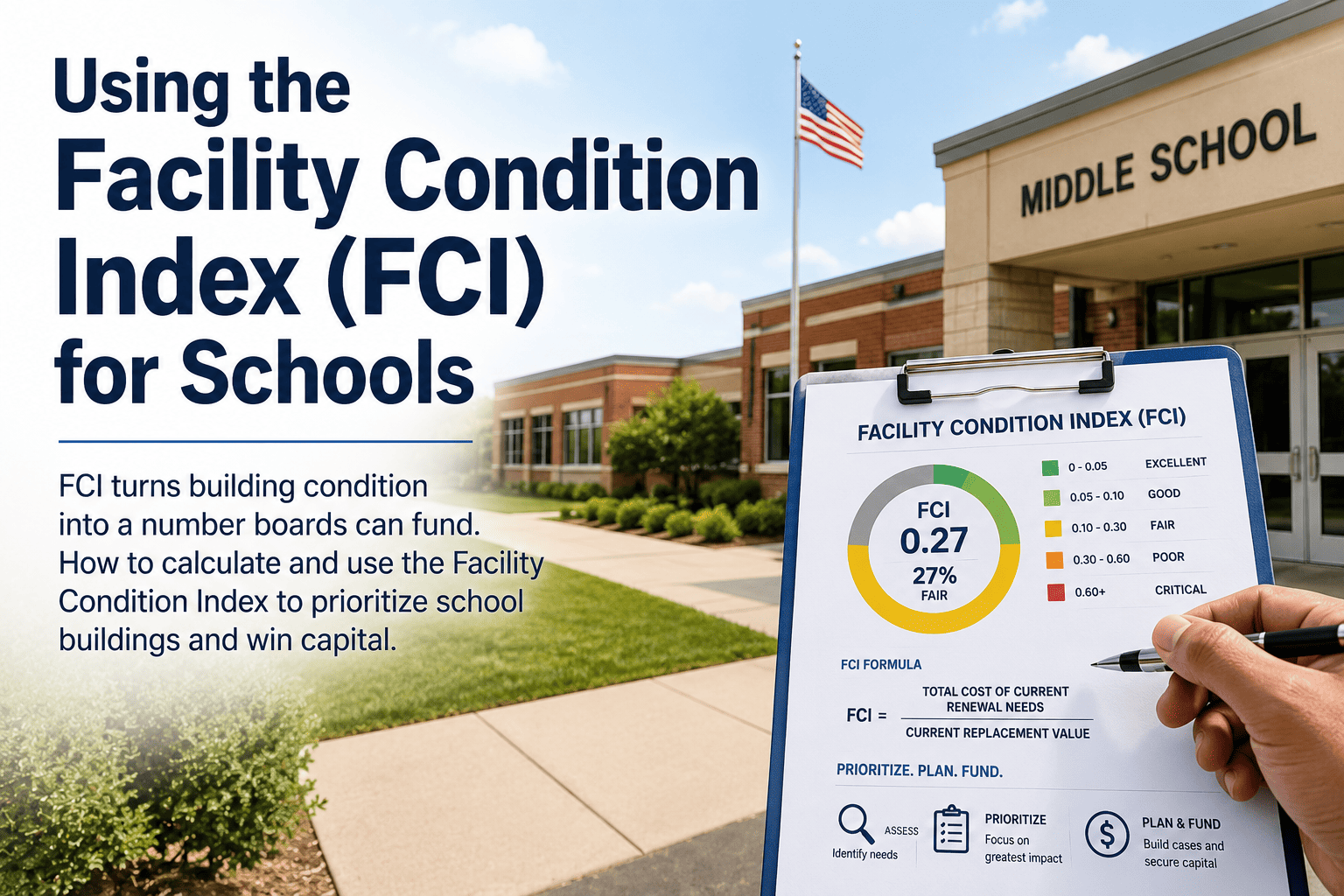
FCI score and failure risk ranked per building
Is our maintenance team productive enough?
PM completion rate unknown
PM completion rate, backlog, and productivity per technician
Frequently Asked Questions
Cost visibility and basic reporting activate from day one. Failure prediction requires a minimum of 6 months of work order history — accuracy improves substantially at 12 months. Capital forecasting becomes board-presentable quality after 18–24 months of real district data. The earlier a district starts, the more valuable the analytics become. Start free today — every work order logged now builds the AI model for next year's board presentation.
Work order history (frequency, cost, type), asset age and condition scores, PM completion rates, energy bills by building (via utility data import or IoT sensor data), repair cost trends, and OEM equipment lifespan data. No separate data collection system is required — all inputs are generated by normal OxMaint operations. The analytics layer is built on data the facilities team generates anyway.
OxMaint's AI analyses three signal types: increasing repair frequency (same unit repaired more than twice in 12 months), component replacement pattern (certain parts replaced in sequence that precedes compressor failure), and age relative to design life. When these signals combine, the unit receives a high failure probability score and appears in the 30-day or 60-day predicted failure report — giving the facilities team time to plan a replacement rather than responding to an emergency.
Yes — OxMaint's board report package includes the 5-year capital forecast, deferred maintenance backlog with cost escalation, reactive maintenance cost premium, and energy-maintenance correlation — all exportable as a single PDF with building-level breakdown. The format is designed for non-technical board members: financial language, clear numbers, and documented consequence of inaction. Book a demo to see the board report format.
Standard CMMS reports show what happened — work orders completed, costs incurred, PMs scheduled. OxMaint analytics shows what will happen: which assets are likely to fail, what they will cost to replace, and what the financial consequence of deferral looks like in three and five years. The shift is from historical reporting to predictive intelligence — the difference between a maintenance log and a capital investment case. Start your free trial to see both in one platform.
From Maintenance Logs to Board-Approved Budgets.
AI failure prediction, capital forecasting, energy analytics, and board-ready reports — all from the maintenance data already in OxMaint. Free to start today.