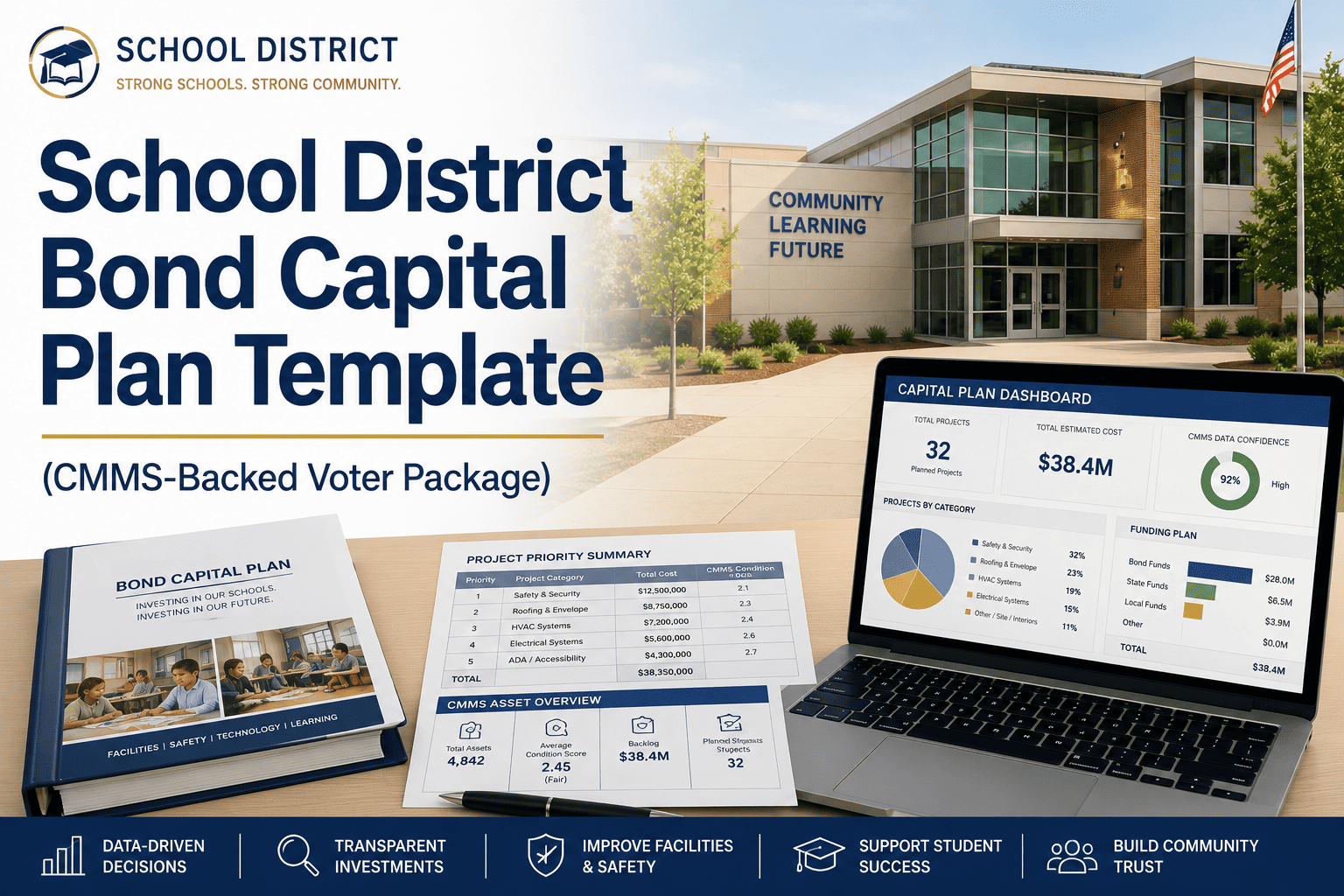
School districts face a mounting challenge: aging facilities, limited budgets, and no clear way to prioritize which buildings need capital investment first. Without a structured Facility Condition Index (FCI) scoring process and a rolling 5-year capital plan, districts risk reactive spending, deferred maintenance cycles, and failed bond referendums. Oxmaint gives K-12 facility teams the tools to Sign Up Free and build audit-ready FCI data from day one — digitizing asset inventories, condition ratings, and replacement cost modeling across every school building. Whether you're preparing for a board presentation or a state facility audit, Book a Demo to see how districts use Oxmaint to turn field inspections into capital planning intelligence. A credible FCI score isn't a spreadsheet exercise — it's a live asset management process, and the districts that today are the ones winning bond referendums tomorrow.
Build Your District FCI Scoring System Today
Oxmaint centralizes asset condition data, automates PM tracking, and produces board-ready capital forecasts — no spreadsheet required.
What Is FCI and Why Does It Drive K-12 Capital Planning?
Facility Condition Index (FCI) is the industry-standard metric for comparing building health across a portfolio. It divides total deferred maintenance cost by current replacement value — a score under 0.10 signals good condition; above 0.30 signals critical need. For K-12 districts, FCI scoring gives CFOs and superintendents the objective data needed to prioritize capital budgets, defend bond referendum scopes, and satisfy state facility reporting requirements.
A score of 0.05–0.10 is good condition. 0.10–0.30 is fair. Above 0.30 triggers priority capital action. Oxmaint tracks this live as work orders and PM records accumulate.
FCI accuracy depends on a complete asset list — HVAC units, roofing systems, electrical panels, plumbing, and structural elements. Oxmaint's mobile app lets technicians capture and rate assets during walkthroughs, building the inventory that powers your FCI model.
Consistent ratings across inspectors eliminate subjectivity. Oxmaint enforces standardized condition categories — Good, Fair, Poor, Critical, Failed — with photo documentation attached to every rating, making scores defensible at audit and board level.
FCI calculations require current replacement cost data. Oxmaint allows cost benchmarks per asset category so your FCI scores reflect current construction pricing, not outdated estimates from the last facilities study.
What a School District FCI and 5-Year Capital Plan Template Must Include
A complete K-12 FCI and capital planning template covers five interconnected components. Districts that skip any one of them produce capital plans that boards and state agencies reject as incomplete.
Building-by-building register of all major systems and components — HVAC, roofing, electrical, plumbing, flooring, envelope — with install year, expected life, and asset ID. Oxmaint generates this from field inspection data, eliminating manual spreadsheet entry.
Standardized condition scores per asset, per building, with inspector ID and date. Oxmaint timestamps every rating and attaches photo evidence — creating the documentation chain that satisfies state auditors and bond counsel.
Per-asset repair or replacement cost for all items rated Fair, Poor, or Critical. This is the numerator in your FCI calculation. Oxmaint pulls from maintenance cost history and configurable replacement cost benchmarks to auto-populate this column.
School-level FCI scores ranked from worst to best, plus a district portfolio FCI. This is the output that drives prioritization — districts use it to sequence capital projects, apply for state facility grants, and substantiate bond referendum scopes.
Year-by-year project pipeline built from FCI scores and asset remaining useful life. Oxmaint's CapEx forecasting module generates rolling 5-to-10 year forecasts as PM and inspection data accumulates — turning a one-time study into a living capital plan.
Why Most K-12 FCI Templates Fail at the Board Level
A static spreadsheet FCI study is outdated the day it's published. Every completed repair, every new PM failure, and every aging HVAC unit changes the score. Oxmaint keeps FCI data live as work orders close and inspections complete.
Board members and state grant reviewers reject capital requests backed only by condition ratings without evidence. Oxmaint attaches photos to every asset condition entry at the time of inspection — not retroactively assembled before the deadline.
When different inspectors use different interpretations of "fair" vs. "poor," cross-school FCI comparisons are meaningless. Oxmaint enforces standardized condition definitions and requires specific criteria before a rating is accepted.
A capital plan that ignores actual maintenance history misses the equipment that's been repeatedly patched beyond economic repair. Oxmaint links asset condition scores to work order history — surfacing the chronic failures that deserve capital replacement, not another repair.
How Oxmaint Powers Live FCI Scoring and Capital Planning for K-12 Districts
Oxmaint replaces the static facilities study with a continuous FCI and capital planning process — driven by real maintenance data from every technician's daily work. Districts using Oxmaint can Book a Demo to see a live portfolio FCI dashboard, or Sign Up Free and begin building asset condition data within the first week.
Every asset across every school building — tagged, rated, and linked to its full maintenance history. FCI calculations update as conditions change, not annually when the facilities consultant returns.
Technicians complete condition assessments on mobile, attaching photos and rating each asset against standardized criteria. Inspector ID, timestamp, and GPS location are captured automatically — creating an audit trail that satisfies state facility grant reviewers.
Superintendents and CFOs see school-by-school FCI scores ranked in a single dashboard. Capital prioritization conversations use live data, not an 18-month-old facilities study that's already obsolete.
Asset remaining useful life data and replacement cost benchmarks drive a rolling capital forecast. Bond referendum scopes are built on documented asset condition evidence — not subjective walkthroughs that bond counsel can't defend.
Districts that reach 90%+ PM compliance rates slow the FCI degradation curve, reducing annual capital requirements. Oxmaint automates PM scheduling and tracks compliance rates by school, by system, and by technician.
FCI reports, capital project lists, and PM compliance summaries export in formats suited for board presentations, state facility grant applications, and bond referendum support documentation — in minutes, not weeks.
Turn Asset Data Into a Defensible 5-Year Capital Plan
Oxmaint gives K-12 facility teams live FCI scoring, CapEx forecasting, and board-ready reporting — no consultant required.
K-12 FCI Scoring and Capital Planning FAQs
What is a good FCI score for a school district building?
How often should a school district update its FCI scores?
Can Oxmaint replace a formal facilities condition assessment?
What asset categories should be included in a K-12 FCI template?
How does FCI data support a bond referendum campaign?
Start Building Your K-12 FCI Scoring System
No implementation fee. First PM work orders in week one. Oxmaint gets K-12 districts from spreadsheets to live FCI dashboards faster than any other platform.