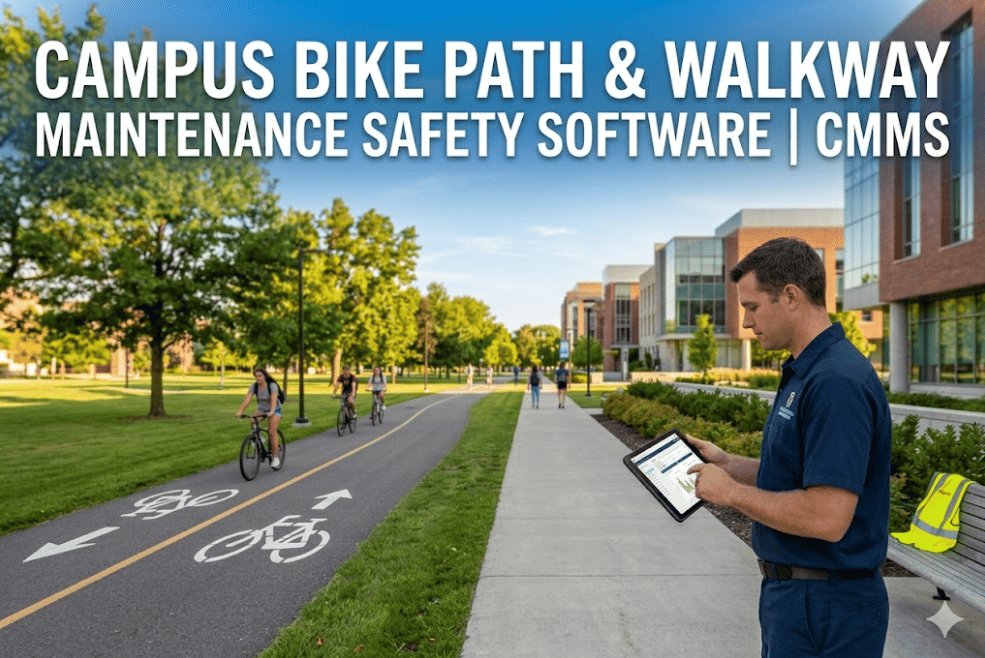
Campus Bike Path & Walkway Maintenance Safety Software | CMMS
By Jamie lanister on April 23, 2026
A private university in Pennsylvania settled a slip-and-fall lawsuit for $340,000 after a student tripped on a heaved section of brick pathway outside the student union in November 2023. The facilities team had a documented inspection programme — quarterly walkway audits logged in a shared Excel spreadsheet accessible to all supervisors. When the plaintiff's attorneys subpoenaed the inspection records during discovery, the university produced three years of spreadsheet files showing dates, inspector names, and zone labels. What the spreadsheets did not contain: a single photograph of any pathway surface. A single GPS coordinate linking an inspection to a specific location. A single work order auto-generated from a hazard finding. A single timestamp proving when a defect was found vs when it was repaired. The inspection programme existed. The accountability trail did not. The settlement was not for negligence in inspection frequency — it was for negligence in documentation quality. Campus walkway and bike path maintenance is not a facilities problem. It is a liability management problem. And the only evidence that survives a courtroom is digital, timestamped, GPS-tagged, photo-documented, and linked to a closed corrective work order. Sign in to OxMaint to build an auditable campus walkway inspection programme that creates the evidence trail your attorneys need, or book a demo to see how hazard documentation works in litigation-ready detail.
Campus Bike Path and Walkway Maintenance — Safety Software That Creates the Evidence Trail Your Attorneys Need
Uneven pavement, broken curb cuts, cracked bike path surfaces, and clogged drainage are the leading source of campus pedestrian injury claims. This guide covers what an inspectable, defensible campus walkway maintenance programme looks like — and how CMMS makes it executable across every path, every zone, every season, with the documentation quality that survives litigation.
$340K
Settlement paid by Pennsylvania campus — inspections existed; digital evidence did not
Maximum recommended response time for reported walkway hazard before liability escalates
4.2x
Faster hazard closure with mobile CMMS vs paper-based walkway inspection systems
Campus walkway inspections only protect the institution if the evidence is digital, timestamped, GPS-tagged, and photo-documented. A spreadsheet row that says "South Quad — checked, no issues found" on October 3rd does not survive discovery in litigation. A mobile CMMS inspection with GPS coordinates, surface condition photo, hazard severity rating, and a closed corrective work order with completion photo does. The difference is not the inspection — it is the evidence quality.
Liability Categories
The Six Surface Conditions That Drive Campus Pedestrian Injury Claims
Understanding which surface defects generate claims — and which seasons surface them — is the foundation of a legally defensible, prioritized inspection schedule that allocates resources to the highest-risk zones first.
Heave + Displacement
HIGH RISK
Tree root uplift and freeze-thaw cycling creates vertical displacement between pavement sections. Even 0.5-inch lip causes trip hazards — ADA requires corrective action when vertical change exceeds 0.25 inches at any transition.
Peak Season
Spring after freeze-thaw cycles + Fall root expansion
Surface Cracking
MED RISK
Asphalt and concrete crack from UV degradation, heavy vehicle loading, thermal cycling. Alligator cracking on bike paths creates wheel-catching hazards. Longitudinal cracks collect water that freezes into dangerous ice strips in winter.
Peak Season
Late summer heat expansion + Winter freeze propagation
Drainage Failure
HIGH RISK
Clogged drain inlets and inadequate cross-slope create standing water on walkways and bike paths. Water-covered asphalt hides surface defects from inspection. In freezing conditions, drainage failure converts damp path into sheet ice within hours.
Peak Season
Fall leaf accumulation + Winter ice/snow melt cycles
ADA Non-Compliance
LEGAL RISK
Curb cuts with broken lips, tactile warning strips that have delaminated, running slopes exceeding 1:20, and cross-slopes over 1:48 create both injury risk and federal ADA liability exposure. Annual ADA accessibility inspections are legal obligation for campus routes of travel.
Peak Season
Year-round — ADA compliance is continuous obligation
Low Lighting Zones
HIGH RISK
Failed pathway luminaires create dark zones where surface defects become invisible and personal safety risk compounds. Campus lighting maintenance must integrate with walkway inspection — dark path over damaged pavement is compounding liability, not separate issue.
Peak Season
October through March — shorter daylight hours
Bike Path Edge Drop
MED RISK
Asphalt bike paths erode at edges, creating drop-off between paved surface and adjacent shoulder. When cyclist drifts onto shoulder, edge drop catches front wheel causing loss of control. Edges exceeding 2 inches require immediate hazard marking and repair scheduling.
Peak Season
Spring edge erosion after snowmelt + storm washout
Build the Inspection Evidence Record That Protects Your Campus in Court
OxMaint creates GPS-stamped, photo-evidenced, timestamped walkway inspection records with automatic corrective work order generation for every hazard found — documentation quality that survives discovery and expert witness cross-examination.
Campus Walkway and Bike Path Inspection Frequency by Zone Type
Inspection frequency must scale with pedestrian traffic volume, surface type, environmental exposure, and ADA route classification. This table shows the minimum defensible inspection cadence for each campus zone category.
Zone / Surface Type
Inspection Frequency
Required Evidence
Urgency Trigger
Main pedestrian corridors
Weekly
Photo, GPS, heave measurement
Heave >0.25 in
Bike paths and dedicated lanes
Bi-weekly
Edge drop photo, crack width
Edge drop >2 in
ADA curb cuts and ramps
Monthly + post-winter audit
Slope %, tactile strip, lip height
Any ADA deviation
Secondary and service paths
Monthly
Surface condition photo
Crack >0.5 in
Pathway lighting fixtures
Monthly night audit
Lux reading, outage flag
Dark zone >50 ft
Storm drain inlets on paths
Post-rainfall + monthly
Blockage photo, standing water
Water after 2h dry
Evidence Trail Workflow
How OxMaint Runs Campus Walkway Maintenance — With Litigation-Ready Documentation
The difference between a defensible walkway maintenance programme and one that collapses under legal scrutiny is not the inspection — it is the documentation workflow. OxMaint enforces evidence capture at every step, making compliance automatic instead of optional.
01
Route Mapping
Scheduled Inspection
Campus segmented into inspection zones with GPS-mapped routes. Weekly, monthly, and seasonal inspection work orders generate automatically — assigned by zone to responsible crew with mobile checklist pre-loaded.
Inspectors use OxMaint mobile app to photograph surface defects directly in work order, with GPS location auto-captured. Image becomes permanent evidence tied to that specific location, inspection date, and inspector ID — immutable record.
Evidence: Timestamped photo + GPS coordinates + EXIF data
03
Auto Hazard WO
Immediate Response
When inspector tags defect as hazard, OxMaint auto-generates corrective work order with priority based on defect type. Heave exceeding ADA threshold triggers high-priority WO immediately — not at next morning meeting or weekly review.
Evidence: Hazard-to-WO timestamp showing response time
04
Escalation Chain
Automatic Alerts
High-severity hazards unaddressed within configured window escalate automatically to supervisor, then facilities director. Escalation trail is timestamped — demonstrating institutional response regardless of outcome, critical for liability defense.
Evidence: Complete escalation audit trail with alert timestamps
05
Repair Verification
Closed-Loop Proof
Technicians cannot close corrective WO without completion photo showing repaired surface. Before-and-after photo pair with matching GPS coordinates proves specific hazard was addressed — not just work order marked complete in database.
OxMaint generates inspection compliance reports showing every route inspected, every hazard found, every corrective WO generated and closed — exportable in PDF for risk management, legal counsel, or accreditation review in under 10 minutes.
Evidence: Complete programme documentation for any date range
"After the Pennsylvania settlement, our general counsel told us we needed photo evidence and timestamps for every hazard found and every repair completed. Paper inspection logs were not going to survive discovery anymore. OxMaint gave us that documentation quality from day one. Last academic year we had a slip-and-fall claim on the south quad pathway. We pulled the inspection record in under 10 minutes and showed the exact location was inspected and photographed clear of hazards 4 days before the reported incident. The claim was dismissed before it reached deposition. That one case saved us what would have been a $200,000+ settlement based on our historical average."
Director of Facilities · Private liberal arts campus · New England · OxMaint user since 2022
FAQ
Frequently Asked Questions
How often should campus walkways be inspected for liability protection?+
High-traffic corridors weekly; bike paths bi-weekly; ADA curb cuts monthly. Post-winter and post-storm inspections are essential for all zones regardless of normal schedule. Frequency must be defensible relative to pedestrian volume and known risk factors.
What evidence does OxMaint produce for slip-and-fall defense?+
Timestamped inspection records, GPS location stamps with map view, inspector photos with EXIF data, hazard severity ratings, corrective WO generation timestamp, repair completion photos, and technician certifications — all exportable in PDF format within minutes for legal counsel review.
Can OxMaint handle ADA compliance documentation for campus routes of travel?+
Yes — OxMaint includes ADA inspection templates with specific checkpoints for curb cut slope percentage, tactile warning strip condition, running slope compliance, cross-slope limits, and clear width measurements. Templates align with 2010 ADA Standards for Accessible Design.
What does OxMaint campus walkway maintenance software cost?+
OxMaint starts at $8/user/month. Inspection route management, GPS tagging, photo capture, corrective WO generation, and audit report export are all included in base pricing — no additional liability management module fees.
Can OxMaint manage winter ice/snow response alongside walkway inspection?+
Yes — winter-specific inspection routes and snow/ice response work orders can be managed in the same platform with the same evidence trail quality. Pre-storm staging, treatment application logs, and post-storm clearance verification all documented with GPS and photos on the same mobile device.
Protect Pedestrians and Your Institution — One Documented Inspection at a Time
OxMaint makes your walkway inspection programme visible, defensible, and auditable — building the evidence trail that protects students and protects the university when claims arise.