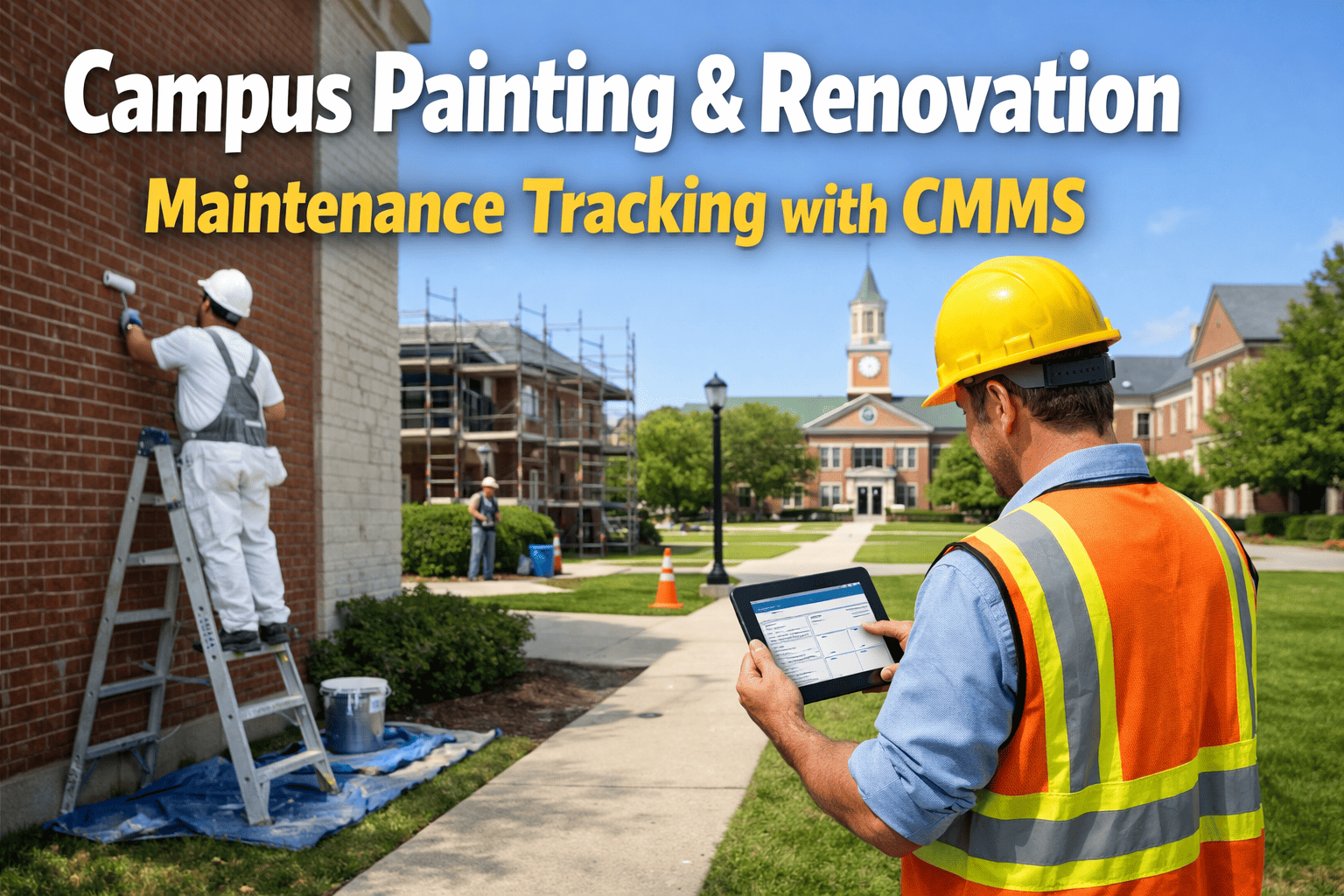
Active campus construction silently inflates your maintenance budget — dust ingress, vibration damage, and utility crossovers generate thousands in untracked work orders every month. A single overnight concrete-cutting incident at an Ohio university severed a chilled water line, leaving HVAC systems cycling against a dead loop for six hours. The total damage: $294,000 — none of it budgeted, none of it attributed to the construction project. If your campus has active renovation and your maintenance costs are climbing without explanation, start a free trial with OxMaint or book a demo to see construction-impact tracking in action.
Campus Construction Impact on Maintenance
Active Renovation Zones Are Inflating Your Maintenance Budget — And Nobody Is Tracking It
23%
Of reactive maintenance spend during renovation is construction-caused
APPA 2023 Facilities Performance Indicators — yet under 11% of campuses isolate this cost
$1.2M
Average hidden maintenance cost per major campus renovation project
Dust damage, vibration failures, system crossovers, and accelerated filter replacement over 18-month build cycles
4.7x
Filter replacement rate increase in buildings within 200ft of active demolition
Particulate loading from concrete cutting, drywall demolition, and excavation overwhelms standard PM schedules
89%
Of campuses have no CMMS tag to separate construction-caused work orders
Construction impact gets buried in general maintenance — inflating baseline costs and hiding the true project expense
Stop Absorbing Construction Costs in Your Maintenance Budget
OxMaint tags, tracks, and reports every maintenance work order caused by active construction — giving you the data to charge back to project budgets and protect your operating baseline.
What Is Construction-Impact Maintenance?
Construction-impact maintenance covers all work orders, equipment failures, and emergency repairs directly caused or accelerated by active renovation or demolition on campus. This is not normal wear-and-tear — it is a distinct cost category that belongs on the construction project budget, not your facilities operating baseline. When a campus runs a $60 million renovation and the maintenance department silently absorbs $1.4 million in construction-caused costs, the maintenance budget appears to grow 18% — triggering efficiency reviews that are entirely misdirected. The problem is not maintenance performance. The problem is cost misattribution. Teams ready to isolate construction-caused costs immediately can start a free trial or book a demo to see project-linked work order tagging live.
The Six Hidden Maintenance Loads from Active Construction
01
Dust Ingress and Particulate Damage
Concrete cutting and demolition generate airborne particulate that clogs HVAC filters, fouls AHU coils, and accelerates bearing wear. Buildings within 200ft of active demolition see filter loading increase 4.7x — turning quarterly changes into monthly replacements.
Average additional HVAC maintenance cost per building per month of adjacent demolition: $8,200
02
Vibration Damage to Adjacent Systems
Pile driving and heavy equipment create ground-borne vibration that loosens pipe joints, cracks brittle connections, and accelerates pump and fan bearing failure. Buildings within 50ft of active pile driving see a 340% increase in plumbing leak work orders.
Plumbing leak work orders within 50ft of pile driving: 340% above pre-construction baseline
03
System Crossover and Utility Disruption
Construction tie-ins, valve shutdowns, and temporary bypasses on chilled water, steam, and electrical distribution create maintenance work orders in buildings that are not even part of the renovation project.
Utility crossover incidents per major campus renovation: 14–28 events over a typical 18-month project
04
Temporary Occupancy Overloading
When a building goes offline, displaced occupants overload receiving buildings — adding thermal load, plumbing demand, and elevator wear to systems not designed for the additional capacity. HVAC work orders spike 62% in receiving buildings.
Temporary occupancy overloading increases HVAC work orders by 62% in receiving buildings
05
Construction Traffic Infrastructure Damage
Heavy truck routes, crane pads, and material staging destroy sidewalks, irrigation systems, and landscape lighting. Grounds maintenance work orders spike 80–120% along active construction corridors throughout the build period.
Average grounds infrastructure repair cost per major campus construction project: $47,000
06
Water Intrusion from Envelope Breach
Temporary roof penetrations and exterior wall modifications admit water during rain events, promoting mold and triggering emergency response. A single unprotected roof penetration during an overnight storm can generate $40,000–$120,000 in remediation costs.
Median water intrusion remediation cost per construction-related envelope breach: $67,000
Why 89% of Campuses Fail to Track Construction-Caused Maintenance
01
No Construction-Impact Tag in the CMMS
Most CMMS platforms categorize work orders by trade type — plumbing, electrical, HVAC — but have no field to record the cause. Without a construction-cause tag, every construction-driven work order is indistinguishable from routine maintenance in every report and budget review.
02
Technicians Do Not Connect Cause to Work
A technician replacing a clogged filter does not instinctively link it to demolition 150 feet away. Without a system prompt at work order completion, the causal connection is never captured — and the cost is permanently misattributed to normal operations.
03
No Pre-Construction Baseline for Comparison
To prove construction caused a maintenance cost increase, you need a baseline. Without a CMMS that automatically captures pre-construction maintenance rates for every affected building, the impact is invisible — it just looks like maintenance is getting more expensive.
04
No Chargeback Mechanism to Project Budgets
Even when construction-caused costs are identified, most campuses have no formal process to move them from the maintenance operating budget to the capital project ledger. The accounting structure does not support it — and the maintenance department absorbs costs that should appear on the contractor's books.
Before vs. After: Construction-Impact Tracking with OxMaint
| Without OxMaint Construction Tracking |
With OxMaint Construction Tracking |
| Construction-caused work orders buried in general maintenance — no way to identify, isolate, or report them |
Every work order tagged with construction project link, proximity zone, and cause classification at point of entry |
| Filter spike appears as HVAC cost increase — triggers budget scrutiny of the maintenance department |
Filter spike flagged as construction-related based on proximity to active demolition — cost attributed to project |
| No pre-construction baseline — impossible to prove maintenance costs increased because of the renovation |
Automated 12-month baseline snapshot for every building within 300ft of a new construction project |
| Chargeback requires manual research, spreadsheet compilation, and a political conversation with the project manager |
Monthly construction-impact report generated automatically — ready for chargeback submission |
| Maintenance budget appears to grow 15–25% during renovation — leadership questions team efficiency |
Maintenance baseline stays clean — construction-caused costs reported separately with full audit trail |
| Post-construction elevated costs persist undetected — new inflated baseline accepted as normal |
12-month post-construction monitoring tracks return to baseline — delayed damage charged to project warranty |
How OxMaint Tracks Construction-Impact Maintenance
Feature 01
Construction Project Registry with Impact Zones
Register every active construction project in OxMaint with its physical footprint and impact radius — 200–300ft for dust, 50ft for vibration, full utility network for crossovers. Every building in the zone is automatically flagged and every work order receives a construction-impact prompt at completion.
Automatic identification of every asset within each construction project's impact radius
Feature 02
Construction-Cause Tagging on Work Orders
When a technician completes a work order in a construction-affected building, OxMaint prompts a one-tap cause tag — project name and impact category auto-populated. The tag follows the work order through every report, cost roll-up, and budget analysis without additional data entry.
94% technician tagging compliance within first 30 days of deployment
Feature 03
Pre-Construction Baseline Snapshot
When a construction project is registered, OxMaint automatically captures the trailing 12-month maintenance baseline for every building in the impact zone — work order volume, filter frequency, leak rate, HVAC call volume, and total cost. This baseline is the comparison point for every construction-impact analysis.
Automated baseline capture — no manual data compilation required at project start
Feature 04
Deviation Alerts and Trend Monitoring
OxMaint monitors construction-zone buildings against their pre-construction baselines continuously. When filter changes exceed baseline by 200% or plumbing leak work orders spike 3x, the system generates an alert — catching construction damage patterns within 2 weeks of onset, before costs accumulate unnoticed.
Early detection compresses construction-impact cost by 40–60% versus post-hoc discovery
Feature 05
Automated Construction-Impact Cost Reports
Monthly, quarterly, and project-lifetime cost reports — filtered by construction project, impact category, affected building, and work order type. Labor, parts, contractor, and emergency costs for every construction-tagged work order, compared against baseline. Ready for chargeback submission in one click.
Replaces 8–12 hours of manual spreadsheet compilation per project per quarter
Feature 06
Post-Construction Warranty Monitoring
OxMaint continues monitoring construction-zone buildings against baseline for 12 months after project completion — catching delayed-onset damage from vibration-loosened joints or dust-contaminated bearings while still within the contractor's warranty or project contingency budget.
Average delayed-damage recovery from post-construction monitoring: $38,000 per project
ROI: What Construction-Impact Tracking Recovers
$1.2M
Average recoverable construction-caused maintenance cost per major campus renovation
Currently absorbed into maintenance operating budget at most campuses — never charged back to the project
23%
Reduction in apparent maintenance cost growth when construction impact is separated
Maintenance budget stops appearing to grow — leadership sees accurate operational baseline
8 hrs
Manual reporting time eliminated per project per quarter
Automated construction-impact reports replace manual spreadsheet compilation
$38K
Average delayed-damage recovery from post-construction warranty monitoring
Damage manifesting 3–12 months after completion — still within warranty when documented and attributed
Campuses running active construction right now are accumulating construction-caused maintenance costs every week — invisible in current reporting and never recovered without a system to identify, tag, and report them. Every month of untracked construction impact is a month of budget distortion that compounds into next year's baseline assumptions. Facilities directors ready to see exactly how construction-impact tagging works for their project portfolio can start a free trial or book a demo to walk through a live construction-impact cost report.
Frequently Asked Questions
How do technicians know which work orders are construction-related if the connection is not obvious?+
OxMaint automatically identifies when a work order is in a construction impact zone and prompts the technician with a single-tap construction-cause question at work order completion. The technician does not need to know the proximity radius — the system knows and asks. Compliance reaches 94% within 30 days because the prompt adds under 3 seconds to work order closure. For ambiguous cases, the deviation alert system catches patterns even when individual work orders are not tagged — a 4x filter spike in a construction-zone building triggers investigation regardless.
Can we formally charge construction-caused maintenance costs back to the project budget?+
Yes — and this is the primary financial objective of construction-impact tracking. OxMaint generates monthly cost reports segmented by construction project, impact category, and affected building — complete with pre-construction baseline comparison showing the exact cost deviation attributable to the project. These reports are formatted for direct submission to the project manager or capital budget office. Average recovery from the first tracked project: $240,000 in costs that would otherwise have been permanently absorbed into the facilities operating budget.
Book a demo to see a sample chargeback report.
What if we have multiple construction projects running simultaneously?+
OxMaint supports unlimited concurrent construction project registrations, each with its own impact zone, baseline snapshot, and cost tracking. When impact zones overlap, the system allows dual-tagging so costs can be allocated proportionally or attributed to the project with the stronger causal connection. The portfolio-level dashboard shows total construction-caused maintenance across all active projects, with drill-down to individual project breakdowns.
How does post-construction monitoring help recover warranty costs?+
When a project is marked complete, OxMaint enters a 12-month monitoring phase for all buildings in the former impact zone. Maintenance rates continue to be compared against the pre-construction baseline. If plumbing leak rates have not returned to baseline 6 months after construction ended, the system flags the persistent deviation — indicating probable construction-caused damage still under warranty. This documentation supports warranty claims and justifies contingency budget access for delayed-onset repairs. Average recovery: $38,000 per project.
Start a free trial to configure your first construction impact zone today.
Campus Construction Impact Tracking — OxMaint
Every Dollar Your Construction Project Costs Your Maintenance Budget Should Be Tracked, Reported, and Recovered.
OxMaint builds construction-impact zones, automated work order tagging, pre-construction baselines, deviation alerts, and chargeback-ready cost reports directly into your CMMS workflow. Stop absorbing construction costs in your maintenance budget. Start tracking them.
$1.2M
Recoverable cost per major renovation
94%
Technician tagging compliance in 30 days
3 sec
Added per work order for construction tagging
12 mo
Post-construction warranty monitoring