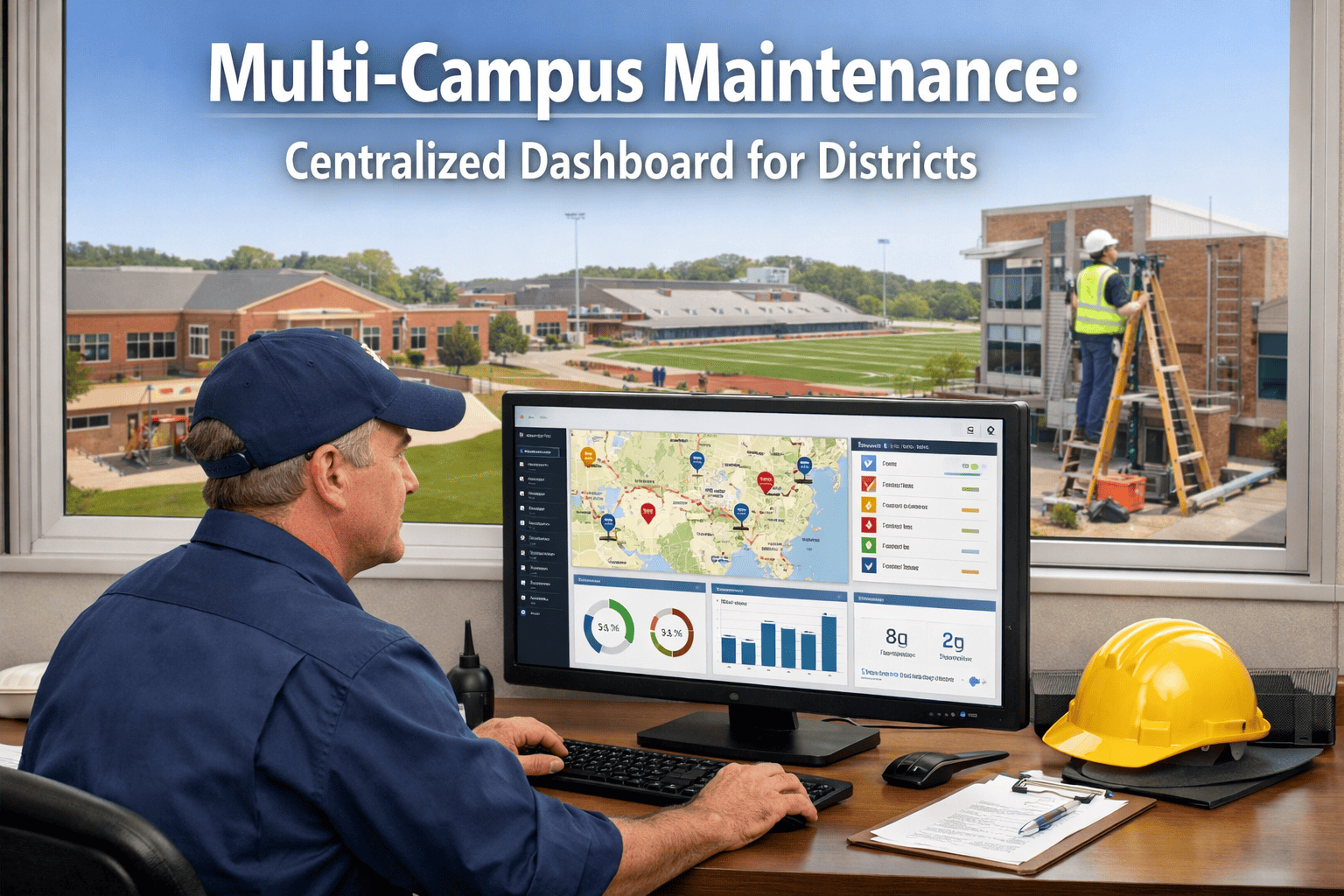
You don't run one campus. You run four — or seven, or twelve — each with its own aging infrastructure, its own maintenance backlog, and its own underfunded facilities team submitting budget requests that look identical but never get compared. The Director of Facilities at your flagship campus doesn't know that the satellite campus 40 miles away solved the same chiller problem six months ago for half the cost. Your CFO sees twelve separate maintenance spreadsheets and has no way to benchmark spend-per-square-foot across locations. Your compliance officer discovers that two campuses missed their fire suppression inspections on the same week — but nobody connected the dots because nobody has a shared system. This is the reality of multi-campus operations in American higher education: duplicated effort, invisible risk, and zero economies of scale from the portfolio you already own. According to APPA (the Association of Physical Plant Administrators), universities operating 3+ campuses spend 18-25% more per square foot on maintenance than single-campus institutions of equivalent size — not because their buildings are worse, but because their operations are siloed. Start your free Oxmaint account and centralize every campus, every building, and every asset into one AI-powered operations platform.
The Multi-Campus Operations Gap: Why Siloed Facilities Management Costs You Millions
Most university systems grew by acquisition, merger, or organic expansion over decades. Each campus developed its own maintenance processes, its own vendor relationships, its own inspection schedules, and — critically — its own way of tracking (or not tracking) assets. The result isn't just inefficiency. It's systemic blindness. Your central administration cannot answer basic portfolio-level questions that any commercial real estate operator would consider table stakes:
The AI-Powered Centralization Framework
Centralization doesn't mean stripping campus autonomy. It means creating a shared operational language — standardized data, standardized processes, and a single source of truth — while preserving local flexibility where it matters. Here's how Oxmaint's multi-campus architecture works:
Unified Asset Registry
Every asset across every campus — from central plant chillers to classroom projectors — lives in one hierarchical database: University → Campus → Building → Floor → System → Asset. Each asset carries its install date, warranty, maintenance history, FCI score, and replacement cost.
Standardized Work Orders
Every campus uses the same work order taxonomy: problem codes, priority levels, asset categories, and completion criteria. AI-powered routing assigns work to the nearest qualified technician — even across campus boundaries — based on skills, location, and current workload.
Centralized Compliance Engine
One compliance calendar governs all campuses. NFPA inspections, OSHA protocols, ADA assessments, EPA testing, and ASHRAE monitoring are scheduled, tracked, and documented from a single dashboard — with automatic escalation when any campus falls behind.
AI-Driven Analytics
Machine learning models analyze maintenance patterns across all campuses simultaneously. If Campus A's cooling tower failed after exhibiting specific vibration patterns, the AI flags the same pattern at Campus C — weeks before failure. Cross-campus intelligence turns your portfolio size into a predictive advantage.
Portfolio-Level Reporting
Board-ready dashboards show portfolio-wide KPIs: total FCI, cost per square foot by campus, compliance status, energy consumption, work order velocity, and capital planning forecasts. Drill down from system-wide to a single valve in a single building in three clicks.
Your Portfolio Is Your Advantage — If You Can See It
Multi-campus universities have more data, more patterns, and more purchasing power than single-campus institutions. Oxmaint turns that scale into measurable savings by centralizing operations without centralizing control.
Campus-Specific Challenges Oxmaint Solves at Scale
Each campus type within a university system carries unique operational burdens. Oxmaint's AI adapts to these differences while maintaining centralized visibility:
Flagship / Main Campus
Satellite / Branch Campuses
Medical / Health Science Campuses
Athletic & Event Campuses
Cross-Campus KPIs: The Centralized Operations Dashboard
When every campus feeds data into one system, benchmarking becomes possible — and powerful. Here are the KPIs university CBOs track across their entire portfolio with Oxmaint's centralized dashboards:
Cost Per Square Foot by Campus
Standardized maintenance cost including labor, materials, contractors, and energy — normalized per gross square foot. Identifies which campuses are overspending and why, enabling targeted operational improvements.
Portfolio-Wide Compliance Rate
Percentage of all scheduled inspections (OSHA, NFPA, ADA, EPA, ASHRAE) completed on time across every campus. Single view eliminates the "we didn't know" excuse for any location.
Facility Condition Index (FCI) by Campus
Ratio of deferred maintenance cost to current replacement value. Scores above 0.15 signal buildings approaching critical condition. Portfolio-level FCI directly impacts Moody's credit assessments.
Planned vs. Reactive Ratio
Percentage of work orders that are planned/preventive vs. emergency/reactive. Best-in-class university systems achieve 80%+ planned. Below 60% signals systemic maintenance program failure.
Average Work Order Response Time
Time from request submission to technician assignment — tracked by campus, priority, and trade. AI routing reduces this by 40%+ by dispatching the nearest qualified technician across campus lines.
Energy Cost Per Campus
Normalized energy consumption tracked by building type, age, and occupancy. IoT-connected monitoring identifies waste patterns — ghost loads, scheduling inefficiencies, equipment running past efficiency thresholds.
Implementation: Centralize Operations in 120 Days
Oxmaint's multi-campus rollout follows a phased approach that starts with your highest-priority campus and scales across the portfolio. Each phase builds on the previous — so you see ROI before full deployment is complete:
Phase 1: Pilot Campus — Foundation
Phase 2: Compliance & Integration
Phase 3: Multi-Campus Expansion
Phase 4: Portfolio Intelligence
Why 2026 Makes Centralization Urgent
Three converging forces make 2026 the year multi-campus universities can no longer afford siloed operations. The enrollment cliff is eliminating the revenue cushion that previously masked operational inefficiency — every dollar wasted on duplicated vendors, uncoordinated staffing, and reactive emergency repairs is now a dollar that could have funded the classroom renovation that keeps a student enrolled. OSHA's new Heat Illness Prevention rule, expanded EPA testing mandates, and tightening ADA enforcement create compliance exposure that multiplies with every campus operating independently. And Moody's now factors deferred maintenance backlogs into institutional credit assessments, meaning the university system that can't produce a portfolio-wide FCI report is borrowing at higher rates than the one that can.
The universities that centralize operations in 2026 will compound their advantage every year: better data driving better capital decisions, better vendor pricing from aggregated spend, better compliance from unified oversight, and better enrollment from facilities that prospective students actually want to attend. The ones that wait will keep paying the 18-25% multi-campus premium — and wondering why their competitors' budgets seem to stretch further.
Free Multi-Campus Operations Assessment
Find out exactly how much your siloed operations are costing you. Oxmaint's Multi-Campus Assessment benchmarks your cost-per-square-foot, compliance gaps, and resource utilization across every campus — and delivers a centralization roadmap with projected ROI within 10 business days.
Frequently Asked Questions
Does centralization mean campus facilities teams lose control?
No. Oxmaint uses a federated model: each campus facilities team retains full control over day-to-day operations, work order prioritization, and local vendor management. Centralization applies to data standards, compliance oversight, and portfolio-level analytics. Campus directors still run their buildings — they just do it with better tools, shared intelligence, and standardized reporting that makes their performance visible and comparable. The result is more resources flowing to campuses that demonstrate need, not just campuses that lobby loudest.
How does Oxmaint handle campuses that are already using different CMMS platforms?
This is the most common starting condition. Oxmaint's migration team extracts asset data, maintenance history, and open work orders from existing systems — including legacy platforms like SchoolDude, TMA, Maximo, and Archibus. Historical data is normalized into Oxmaint's standardized taxonomy so that cross-campus comparison is immediately possible. The migration typically runs parallel to Phase 1 (pilot campus deployment), so existing systems remain operational until Oxmaint is fully validated. Most universities complete the full transition within 120 days without disrupting daily operations.
What savings should we expect from centralizing multi-campus operations?
APPA data indicates that multi-campus institutions spend 18-25% more per square foot than comparable single-campus peers — primarily from duplicated procurement, uncoordinated staffing, and reactive maintenance across isolated locations. Universities implementing centralized CMMS platforms typically recover $2.8M annually through four channels: procurement consolidation (8-15% savings on parts and vendor contracts), cross-campus resource sharing (reducing overtime and contractor dependence by 20-30%), predictive maintenance reducing emergency spend (3:1 cost avoidance ratio), and energy optimization across the portfolio (10-15% reduction). For a 5-campus system managing 4M+ gross square feet, these savings compound into $10M+ over a 5-year capital planning cycle.
Can Oxmaint support both owned and leased campus facilities?
Yes. Oxmaint's asset hierarchy distinguishes between owned buildings, ground-leased facilities, and third-party leased spaces. For leased facilities, the platform tracks landlord vs. tenant maintenance responsibilities, lease-required maintenance obligations, and warranty/service contract coverage — ensuring your team isn't performing (or paying for) maintenance that is the landlord's responsibility. This is especially critical for satellite campuses where leased spaces are common. Lease obligation tracking alone often saves $50K-$200K annually at institutions with significant leased portfolios.
How does the AI cross-campus prediction actually work?
Oxmaint's AI analyzes maintenance patterns across all campuses simultaneously. When a piece of equipment at Campus A fails, the system records the sequence of conditions that preceded the failure: vibration patterns, temperature readings, maintenance intervals, age, run hours, and environmental factors. It then scans every similar asset across every other campus for matching patterns. If Campus C has a cooling tower exhibiting the same vibration signature that preceded Campus A's failure — the system generates a predictive work order before the failure occurs. The more campuses in your portfolio, the more failure patterns the AI learns, and the earlier it can predict problems. This is why multi-campus systems have a structural AI advantage over single-campus institutions: more data, better predictions, fewer surprises.