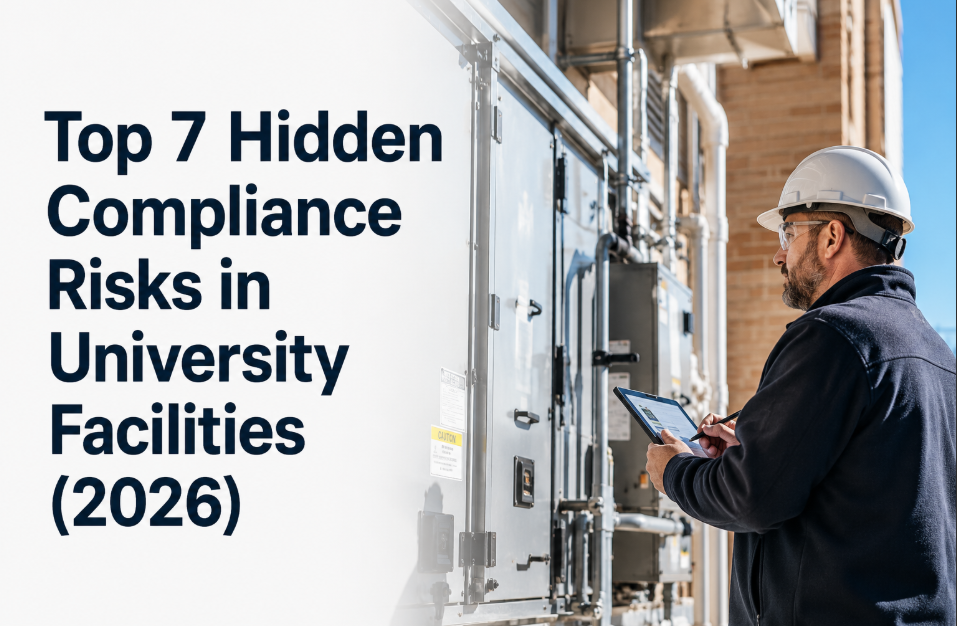
A research university in Virginia lost 72 hours of vivarium environmental control when a 14-year-old air handler serving its animal research facility failed catastrophically on a Friday evening. The compressor had been showing elevated current draw for 11 weeks — data that existed in the building automation system but was never analyzed. By Monday morning, 340 research animals requiring precise temperature and humidity control had been relocated to emergency backup facilities at a neighboring institution. Three NIH-funded studies worth $2.8 million in cumulative grant funding required protocol amendments and timeline extensions. The emergency HVAC rental and installation cost $94,000. The total financial impact exceeded $3.4 million — from a compressor bearing replacement that would have cost $6,200 if caught six weeks earlier during a planned maintenance window. This is not an outlier. Across U.S. higher education, critical asset failures account for 78% of unplanned campus downtime, and 85% of those failures show detectable degradation patterns 3–18 months before catastrophic breakdown. Universities using predictive maintenance platforms reduce unplanned critical asset downtime by 65% within the first year. Start your free trial today and begin predicting failures before they disrupt academics, destroy research, and drain emergency budgets. Schedule a 30-minute demo with our higher education facilities specialists to see predictive maintenance in action for your campus.
Reactive / Calendar-Based
Critical Asset Failure Detection
After Breakdown Occurs
Average Repair Cost Multiplier
4.8x Emergency Premium
Unplanned Downtime per Year
180–340 Hours Campus-Wide
Academic & Research Disruption
12–28 Events per Year
Predictive / Condition-Based
Critical Asset Failure Detection
3–18 Months Before Failure
Average Repair Cost Multiplier
1x Planned Rate
Unplanned Downtime per Year
45–95 Hours (65% Reduction)
Academic & Research Disruption
1–4 Events per Year
Average Annual Value for a 3M SF Campus: $1.8M–$3.2M
Critical Campus Assets That Demand Predictive Maintenance
Not every piece of campus equipment justifies predictive investment. But the assets that serve life safety functions, protect irreplaceable research, support academic continuity, and carry catastrophic failure costs absolutely do. These six asset categories account for 91% of unplanned campus downtime and 87% of emergency maintenance spending. Predictive monitoring on these systems alone delivers ROI that funds the entire program. Universities deploying predictive platforms through Oxmaint prioritize these high-impact systems first, expanding coverage as the program matures and proves value.
Central Plant HVAC
40%
Of total campus emergency spend — chillers, boilers, cooling towers, major AHUs
Elevators & Lifts
18%
Of campus accessibility complaints — ADA compliance, entrapment risk, code violations
Electrical Switchgear
Arc Flash
Fire and safety risk — pre-1980 panels, transformer oil, breaker trip patterns
Emergency Generators
Life Safety
Must-run assets serving hospitals, data centers, vivariums, and emergency egress systems
Research Lab Systems
$2.8M+
Average loss from single vivarium or cleanroom failure — fume hoods, ULT freezers, BSCs
Steam & Piping
Cascade
Single pipe rupture cascades to multi-building heating loss — corrosion, trap cycling, pressure
How Predictive Maintenance Intelligence Works for Campus Assets
Predictive maintenance is not guesswork with better tools — it is a structured intelligence pipeline that converts continuous equipment performance data into failure forecasts with specific timelines, recommended actions, and cost impact projections. The system works in four stages: continuous data ingestion from BAS, IoT sensors, and CMMS work history; AI-powered anomaly detection comparing real-time behavior against learned baselines; failure probability scoring with remaining useful life estimation; and automated work order generation with parts, labor, and timing recommendations that enable planned intervention weeks or months before catastrophic breakdown. Universities implementing this pipeline through Oxmaint connect their existing BAS, metering, and sensor data to predictive algorithms without replacing any current systems.
01
Continuous Monitoring
BAS data: temp, pressure, flow, runtime
IoT sensors: vibration, current, acoustics
CMMS history: repairs, parts, failure codes
Ingestion: Every 30 Sec
02
AI Anomaly Detection
Compare real-time vs learned baselines
Detect subtle degradation invisible to humans
Cross-reference weather, load, and season
Accuracy: 85–92%
03
Failure Forecasting
Remaining useful life estimation per asset
Risk scoring: safety, academic, cost impact
Probability timeline: weeks to months ahead
Prediction: 3–18 Months
04
Automated Action
Work orders auto-generated with parts & labor
Optimal timing aligned to academic calendar
Cost avoidance documented for board reporting
Response: Weeks Ahead
Asset-by-Asset: What Predictive Maintenance Catches and When
Each critical campus asset category produces distinct degradation signatures that predictive algorithms detect at different lead times. Understanding what the system monitors, what patterns indicate impending failure, and how far in advance intervention is possible helps facilities leaders prioritize sensor deployment and set realistic expectations for program outcomes. Schedule a demo to see these predictive models applied to your specific campus asset portfolio.
Chillers & Boilers
Vibration signatures, kW/ton efficiency, refrigerant charge, condenser pressure, current draw trending
4–12 Weeks
Elevators
Door operator current, ride quality vibration, leveling accuracy, motor temperature, sheave groove wear
2–8 Weeks
Electrical Switchgear
Thermographic hot spots, breaker trip frequency, transformer oil dissolved gas, load capacity utilization
3–18 Months
Emergency Generators
Load bank test performance, fuel quality, coolant chemistry, battery voltage sag, block heater function
4–16 Weeks
Research Lab Systems
ULT freezer compressor cycling, fume hood face velocity, BSC airflow differential, vivarium temp/humidity drift
1–6 Weeks
Steam & Piping
Condensate return temp, trap cycling frequency, pressure differential trending, wall thickness correlation
6–18 Months
Overall Predictable Failure Rate
85%
The 15% of failures not predicted are typically sudden catastrophic events — road debris impacts, manufacturing defects, vandalism — that produce no degradation pattern. Every other failure mode shows detectable signatures when the right data is monitored.
Predict Failures Weeks Before They Disrupt Your Campus
Oxmaint connects to your existing BAS, IoT sensors, and metering systems to detect equipment degradation patterns invisible to manual inspection — then auto-generates work orders with parts, timing, and cost impact documentation so your team intervenes during planned windows, not during finals week.
ROI of Predictive Maintenance for University Campuses
The financial case for predictive maintenance on critical campus assets is not theoretical — it is arithmetic. Every prevented emergency failure avoids 4.8x cost multipliers from overtime labor, expedited parts, temporary equipment rental, and cascade damage to adjacent systems. Every predicted failure that enables planned repair during an academic break eliminates the academic disruption, research loss, and student/faculty impact that reactive failures impose. Universities that present this ROI data to boards of trustees consistently secure capital funding that reactive-mode budget requests never achieve.
Emergency Repair Avoidance
14 prevented emergencies × $48,000 avg cost avoided (4.8x multiplier eliminated)
$672,000
Energy Optimization
Fault detection eliminates 15–20% HVAC waste from stuck valves, simultaneous heating/cooling
$480,000
Equipment Life Extension
Optimal maintenance timing extends critical asset life 15–25%, deferring $4M in capital replacement
$340,000
Research & Academic Protection
3 prevented lab/vivarium failures × avg $180K research impact avoided per event
$540,000
Staff Productivity Gains
30% increase in wrench-time — technicians fix instead of diagnose, search, and wait for parts
$188,000
Total Annual Value Delivered
$2.22M
Platform investment: $200K–$400K/year including software, IoT sensors, and integration. Net ROI: $1.8M–$2.0M. Return: 5–10x in first year. Value compounds as AI models mature with additional campus-specific operational data.
Implementation: From Pilot to Campus-Wide Predictive Operations
Deploying predictive maintenance for critical campus assets follows a structured path that delivers measurable value at each phase — building confidence and internal funding for expansion. The critical insight: you don't need to instrument every asset on day one. Start with the 15–20% of assets that cause 60–70% of your emergency costs. Prove value fast. Expand with evidence. Schedule a demo to design a phased deployment plan for your specific campus.
01
Month 1–2: Connect
Audit existing BAS, CMMS, metering data
Select 3–5 pilot buildings (highest risk)
Connect data feeds to Oxmaint platform
Output: Visibility
02
Month 3–6: Detect
AI learns asset baselines (2–4 weeks)
First fault detections and predictive alerts
Deploy IoT on highest-cost critical assets
Output: $400K–$800K
03
Month 7–12: Prevent
Expand to 15–25 buildings campus-wide
Predictive WOs embedded in daily workflow
First board presentation with ROI data
Output: $1.2M–$2.2M
04
Year 2+: Optimize
Full campus coverage on critical assets
AI models continuously improving accuracy
Capital planning driven by condition data
Output: 5–10x ROI
Real-World Predictive Catches: What the Data Reveals
The most compelling evidence for predictive maintenance comes from what it catches — the failures that would have happened but didn't because data-driven alerts enabled planned intervention. These are not hypothetical scenarios. They are documented catches from university predictive maintenance deployments, each representing a disaster that was prevented by weeks or months of advance warning.
Catch 1: Chiller Compressor — Research Building
What AI Detected
12% current draw increase + 8% cooling output decline over 3 weeks
Prediction Lead Time
6 Weeks Before Projected Failure
Planned Repair Cost
$4,200 (Bearing Replacement)
Avoided Emergency Cost
$274,000 (Rental + Research Loss)
Catch 2: Elevator Motor — Student Center
What AI Detected
Motor temperature trending 14°F above baseline, door cycle time increasing 22%
Prediction Lead Time
4 Weeks Before Projected Entrapment Risk
Planned Repair Cost
$8,600 (Motor + Door Operator Service)
Avoided Emergency Cost
$62,000 (Entrapment + ADA + Emergency)
Combined ROI from Two Catches Alone: 65x Sensor Investment
Overcoming Common Implementation Barriers
Every campus faces obstacles when deploying predictive maintenance. Understanding the most common barriers — and their proven solutions — accelerates the path from pilot to campus-wide value. None of these challenges are insurmountable. Every one has been solved by universities already operating predictive programs.
Legacy BAS Systems
Solved
Protocol gateways bridge legacy BACnet/Modbus for $500–$2K per building
IT Security Concerns
Solved
Read-only data collection, SOC 2, encrypted, network-segmented OT/IT
Staff Skepticism
Solved
Advisory mode first — AI recommends, humans decide. Trust builds with validated catches.
Messy Data Quality
Solved
AI platforms auto-detect sensor drift and anomalies. Imperfect data is expected — not a blocker.
Budget Constraints
Solved
Self-funding: energy savings in months 3–6 typically exceed annual platform cost. Free pilot available.
Organizational Silos
Solved
Platform serves Facilities, IT, Sustainability, and Finance — shared infrastructure, not single-dept tool.
Frequently Asked Questions
Which campus assets should be prioritized first for predictive maintenance?
Start with the 15–20% of assets that cause 60–70% of your emergency repair costs and academic/research disruption. For most universities, this means central plant chillers and boilers (single points of failure for entire building zones), emergency generators (life safety, must-run), electrical switchgear over 25 years old (arc flash and fire risk), elevators in high-traffic buildings (ADA compliance, entrapment liability), and HVAC systems serving research vivariums, cleanrooms, or data centers (irreplaceable research protection). Deploy IoT sensors on these assets first, prove value within 90 days, and expand from there. This targeted approach typically costs $30K–$60K for initial sensor deployment and delivers $200K–$500K in first-year avoided failures — a clear payback that justifies campus-wide expansion.
Sign up free to start building your critical asset priority list.
Do we need to replace our existing BAS or CMMS to deploy predictive maintenance?
No — and this is a critical point that often prevents universities from getting started. Modern predictive maintenance platforms are designed to layer on top of existing infrastructure, not replace it. Oxmaint connects to legacy BAS systems through standard protocols (BACnet, Modbus, LonWorks) using protocol gateways costing $500–$2,000 per building. It integrates with existing CMMS and metering systems via API connections established in minutes. For buildings with minimal automation, standalone wireless IoT sensors at $100–$500 per monitoring point fill data gaps without any BAS installation. The platform adds predictive intelligence to whatever data infrastructure exists today. Most campuses achieve initial integration within 4–8 weeks using existing hardware — the AI begins learning equipment baselines immediately upon connection.
How accurate are predictive maintenance failure forecasts for campus equipment?
Accuracy varies by asset type and monitoring maturity. For fault detection (identifying current operational problems like stuck valves, simultaneous heating/cooling, or sensor drift), accuracy exceeds 90% from day one because rules-based detection works immediately upon data connection. For predictive failure forecasting (projecting when equipment will fail), models need 2–4 weeks to learn each asset's normal operating baseline, with accuracy improving over 3–6 months as the system learns seasonal patterns, load variations, and equipment-specific behaviors. By month 6, most campuses report 85–92% prediction accuracy for major equipment failure modes. The 8–15% of failures that aren't predicted are typically sudden catastrophic events — manufacturing defects, external damage, vandalism — that produce no degradation pattern. Every gradual wear-based failure mode shows detectable signatures when the right data is monitored.
How does predictive maintenance help protect research assets specifically?
Research facilities present the highest-consequence failure scenarios on campus because losses are often irreversible. A vivarium environmental failure can destroy years of breeding programs and active NIH-funded studies. A ULT freezer failure can destroy biological samples with no replacement value. A cleanroom contamination event can invalidate months of semiconductor or materials research. Predictive maintenance protects these assets by monitoring the specific parameters that precede failure: compressor cycling patterns on ULT freezers, supply air temperature and humidity drift in vivariums, differential pressure trends in cleanrooms, and fume hood face velocity variations in chemistry labs. Alerts trigger with 1–6 weeks of lead time — enough to plan intervention during scheduled maintenance windows rather than scrambling for emergency contractors on a weekend. The $2.8M average research impact from a single vivarium failure makes the $15K–$30K annual cost of monitoring these systems trivially justifiable.
What is the typical payback period for a campus predictive maintenance program?
Most universities achieve positive ROI within 6–12 months of full deployment. The math is straightforward: if your campus experiences 12–18 emergency critical asset failures per year at an average cost of $35,000–$65,000 per event (including overtime, expedited parts, temporary rentals, and cascade damage), and predictive maintenance prevents 65% of those failures, you avoid $273,000–$760,000 in emergency costs annually. Add $300K–$600K in energy savings from automated fault detection (stuck valves, simultaneous heating/cooling, equipment running in unoccupied buildings) and the total first-year value typically reaches $600K–$1.4M. Against an annual platform investment of $200K–$400K (including software, IoT sensors, integration, and training), this represents 3–7x first-year ROI — with returns compounding as AI models improve and coverage expands.
Book a demo and we'll model ROI using your campus's actual emergency repair history and asset portfolio.
Your Critical Assets Are Degrading Right Now. The Data Exists. Use It.
Every chiller, boiler, elevator, and switchgear panel on your campus is generating performance data that reveals its health trajectory. The question is not whether failures are predictable — 85% of them are. The question is whether you'll see the warnings weeks ahead or discover them at 2 AM when the campus police dispatcher calls. Oxmaint connects your existing BAS, sensors, and maintenance data into predictive intelligence that prevents the emergency calls, protects irreplaceable research, and transforms your facilities team from firefighters into strategic asset stewards.