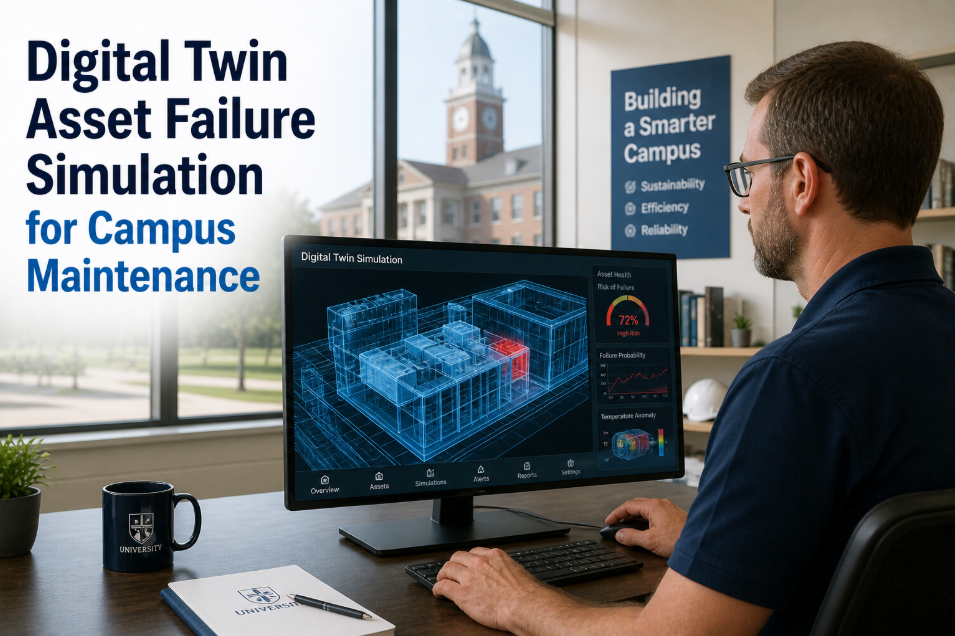
A digital twin is a real-time virtual replica of a physical asset — a chiller, a boiler, an air handling unit, an elevator, an electrical switchgear panel — that mirrors the actual equipment's operating condition, maintenance history, energy consumption, and degradation trajectory using live sensor data and machine learning models. Universities deploying digital twins on critical infrastructure are seeing failures predicted 3–6 weeks in advance, energy waste identified per-asset in real time, and capital replacement decisions backed by simulation rather than guesswork. For a sector managing $1.3 trillion in physical plant assets with a $36 billion deferred maintenance backlog and a 34% workforce shortage, digital twins are not a future technology — they are the operational layer that makes predictive maintenance, energy optimization, and capital planning actually work at scale. Schedule a demo to see digital twin simulation running on campus infrastructure data.
What a Digital Twin Actually Is — and Is Not — in Campus Facilities
The term "digital twin" has been diluted by marketing to the point where a 3D building model, a BAS dashboard, or even a spreadsheet of asset data gets labeled as a twin. Understanding the technical distinction is essential to evaluating whether a platform delivers genuine digital twin capability or just relabeled asset management.
BIM / 3D Visualization
- Static geometric representation of building
- No live data connection to physical asset
- Does not simulate operating behavior
- Cannot predict failure or optimize performance
BAS Monitoring Screen
- Displays current sensor readings only
- No behavioral model of how asset should perform
- Cannot detect gradual degradation patterns
- Shows symptoms, not root causes or projections
CMMS Asset Registry
- Static record of installed equipment
- Maintenance history without behavioral context
- No simulation of remaining useful life
- Cannot model "what-if" maintenance scenarios
Live Behavioral Simulation
- Real-time data feed from physical asset sensors
- ML model of how asset should behave vs. actual
- Predicts failures by detecting deviation trajectories
- Simulates maintenance scenarios and capital decisions
A genuine digital twin maintains three capabilities simultaneously: it ingests live sensor data from the physical asset, it runs a behavioral model that defines how the asset should perform under current conditions, and it detects deviations between expected and actual behavior that signal developing problems. The deviation between the twin's model and the physical asset's real performance is where every prediction, every anomaly alert, and every optimization recommendation originates.
How Digital Twins Work on Campus Infrastructure
The digital twin architecture for campus facilities operates in four connected layers. Each layer builds on the one below it, creating increasingly valuable intelligence from the same underlying data stream.
Data Ingestion Layer: Connecting Physical Assets to Their Twins
Temperature, pressure, flow rate, damper position, valve state, and equipment runtime data feeds continuously from existing building automation systems — no new sensor hardware required for most campus deployments
Vibration monitors on central plant rotating equipment, power quality meters on electrical switchgear, and acoustic sensors on pumps provide the granular data that enables failure-mode-specific predictions
Building-level and circuit-level consumption data establishes the energy baseline against which the twin detects waste — simultaneous heating/cooling, stuck dampers, after-hours operation, and coil fouling
Every past repair, part replacement, and failure event trains the twin's behavioral model — the richer the history, the more accurate the predictions become over time
Behavioral Model Layer: How the Asset Should Perform
Thermodynamic models for chillers and boilers, electrical models for switchgear and transformers, and mechanical models for pumps and fans define how each asset type should behave given current load, weather, and operating conditions
ML algorithms calibrate physics-based models to each specific asset's unique characteristics — accounting for installation age, maintenance history, local water chemistry, building-specific load patterns, and operational quirks
The twin tracks how each asset's actual performance diverges from its ideal baseline over time — mapping the degradation trajectory that enables remaining useful life estimation and optimal maintenance timing
Outdoor temperature, humidity, occupancy levels, and academic calendar events are factored into the expected performance baseline — preventing false anomaly alerts during normal seasonal or operational variations
Deviation Detection Layer: Where Predictions Originate
The twin continuously compares what the asset is doing against what it should be doing — a chiller drawing 8% more energy than the model predicts under identical conditions signals developing compressor degradation
Simultaneously tracks vibration, temperature, pressure, energy, and maintenance signals — correlating gradual changes across variables that individually fall below alarm thresholds but collectively signal imminent failure
When deviation is detected, the twin classifies the specific failure mode developing — bearing degradation vs. refrigerant leak vs. coil fouling — enabling targeted repair rather than general inspection
Based on the deviation trajectory and historical failure data, the twin estimates when the failure will become critical — giving maintenance teams a 3–6 week window to plan repairs during academic breaks
Decision Simulation Layer: What-If Scenario Modeling
Models the risk and cost of immediate repair against deferring to the next academic break — factoring failure probability, consequence severity (student impact, research loss), and technician availability
For assets approaching end-of-life, the twin simulates continued maintenance cost against replacement — including energy savings from new equipment, warranty value, and reduced failure probability
CBOs can simulate different capital investment scenarios — "What happens to failure rates if we replace the 5 oldest chillers vs. the 10 highest-maintenance AHUs?" — using twin projections rather than guesswork
Before committing capital to energy retrofits, the twin simulates projected energy savings under actual campus operating conditions — not manufacturer estimates — providing realistic ROI projections for board approval
The Six Campus Systems Where Digital Twins Deliver the Highest ROI
Not every campus asset justifies a digital twin. The highest ROI comes from twinning systems that are expensive to repair, critical to operations, and generate sufficient data for behavioral modeling. These six system categories represent 85%+ of preventable emergency spending at universities:
Twins model compressor efficiency curves, bearing vibration trajectories, refrigerant charge levels, and condenser fouling rates — predicting catastrophic failures 4–6 weeks before seizure.
Combustion efficiency modeling, heat exchanger fouling detection, feedwater chemistry correlation, and burner degradation tracking — enabling scheduled repairs during summer months.
Thermal imaging anomaly tracking, partial discharge progression modeling, insulation resistance decline curves, and load imbalance detection — the highest-consequence failure on campus.
Fan bearing degradation, coil fouling energy impact, economizer damper failure, VAV box actuator drift, and simultaneous heating/cooling fault isolation — the largest source of energy waste.
Door operator motor current trending, leveling accuracy degradation, brake pad wear prediction, and hydraulic pressure loss detection — with ADA compliance implications for every hour of downtime.
Steam trap failure detection from temperature differentials, chilled/hot water leak identification via flow analysis, pump cavitation acoustic matching, and pipe corrosion rate modeling.
Digital Twins for Energy Optimization: Finding the 15–25% You Are Wasting
Energy is the second-largest facilities line item after labor. Buildings with degraded HVAC systems waste 15–25% of their energy budgets through faults that are invisible on BAS dashboards but immediately apparent to digital twins. The twin knows how much energy the chiller should consume at a given outdoor temperature, load, and time of day. When actual consumption deviates from the modeled expectation, the twin identifies the specific fault causing the waste — and generates a work order to correct it. Start a free trial to see energy anomaly detection running on your building data.
Digital Twins for Capital Planning: Simulation Replaces Guesswork
The most strategically valuable application of digital twins is not failure prediction — it is capital planning simulation. Every CBO faces the same question each budget cycle: which assets should we replace, which can we maintain, and how do we justify the decision to the board? Without digital twins, the answer relies on asset age, maintenance complaints, and professional judgment. With digital twins, the answer is a simulation.
What Digital Twin Simulation Gives Your CBO That Spreadsheets Cannot
A digital twin does not just tell you that a chiller is 18 years old. It tells you that this specific chiller, given its actual operating history, maintenance record, current COP degradation curve, and projected load demands, has a 72% probability of requiring $85,000 in repairs within the next 24 months — versus a $320,000 replacement that would reduce annual energy consumption by $28,000 and eliminate the failure risk entirely. The NPV calculation favoring replacement becomes defensible because it is based on simulation of this asset's actual trajectory, not industry averages.
When a CBO presents a capital request backed by digital twin simulation — with failure probability curves, remaining useful life projections, energy savings modeling, and risk quantification for deferral — boards approve funding because the analysis is specific, defensible, and tied to financial outcomes. The twin transforms the capital conversation from "trust me, we need this" to "here is what the data projects under three scenarios."
Measurable Outcomes: What Digital Twins Deliver Annually
The financial impact of digital twins compounds across failure prevention, energy optimization, asset life extension, and capital planning efficiency. Conservative estimates for a mid-size university managing 2–3 million gross square feet with 1,500–3,000 major assets: Schedule a demo to see these projections modeled with your institution's actual asset data.
Digital twin deviation detection identifies developing failures 3–6 weeks before breakdown. Emergency repairs cost 3× planned maintenance. Preventing 65% of emergencies saves $800K–$2M annually.
Twin anomaly detection identifies per-asset energy waste — stuck dampers, simultaneous heating/cooling, after-hours operation, coil fouling — that is invisible on standard BAS dashboards.
Condition-based maintenance timed by twin degradation curves extends equipment life 25–35% beyond calendar replacement. A chiller lasting 26 years instead of 20 defers $320K+ in capital.
Replace-vs-repair decisions backed by twin simulation achieve 3–5× higher board approval rates than anecdotal requests — unlocking $500K–$2M in approved capital annually.
Twin-generated predictive work orders with specific failure modes, repair procedures, and pre-staged parts eliminate diagnostic time — doubling effective technician capacity without adding headcount.
Twins continuously log asset conditions, maintenance actions, and performance data — generating OSHA, NFPA, ADA, and ASHRAE compliance documentation as a byproduct of normal monitoring.
Implementation: From Zero to Digital Twins in 90 Days
Deploying digital twins on campus infrastructure does not require a multi-year IT project, a data science team, or a complete sensor overhaul. The data sources that feed twin models already exist at most universities. The platform connects to them and begins building behavioral models within the first two weeks.
By day 90, the platform has learned your campus's unique operating patterns, generated its first predictive work orders, documented energy savings, and produced the capital planning simulations your CBO needs for the next board cycle. The twins improve continuously — accuracy, lead time, and coverage all increase with every additional week of data. Start your free trial and begin the 90-day path from reactive maintenance to simulation-driven operations.
Frequently Asked Questions
Do we need to install new sensors across campus to use digital twins?
No. Most university campuses already have building automation systems generating the temperature, pressure, flow, and runtime data that digital twin models need. Energy meters, maintenance history records, and work order logs provide additional training data. For 80%+ of campuses, the existing data infrastructure is sufficient to begin building twins within two weeks of deployment. Targeted sensor additions — vibration monitors on central plant rotating equipment ($500–$2,000 per asset), power quality meters on main switchgear ($1,000–$3,000 per panel) — enhance accuracy for specific high-value assets but are not prerequisites. Book a demo to assess your existing data infrastructure and identify any enhancement opportunities.
How is a digital twin different from the predictive maintenance we already have?
Most platforms labeled "predictive maintenance" use rule-based alerts — static thresholds that trigger when a single sensor reading exceeds a preset value. A digital twin goes further: it maintains a behavioral model of how each specific asset should perform under current conditions, detects multi-variable deviations that fall below any individual alarm threshold, and simulates future scenarios including remaining useful life and capital planning decisions. The twin does not just predict that something will fail — it tells you what specific failure mode is developing, when it will become critical, what the repair should cost, and whether repair or replacement generates better financial outcomes over the planning horizon.
Can digital twins help with state decarbonization mandates?
Yes — this is one of the highest-value applications. Digital twins model the energy performance of every major campus asset against its expected efficiency. When a chiller's COP degrades 8%, the twin quantifies exactly how many additional kWh that degradation generates annually. When an economizer damper fails, the twin calculates the tonnage of cooling being wasted by not using free outdoor air. This asset-level energy waste quantification feeds directly into EUI tracking dashboards that document decarbonization progress building by building against state targets. Institutions in New York, California, Massachusetts, and Washington with emissions reporting mandates use twin data to demonstrate compliance progress and prioritize the energy retrofits that deliver the highest carbon reduction per dollar invested. Start a free trial to see energy performance modeling and EUI tracking on your building portfolio.
What is the realistic timeline and budget for digital twin deployment?
Cloud-native platforms deploy digital twins in 90 days through a phased approach: weeks 1–2 connect data sources and begin model building; weeks 3–4 calibrate models and activate first predictions; weeks 5–8 bring full predictive and simulation capability online; weeks 9–12 deploy executive dashboards and capital planning tools. A mid-size institution (50–100 buildings, 1,500–3,000 major assets) can deploy the full platform for $200K–$500K annually against $1.3M–$4.4M in documented annual savings and risk reduction — a 5–8× first-year ROI. Most institutions see positive ROI within the first 90 days through energy savings and emergency failure prevention alone.
How do we present digital twin ROI to our board of trustees?
Boards respond to quantified financial exposure, not technical maintenance terminology. Present the case in four pillars: (1) emergency failure prevention — $800K–$2M annually from eliminating 65% of emergency repairs; (2) energy cost reduction — $150K–$500K annually from identifying and correcting 15% waste; (3) asset life extension — $2M–$8M in capital avoidance over 5 years from 30% longer equipment life; (4) enrollment protection — facility condition as a top-3 retention factor means every percentage point of student satisfaction improvement protects $500K–$2M in annual tuition. The digital twin platform generates the board-ready dashboards that present these metrics with your institution's actual data — not industry averages. Schedule a demo and we will model the specific ROI projection for your board presentation.