How to Build a Data-Driven Maintenance Strategy for Large University Campuses
By Oxmaint on February 26, 2026
A flagship state university in the Midwest discovered the cost of gut-feeling maintenance in the worst possible way. Their Director of Facilities had managed 4.8 million square feet across 72 buildings for 19 years — and carried the maintenance strategy almost entirely in his head. He knew that the Engineering Complex boiler was "probably due," that the Library's AHU had been "acting up since March," and that the Student Center's roof would "need attention before next winter." Then he retired in June. His replacement inherited zero documented maintenance baselines, no failure trend data, no prioritized capital backlog, and no KPI dashboards — just 14,000 open work orders in a CMMS that had been used as a digital clipboard rather than an intelligence platform. By October, three buildings experienced simultaneous HVAC failures because seasonal PM programs existed only as tribal knowledge that walked out the door. Emergency repair costs for Q4 alone exceeded the entire annual planned maintenance budget by 40%. The board demanded answers. The new director had none — because there was no data to answer with. Book a Demo to see how Oxmaint transforms maintenance data into strategic campus intelligence. Sign Up to start building your data-driven strategy today.
78%
of university facilities departments cannot answer "what is our cost per square foot for maintenance?" — the most basic KPI in facilities management
Composite data from APPA FPI surveys and campus CMMS audits 2023–2026
78%of campus facilities teams lack actionable KPI dashboards for maintenance decisions
65%of CMMS implementations in higher ed are used only for work orders — not analytics
$112Btotal U.S. higher ed deferred maintenance — growing 5%+ annually without data intervention
42%backlog growth rate reduction achievable with data-driven maintenance strategy within 2 years
Your campus generates millions of maintenance data points every year. Are you using them? Oxmaint transforms work orders, sensor feeds, and inspection records into KPI dashboards, predictive alerts, and capital planning intelligence — turning reactive chaos into strategic operations.
Why Most Campus Maintenance Strategies Fail Without Data
The fundamental problem in university facilities management isn't lack of effort — it's lack of visibility. Maintenance teams work exhausting hours responding to emergencies, completing PM checklists, and managing contractor projects. But without structured data capture and analytics, all that effort produces no strategic intelligence. You can't optimize what you can't measure. You can't predict what you don't track. And you can't justify budget requests to trustees with anecdotes instead of evidence. The shift from experience-based to data-driven maintenance doesn't replace skilled technicians — it amplifies their impact by directing their expertise toward the work that matters most.
The Five Pillars of a Data-Driven Campus Maintenance Strategy
A data-driven maintenance strategy is not a single tool or dashboard — it is five interconnected capability layers, each feeding the next. A campus that builds only one pillar (usually work order tracking) and ignores the others will never achieve strategic operations. All five must work together. Book a Demo to assess which pillars your campus has built — and which are missing.
Five Pillars of Data-Driven Campus Maintenance
Pillar 1
Comprehensive Asset Intelligence
Every asset cataloged with age, condition, costQR-coded for field accessLinked to maintenance historyReplacement cost documented
Foundation
Pillar 2
Structured Work Order Analytics
Failure codes standardized fleet-wideLabor hours captured per taskParts cost linked to assetsPlanned vs reactive ratio tracked
Operational
Pillar 3
KPI Dashboards & Benchmarking
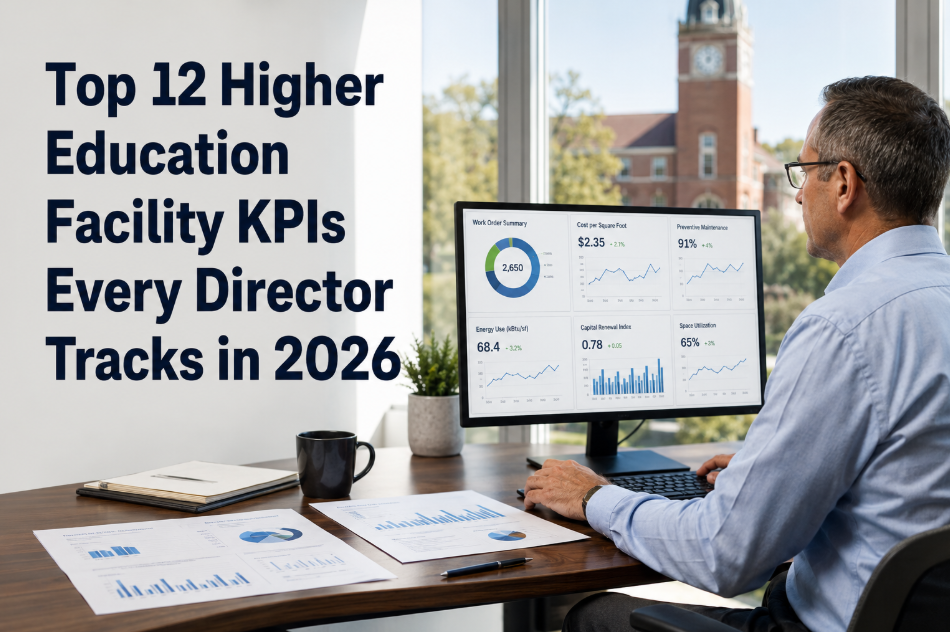
Cost per SF by buildingPM completion rate trackedMTBF / MTTR per asset classAPPA FPI benchmarks compared
Intelligence
Pillar 4
Predictive Analytics & Condition Monitoring
IoT sensor integration for critical assetsAI failure pattern detectionRemaining useful life forecastingCondition-based PM intervals
Predictive
Pillar 5
Strategic Capital Planning & FCI Tracking
Facility Condition Index per buildingDeferred maintenance prioritized by riskScenario modeling for capital projectsBoard-ready investment roadmaps
Strategic
Essential KPIs Every University Facilities Team Must Track
You cannot manage a 50-building campus portfolio with the same instinct-based approach that works for a single commercial property. Large university campuses require structured KPIs that expose operational health at the building level, asset class level, and portfolio level simultaneously. Here are the metrics that separate strategic operations from expensive guesswork. Sign Up — start measuring what matters across your campus.
Campus Maintenance KPI Framework
KPI Category
Specific Metrics
Target Benchmark
Why It Matters
Cost Efficiency
Maintenance cost per gross SF, cost per building, labor vs parts ratio
$2.50–$4.50/SF (APPA Level 2-3)
Benchmarks total spend against peers; identifies buildings consuming disproportionate budget
Work Order Performance
Planned vs reactive ratio, WO completion rate, average days to close, backlog size
70:30 planned:reactive, 95%+ completion
Reactive work costs 4-6x more; ratio reveals operational maturity and crisis frequency
Incomplete PMs create deferred risk; tracking proves program value to leadership
Asset Reliability
Mean Time Between Failures, Mean Time To Repair, repeat failure rate per asset
MTBF increasing, MTTR decreasing quarter over quarter
Identifies chronic equipment problems and validates maintenance effectiveness over time
Facility Condition
Facility Condition Index per building, deferred maintenance backlog $, backlog growth rate
FCI <0.05 Good, 0.05–0.10 Fair, >0.10 Poor
The single most important metric for capital planning and trustee communication
Energy & Sustainability
Energy use intensity (kBTU/SF), utility cost per SF, carbon emissions per building
Trending downward year-over-year
Connects maintenance operations to sustainability commitments and cost reduction
Staff Productivity
Wrench time %, WOs completed per tech per day, overtime ratio
55–65% wrench time, 4–6 WOs/tech/day
Reveals whether staff spend time fixing or searching, diagnosing, and waiting for parts
Universities achieving APPA Level 2 (Comprehensive Stewardship) track all seven categories. Most campuses currently track only one or two — leaving massive blind spots in operational intelligence.
How a CMMS Transforms Campus Maintenance Data Into Strategy
A CMMS used as a digital clipboard — open work order, close work order — delivers almost zero strategic value. A CMMS used as an intelligence platform captures structured data at every maintenance touchpoint and converts it into the KPI dashboards, predictive alerts, and capital planning forecasts that drive decisions. The difference is not the software — it is how you configure and use it.
Oxmaint Campus Maintenance Intelligence Platform
Automated KPI Dashboard Generation
Every closed work order automatically feeds cost-per-SF, planned-vs-reactive ratio, PM completion rate, and MTBF calculations — no manual spreadsheet assembly. Leadership dashboards update in real time.
Building-Level Asset Registry with FCI Scoring
Every major system — HVAC, roofing, electrical, plumbing, elevator, fire safety — cataloged with condition rating, age, replacement cost, and maintenance history. FCI calculated per building and updated with every inspection and repair.
Predictive Failure Pattern Detection
AI analyzes work order history, parts replacement patterns, and IoT sensor data to identify assets trending toward failure. Alerts generated weeks before breakdown — with predicted failure mode, recommended action, and cost impact.
Capital Planning & Board Reporting
Deferred maintenance backlog ranked by composite risk score — safety, academic impact, energy waste, cost escalation rate. Board-ready reports generated automatically showing where every capital dollar delivers maximum impact.
Multi-Building Benchmarking & Trend Analysis
Compare performance across buildings by age, type, usage intensity, and maintenance investment. Identify outliers consuming disproportionate resources. Benchmark against APPA Facilities Performance Indicators nationally.
Mobile-First Technician Data Capture
Technicians capture failure codes, labor hours, parts used, and condition photos from the field via mobile app. Every data point feeds analytics automatically — no end-of-day paperwork, no data gaps, no lost institutional knowledge.
Stop Managing by Instinct. Start Managing by Intelligence.
Oxmaint gives campus facilities leaders a single platform to track every asset, every work order, and every dollar — then transforms that data into the KPI dashboards, predictive alerts, and capital planning forecasts that earn trustee confidence and budget approval.
Instinct-Based vs. Data-Driven Maintenance Operations
The difference between campuses that drown in deferred maintenance and campuses that strategically manage their infrastructure is not budget size — it's whether decisions are made from data or from memory. Campuses ready to make the shift can start a free Oxmaint account and begin structuring their maintenance data today.
Campus Maintenance Strategy Comparison
Instinct-Based / Reactive
Data-Driven / Strategic
Capital priorities based on who complains loudest to the provost
Capital priorities ranked by FCI, risk score, and cost escalation data
No visibility into planned vs reactive work ratio — feels like "constant firefighting"
Real-time dashboard shows 72:28 planned:reactive ratio improving quarterly
PM schedules based on calendar guesses, not actual equipment condition or usage
PM intervals optimized by usage data, failure history, and sensor condition monitoring
Budget requests to trustees rely on "our buildings are old" — denied or underfunded
Budget requests backed by building-level FCI, peer benchmarks, and projected risk
When experienced staff retire, institutional knowledge leaves permanently
Every decision, repair, and inspection documented in CMMS — knowledge preserved
5.2%/yraverage deferred maintenance backlog growth without data strategy
-3%/yrbacklog declining annually with data-driven capital prioritization
Building the Data Foundation: What to Capture and How
The most common failure point in data-driven maintenance isn't software selection — it's data capture discipline. A CMMS is only as powerful as the structured data flowing into it. These are the six data streams that must be captured consistently to enable strategic analytics. Without standardized inputs, every dashboard and report will be unreliable.
Essential Data Capture Points for Campus Maintenance Intelligence
Data Stream
What to Capture
Capture Method
Analytics Enabled
Asset Registry
Every major system: model, age, install date, condition score, replacement cost, location, photos
Initial audit + QR tagging; updated at every service event via mobile CMMS
FCI calculation, lifecycle forecasting, capital planning, replacement timing
Work Orders
Standardized failure codes, labor hours, parts used with cost, root cause, corrective action taken
Technician mobile app with required fields — incomplete WOs cannot be closed
Cost per asset, MTBF/MTTR, failure trending, repeat issue detection
The most critical rule: every data field that drives a KPI must be required — not optional — in the CMMS workflow. Optional fields stay empty. Empty fields produce meaningless dashboards.
Data in. Intelligence out. Decisions made. Oxmaint enforces structured data capture at every touchpoint — then auto-generates the KPI dashboards that turn raw maintenance data into board-ready strategic intelligence.
Impact: What Data-Driven Maintenance Delivers to Universities
65%
Fewer emergency repairs
Predictive analytics and optimized PM programs catch failures before they become 4x-cost emergencies
42%
Slower backlog growth
Data-prioritized capital investment addresses highest-risk items first — halting the compounding cycle
75%
Better budget accuracy
Historical cost data and trend analysis enable maintenance budget forecasts within 5% of actual spend
100%
Knowledge preserved
Every repair, inspection, and decision documented in CMMS — institutional knowledge survives retirements
Implementation Roadmap
Most universities achieve a functioning data-driven maintenance strategy within 16–24 weeks when they commit to structured implementation. The critical success factor is not software deployment speed — it is data capture discipline in the first 60 days. Build the habit first; analytics follow automatically. Book a Demo to plan your phased rollout.
Inventory every major building system campus-wide. Tag with QR codes. Configure Oxmaint with standardized failure codes, required work order fields, and building hierarchy. Import historical work orders and parts records.
2
Weeks 4-8
Data Capture Discipline & Staff Training
Train every technician on mobile CMMS data entry — failure codes, labor hours, parts, photos. Establish the rule: no work order closes without structured data. Supervisors audit data quality weekly for first 30 days.
3
Weeks 8-16
KPI Dashboards & Baseline Measurement
With 8+ weeks of structured data flowing, configure automated KPI dashboards: cost/SF by building, planned vs reactive ratio, PM completion rate, MTBF per asset class. Establish baselines. Calculate FCI per building for the first time.
4
Weeks 16-24
Predictive Analytics & Capital Planning
Connect IoT sensors on highest-risk assets. Enable AI failure pattern detection. Build first data-driven capital prioritization report for board presentation. Optimize PM intervals based on actual failure data. Establish quarterly strategy reviews using KPI trends.
The Data Already Exists. The Strategy Doesn't — Yet.
Your technicians complete thousands of work orders per year. Your buildings generate millions of sensor data points. Your parts room processes thousands of transactions. All that data is either building your strategy — or disappearing into a spreadsheet no one reads. Oxmaint captures it, structures it, and converts it into the intelligence your campus needs to move from reactive to strategic.
APPA (the association for facilities professionals in higher education) provides the most widely recognized benchmarking framework for campus maintenance through its Facilities Performance Indicators (FPI) program. A data-driven CMMS automatically calculates where your campus falls on the APPA stewardship scale — and what it takes to move up.
Basic PM programSome data trackingFCI 0.05–0.10Growing backlog
Majority
Level 4-5
Reactive / Crisis — Below $2.50/SF
Minimal or no PMNo data strategyFCI above 0.10Backlog spiraling
Crisis
Frequently Asked Questions
How long does it take to build a data-driven maintenance strategy for a large campus?
Most universities achieve a functioning data-driven strategy within 16–24 weeks, broken into four phases: asset audit and CMMS configuration (weeks 1-4), data capture discipline and staff training (weeks 4-8), KPI dashboard activation with baseline measurement (weeks 8-16), and predictive analytics with capital planning integration (weeks 16-24). The critical success factor is not technology deployment speed — it's establishing consistent, structured data capture habits in the first 60 days. Analytics are only as reliable as the data feeding them. Universities that enforce required fields in work orders from day one see dashboard accuracy within 8 weeks. Sign Up and start building your data foundation today.
What KPIs should university facilities leaders track first?
Start with three foundational KPIs that deliver immediate strategic value: (1) Planned vs. reactive work order ratio — this single number tells leadership whether your operation is strategic or in crisis mode, target 70:30 or better. (2) Maintenance cost per gross square foot by building — identifies which buildings consume disproportionate budget and enables peer benchmarking against APPA FPI data. (3) PM completion rate — proves whether your preventive program actually runs or exists only on paper. Once these three are reliable (typically by week 8-10), add MTBF/MTTR per asset class, Facility Condition Index per building, and energy use intensity. Don't try to track 20 KPIs on day one — master three, then expand.
How do you get technicians to capture structured data consistently?
This is the hardest and most important implementation challenge. Three strategies work: First, make critical data fields required in the CMMS — work orders literally cannot be closed without failure code, labor hours, and parts used. Second, make data entry faster than paper — mobile apps with pre-populated drop-downs, QR code scanning, and voice-to-text notes eliminate the "this takes too long" objection. Third, show technicians their own data — when a mechanic sees that their MTTR is 45 minutes better than average, or that their PM catches prevented 3 emergency calls last month, data entry stops feeling like paperwork and starts feeling like recognition. Supervisors must audit data quality weekly for the first 30 days — after that, the habit is set.
Can a data-driven strategy help secure more funding from the board of trustees?
This is one of the highest-value outcomes. Trustees are fiduciaries — they respond to data-backed investment cases, not "our buildings are old" assertions. A data-driven strategy delivers three things boards need: (1) Building-level Facility Condition Index compared to peer institutions — if peers average FCI 0.06 and your campus is at 0.12, that's a credible urgency signal. (2) Cost escalation evidence — showing that every $1 deferred today costs $4 in 5 years with specific campus examples. (3) A prioritized 5-year capital roadmap showing exactly where each dollar goes and what risk it mitigates. Universities that present real-time FCI dashboards at board meetings report significantly higher capital approval rates than those presenting static spreadsheets. Book a Demo to see how Oxmaint generates board-ready capital reports from your maintenance data.
What role does IoT and sensor data play in a campus maintenance strategy?
IoT sensors transform maintenance from calendar-based to condition-based — but they're Pillar 4, not Pillar 1. Start with structured work order data (Pillar 2) and KPI dashboards (Pillar 3) before investing in sensors. When you're ready, deploy IoT selectively on your highest-risk, highest-cost assets: central plant chillers and boilers, main electrical switchgear, major air handlers serving research spaces, and critical building systems like smart locks and fire panels. These 15-20% of assets typically account for 60-70% of emergency repair costs. Wireless IoT sensors cost $100-$500 per monitoring point with $50-$100 annual data fees — a fraction of the cost of a single prevented emergency. The sensor data feeds your CMMS predictive algorithms, enabling condition-based PM triggers that replace wasteful fixed-interval schedules.
How does Oxmaint compare to legacy CMMS platforms used by universities?
Most legacy campus CMMS platforms (installed 10-15 years ago) were designed as work order databases — they capture what happened but don't analyze why or predict what's next. Oxmaint is built as an intelligence platform: mobile-first technician experience that drives data capture discipline, automated KPI dashboard generation without manual spreadsheet assembly, AI-powered predictive failure detection from work order patterns and IoT sensor data, and FCI-based capital planning reports generated automatically from maintenance data. The platform integrates with existing BAS, metering, and IoT systems via standard protocols — layering intelligence on top of your current infrastructure rather than requiring replacement. Most campuses achieve initial deployment within 2-4 weeks and measurable KPI improvement within 90 days. Sign Up free to evaluate the platform with your own campus data.
Your Campus Deserves Decisions Based on Data, Not Memory
Every work order your team closes either builds institutional intelligence or disappears into a void. Every inspection either updates your facility condition index or generates another forgotten PDF. Every emergency repair either teaches your predictive models or repeats last year's mistake. Oxmaint ensures every maintenance touchpoint feeds the strategic intelligence that earns trustee confidence, protects campus infrastructure, and transforms your facilities team from firefighters into stewards. The data is already flowing through your buildings. Start using it.