
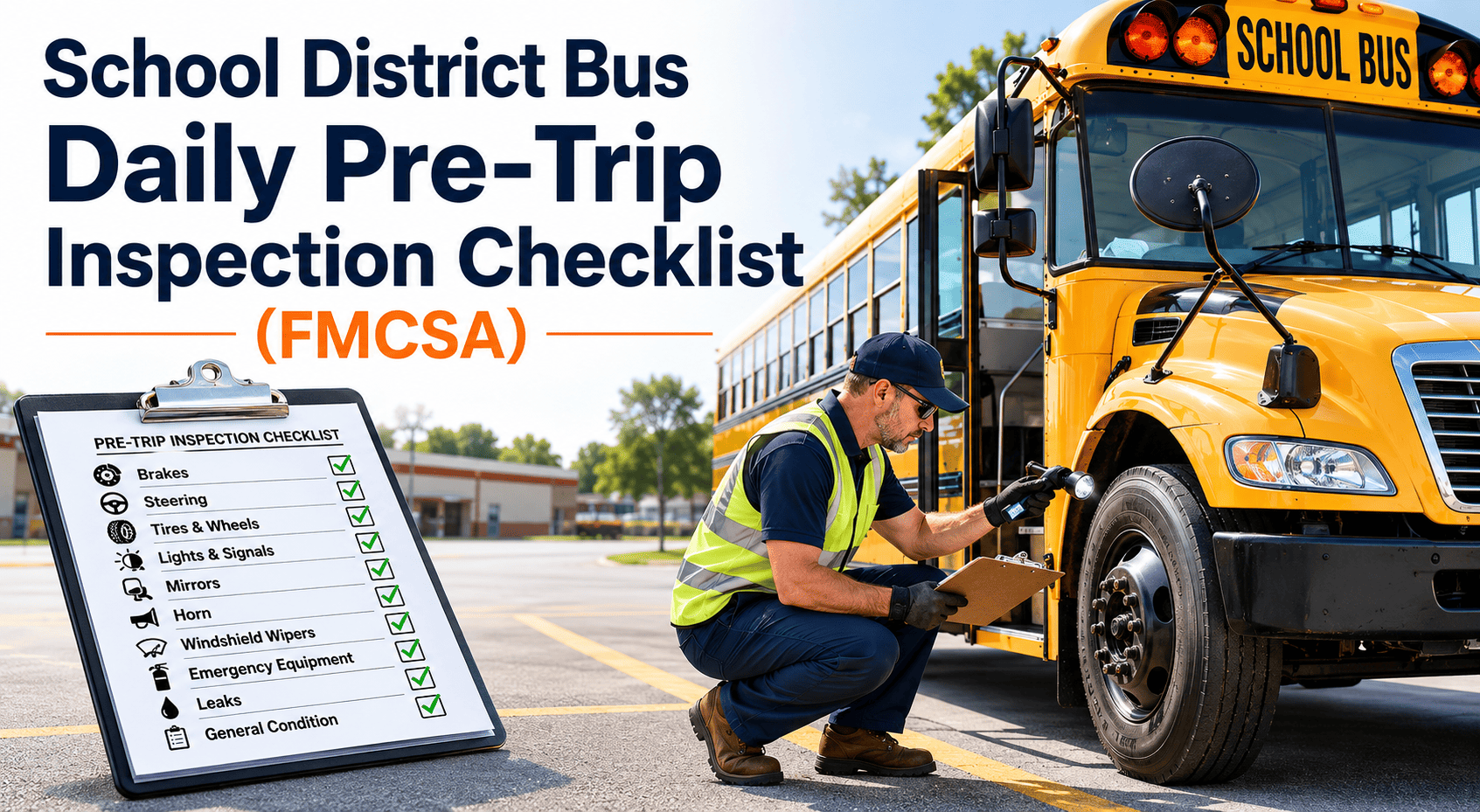
FMCSA regulations require a documented pre-trip inspection before every school bus route. A bus that departs without a completed record is operating in violation — and any incident carries full district liability exposure. This checklist covers the complete school bus pre-trip inspection per FMCSA Part 396.13 — exterior walk-around, engine, brakes, tires, lights, interior safety, emergency exits, wheelchair lift, and communication systems. Deploy it in OxMaint to generate a pre-trip work order before every route and produce DOT-ready records on demand. Book a demo.
1. Exterior Walk-Around
Begin at the front left and walk clockwise around the vehicle. Inspect every panel, mirror, light, door, and tire at each position before moving to the next. Any fluid puddle under the bus must be identified before departure.
2. Engine Compartment
Open the hood and inspect all fluid levels, belts, hoses, and engine components with the engine cold before starting. Engine compartment checks are the primary source of preventable road calls — a low oil or coolant reading caught at the yard costs nothing; the same reading discovered by a temperature warning light at a school stop costs the district a road call and service delay.
3. Brakes and Steering
Brake system failure is the leading mechanical cause of fatal school bus incidents. FMCSA Part 393 mandates specific brake performance requirements — any brake that does not meet the minimum standard is an out-of-service condition. Air brake systems require additional checks specific to their operation.
4. Tires and Wheels
Tire failures are the leading cause of school bus mechanical breakdowns on route. FMCSA Part 393.75 defines out-of-service tire conditions — any bus with a tire meeting these criteria must not operate. Tires on school buses with student passengers are held to higher standards than general commercial vehicles.
5. Lights and Signals
School bus lighting requirements exceed those of general commercial vehicles. In addition to standard running and brake lights, school buses require operational amber and red loading/unloading lights, an amber crossing control arm on newer buses, and strobe lights in most states. All must be confirmed operational before every route.
6. Interior Safety Equipment
Interior inspection is completed after the exterior walk-around with the engine running. Every seat, safety device, and student area must be checked before students board. Many interior defects that are safe to defer on a commercial vehicle are out-of-service conditions on a student-occupied school bus.
7. Emergency Exits
FMCSA and state regulations require that all emergency exits be fully operational before every route. The number of required emergency exits depends on bus capacity — all exits must open from both inside and outside, and drivers must physically test each one before boarding students. Blocked or inoperative emergency exits are an immediate out-of-service condition.
8. Wheelchair Lift and Communication Systems
Buses equipped with wheelchair lifts must have the lift tested before every route where a wheelchair user is scheduled to ride. The ADA requires that all accessibility equipment be operational when needed — a failed lift on a route with a wheelchair-using student is a civil rights incident, not just a mechanical failure.

.png)

.png)


