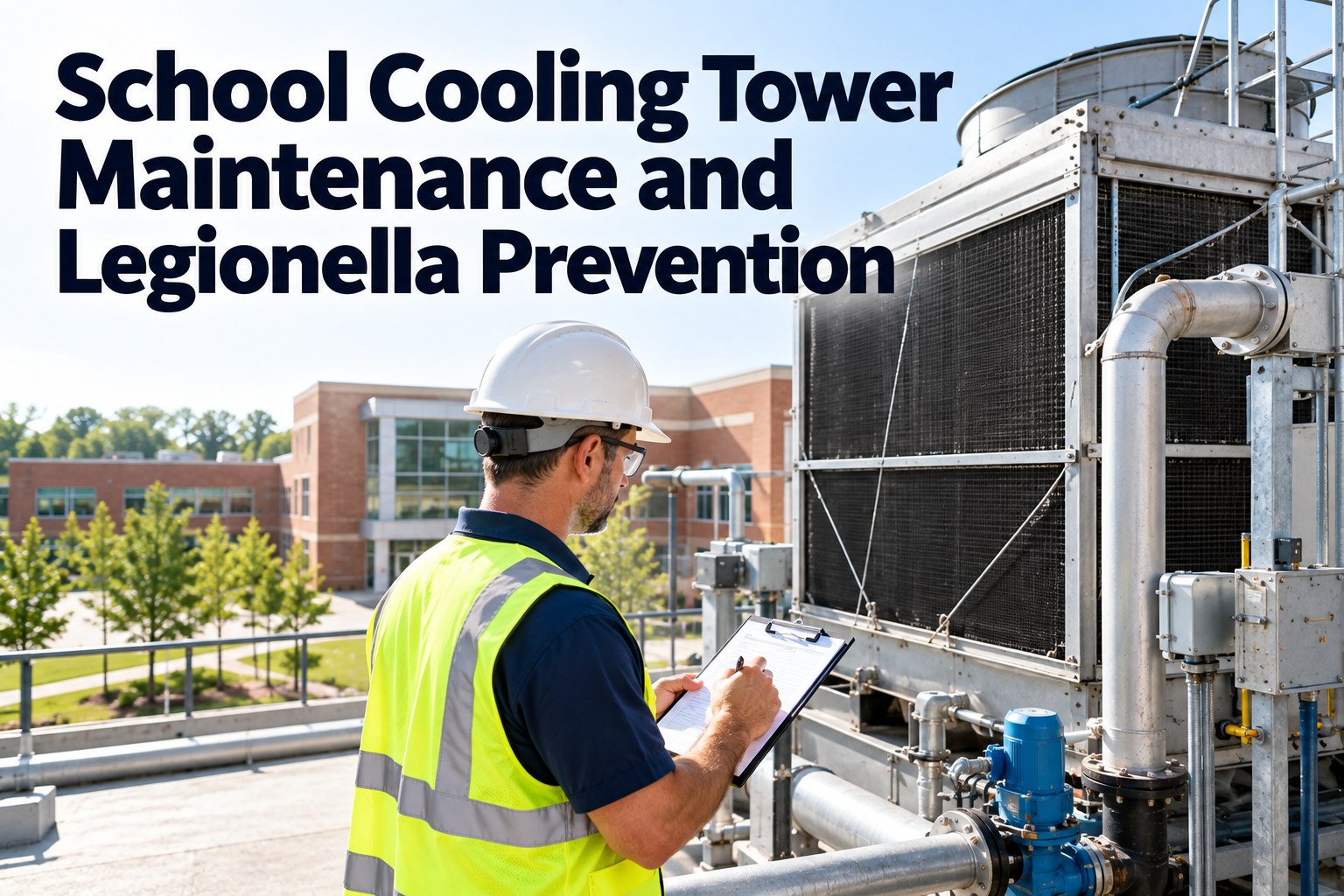
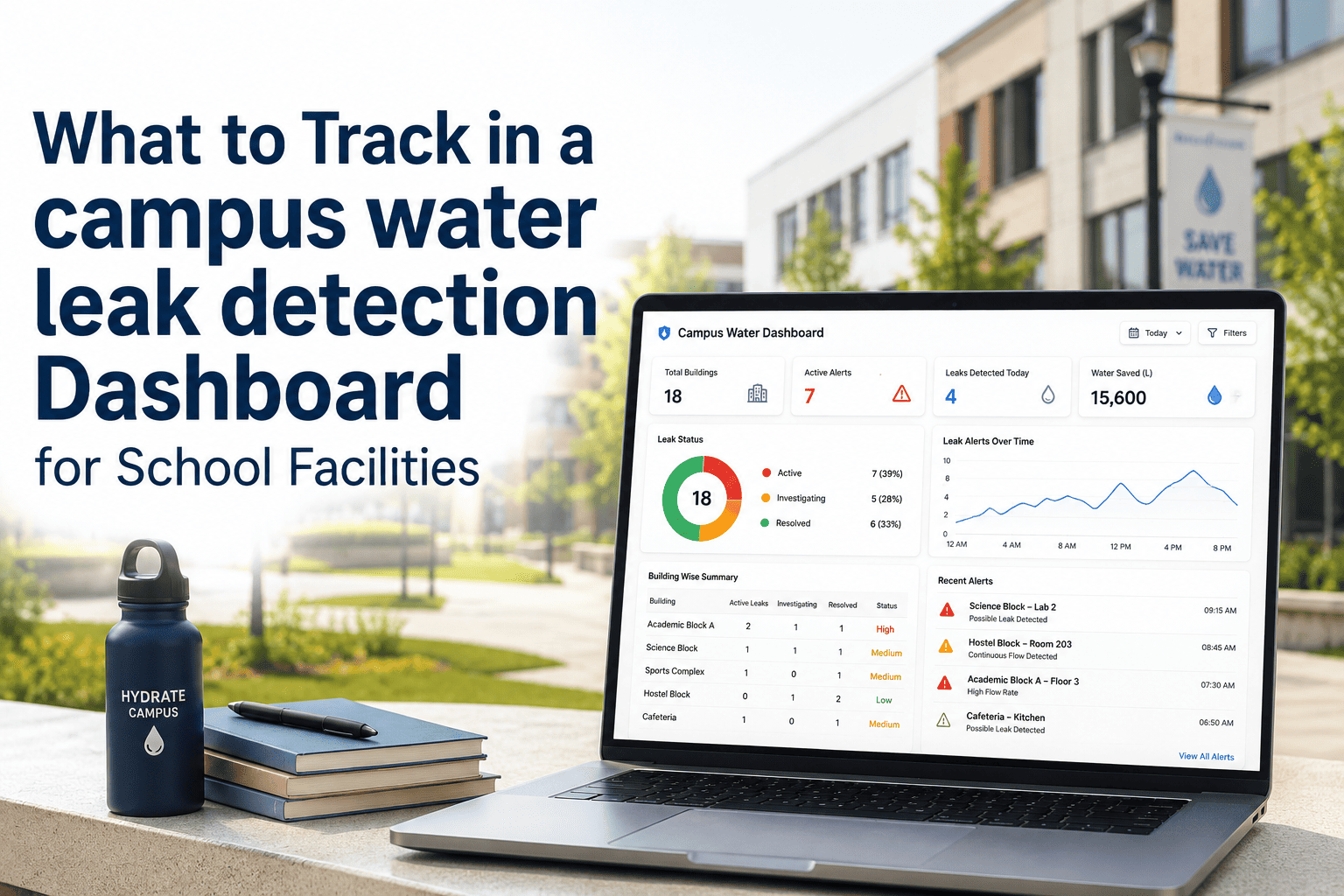
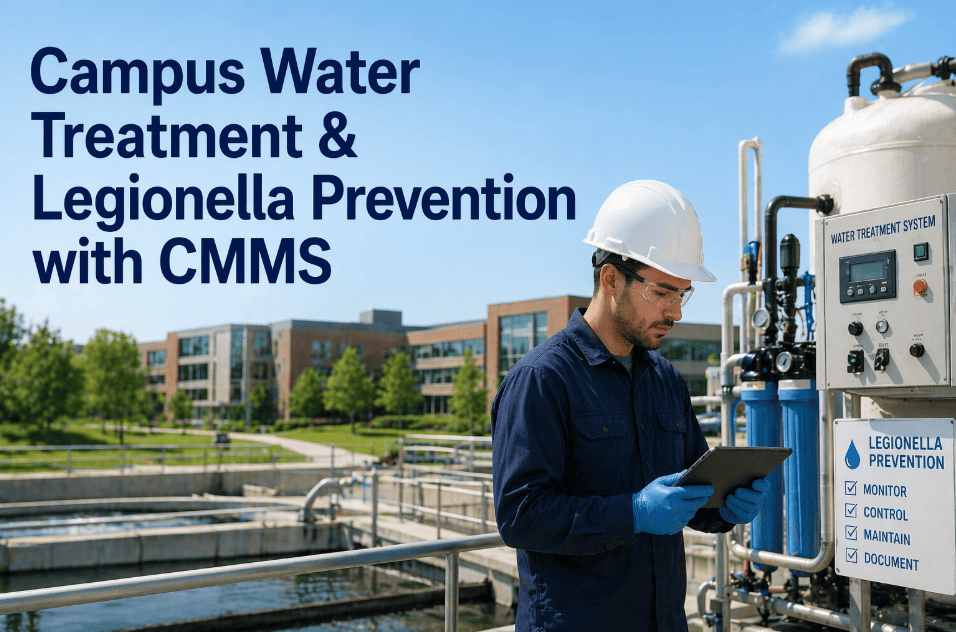
A campus cooling tower is a warm, wet, nutrient-rich box of water sitting on a roof and left unmanaged, it's one of the most efficient Legionella amplifiers a building can have. Schools and universities carry an extra burden: long summer and holiday shutdowns leave water stagnant, aging plant hides scale and biofilm, and the people downwind — children, students, staff, visitors — are exactly who you can't afford to expose. ASHRAE Standard 188 makes the response concrete: a written water management plan, with defined control limits and proof you followed it. OxMaint AI maintenance management software runs that plan on schedule and keeps the record audit-ready.
Education & Campus · Cooling Tower Maintenance · Legionella Prevention
School Cooling Tower Maintenance and Legionella Prevention
Cooling tower maintenance is Legionella prevention — and ASHRAE 188 turns it into a documented duty, not a good intention. OxMaint AI schedules every treatment, cleaning and test, flags any reading that crosses a control limit, and holds a timestamped, signed record for the day an inspector or public-health officer asks. Compliance becomes routine, and the campus stays safe.
1 Treat the water
2 Control the biocide
3 Clean & sample
4 Document it all
68–113°F
the range where cooling-tower water grows Legionella
ASHRAE 188
requires a written water management plan
>10 CFU/mL
Legionella action threshold in the tower
Signed record
every task logged with technician and timestamp
Why Campus Cooling Towers Are a Special Risk
A cooling tower on a school or university isn't the same risk as one on a 24/7 facility. The academic calendar itself works against you — and the exposure, when it goes wrong, is public. These are the factors that make a campus tower demand more discipline, not less. Start free and put your campus towers on a managed schedule in OxMaint AI.
Seasonal Shutdowns
Summer and holiday breaks leave water stagnant for weeks — prime conditions for biofilm and amplification before restart.
Aging Plant
Older campus towers accumulate scale, sediment and corrosion that shelter bacteria from biocide.
Vulnerable Populations
Children, students and staff — and nearby residents downwind of the drift — are the people you least want exposed.
Thin Facilities Staff
Small teams juggling a whole campus can let a daily reading or a cleaning slip without a system prompting it.
Public Accountability
A school outbreak is a headline. Regulators and parents expect documented proof the tower was managed.
Restart Blind Spots
Bringing a tower back after a break without hyperchlorination and testing is one of the most common failure points.
How a Tower Becomes a Legionella Source
Legionella doesn't appear — it amplifies, when four conditions line up inside a neglected tower. Break any one and you break the chain; a good maintenance program breaks all four. Book a demo to see how each control maps to a scheduled task.
01
Warm Water
Tower water sits in the 68–113°F band where Legionella thrives — unavoidable by design, so the other controls matter more.
02
Stagnation
Still water during shutdowns and in dead legs lets bacteria settle and multiply undisturbed.
03
Biofilm & Scale
Slime layers and mineral scale shelter Legionella from biocide and give it a surface to colonize.
04
Drift Aerosols
The tower's fine mist carries bacteria into the air people breathe — which is why drift eliminators matter.
A Missed Reading Isn't Paperwork. It's an Open Door.
Most outbreak-linked facilities had no water management plan or incomplete records. The gap is rarely the chemistry — it's the day a task slipped and no one caught it. OxMaint AI schedules every control and alerts you the moment a limit is crossed.
The ASHRAE 188 Water Management Plan — 7 Elements
ASHRAE 188 doesn't hand you a cleaning checklist — it requires a plan: a structured, documented program with control limits and proof of follow-through. These are its seven building blocks, in order. Sign up free and build each element into OxMaint AI.
1
Assemble the Team
Name a water management team with defined roles — who monitors, who acts, who signs off.
2
Describe the System
Map and diagram the tower and connected water systems, with normal operating parameters.
3
Identify Hazards & Control Points
Find where Legionella could grow and set the control points that keep it in check.
4
Set Control Limits
Define the acceptable range for each measure — biocide residual, pH, and microbial counts.
5
Monitor
Test on schedule and confirm each control measure is actually holding within its limits.
6
Define Corrective Action
Decide in advance what happens when a reading crosses a limit — the response, not a scramble.
7
Verify, Validate & Document
Confirm the plan works, review it annually, and keep the records that prove all of the above.
The Four Maintenance Disciplines
Under the plan sit four hands-on jobs that actually keep the tower clean. Each has its own cadence — and each is only as good as the record that it happened. Book a demo to schedule all four in OxMaint AI.
DAILY / WEEKLYWater Treatment
Hold pH in the 7.0–8.5 range, track conductivity and corrosion inhibitors, and inspect fill media and drift eliminators weekly.
DAILYBiocide Management
Monitor oxidizing biocide residual (chlorine ~0.5–1.0 ppm) daily and rotate non-oxidizing agents on schedule so bacteria can't adapt.
ANNUAL / RESTARTPhysical Cleaning
Clean the basin at least annually (twice for high-risk), hyperchlorinate before shutdown, high-pressure wash surfaces, then disinfect and verify.
MONTHLY / QUARTERLYSampling & Testing
Monthly heterotrophic plate counts and quarterly Legionella culture, plus event-triggered testing after any shutdown or system change.
Control Limits at a Glance
A plan needs numbers, not adjectives. These are the common control points a campus tower program tracks — your treatment provider sets the exact targets for your water. Start free and log every reading against its limit in OxMaint AI.
| Parameter | Typical target | How often |
| Oxidizing biocide (free chlorine) |
~0.5–1.0 ppm residual |
Daily |
| pH |
7.0–8.5 |
Daily |
| Heterotrophic plate count |
< 10,000 CFU/mL |
Monthly |
| Legionella culture |
< 1 CFU/mL · action > 10 CFU/mL |
Quarterly |
| Basin cleaning |
Full clean & disinfect |
Annual (2× high-risk) |
| Fill & drift eliminators |
Visual inspection |
Weekly |
How OxMaint AI Keeps the Plan Running
The chemistry is well understood — the failures are almost always missed tasks and lost records. That's precisely the gap maintenance management software closes. Start free and turn your water plan into a running system.
Scheduled Task Generation
Daily, weekly, monthly and quarterly tasks raised automatically — nothing depends on someone remembering.
Control-Limit Alerts
A reading outside its limit triggers an alert and a corrective work order the moment it's logged.
Timestamped Sign-Off
Every task logged with the technician and time — the traceability ASHRAE 188 expects.
Restart Protocols
Post-shutdown hyperchlorination and testing built as a checklist so no tower comes back untreated.
Reading & Result History
Every biocide, pH and Legionella result trended per tower, so drift is visible before it's a breach.
Audit-Ready Reports
The full compliance record produced in minutes when an inspector or health officer asks.
Frequently Asked Questions
Does ASHRAE 188 apply to schools and universities?
Why are cooling towers such a Legionella risk?
They hold warm water in the ideal growth range, accumulate biofilm and scale that shelter bacteria, and release fine aerosols people can breathe — an amplifier and a delivery system in one.
Book a demo of control-point scheduling.
What's the biggest risk after a school break?
How often should we test for Legionella?
A common program runs monthly plate counts and quarterly Legionella culture, plus event-triggered testing after shutdowns — your treatment provider sets the exact plan for your water.
Book a demo of sampling schedules.
How does a CMMS help with compliance?
It schedules every task, alerts on any out-of-limit reading, logs each action with a timestamp and sign-off, and produces the audit-ready record ASHRAE 188 expects — turning compliance from reactive to routine.
Start free and make compliance routine.
Protect the Campus. Prove the Plan.
A school cooling tower kept clean, treated and tested — on a schedule, with a signed record behind every task — is the difference between routine compliance and a public-health incident. OxMaint AI maintenance management software runs the ASHRAE 188 plan for every tower and keeps the proof ready, so the water stays safe and the paperwork is never a scramble.