At 2:47 AM on a January morning, a boiler failure triggered a building evacuation at a mid-sized university in Ohio. The emergency generator that was supposed to power exit lighting, fire alarm panels, and the emergency communication system failed to start. Backup batteries in emergency lights had not been tested since installation three years earlier—half were dead. Students evacuated a four-story residence hall in near-total darkness using cell phone flashlights. No one was injured, but the near-miss investigation revealed a systemic failure: not a single life safety system in the building had a documented maintenance history. The generator had never been load-tested. Fire alarm panel batteries had never been replaced. Emergency lighting had never been verified. Every system existed on paper. None had been proven to work. Schedule a demo to see how life safety maintenance tracking works.
School life safety systems—emergency generators, fire alarm panels, emergency lighting, mass notification systems, and exit signage—exist for one purpose: to function during the moments when everything else fails. But these systems sit idle for months or years between emergencies, silently degrading without anyone knowing until the moment they're needed. Systematic maintenance transforms life safety from assumed readiness to proven readiness. Sign up free to start tracking life safety system maintenance digitally.
Emergency generators fail to start or transfer load on first demand due to lack of regular testing
Emergency lighting and fire alarm batteries found dead or below capacity during inspection
Cost per hour of unplanned campus-wide system outage including emergency response and remediation
Of school life safety code violations trace to documentation gaps, not equipment failure
Critical Life Safety Systems in Schools
Schools and universities maintain more life safety systems per campus than most commercial properties—and each system has its own NFPA code, testing frequency, and documentation requirement. When any one fails during an emergency, the consequences cascade through every building it protects.
NFPA Compliance Requirements by System
Each life safety system is governed by a specific NFPA code with defined testing frequencies. Missing any single requirement creates a compliance gap that fire marshals cite and insurance carriers flag.
| System | NFPA Code | Testing Frequency | Key Documentation Required |
|---|---|---|---|
| Emergency Generators | NFPA 110 | Weekly no-load / Monthly load / Annual full-load transfer | Run time, load percentage, fuel level, transfer time, battery voltage |
| Fire Alarm Panels | NFPA 72 | Monthly visual / Semi-annual device test / Annual full test | Panel condition, detector sensitivity, pull station test, monitoring signal |
| Emergency Lighting | NFPA 101 | Monthly 30-second / Annual 90-minute battery discharge | Unit location, test result (pass/fail), battery replacement date |
| Sprinkler Systems | NFPA 25 | Monthly valve / Quarterly flow / Annual full inspection | Valve position, gauge readings, flow test results, contractor report |
| Fire Doors | NFPA 80 | Annual fire-rated door assembly inspection | Door, frame, hardware, glazing, seals—all components documented |
| Kitchen Suppression | NFPA 96 | Monthly visual / Semi-annual full service | Fusible links, nozzle coverage, manual pull, contractor certification |
Emergency Generator Maintenance Deep Dive
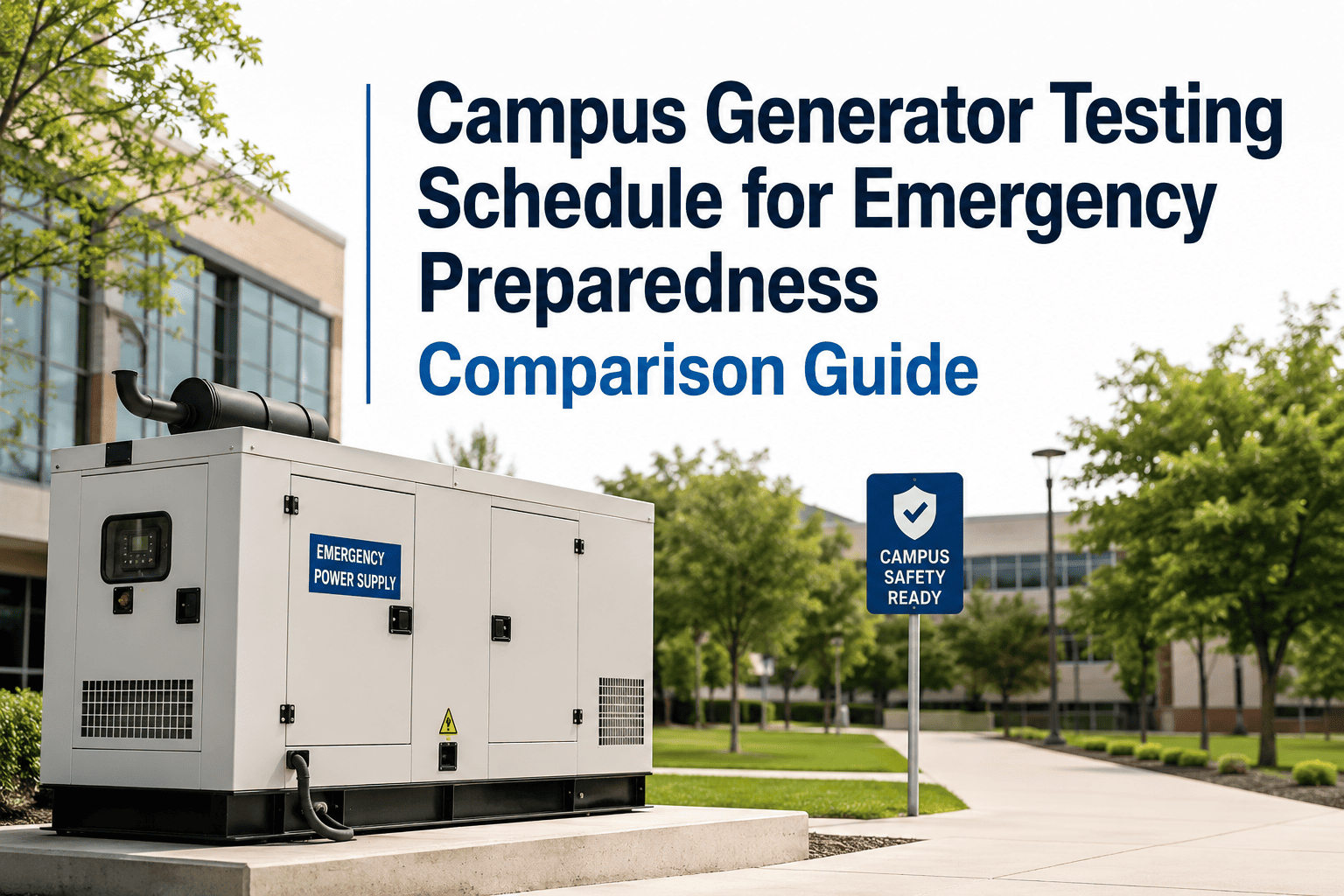
Emergency generators are the backbone of campus life safety—when utility power fails, every other system depends on the generator starting and transferring load within 10 seconds (NFPA 110 Level 1). Yet generators sit idle for weeks or months between tests, silently developing fuel, battery, and mechanical issues that only reveal themselves during an actual emergency.
Start generator and run minimum 30 minutes. Verify start sequence, oil pressure, coolant temperature, and charging system. Document run time and any alarms.
Apply minimum 30% rated load for 30 minutes. Record voltage, frequency, amperage, and fuel consumption. Prevents wet-stacking from underloading.
Change oil and filters. Test coolant concentration and condition. Inspect belts, hoses, and exhaust system. Verify fuel quality and treatment.
Simulate utility failure. Verify automatic transfer switch engages within 10 seconds. Run at full rated load. Test retransfer to utility. Document all readings.
Full mechanical overhaul. Replace batteries, belts, hoses. Calibrate governor and voltage regulator. Update firmware on ATS controls. Recertify system.
Common Life Safety System Failures in Schools
These are the failures that fire marshals and insurance auditors find most frequently in school inspections. Every one is detectable with systematic maintenance and preventable with digital tracking.
| System | Common Failure | Root Cause | Prevention |
|---|---|---|---|
| Generator | Fails to start on demand | Dead starting battery, stale fuel, coolant heater failure | Weekly no-load test, battery voltage monitoring, fuel treatment program |
| Generator | Starts but fails to accept load | Transfer switch contact wear, governor calibration drift | Monthly load bank test, annual ATS maintenance, transfer test |
| Fire Alarm | Panel trouble light ignored | Alarm fatigue, no escalation protocol, staff turnover | Digital panel monitoring with auto-escalation to facilities director |
| Emergency Lighting | Batteries dead during outage | No testing program, batteries past rated life, no replacement schedule | Monthly 30-second test, annual 90-minute test, proactive replacement at 3 years |
| Sprinkler | Valve found closed during inspection | Closed for maintenance and not reopened, no tamper monitoring | Monthly valve position check, tamper switches with monitoring, chained-open valves |
| Exit Signage | Illumination failed, not reported | No daily check protocol, lamp/LED burnout, battery failure | Monthly illumination verification, digital checklist with photo capture |
Building an Emergency Preparedness Maintenance Program
Schools that transition from reactive to proactive life safety maintenance follow a consistent implementation path. This roadmap covers the typical 60-day process from audit to operational program.
| Phase | Timeline | Key Activities | Deliverable |
|---|---|---|---|
| Asset Inventory | Week 1-2 | Walk every building and document every life safety asset: generators, panels, emergency lights, exit signs, sprinkler valves, fire doors | Complete asset register with location, model, installation date, and current condition |
| Schedule Configuration | Week 3-4 | Build inspection schedules per NFPA codes for each system type. Configure digital checklists with photo requirements and pass/fail criteria | Automated schedule with correct frequencies for every system and building |
| Staff Training | Week 5-6 | Train maintenance staff on mobile inspection app. Train building managers on daily visual protocols. Document training with signatures | Trained inspection team with documented competency for each system type |
| Pilot & Validate | Week 7-8 | Run first full inspection cycle across pilot building. Validate checklists capture all required data. Test report generation for audit readiness | Validated inspection process and first complete compliance report |
Paper Logs vs. Digital Life Safety Tracking
The gap between managing life safety systems via paper clipboards versus a digital platform is the difference between hoping systems work and proving they work. When a fire marshal asks for your generator test records, the answer should take seconds, not hours.