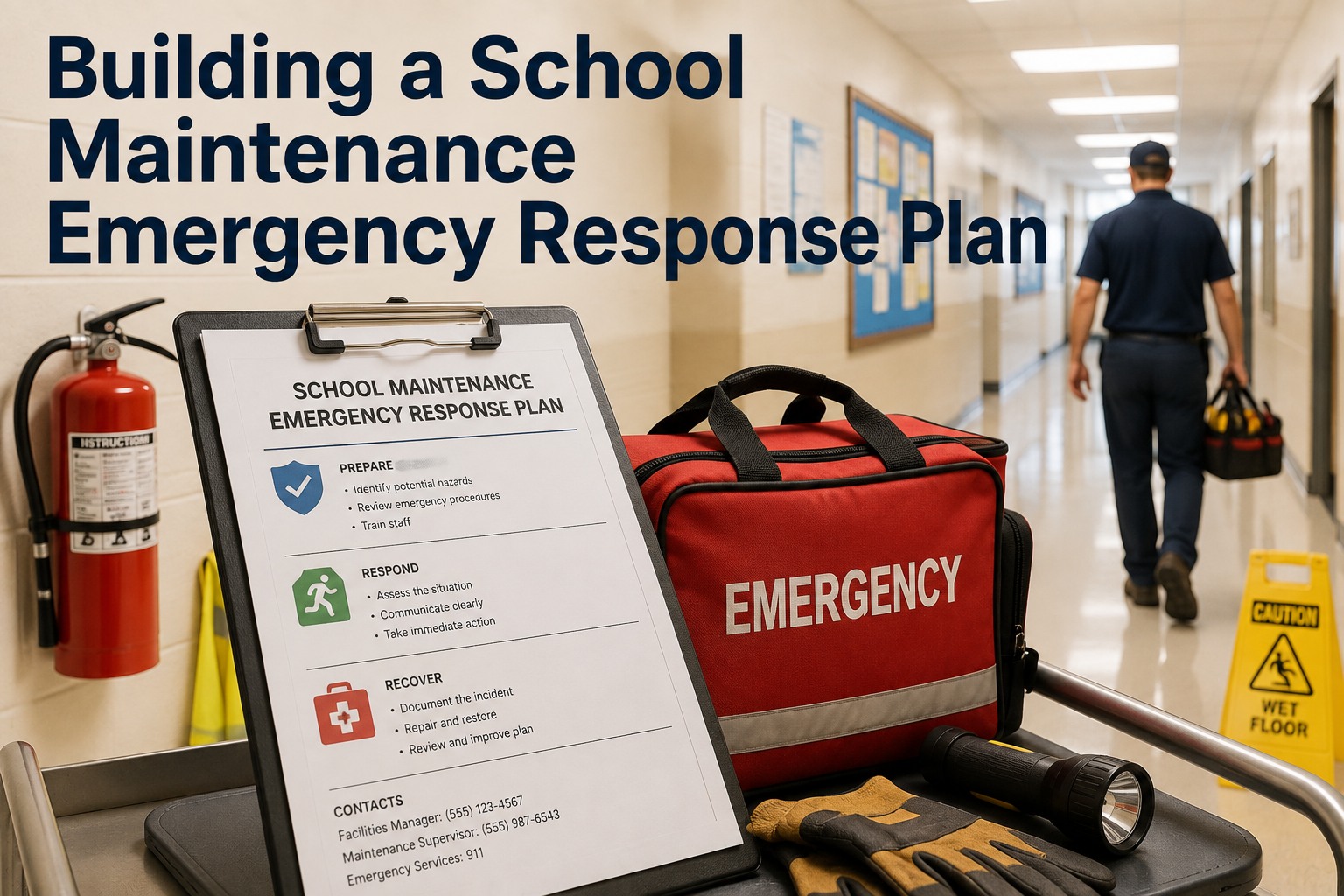
When a boiler fails at 4 AM on a January weekend or a six-inch main bursts between passing periods, the cost of improvisation is measured in soaked ceilings, cancelled classes, and emergency contractor invoices that can run 3–5× a planned repair rate. Districts that recover fastest are not the ones with the biggest budgets—they are the ones with a written, rehearsed school maintenance emergency response plan that names the on-call technician, the vendor to call, and the principal who can authorize a shutdown without a committee. Building that plan takes a weekend of focused work, a clear chain of authority, and the discipline to revisit it every quarter. Start Free Trial to template the whole thing in a system crews can actually open from a phone at 2 AM.
Will your crew know the first move when the boiler dies at 4 AM on the coldest Saturday of the year?
Every minute between failure and first-response costs a district roughly $180 in compounded damage, lost instructional time, and after-hours contractor premiums. A rehearsed plan collapses that gap from hours to under 15 minutes.
Why improvisation is the most expensive response
The average K–12 facility portfolio loses 4–6% of its annual maintenance budget to unplanned emergency work every year—money that comes out of capital reserves, not a planned contingency line. The gap between districts with a written plan and those without is stark.
A 14-building district serving 8,200 students spent $87,000 on a single January weekend when a 1996-era cast-iron boiler cracked, the on-call number routed to a retired foreman, and the backup vendor couldn't get a tech on site for 9 hours. By the time heat was restored, three wings had sprinkler-fed freeze damage. A written plan with a verified 24/7 boiler vendor and a principal empowered to authorize a portable heater deployment would have capped the same event at roughly $14,000.
A six-phase emergency response timeline, built before the call
A workable plan is not a 90-page binder—it is six tight phases that any crew lead can recite under stress. Build each one in order, test it twice a year, and revise after every real activation.
Asset & risk register
Tag every life-safety and mission-critical asset—boilers, mains, switchgear, elevators, kitchen gas—with a criticality score (A/B/C) and the failure mode most likely to hit each. A 200,000 sq ft secondary school typically carries 40–70 A-tier assets that warrant a written emergency response. Capture make, model, serial, install date, and the single most likely failure scenario per asset.
On-call staffing ladder
Define a four-tier on-call rotation: Tier 1 first responder (internal tech, 15-min callback), Tier 2 facility supervisor (30-min decision authority), Tier 3 director of operations (vendor authorization up to $25K), Tier 4 assistant superintendent (authorization above $25K and building-closure calls). Publish the rotation 90 days out and push it to every staff phone.
Pre-qualified vendor network
Sign master service agreements with at least two vendors per critical trade—HVAC, plumbing, electrical, restoration, elevator, roof. Each agreement locks hourly rates, guaranteed response windows (target ≤2 hrs), and a named dispatcher. A district with 10 buildings should carry 12–18 active MSAs, each reviewed annually for responsiveness.
Decision authority matrix
Write a one-page matrix that pairs each failure category (water, heat, power, gas, structural, security) with who can authorize what spend, who calls the principal, who calls the fire marshal, and who communicates to parents. Eliminate every "call around to find approval" path. The matrix should fit on a single lanyard card.
Communication protocol
Stand up a single emergency hotline or channel that auto-pages the on-call tier. Pre-draft message templates for staff, principals, parents, and media—each ready to fill in five blanks (what, where, when, what we are doing, what you should do). ISO 22320-aligned incident communication targets stakeholder notification within 30 minutes of confirmed event.
Drill, review, revise
Run one tabletop drill per semester (a burst pipe scenario in fall, an HVAC outage in spring) and one full live activation per year. After every real event, hold a 60-minute after-action review within 5 business days. Update the asset register, vendor list, and authority matrix based on what broke in the response, not just the equipment.
The decision-authority matrix that ends phone tag
The single most common failure mode in school facility emergencies is not a lack of vendors—it is a 45-minute delay while three people text each other asking who can approve a $4,200 after-hours plumbing call. This matrix collapses that loop to under two minutes.
| Failure category | First responder action (≤15 min) | Authorization owner | Spend ceiling | External notify |
|---|---|---|---|---|
| Water main / major leak | Isolate zone valve, deploy wet-vacs, protect electrical | Facility supervisor (Tier 2) | Up to $15,000 | Restoration vendor, principal |
| Boiler / heating outage (winter) | Verify safeties, check fuel supply, call MSA HVAC vendor | Director of operations (Tier 3) | Up to $25,000 | HVAC vendor, principal, transportation (if relocate) |
| Electrical / power loss | Confirm generator transfer, isolate faulted panel | Director of operations (Tier 3) | Up to $25,000 | Electrician, utility company, IT director |
| Gas leak / odor | Evacuate zone, do not toggle switches, call 911 + utility | First responder + fire marshal | No ceiling—life safety | 911, gas utility, principal, superintendent |
| Roof / structural failure | Cordon zone, photograph, deploy tarps if safe | Assistant superintendent (Tier 4) | Up to $50,000 | Roofing vendor, structural engineer, insurance carrier |
| Elevator entrapment | Confirm entrapment, reassure passenger, call elevator MSA | Facility supervisor (Tier 2) | Up to $5,000 | Elevator vendor, principal, parent notify |
The 90-day readiness checklist for facility directors
Run this checklist every quarter. If you cannot check every box, you have a gap that will surface at the worst possible hour. Most districts find 4–6 unchecked boxes on their first pass.
Staffing & contact integrity
- On-call rotation published 90 days forward, accessible from any phone
- Every Tier 1–4 contact verified callable within the last 30 days
- Two-deep backup for every tier (primary, secondary, tertiary)
- After-hours auto-attendant routes to on-call tech, not a generic voicemail
Vendor & MSA readiness
- Two signed MSAs per critical trade with locked rates and response SLAs
- Each vendor's 24/7 dispatcher number tested in the last 60 days
- Certificate of insurance on file, current, and auto-expiring alerts set
- Restoration vendor pre-authorized for Cat-3 water events, no re-bid needed
Asset & documentation
- A-tier asset register current with photos, specs, and failure modes
- Shut-off valve & breaker locations mapped and photographed per building
- As-built drawings accessible offline from a mobile device
- Spare parts critical list (belts, fuses, couplings) with min-on-hand quantities
Communication & drill
- Pre-drafted message templates for staff, parents, media loaded and ready
- One tabletop drill completed in the last 6 months, after-action logged
- Decision-authority matrix printed on lanyard cards for all supervisors
- Mass-notification system tested with live push to all-staff in last 90 days
Stop rebuilding the plan in the parking lot at 3 AM
Template the asset register, vendor MSAs, authority matrix, and drill logs in one system your crew can open from a phone—before the next freeze, flood, or failure.
School maintenance emergency response: five questions that matter
How often should a school maintenance emergency response plan be reviewed and updated?
Run a full documented review every 6 months at minimum—once before heating season (October) and once before storm season (March). Trigger an immediate off-cycle review after any real activation, any staff turnover in the Tier 1–4 ladder, any vendor MSA expiration, and any capital project that changes building infrastructure. A plan that sits untouched for 18 months is effectively a plan that does not exist. Book a Demo to see how automated review reminders keep the plan alive.
What is the single most common failure point in a school facility emergency?
The authority gap—the minutes burned between the first responder arriving on site and someone with spending authority picking up the phone. In audited district incidents, this gap averages 38 minutes and accounts for the majority of escalated damage. The fix is a written, lanyard-card matrix that pre-authorizes specific spend ceilings for specific roles by failure category, so no one has to "call around" while water is running.
How many vendors should a district pre-qualify for emergency maintenance?
At minimum two per critical trade: HVAC, plumbing, electrical, water restoration, elevator, and roofing. For a 10-building district, that means 12–18 active master service agreements. Each MSA should lock after-hours rates, guarantee a response window (target ≤2 hours for life-safety, ≤4 hours for mission-critical), and name a specific 24/7 dispatcher—not a general company line.
Who should hold final authority to close a building or relocate students during a facility emergency?
Final building-closure and student-relocation authority should sit with the superintendent or a designated assistant superintendent (Tier 4), never with a facility director alone. The facility director recommends based on life-safety assessment; the superintendent decides based on operational impact. Document the handoff explicitly so the facility team is not left waiting for a decision while a wing is without heat.
What is the target response time from the first emergency call to a qualified crew on site?
For life-safety events (gas leak, electrical fault, structural failure), target qualified personnel on site within 15 minutes and a vendor en route within 30. For mission-critical but non-life-threatening events (boiler outage, major leak), target 30 minutes for internal first response and 2 hours for the contracted vendor. Districts that hit these benchmarks consistently are those that drill twice a year and keep the plan in a mobile-accessible system. Start Free Trial to set up automated on-call paging and vendor SLA tracking.
Build the plan this week, not after the next failure
Template the asset register, on-call ladder, vendor MSAs, authority matrix, and drill schedule in a system designed for the 3 AM call. Your crew deserves a playbook that works in the dark.
Free 14-day trial · No credit card