Managing roof leaks across a multi-building school campus is one of the most overlooked yet high-stakes challenges in K-12 and higher education facilities management. A single undetected leak can close classrooms, damage IT infrastructure, and trigger mold remediation costing $15,000 to $50,000 — all from what started as a slow drip. Facilities teams juggling 10, 20, or 50 buildings often lack a unified system to log, prioritize, and track leak responses in real time. The difference between a contained repair and a six-figure emergency almost always comes down to response speed and documentation discipline. OxMaint gives school facilities teams a structured CMMS workflow to catch, track, and close every roof leak before it escalates — start a free trial or book a demo to see it in action.
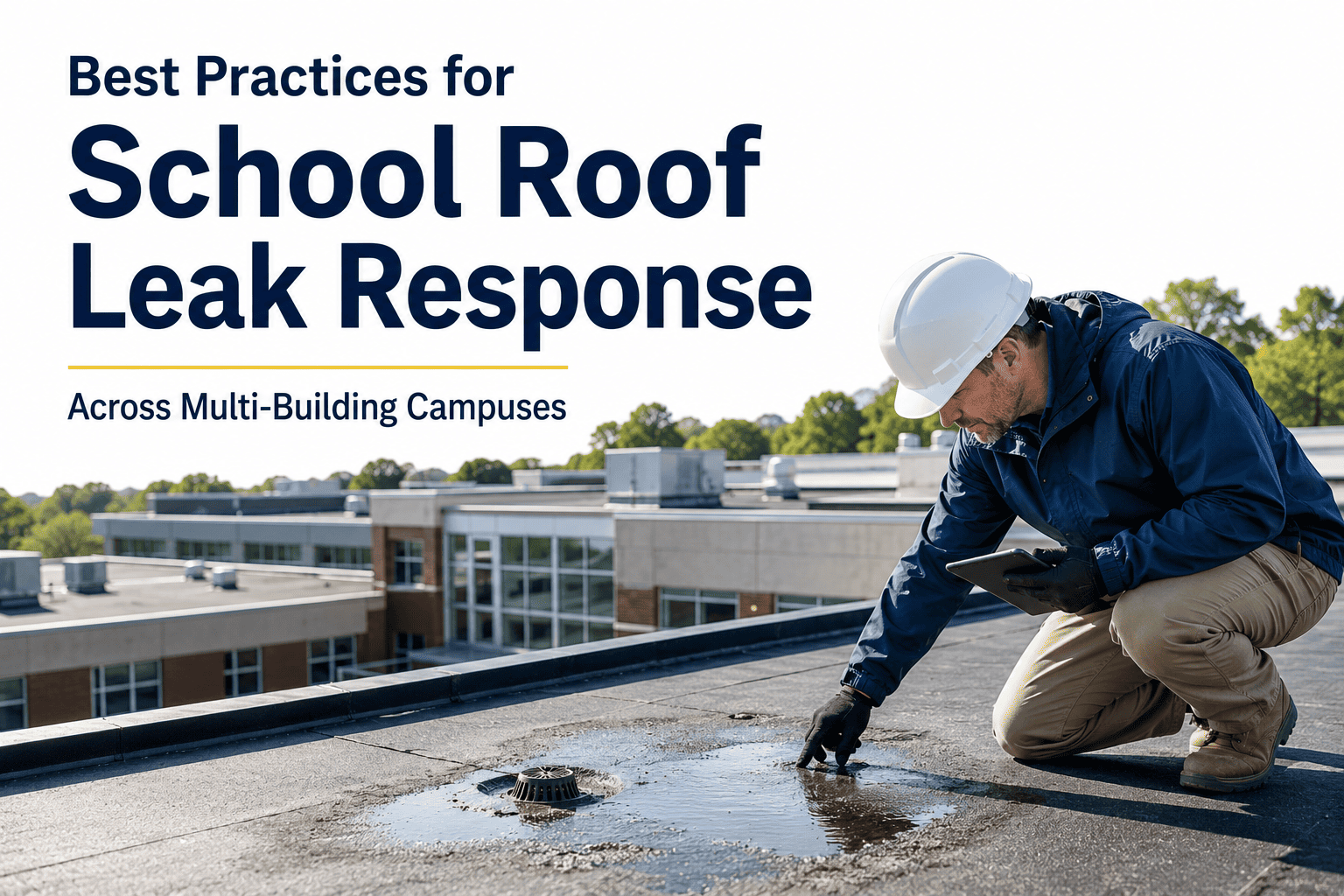
Best Practices for School Roof Leak Response Across Multi-Building Campuses
From first report to closed work order — a structured response framework for K-12 districts and university campuses managing roof leaks across dozens of buildings.
Roof Leaks Are a Data Problem as Much as a Repair Problem
Most school districts don't lack the crew to fix leaks — they lack the system to know which buildings have leaks, which ones are recurring, and which roofs are approaching end of life. OxMaint turns every leak report into structured data that drives smarter repair, capital planning, and insurance documentation.
Why Multi-Building Campuses Struggle With Roof Leak Response
A single-building facility manager can stay on top of roof issues through direct observation. A campus with 15 to 60 buildings is a different challenge entirely — leaks are reported by teachers, custodians, or students, often with incomplete location data, and routed to a facilities team that may be managing hundreds of open work orders simultaneously.
Leak reports arrive by phone, email, hallway conversation, and sticky note. No single intake channel means no reliable log. Facilities teams have no way to know how many leaks are active at any given time across all buildings.
Not all leaks are equal — a drip near an electrical panel is a life-safety issue; a stain on a ceiling tile is a cosmetic concern. Without a triage framework, crews often address what was reported first rather than what is most urgent.
Without historical records, the same roof penetration gets patched repeatedly without ever triggering a capital repair. Facilities teams don't realize they've spent $12,000 patching a roof that needed $4,000 in membrane replacement.
When a storm-related leak causes significant damage, insurance claims require documentation of inspection history, prior repairs, and response timeline. Schools with no CMMS records often receive reduced settlements or claim denials.
The 5-Step Roof Leak Response Protocol for School Campuses
All leak reports — regardless of who discovers them — enter a single intake channel (QR code scan, mobile app, or phone-to-CMMS). Each report captures building ID, room number, reporter name, and initial severity estimate. This step alone eliminates the "I thought someone else reported it" problem.
A facilities coordinator reviews each intake within two hours and assigns a priority level: Life-Safety (electrical proximity, structural threat), Operational (classroom closure risk), or Cosmetic (ceiling stain, no active drip). Priority drives response time SLA — life-safety dispatches same day, cosmetic enters the scheduled maintenance queue.
The responding technician documents the leak source, interior damage scope, and initial repair assessment with timestamped photos attached directly to the work order. Photos are non-negotiable — they establish the condition at response time, which matters for insurance and for tracking deterioration.
Repairs are logged with labor hours, materials used, and contractor name if outsourced. For temporary patches, a follow-up work order is auto-generated with a deadline for permanent repair. This prevents temporary fixes from becoming forgotten permanent ones — a leading cause of recurring leak claims.
Work order is closed with post-repair photos and technician sign-off. If the same roof area has had three or more repairs within 24 months, OxMaint flags it for capital review — triggering a full roof assessment instead of another patch. This feedback loop is how reactive maintenance becomes strategic capital planning.
Reactive vs Structured Leak Response — What It Costs Schools
| Factor | Reactive / Ad-Hoc | Structured CMMS Protocol |
|---|---|---|
| Average time from report to dispatch | 18–36 hours | Under 4 hours |
| Recurring leak detection | None — no history tracking | Automatic after 3rd repair flag |
| Insurance claim documentation | Incomplete or unavailable | Full photo and timeline record |
| Average repair cost per incident | $2,800 (delayed response) | $640 (early response) |
| Mold incidents per year (20-building campus) | 3–5 events | Under 1 event |
| Capital planning data | Not available | Building-level repair history report |
Prioritizing Buildings Across a Large Campus
Not all school buildings deserve equal monitoring intensity. Use this tiered framework to allocate inspection and response resources based on roof age, occupancy, and historical leak frequency.
What to Track in Your Roof Leak Response Dashboard
Time from leak report submission to technician dispatched. The single most impactful metric for preventing escalation to water damage and mold.
Percentage of buildings that experience a second leak within 12 months of repair. High rates indicate patch-only maintenance strategy that needs capital intervention.
Percentage of temporary patches that receive a documented permanent repair within the target window. Unconverted patches are your highest-risk open items.
Percentage of closed leak work orders that include before/after photos and technician sign-off. Incomplete records create insurance and liability exposure.
Frequently Asked Questions
How does OxMaint help identify recurring roof leaks across multiple buildings? +
Can staff with no technical training submit roof leak reports through OxMaint? +
How does roof leak documentation in OxMaint support insurance claims? +
What is the right inspection frequency for aging school roofs? +
How long does it take to set up OxMaint for a school campus with 20 to 40 buildings? +
Stop Managing Roof Leaks by Memory. Start Managing Them by Data.
OxMaint gives school facilities teams the intake system, response workflow, and historical data to turn roof leak response from a reactive scramble into a managed, documented process — across every building on campus.