Every school facilities manager has experienced it — a routine leak report that somehow escalated into a classroom evacuation, a mold remediation contract, and a parent complaint to the school board, all within two weeks. These emergencies rarely come out of nowhere. They almost always trace back to one or two preventable process failures that happened weeks or months earlier. The six mistakes in this guide account for more than 80 percent of school roof emergencies that begin as manageable leaks and end as budget disasters. Understanding where the process breaks down is the first step to building a response system that catches leaks before they multiply. OxMaint helps school facilities teams close every one of these gaps with structured workflows and CMMS-tracked records — start a free trial or book a demo to see how it works.
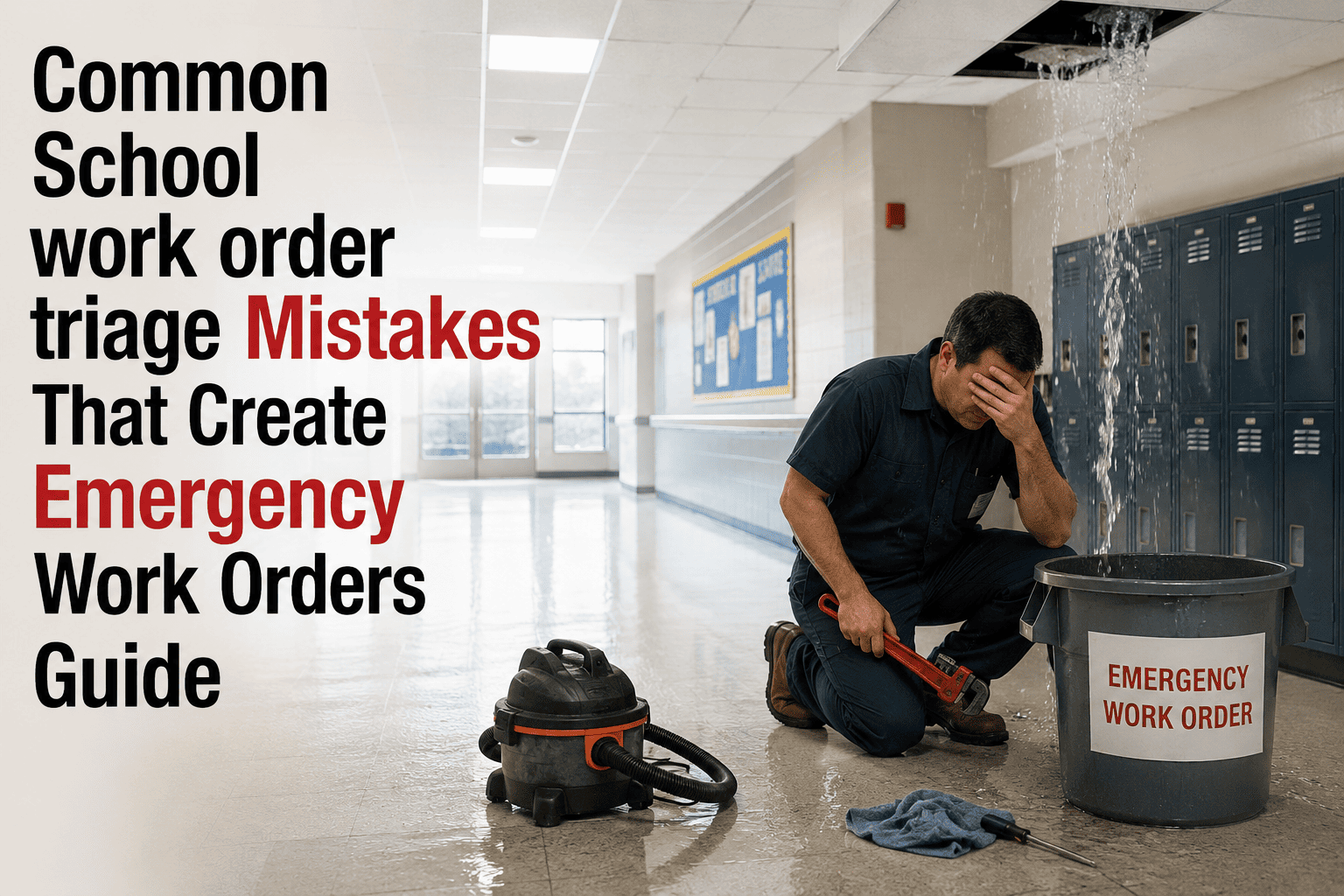
Common School Roof Leak Response Mistakes That Create Emergency Work Orders
Six process failures that turn manageable leaks into expensive emergencies — and the system changes that prevent them.
How a Minor Leak Becomes a Major Emergency
The anatomy of a school roof emergency is almost always the same: a small leak is noticed but not formally reported, or it is reported but not prioritized, or it is patched temporarily and forgotten. Weeks later, water has been infiltrating a wall cavity or attic space the entire time. By the time the damage is discovered, what was a $400 repair is a $25,000 project. Each of the six mistakes below represents a specific point in that chain where the emergency could have been stopped.
Mistakes That Turn Leaks Into Emergencies
Teachers report leaks verbally to custodians. Custodians mention it at the end of the week. Facilities coordinators hear about it secondhand. By the time a work order exists, three days have passed. Informal reporting is the leading cause of delayed response — and delayed response is the leading cause of escalation.
A ceiling stain in a storage room and a drip directly above an electrical panel are not the same emergency. Without a triage framework, crews respond in first-in, first-out order — which sometimes means a life-safety issue waits while a cosmetic issue is addressed. A three-tier priority system prevents this with almost no additional overhead.
The most common mistake in school roof maintenance. A technician applies a temporary sealant, marks the work order closed, and moves on. No follow-up is scheduled. Six months later, the same location leaks again — larger, with interior damage — and no one remembers the previous repair. Temporary fixes need their own work order lifecycle.
When a storm generates multiple simultaneous leaks, the school district files an insurance claim. The insurer asks for documentation of the pre-storm condition, inspection history, and response timeline. The school has email records and nothing else. Without photo-documented work orders, claims are reduced or denied — adding financial damage on top of physical damage.
Building 12 has been patched four times in two years, always in the same northeast corner. Each time, a different technician responds, sees a fresh work order, applies a patch, and closes it. No one sees that this is the fifth response to the same location because there is no system connecting those work orders. This building needs roof replacement, not another patch.
After a major storm event, many facilities teams respond only to reported leaks — missing the ones that haven't reached interior finishes yet. Roof membrane punctures, flashing displacement, and drain blockages from storm debris are invisible from inside the building. A post-storm inspection checklist, triggered automatically in OxMaint, catches these before they become interior damage.
What Each Mistake Costs Schools Annually
| Mistake | Frequency (20-building campus) | Average Cost Per Event | Estimated Annual Impact |
|---|---|---|---|
| Informal-only leak reporting | 8–12 delayed reports per year | $2,400 added damage per delay | $19,200–$28,800 |
| No triage priority system | 3–5 priority errors per year | $4,800 per misprioritized life-safety | $14,400–$24,000 |
| Temporary patches not followed up | 6–10 forgotten patches per year | $3,200 per re-escalation | $19,200–$32,000 |
| Missing documentation for claims | 1–2 claim reductions per year | $8,500 per reduced claim | $8,500–$17,000 |
| Recurring leaks not caught | 2–4 buildings per year | $12,000 per unplanned replacement | $24,000–$48,000 |
What a Mistake-Proof Response System Looks Like
Every leak report enters one system — phone, QR code, or coordinator submission. No verbal-only reports. Every report creates a timestamped work order before the conversation ends.
Life-safety leaks (near electrical, structural risk) are flagged automatically and dispatched within two hours. Operational leaks get same-day scheduling. Cosmetic leaks enter the planned maintenance queue.
Work orders cannot be marked complete without before/after photo documentation. This single requirement eliminates the documentation gaps that cost schools thousands in reduced insurance claims.
Temporary repairs close with a linked follow-up work order and a 60-day deadline. The follow-up auto-escalates if not completed. No patch ever disappears into a closed ticket again.
Three leaks at one building in 24 months automatically triggers a capital review task. The facilities director sees it the same day. No more discovering that a building has been patched ten times after the roof fails.
Storm events automatically generate inspection work orders for all high-priority buildings. Inspections happen within 48 hours of a qualifying weather event — before unreported damage has time to become interior damage.
These Mistakes Are Preventable — With the Right System in Place
OxMaint gives school facilities teams the intake channel, triage rules, photo requirements, follow-up automation, and capital flagging that close every one of these gaps — without adding headcount. Most districts eliminate their most expensive recurring leak patterns within the first 90 days.
Frequently Asked Questions
How does OxMaint prevent temporary patches from being forgotten? +
Can OxMaint be configured to automatically schedule post-storm inspections? +
What is the correct triage system for school roof leaks? +
How much does it cost when schools miss these mistakes compared to using OxMaint? +
What is the fastest way to get staff reporting leaks through OxMaint? +
Stop Repeating the Mistakes That Create Your Emergencies
Every emergency work order your district has paid for in the last three years had a prevention opportunity earlier in the chain. OxMaint gives you the system to catch leaks at the $400 stage — before they reach the $40,000 stage.