School Water Testing and Quality Management Checklist

By jamie lanister on March 24, 2026

school-water-testing-quality-management-checklist

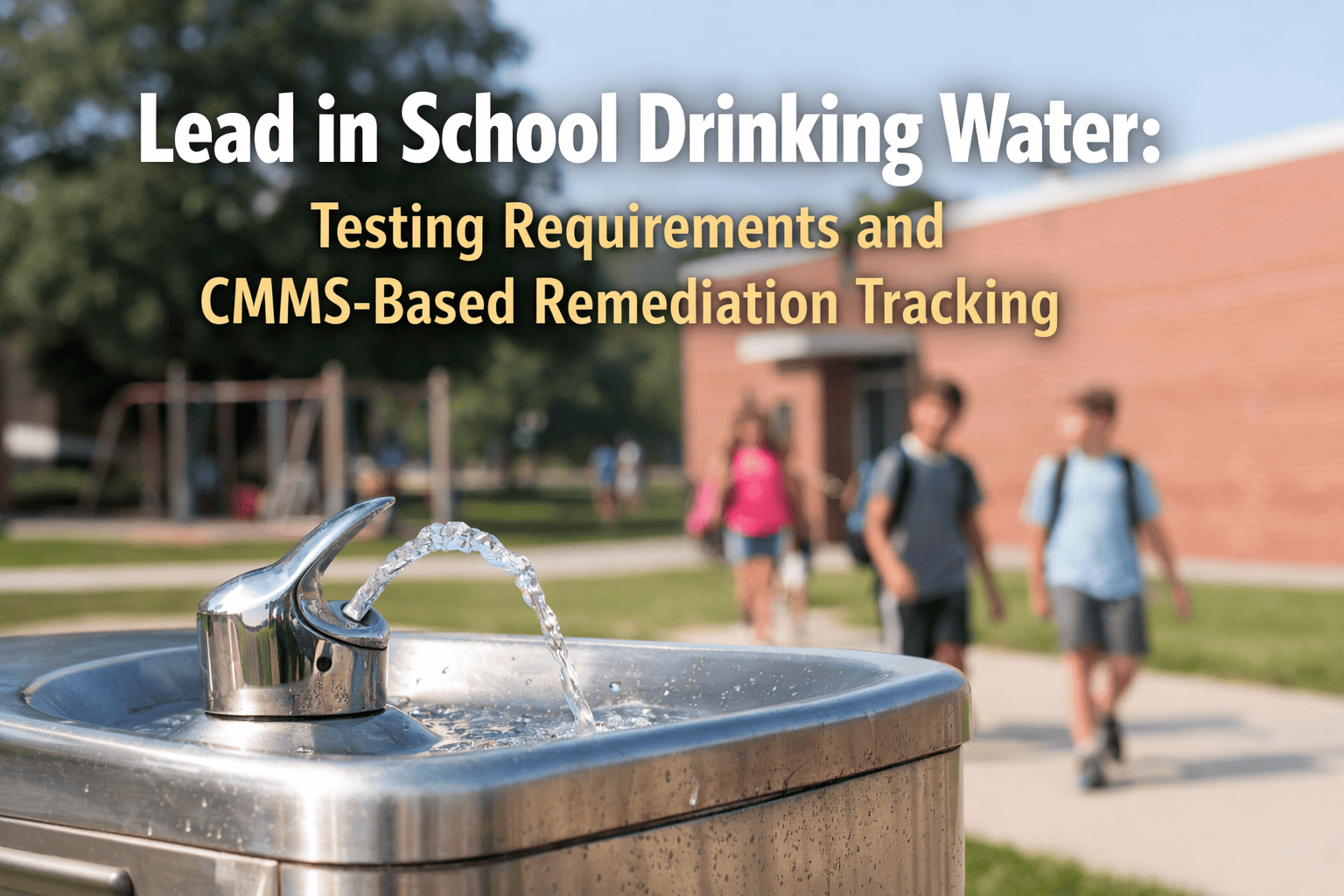
Lead in school drinking water has no taste, colour, or smell — the only way to know is to test every outlet. The 2021 Lead and Copper Rule Revisions (LCRR) expanded testing obligations for all schools. This checklist covers lead, copper, and bacterial testing, Legionella temperature controls, flushing protocols, and EPA compliance documentation. Deploy it in OxMaint to auto-schedule every test, log results per outlet, and generate compliance reports instantly.

School Water Testing and Quality Management Checklist
Lead testing at every outlet, copper testing, bacterial testing, temperature verification, fixture flushing protocols, and EPA Lead and Copper Rule compliance documentation — complete water quality management checklist for K-12 and university facilities.
7
Testing categories

60+
Checklist items

EPA
LCR · LCRR · 3Ts

Free
CMMS import
How to Use This Checklist
Items marked Action Level require immediate response if exceeded. Items marked Compliance reference a specific federal or state regulatory requirement. Frequency: Weekly Quarterly Annual Every 3 Years. All test results must be logged in OxMaint with outlet ID, sample date, collection method, and result value. State requirements may be more stringent than federal minimums — confirm with your state drinking water programme.

1. Lead Testing at Every Outlet

The EPA action level for lead in drinking water is 15 parts per billion (ppb). For schools, the EPA recommends a health-based guidance value of 1 ppb — the level at which no known health effects occur in children. Every outlet that children or staff could drink from must be tested individually. A result of zero at the fountain does not mean the classroom tap is safe.

Every 3 YearsComprehensive Lead Sampling — All Outlets
AnnualTargeted Lead Monitoring
Every Outlet Test Result Logged in OxMaint — With Outlet-Level Traceability
OxMaint logs lead and copper test results against each outlet asset record — building, room, outlet ID, sample date, and result value. The complete test history for any outlet is retrievable in under 2 minutes for state regulators, parent requests, or legal review. Parent notification reports generated automatically when action levels are exceeded.

2. Copper Testing

The EPA action level for copper is 1,300 ppb (1.3 mg/L). Copper leaches from plumbing into water with low pH — acidic water is the primary driver of elevated copper levels in schools. Unlike lead, copper affects taste at high levels, but health effects (particularly for infants) occur well below the taste threshold.

Every 3 YearsCopper Sampling
AnnualWater pH and Corrosion Control

3. Bacterial Testing

Total coliform and E. coli testing verifies that the water distribution system within the school building has not been contaminated. Positive coliform results do not always indicate immediate danger, but a positive E. coli result is a public health emergency requiring immediate action — no further consumption until confirmed safe.

AnnualTotal Coliform and E. coli Testing
QuarterlyPlumbing Hygiene Checks

4. Temperature Verification and Legionella Management

Legionella bacteria grow in water between 20°C and 50°C (68°F–122°F) — with optimal growth at 35–46°C. The two primary controls in building water systems are heat (hot water stored and distributed above 60°C) and cold (cold water maintained below 20°C). Any stagnant water section of the building distribution system within the growth range is a Legionella risk.

WeeklyHot and Cold Water Temperature Checks
AnnualLegionella Water Management Plan
Auto-Schedule Every Water Test in OxMaint
Weekly temperature checks, annual lead sampling, and 3-year comprehensive programmes all auto-scheduled in OxMaint — tasks assigned to the correct staff before they are due, with test results logged per outlet and compliance reports generated automatically when action levels are exceeded.

5. Fixture Flushing Programme

Flushing removes stagnant water that has been in contact with plumbing materials — the primary source of elevated lead and copper readings at school outlets. A building that has been closed for summer break, a classroom that has been unused over a long weekend, or a wing that is underenrolled all accumulate stagnant water. Flushing is the lowest-cost, fastest-acting intervention available.

WeeklyLow-Use Outlet Flushing
After Extended ClosureReturn-to-Occupancy Flushing

6. Remediation Protocol

Immediate ResponseAction Level Exceedance Response

7. Documentation and Compliance Reporting

AnnualRequired Reporting
Every 3 YearsComprehensive Programme Review

Frequently Asked Questions

Under EPA's 2021 Lead and Copper Rule Revisions (LCRR), all schools and childcare facilities served by community water systems must test every drinking water outlet every 3 years. Many states have more frequent requirements — some require annual testing. Confirm the requirement with your state primacy agency, which may be more stringent than the federal minimum. OxMaint schedules tests per outlet automatically so no outlet misses its test cycle.
The EPA action level is 15 ppb — but EPA also recommends a health-based guidance value of 1 ppb for schools. When 15 ppb is exceeded, the outlet must be removed from service immediately, alternative drinking water provided, parents notified within the state-required timeframe, and the source identified and remediated before the outlet returns to service. Post-remediation sampling must confirm the level is below the action level.
The outlet must be stagnant for 8–18 hours before collection — typically collected first thing in the morning before any water has been run that day. The sample is 250 mL collected in a certified sample bottle without pre-flushing. Improper collection (flushing before sampling, wrong stagnation time, incorrect volume) invalidates the result. Train all staff collecting samples on the protocol and use a certified laboratory with chain of custody documentation.
Lead leaches into water that is in contact with lead-containing plumbing materials — primarily during stagnation. Flushing removes this stagnant water from the line before consumption. A 2-minute cold flush before the first use of the day significantly reduces lead exposure. Flushing is a control measure, not a remediation — it must be combined with testing and source removal for outlets that consistently exceed action levels.
OxMaint registers every drinking water outlet as an asset with its test history, flushing schedule, and remediation record. Test schedules auto-generate tasks before they are due. Results are logged per outlet. When action levels are exceeded, OxMaint generates remediation work orders and parent notification reports automatically. The complete water quality record for any outlet — test history, flushing log, and remediation actions — is exportable in under 3 minutes. Book a demo to see water quality management in OxMaint.
School Water Quality — OxMaint
Test Every Outlet. Log Every Result. Notify Before You Have To.
Auto
test scheduling per outlet

Outlet
level result traceability

<3 min
compliance record export

Free
to start
Every outlet registered — 3-year and annual test cycles auto-scheduled
Action level exceedance auto-generates remediation work order and notification
Flushing logs and temperature records retained per outlet per building
Complete water quality history exportable for state regulators in under 3 minutes

Share This Story, Choose Your Platform!