Universities with solar installations exceeding 1 MW lose an average of $47,000 annually in unrealized energy production due to undetected inverter faults, soiled panels, and degraded string performance — losses that are entirely preventable with structured O&M. As 72% of higher education institutions have committed to carbon neutrality by 2050, solar arrays and microgrids have become critical campus infrastructure, not optional sustainability projects. Yet 58% of campus solar installations operate without formal preventive maintenance programs, relying on inverter error codes instead of scheduled inspections. Oxmaint tracks every solar string, inverter, BESS module, and microgrid controller as individually scheduled assets with performance-based PM triggers — turning your net-zero commitment from an aspirational statement into a documented, maintainable operation. If your solar maintenance consists of "wait for production to drop and then investigate," start a free trial or book a demo to see campus solar O&M managed at the component level.
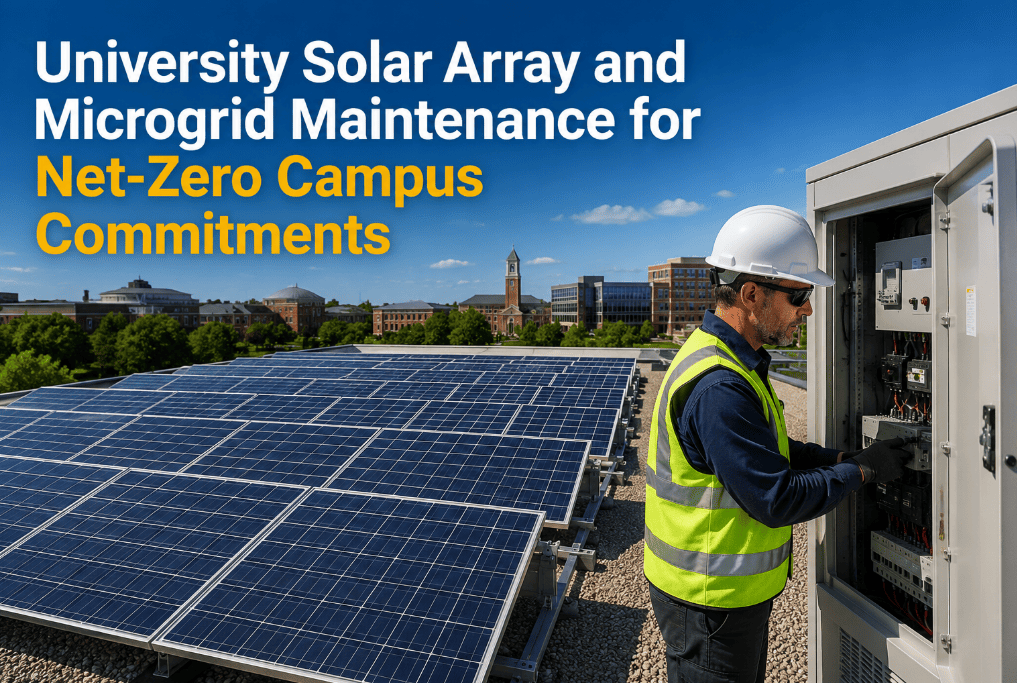
University Solar Array and Microgrid Maintenance for Net-Zero Campus Commitments
72% of universities have net-zero commitments — but 58% of campus solar installations operate without formal PM programs. Component-level O&M closes the gap between sustainability pledges and actual energy production.
Your Net-Zero Commitment Is Only as Reliable as Your Solar Maintenance Program
A university president signs a carbon neutrality pledge. Facilities installs a 2 MW rooftop array. Three years later, production has dropped 18% due to soiled panels, degraded strings, and an inverter that has been faulting intermittently for 14 months without anyone noticing. The pledge remains on the website, but the electrons are not flowing. Oxmaint connects your maintenance operations to your sustainability commitments — every panel cleaning, every inverter PM, every BESS cycle count documented and reportable. See how structured solar O&M works across your campus portfolio — start a free trial or book a demo to configure it for your installations.
Six Critical Components in Campus Solar and Microgrid Infrastructure
A campus solar installation is not a single asset — it is an interconnected system of six component categories, each requiring different inspection cadences, different expertise, and different failure detection methods. Effective O&M treats each as a separately scheduled CMMS asset class.
Monocrystalline and polycrystalline panels degrade at 0.5% annually under ideal conditions — but soiling, microcracks, hot spots, and bypass diode failures accelerate degradation to 1.5–2.0% per year. IR thermography identifies hot spots invisible to visual inspection. Panel cleaning in dusty or pollen-heavy campus environments recovers 3–8% of lost production per cleaning cycle.
Inverters convert DC from panels to AC for campus distribution. Fan filters, capacitor health, thermal paste, and firmware updates each follow different service intervals. Inverter failure takes an entire string or array offline — a single failed 50 kW string inverter costs the university $3,200/month in lost production until replaced. Average inverter lifespan: 10–12 years with PM vs. 6–8 without.
Lithium-ion and flow battery systems store excess solar production for demand response and grid resilience. BESS requires thermal management monitoring, state-of-health (SOH) tracking, cell balancing verification, and fire suppression system inspection. A BESS module at 80% SOH has reached its replacement threshold — but without CMMS tracking, degradation goes unmonitored until capacity drops below usable levels.
Campus microgrids coordinate solar, BESS, grid power, and backup generators through intelligent controllers. Controller firmware, communication links, transfer switch testing, and islanding verification require scheduled maintenance. A microgrid that cannot island during a grid outage defeats its entire purpose — and 34% of campus microgrids have never been tested for successful islanding after initial commissioning.
Rooftop and ground-mount racking systems endure wind loads, thermal cycling, and UV degradation. Loose mounting hardware, corroded fasteners, and failed waterproofing penetrations cause both structural and roofing damage. A single racking failure in high winds can cascade across an entire row — creating $120,000+ in panel and roof damage from a $15 bolt that was not retorqued at its annual inspection.
Revenue-grade meters, production monitoring platforms, and weather stations provide the data that validates net-zero progress. Meter calibration drift, communication dropouts, and weather station sensor failures create gaps in production data that undermine sustainability reporting credibility. 41% of campus solar monitoring systems have data gaps exceeding 72 hours per year — gaps that hide performance degradation.
What Happens When Campus Solar Runs Without Structured O&M
| Failure Type | Detection Without PM | Annual Production Loss | Cost Impact per MW |
|---|---|---|---|
| Panel soiling accumulation | Gradual — unnoticed for 6–18 months | 3–8% annually | $4,200–$11,200 |
| String inverter fault | Days to weeks if monitoring not checked | 8–15% of affected string | $3,200/month per inverter |
| Hot spot/microcrack propagation | Only detectable via IR — invisible visually | 2–5% per affected panel | $1,800–$4,500 |
| BESS capacity degradation | Unmonitored until demand response fails | Progressive — 2–3% per year | $8,000–$15,000 replacement |
| Monitoring data gaps | Reporting shows incomplete year | Hidden — masks actual losses | Undermines net-zero claims |
| Racking hardware loosening | Storm event causes cascade failure | Total array loss risk in high wind | $120,000+ damage event |
How Oxmaint Manages Solar and Microgrid O&M Across Your Campus
Oxmaint registers every panel string, inverter, BESS module, microgrid controller, and monitoring system as individually tracked assets with performance-based and calendar-based PM triggers. Universities ready to match their maintenance rigor to their net-zero commitments can start a free trial or book a demo.
Individual asset records with install date, warranty expiry, last IR scan, cleaning history, and production baseline — enabling performance comparison that identifies underperforming strings before losses accumulate.
Panel cleaning scheduled for post-pollen spring and pre-winter fall. IR scans timed for peak summer production. BESS thermal checks intensified during heat events. PM cadences that match your campus climate, not generic annual schedules.
Every cleaning cycle, every inverter repair, every production recovery event documented with timestamps and results — providing the verifiable O&M data that sustainability reports, STARS submissions, and accreditation reviews require.
BESS SOH tracked per module with cycle count, capacity test results, and thermal history. Replacement forecasts generated 18–24 months before modules reach the 80% SOH threshold — enabling planned CapEx instead of emergency procurement.
Annual islanding tests and quarterly transfer switch exercises scheduled and documented — proving your microgrid can actually deliver the grid resilience it was designed to provide when the campus needs it most.
Panel and inverter warranties require proof of scheduled maintenance. Oxmaint generates the timestamped O&M records that validate warranty claims — protecting $2M+ in panel warranty coverage and $400K+ in inverter warranties per MW installed.
Neglected Solar O&M vs. CMMS-Managed Campus Solar Program
Campus Solar Outcomes After Implementing Structured O&M
Panel cleaning, string repair, and inverter service recover production losses that accumulated during years without formal O&M
Recovered energy production plus avoided emergency repairs and extended inverter lifespan from scheduled maintenance
Up from 91% average without PM — quarterly inspections catch fan, capacitor, and firmware issues before full failure
Every O&M action timestamped and reportable — STARS, AASHE, and accreditation submissions backed by verifiable data
Frequently Asked Questions
How often should campus solar panels be cleaned?+
What PM does a campus BESS (battery storage) system require?+
Does Oxmaint help document net-zero progress for sustainability reporting?+
Can Oxmaint manage solar O&M across multiple campus locations?+
Your Net-Zero Pledge Needs a Maintenance Program, Not Just Solar Panels
Every unmaintained MW of campus solar loses $47,000 annually in avoidable production losses. Oxmaint schedules every panel cleaning, every inverter PM, every BESS health check — first O&M work orders generated in week one.
![university-sustainability-initiatives-carbon-tracking-scope-1-2-3-cmms[1]](./manage-post-2k26/uploads/university-sustainability-initiatives-carbon-tracking-scope-1-2-3-cmms[1].png)