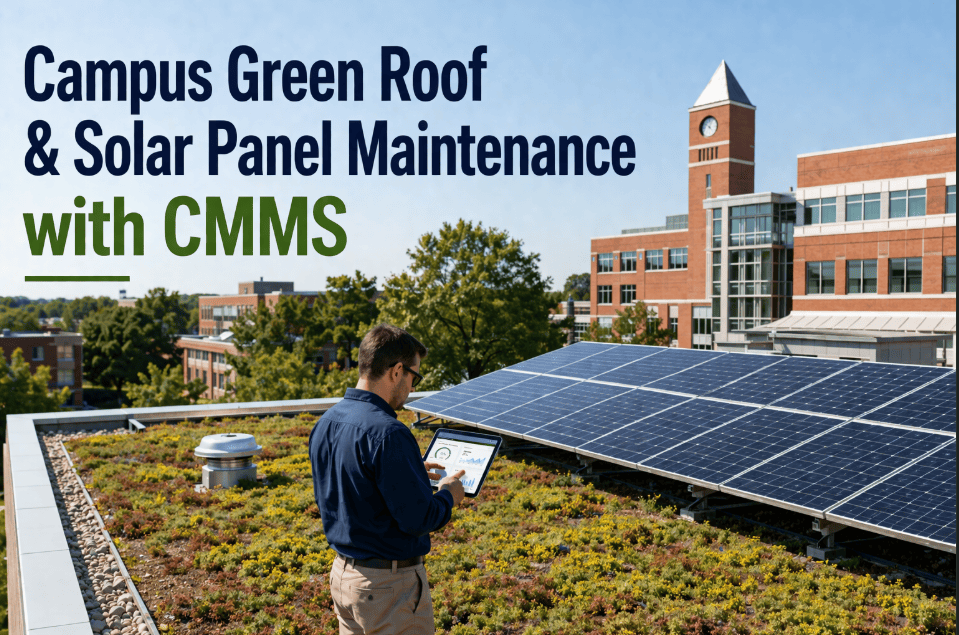
Green roofs absorb 70–90% of summer rainfall and reduce rooftop temperatures by up to 40°C compared to conventional surfaces — but only when their drainage layers, irrigation systems, and vegetation health are maintained on a schedule that standard calendar-based PM completely misses. Solar panels lose 0.5–1% efficiency per year under ideal conditions, but dirty panels, loose wiring, and inverter faults push that degradation to 3–5% annually on campuses without structured inspection programs. Together these renewable energy assets represent $2M–$15M in campus sustainability investment — and both require maintenance workflows fundamentally different from traditional HVAC or plumbing. Standard CMMS templates built for boilers and air handlers do not include drain mat inspections, vegetation health scoring, string-level inverter monitoring, or seasonal irrigation adjustments. That gap between what sustainability assets need and what generic PM tools provide is where ROI erodes silently. If your campus has invested in green infrastructure but your maintenance system still treats rooftops as "inspect annually," start a free trial with Oxmaint or book a demo to see renewable asset maintenance done properly.
Campus Renewable Asset Maintenance — 2026 Benchmarks
Campuses Lose 15–25% of Solar ROI and Risk Green Roof Warranty Voidance Without Specialized Maintenance Programs
25%
Solar output loss from neglect
Panels without structured cleaning and inverter monitoring degrade 3–5x faster than maintained systems
$4.2M
Average campus solar investment
SEIA 2024 — higher education institutions averaging 1.8 MW installed capacity per campus
40°C
Rooftop temperature reduction
Green roofs vs. conventional surfaces — but only with maintained drainage and healthy vegetation
82%
Campuses lacking solar PM programs
APPA 2025 survey — panels installed but no structured inspection or cleaning schedule in CMMS
Purpose-Built for Renewable Campus Assets
Your Solar Panels and Green Roofs Need Maintenance Programs as Specialized as the Assets Themselves
Oxmaint includes renewable energy asset templates — vegetation health scoring, inverter monitoring triggers, seasonal irrigation PM, and drainage layer inspections — built into the campus CMMS from day one.
Green Roof Maintenance: What Generic PM Tools Completely Miss
A green roof is not a roof with plants on it — it is an engineered system with drainage mats, root barriers, waterproof membranes, growing media, irrigation infrastructure, and living vegetation that each have distinct failure modes and maintenance intervals. Standard CMMS platforms treat rooftops as a single asset with an annual inspection. Green roofs require 8–12 distinct maintenance tasks across seasonal cycles that standard PM templates simply do not contain. The difference between a green roof that delivers its 40-year design life and one that fails at year 8 is entirely a maintenance question — and the maintenance question is entirely a CMMS capability question. Campuses investing in green infrastructure without matching maintenance infrastructure can see how Oxmaint addresses this gap — start a free trial or book a demo with your facilities team.
Waterproof Membrane
Annual leak detection survey, penetration inspection after any rooftop work
Failure cost: $85–$150 per sq ft replacement — most expensive green roof failure mode
Root Barrier
Biannual inspection at perimeter edges and penetration points
Root intrusion into membrane voids warranty — damage invisible until leak appears
Drainage Mat and Filter Fabric
Quarterly drain clearing, semi-annual flow test, debris removal after storms
Clogged drainage causes ponding — overloads structure and drowns vegetation
Growing Media and Vegetation
Monthly weed removal, seasonal fertilization, vegetation health scoring, replanting bare spots
Bare patches expose membrane to UV degradation — 5x accelerated aging in exposed areas
Irrigation System
Spring startup, monthly head inspection, winterization, controller programming by season
Over-irrigation saturates growing media — under-irrigation kills vegetation in 2–3 weeks during summer
Perimeter Flashing and Wind Uplift Zones
Post-storm inspection, annual fastener check, sealant condition assessment
Wind uplift at edges can peel entire green roof sections — 60 mph threshold for most extensive systems
Solar Panel Maintenance: The Invisible Efficiency Drain
Solar panels are marketed as "maintenance-free" — and that marketing claim is the single biggest threat to campus solar ROI. A 1 MW campus array generating $140,000 annually in energy savings loses $3,500–$7,000 per year from soiling alone in moderate climates. Add inverter micro-faults, connection degradation, and shading from unmaintained vegetation, and unmaintained arrays lose 15–25% of projected output within five years. The maintenance that protects solar investment is neither expensive nor complex — but it requires structured scheduling that generic CMMS tools do not provide out of the box. Want to protect your campus solar investment with purpose-built PM schedules — start a free trial or book a demo to see string-level monitoring in the CMMS.
Quarterly
Panel Cleaning and Soiling Inspection
Dust, pollen, bird droppings, and leaf debris reduce output 2–5% per quarter in temperate climates and up to 8% in arid regions. Cleaning cost is $3–$5 per panel versus $15–$25 per panel in lost annual output.
Monthly
Inverter Performance Monitoring
String inverters and microinverters fail silently — a single string offline on a 500-panel array reduces output 4–8% with no visible indication at the building level. Monthly string-level output comparison catches faults in days instead of months.
Semi-Annual
Electrical Connection and Wiring Inspection
MC4 connector degradation, ground fault detection, junction box inspection, and combiner box torque verification. Loose connections cause arc faults — the leading cause of solar-related fires on commercial buildings.
Annual
Thermal Imaging Survey
IR camera inspection identifies hot spots from cell defects, bypass diode failures, and connection resistance. A single hot cell can reduce panel output by 30% and create fire risk if left unaddressed.
Seasonal
Vegetation and Shading Management
Trees and shrubs that were clear at installation grow 12–24 inches per year. Shading even 10% of a string-connected array can reduce that string's output by 50% due to bypass diode activation patterns.
Annual
Racking and Mounting Structure Inspection
Corrosion, fastener loosening from thermal cycling, and roof penetration seal degradation. Structural failure of mounting systems is the most expensive solar maintenance event — and the most preventable with annual inspection.
Four Hidden Failures Draining Campus Renewable Asset ROI
01
Solar Inverters Failing Silently for Months
A microinverter serving 12 panels fails in October. The building's total energy consumption masks the loss. Nobody notices until a February sustainability report shows the array is 7% below projection. Four months of lost output — $1,200–$2,800 depending on array size — gone because no CMMS was monitoring string-level performance.
02
Green Roof Drains Clogging After Fall Leaf Season
Autumn debris clogs drainage outlets. Winter rain ponds on the green roof surface. Weight load increases 300%. By spring, the growing media is waterlogged, vegetation is dead, and the membrane has been under sustained hydrostatic pressure for five months. A $200 drain clearing in November would have prevented a $40,000 restoration.
03
Warranty Voided by Undocumented Maintenance
Most green roof manufacturers and solar panel OEMs require documented maintenance as a warranty condition. When a membrane leak appears at year 6, the manufacturer asks for maintenance records. If the campus cannot produce timestamped inspection logs, the warranty claim is denied regardless of the defect's cause.
04
Flat Asset Hierarchy Cannot Track Multi-Layer Systems
Generic CMMS platforms create a single asset record for "Green Roof — Building 4." This flat structure cannot track the membrane, drainage, irrigation, and vegetation as separate components with separate PM schedules, separate failure histories, and separate warranty dates. Without component-level tracking, the maintenance program cannot match the asset's actual complexity.
How Oxmaint Manages Campus Renewable Energy Assets
Hierarchy
Multi-Layer Asset Structure
Green Roof registered as: Campus > Building > Roof System > Membrane > Drainage > Growing Media > Irrigation. Solar Array registered as: Campus > Building > Array > String > Inverter > Panel. Each component carries its own PM schedule, warranty date, and failure history.
Component-level tracking matches actual asset complexity
Seasonal
Climate-Triggered PM Scheduling
Irrigation startup in spring. Drain clearing after fall leaf season. Panel cleaning before peak summer production. Winterization before first freeze. PM schedules tied to seasonal triggers rather than arbitrary calendar intervals.
Maintenance aligned to climate reality, not calendar assumptions
Monitoring
Solar String-Level Output Integration
Inverter monitoring data feeds directly into Oxmaint. When a string's output drops below 90% of expected baseline, an inspection work order generates automatically — with string location, historical performance data, and the specific deviation that triggered the alert.
Silent inverter failures caught in days, not months
Scoring
Vegetation Health and Condition Assessment
Digital inspection forms with vegetation coverage percentage, bare spot mapping, weed density scoring, and photo documentation. Condition scores tracked over time — declining trends trigger replanting work orders before bare patches expose membrane to UV.
Vegetation decline caught early, before membrane damage begins
Compliance
Warranty-Grade Documentation Trail
Every inspection, cleaning, repair, and seasonal service automatically documented with timestamp, technician ID, photos, and condition score. Exportable warranty compliance packages for green roof manufacturers and solar panel OEMs generated on demand.
Warranty claims supported by complete maintenance evidence
Reporting
Sustainability ROI Dashboard
Maintenance cost per kWh generated. Green roof stormwater diversion performance. Energy savings attributed to rooftop temperature reduction. Portfolio-level renewable asset health scores for campus sustainability directors and board reporting.
Sustainability investment ROI visible to leadership
Generic PM vs. Specialized Renewable Asset Maintenance
| Capability | Generic Campus CMMS | Oxmaint Renewable Asset Module |
| Green roof asset depth | Single asset: "Green Roof" | 6-layer component hierarchy with independent PM |
| Solar array monitoring | Annual visual inspection only | String-level output monitoring with auto work orders |
| Seasonal PM triggers | Fixed calendar intervals | Climate-triggered seasonal scheduling |
| Vegetation health tracking | Not supported | Scored inspections with trend analysis |
| Inverter fault detection | Discovered during annual inspection | Auto-detected within days from output deviation |
| Warranty documentation | Manual file assembly | Auto-generated compliance packages |
| Sustainability ROI reporting | Spreadsheet-based estimation | Live dashboard with cost-per-kWh and diversion metrics |
ROI of Structured Renewable Asset Maintenance
15–25%
Solar Output Protected
Avoided degradation from cleaning, inverter monitoring, and connection inspection programs
40 yrs
Green Roof Design Life Achieved
With maintained drainage, vegetation, and membrane protection vs. 8–12 year failure without
$3–5
Panel Cleaning Cost
Per panel per quarter — versus $15–25 per panel in annual lost output from soiling
100%
Warranty Compliance
Timestamped maintenance documentation satisfies OEM warranty requirements automatically
Frequently Asked Questions
Does Oxmaint integrate with solar monitoring systems like SolarEdge or Enphase?+
Yes. Oxmaint connects to inverter monitoring platforms via API — including SolarEdge, Enphase, SMA, and Fronius. String-level production data feeds directly into asset records. When output deviation exceeds configurable thresholds (typically 10% below expected baseline for 48+ hours), an inspection work order auto-generates with string location, deviation data, and historical performance context.
Book a demo to walk through a solar integration.
What maintenance does a green roof actually require — and how often?+
Extensive green roofs (sedum-based) require 4–6 visits annually: spring startup and fertilization, two growing-season weed removal and vegetation health inspections, fall drain clearing, and winter drainage verification. Intensive green roofs need monthly attention. In addition, the waterproof membrane, root barrier, and perimeter flashing require their own annual inspection cycle. Oxmaint templates cover all layers with component-level PM schedules pre-configured for both extensive and intensive green roof types.
How much does deferred solar panel maintenance actually cost a campus?+
A 1 MW campus array generating $140,000 annually in energy savings loses $3,500–$7,000 per year from soiling alone. Add a single string inverter failure undetected for 4 months ($1,200–$2,800), vegetation shading encroachment ($2,000–$4,000 in lost output), and connection degradation ($1,500–$3,000), and total deferred maintenance cost reaches $8,000–$17,000 per year. Structured PM programs cost $2,000–$4,000 per MW annually. Every dollar spent on solar PM returns $3–$5 in protected output.
Can our existing facilities team handle renewable asset maintenance, or do we need specialists?+
70–80% of green roof and solar panel maintenance tasks can be performed by existing campus facilities staff with digital procedure guides. Panel cleaning, vegetation inspection, drain clearing, and visual racking inspection do not require specialized certifications. Electrical connection testing, thermal imaging surveys, and membrane leak detection benefit from specialist contractors on an annual basis. Oxmaint supports both — internal technician assignments for routine PM and contractor work orders for specialized tasks, all documented in the same asset record.
Campus Renewable Assets — Oxmaint
Your Sustainability Investment Deserves Maintenance as Smart as the Technology.
Green roofs and solar arrays are not set-and-forget assets. They require component-level tracking, seasonal PM scheduling, real-time output monitoring, and warranty-grade documentation that generic CMMS tools were never built to provide. Oxmaint is. Protect the renewable energy investments your campus has already made — and prove their ROI to the stakeholders who funded them.
15–25%
Solar output protected annually
40 yr
Green roof design life achieved
6-Layer
Component-level asset hierarchy
Days
Inverter faults detected vs. months