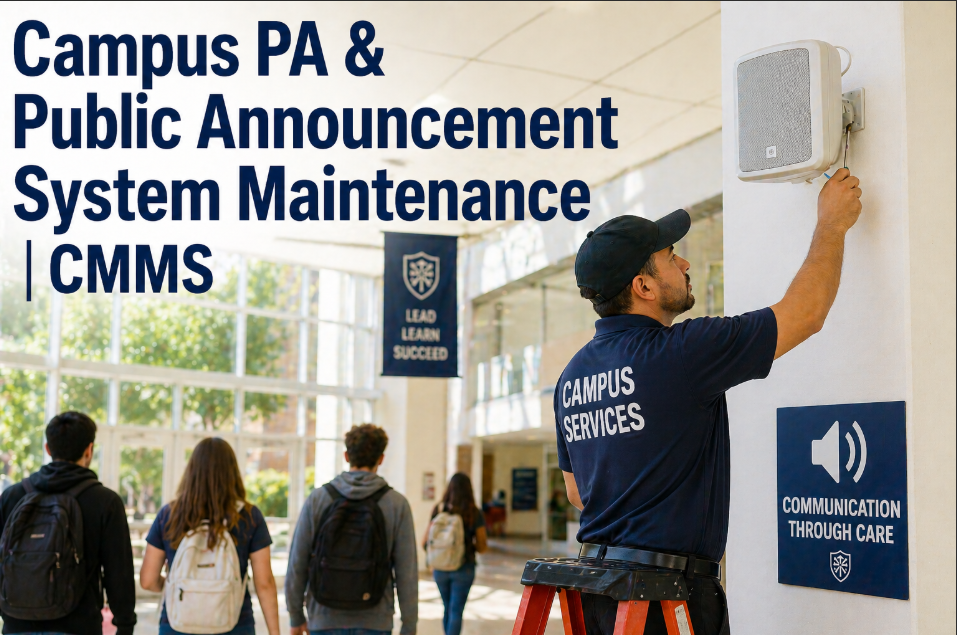
On the morning of April 16, 2007, the Virginia Tech campus PA system broadcast an emergency notification at 9:26 AM — 2 hours and 11 minutes after the first shooting began in West Ambler Johnston Hall. The delay was not entirely a communication failure. The PA system itself worked when activated. The failure was in the decision chain, the alert protocols, and the integration between physical campus infrastructure and emergency response systems. Seventeen years later, campus PA system maintenance remains one of the most compliance-critical and most frequently deferred infrastructure categories in higher education facilities management. A speaker that tests fine in September but fails silently by February produces no visible symptom until it is needed for a life-safety announcement — and then the consequence of that failure is measured in seconds, not dollars. NFPA 72, IBC 907.5.2, and the Jeanne Clery Act all create enforceable obligations around campus mass notification systems — and the maintenance documentation gap is where most institutions are most exposed. If your campus tracks PA system testing on a paper log or a spreadsheet that nobody audits, start a free trial with OxMaint or book a demo to see automated PA system maintenance compliance in action.
Campus PA System Maintenance — Life Safety Compliance
A Failed Speaker During a Campus Emergency Is Not a Maintenance Failure. It Is a Life Safety Failure That Was Preventable.
NFPA 72
Federal fire alarm and mass notification code
Requires documented functional testing of every notification appliance — speakers, strobes, amplifiers — annually at minimum
Clery Act
Campus emergency notification requirement
Requires institutions to have and maintain a system capable of immediate campus-wide emergency notification — undocumented maintenance creates Clery compliance exposure
$54,789
Average Clery Act fine per violation finding
Per incident of non-compliance — not capped per year — Department of Education enforcement
IBC 907.5.2
Intelligibility requirement for voice alarm systems
Speaker coverage must meet defined intelligibility standards — a speaker that passes power test but fails intelligibility is still a code violation
Why Campus PA System Maintenance Is Different From Other Infrastructure
Most campus infrastructure fails visibly — a broken HVAC unit produces discomfort, a failed elevator stops moving, a burst pipe produces water. PA system failures are silent. A speaker that has partially failed still passes a visual inspection. A fiber cable with marginal signal still delivers audio during a quiet weekly test at low volume — and fails under full load during an actual emergency announcement when every amplifier on the system is driven simultaneously. This silent failure mode is what makes PA maintenance categorically different from routine equipment maintenance, and it is why the documentation and testing protocols mandated by NFPA 72 are far more rigorous than for comparable infrastructure systems. Campus teams managing PA maintenance compliance who want to see how automated testing schedules and fault alerts work in practice can start a free trial or book a demo to see the complete PA compliance workflow.
01
Partial Speaker Failure
A speaker cone that has partially deteriorated produces acceptable audio at 40% volume during a weekly test. At full emergency broadcast volume, the diaphragm distorts and intelligibility collapses — the announcement is audible but not understandable. NFPA 72 intelligibility testing catches this. Casual weekly testing does not.
Risk: Announcement heard but not understood during emergency
02
Amplifier Thermal Shutdown Under Load
An amplifier that runs for 3 minutes during a routine test operates within thermal limits. A 25-minute sustained emergency broadcast — evacuation, shelter-in-place, active threat — drives the amplifier into thermal shutdown at minute 18. The zone goes silent mid-emergency. Load testing at full broadcast duration catches this. Standard functional testing does not.
Risk: System goes silent mid-emergency broadcast
03
Zoning Coverage Gaps After Renovation
A building renovation moved walls, added rooms, and created new occupiable spaces. The PA contractor who did the renovation was not coordinated with facilities. Two new seminar rooms are outside the speaker coverage radius for their zone. Nobody notices until an emergency announcement fails to reach those rooms — or until an NFPA 72 inspection identifies the coverage gap as a code violation.
Risk: New occupiable spaces with no emergency notification coverage
04
Backup Power System Degradation
NFPA 72 requires PA systems to operate on backup power for a defined duration after primary power loss. A battery backup that held 4 hours of runtime in 2021 may hold 90 minutes in 2026 due to battery aging — without any visible indication of degradation. The system appears operational. The backup power duration test, required by NFPA 72 Section 14.4, reveals the shortfall.
Risk: PA system goes offline 90 minutes into a power-loss emergency
The NFPA 72 Campus PA Testing Cycle — What Must Be Documented
NFPA 72 Chapter 14 and the supplementary mass notification system requirements in Chapter 24 define specific testing frequencies, test types, and documentation requirements for every component of a campus voice alarm and mass notification system. Most campuses know they need to "test the PA system" — very few have a documented schedule that covers every component at the code-required frequency.
Weekly
Operational Status Verification
System control panel check — all zones showing operational, no fault indicators. Backup power status confirmed. Any fault conditions logged as corrective work orders. This is the minimum weekly check — not a functional test of speakers or amplifiers.
NFPA 72 Table 14.4.2.2 — Visual inspection of control equipment
Monthly
Functional Test — Sample of Notification Appliances
Functional test of a rotating sample of speakers and strobes across each building zone. At least one speaker per zone tested for audio output, coverage area, and intelligibility at operational volume. Results logged per speaker with pass/fail and decibel level documented.
NFPA 72 Table 14.4.2.2 — Functional test of notification appliances
Quarterly
Full Zone Test and Backup Power Check
Full functional test of every speaker in one building zone per quarter — rotating through all zones across the year. Backup battery load test to verify runtime meets NFPA 72 minimum (24 hours for fire alarm systems, 6 hours for most mass notification configurations). Results documented per zone.
NFPA 72 Section 14.4 — Batteries and backup power testing requirements
Annual
Complete System Inspection and Test
Every speaker, every amplifier, every control panel input and output, every signal pathway, every backup power source — full functional test by a qualified technician. Intelligibility measurements per IBC 907.5.2. Load test at full broadcast duration. Third-party inspection report generated and retained for minimum 3 years per NFPA 72.
NFPA 72 Table 14.4.5 — Annual inspection and testing — complete system
Four Compliance Failures That Expose Campuses to Clery and NFPA Liability
01
No Documentation of Required Testing
The testing may have happened. If it was not documented with the required specificity — technician identity, test date, components tested, pass/fail result, decibel levels, and fault conditions found — it did not happen from a compliance standpoint. NFPA 72 Section 14.6 explicitly requires records to be retained and available for the authority having jurisdiction. "We test it but don't always write it down" is not a compliance position.
Fix: Every test auto-documented in CMMS with timestamped technician record, component list, and result log
02
Fault Conditions Not Corrected Within Required Window
A speaker in Zone 4 fails the monthly test. The fault is noted. The work order to replace it sits unassigned for six weeks because the technician who handles PA work is on medical leave. Meanwhile, Zone 4 has a documented non-operational speaker for six weeks — a life safety compliance gap that accumulates per-day exposure under both NFPA 72 and Clery Act. The fault was found; the correction was not tracked.
Fix: Fault detection auto-generates a prioritized corrective work order with deadline tracking and escalation
03
New Buildings Added Without PA Coverage Verification
A new residence hall opens. It has a PA system installed by the construction contractor. The facilities team assumes it was tested and accepted. The PA system was never added to the campus testing schedule, never integrated with the central notification system, and has never been functionally tested under NFPA 72 protocols. The new building has 400 residents and no verified emergency notification coverage.
Fix: New building commissioning checklist in CMMS requires PA system registration and baseline test before occupancy
04
Testing Interrupted by Events — Never Rescheduled
The quarterly zone test for the academic quad buildings was scheduled for the second Tuesday of October. Homecoming week created scheduling conflicts. The test was postponed. Facilities staff forgot to reschedule. By January, the academic quad buildings have been untested for six months — a gap that shows up immediately if a DOE investigator reviews the testing log after any incident involving those buildings.
Fix: Automated rescheduling — postponed tests generate immediate reschedule work orders, not open gaps
Campus PA System Compliance
Every Speaker. Every Zone. Every Test. Documented Before the Inspector Asks.
OxMaint automates the complete NFPA 72 PA testing schedule — weekly status checks, monthly sampling, quarterly zone tests, annual full-system inspections — with instant fault alerts, automatic corrective work order generation, and audit-ready documentation that exports in minutes when the authority having jurisdiction arrives on campus.
How OxMaint Manages Campus PA System Compliance
01
Complete PA Component Registry
Every speaker, amplifier, control panel, signal pathway, backup power unit, and strobe registered with location, zone assignment, manufacturer, model, installation date, and last test result. Campus-wide PA system mapped as a complete asset hierarchy — Building, Floor, Zone, Component. New buildings commissioned directly into the registry before occupancy.
Complete campus PA inventory — no untested components, no coverage gaps
02
NFPA 72-Aligned Automated Testing Schedule
Weekly, monthly, quarterly, and annual testing schedules auto-generated per NFPA 72 Table 14.4.2.2 requirements. Testing rotation configured so every zone is covered within the required frequency window. Postponed tests automatically reschedule within 7 days — no open gaps in the compliance calendar. Technicians receive mobile work orders with the specific component list for each test cycle.
Zero missed testing windows — automated rescheduling prevents compliance gaps
03
Instant Fault Alert With Corrective Work Order
When a component fails a test — speaker below minimum dB threshold, amplifier thermal fault, backup battery runtime below NFPA minimum, signal pathway fault — OxMaint immediately generates a life-safety-priority corrective work order. The work order includes the component ID, fault type, code requirement reference, correction deadline, and escalation path if not resolved within 72 hours.
Faults corrected within code window — not discovered six weeks later on the next test cycle
04
Mobile Testing Checklists With Digital Results Capture
Technicians complete NFPA 72-aligned testing checklists on their smartphone — speaker ID, test type, dB level measured, intelligibility assessment, pass/fail, fault description if applicable, and digital signature. Results sync to the component record instantly. No transcription from paper. No retroactive documentation. Every test record is timestamped, geo-tagged, and technician-attributed at the moment of testing.
Testing documentation created at point of test — immutable, timestamped, technician-signed
05
Clery Act Emergency Notification Readiness Dashboard
Portfolio-level dashboard showing current PA system readiness status across every campus building — green (all components current and tested), amber (tests due within 30 days), red (overdue tests or open fault conditions). Clery Act Annual Security Report preparation uses the dashboard data to document emergency notification system maintenance — the section most frequently cited in DOE Clery audits.
Clery Act Annual Security Report section supported by real maintenance data
06
Authority Having Jurisdiction Audit Package Export
When the state fire marshal, the AHJ, or the DOE investigator arrives requesting NFPA 72 inspection records, OxMaint generates a complete, structured inspection report package — component register, test history per component, fault and correction log, backup power test results, technician credentials — in minutes. The package format is pre-structured to match NFPA 72 Section 14.6 record retention requirements.
AHJ inspection response time reduced from days to under 15 minutes
Campus PA System Compliance — Regulatory Reference Table
| Regulation |
Applies To |
PA System Requirement |
Documentation Required |
Enforcement Body |
| NFPA 72 (2022 Edition) |
All campus fire alarm and mass notification systems |
Annual inspection and test of all notification appliances — Chapter 14 and 24 |
Test records retained minimum 3 years — per component, per test |
State fire marshal, AHJ |
| IBC 907.5.2 |
Voice alarm systems in assembly, educational, and high-rise occupancies |
Intelligibility testing — speech intelligibility index (SII) must meet minimum thresholds |
Intelligibility test report — certified acoustical measurement |
Local building department, fire code official |
| Jeanne Clery Act (34 CFR 668.46) |
All Title IV-eligible institutions of higher education |
Campus must have and maintain immediate campus-wide emergency notification capability |
Annual Security Report must document emergency notification system and procedures |
Department of Education — Office of Federal Student Aid |
| ADA Section 4.28 (ADAAG) |
Any PA system in ADA-covered occupancies |
Auditory and visual notification — strobe lights where hearing-impaired occupancy expected |
Maintenance records for visual notification appliances (strobes) |
DOJ — Office of Civil Rights |
| OSHA 29 CFR 1910.165 |
Workplace emergency alarm systems |
Alarm systems must be maintained, tested, and capable of alerting all employees |
Maintenance records — functional test at least annually |
OSHA — Area office enforcement |
Frequently Asked Questions
How often does NFPA 72 actually require campus PA speakers to be tested?+
NFPA 72 Table 14.4.2.2 requires a visual inspection of notification appliances semi-annually, and a functional test of notification appliances annually at minimum. However, mass notification systems under Chapter 24 have additional requirements — including operational testing of the control interface and pathway verification that most authorities having jurisdiction interpret as quarterly for campus-scale systems. OxMaint configures testing schedules based on the specific code edition adopted in your jurisdiction — which may be 2016, 2019, or 2022 edition depending on your state.
Book a demo to see how jurisdiction-specific testing schedules are configured.
What is intelligibility testing and does my campus PA system need it?+
Intelligibility testing measures whether voice announcements broadcast through your PA system can be understood by occupants — not just heard, but understood. IBC 907.5.2 requires voice alarm systems in educational and assembly occupancies to meet minimum speech intelligibility index (SII) thresholds, typically 0.45 SII or Common Intelligibility Scale (CIS) rating of 0.70. A speaker that produces 85 dB of audio may still fail intelligibility due to reverb, overlap from adjacent speakers, or frequency response issues. Intelligibility testing requires a certified acoustic measurement device and a qualified technician — it cannot be conducted by ear alone. If your campus has voice alarm (not just tone-only fire alarms), intelligibility testing is almost certainly required. OxMaint's annual inspection template includes intelligibility test fields aligned to IBC 907.5.2 documentation requirements.
How does the Clery Act create PA maintenance obligations?+
The Clery Act (34 CFR 668.46(g)) requires campuses to have systems in place to immediately notify the campus community upon confirmation of a significant emergency or dangerous situation. The regulation does not prescribe specific maintenance requirements for those systems — but the Department of Education's enforcement guidance makes clear that a campus whose notification system was non-operational at the time of an incident, or whose maintenance records cannot demonstrate the system was functional, faces significantly elevated Clery Act penalty exposure. The average fine per Clery violation finding is $54,789 — and a systemic notification system failure would likely produce multiple findings. The maintenance documentation is the Clery compliance defense.
What should our campus do when a PA system fault is discovered between scheduled test cycles?+
Under NFPA 72 Section 14.4, any system impairment must be documented, reported to the authority having jurisdiction (in some jurisdictions), and corrected within the timeframe specified by the AHJ — typically 24–72 hours for life-safety systems. During the impairment period, compensating measures may be required: physical staff posted in the affected zone, supplemental notification capability, or temporary PA equipment. OxMaint's fault-to-corrective-work-order workflow automatically generates the impairment notification, creates the corrective work order with the AHJ-required deadline, and tracks the compensating measure status until the fault is resolved.
Start a free trial to see how fault management works in the PA compliance workflow.
Campus PA System Compliance — OxMaint
The Speaker That Works in September Must Work in February. Prove It.
OxMaint automates the complete NFPA 72 PA testing cycle — weekly, monthly, quarterly, and annual — with instant fault alerts, automatic corrective work orders, and audit-ready documentation that satisfies the authority having jurisdiction, the Clery Act auditor, and the ADA investigator. Every speaker. Every test. Every fault corrected on record.
100%
Testing cycles documented per component
72 hrs
Fault correction deadline tracked automatically
15 min
AHJ audit package export time
Zero
Untested components or coverage gaps