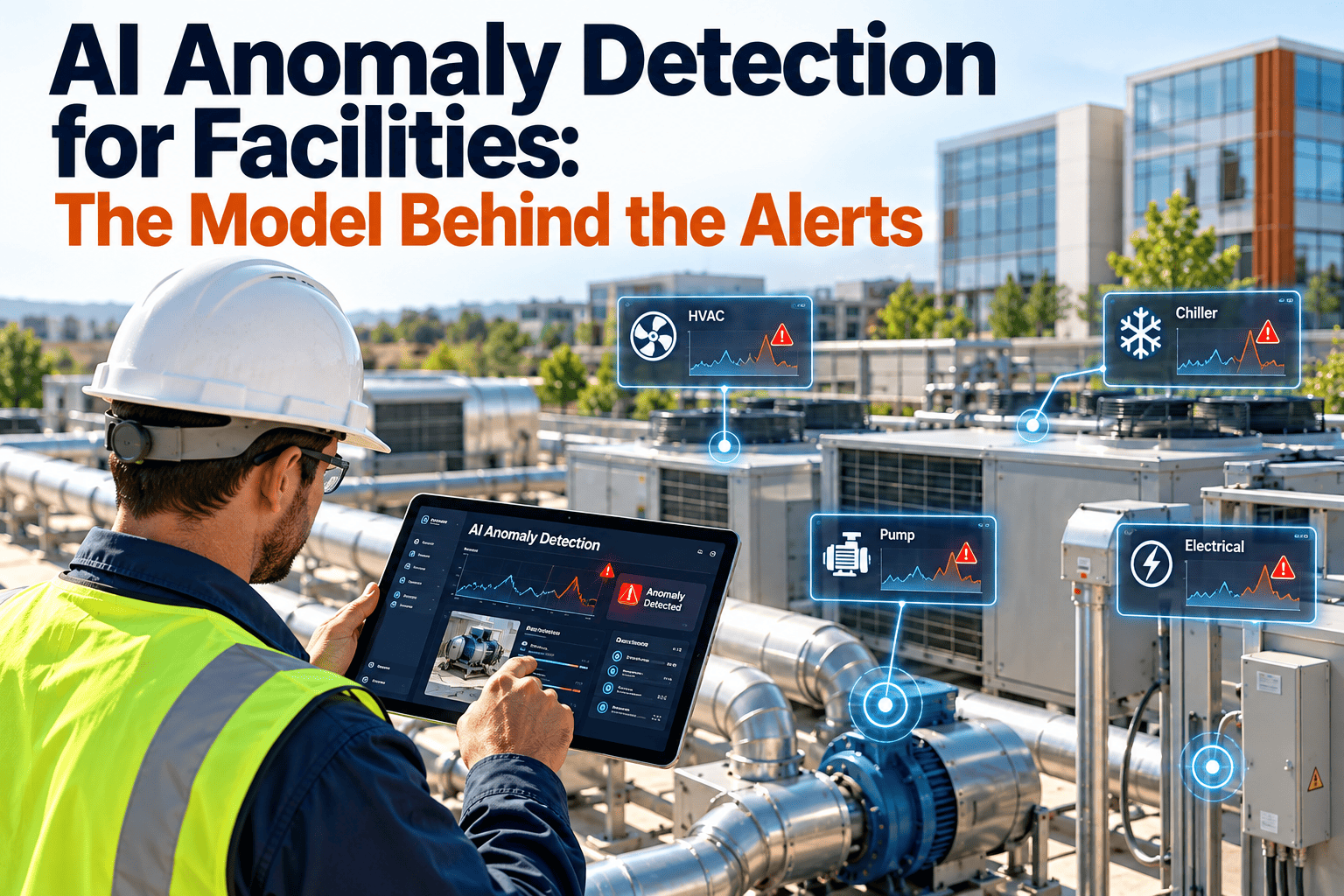
Facility teams have relied on fixed thresholds for years — a vibration alarm at 7 mm/s, a bearing temperature cutoff at 80°C — because they are simple to configure and easy to justify to a building owner. The problem is that a static threshold treats a chiller running at full summer load the same as one quietly drifting toward failure, and it cannot separate a genuine warning from noise until the reading has already crossed a line someone drew months earlier. AI anomaly detection replaces that fixed line with a model that learns what normal actually looks like for each asset and flags the moment its behavior departs from that pattern. This guide breaks down the specific models behind those alerts and shows how Oxmaint's predictive maintenance workflow turns a model's output into an assigned work order instead of just another dashboard number.
Facilities · Predictive Maintenance · Machine Learning
AI Anomaly Detection for Facility Equipment: The Model Behind the Alerts
Chillers, AHUs, pumps, and electrical gear rarely fail without warning signs — they drift. Anomaly detection models learn each asset's normal operating pattern from historical sensor data and surface the drift weeks before a fixed threshold would ever trip, cutting false alarms and buying real lead time for facility teams.
Normal operating band (top) vs. a drifting asset the model flags before it reaches the fixed alarm line
The Problem With Static Thresholds
A Fixed Alarm Line Can't Tell Drift From Noise
A threshold set at commissioning stays fixed while the asset ages, gets rebalanced, or has parts swapped — so the line that was accurate in year one is often wrong by year four. Facility engineers end up tuning it wider to cut nuisance alarms, which quietly erases the early-warning value it was meant to provide.
The result is a familiar cycle: alarms get ignored because too many of them turn out to be nothing, the threshold gets widened again to reduce the noise, and the next real fault slips through undetected until it becomes an emergency call. A model that judges each new reading against a learned baseline, rather than a fixed number, breaks that cycle at its source.
-
No Asset-Specific Baseline
One threshold is applied to every unit of the same model, even though load profile, age, and maintenance history differ between them.
-
Single-Variable Blindness
A threshold on one sensor misses failures that show up as a combination of small shifts across vibration, current, and temperature together.
-
Late-Stage Detection
By the time a single reading crosses a static line, the underlying fault has often been progressing for weeks, shortening the window to plan a repair.
Three Models, Three Jobs
The Models Powering Facility Anomaly Detection
Facility management platforms rarely rely on one algorithm. Each model below is suited to a different kind of asset data, and mature predictive maintenance programs typically combine at least two of them.
-
01
Isolation Forest
Works by randomly partitioning sensor readings and measuring how few splits it takes to isolate a point — anomalies separate quickly because they sit far from the bulk of normal data. It needs no labeled failure history, trains fast, and handles multiple sensor variables at once, which makes it a common first model for a facility's rooftop units, pumps, and fans where failure examples are scarce. Because it is computationally light, it is also the easiest of the three to run continuously across a large portfolio of similar assets without heavy infrastructure.
-
02
Autoencoder (Neural Network)
Learns to compress and reconstruct normal sensor patterns; when it is fed data from a degrading asset, the reconstruction error spikes because the pattern no longer resembles anything the model learned as normal. Autoencoders are well suited to high-frequency vibration and current signatures on rotating equipment like chillers and large motors, where the fault shows up as a subtle change in waveform shape rather than a simple level shift.
-
03
LSTM (Long Short-Term Memory)
A recurrent neural network built to learn sequences over time, so it captures how an asset's readings should evolve across a duty cycle — a chiller's start-up ramp, a boiler's daily load curve. LSTMs catch anomalies that only appear in the timing or shape of a trend, such as a compressor that now takes longer to reach steady state, which point-in-time models like isolation forest can miss entirely.
From Sensor Reading to Work Order
How the Model Actually Catches a Failure
Data Collection
BMS points, IoT sensors, and run-hour meters stream continuous readings for the asset into the platform.
Feature Extraction
Raw signals are converted into features — rolling averages, rate of change, frequency bands — the model can compare against its learned baseline.
Model Scoring
Isolation forest, autoencoder, or LSTM scores each new reading against normal behavior and produces an anomaly score in real time.
Threshold & Alert
A sustained score above the model's learned confidence band triggers an alert, not a single noisy spike.
Work Order
The alert opens a work order with the asset, trend, and likely cause pre-attached, so a technician isn't starting from a blank page and doesn't have to reconstruct the anomaly history from scratch on site.
What The Models Actually Catch
Failure Modes These Models Are Trained To Find
The value of an anomaly model is easiest to see against specific failure modes facility teams already recognize after the fact. In each case below, the pattern was present in the data long before a technician was called in.
Bearing Wear on Rotating Equipment
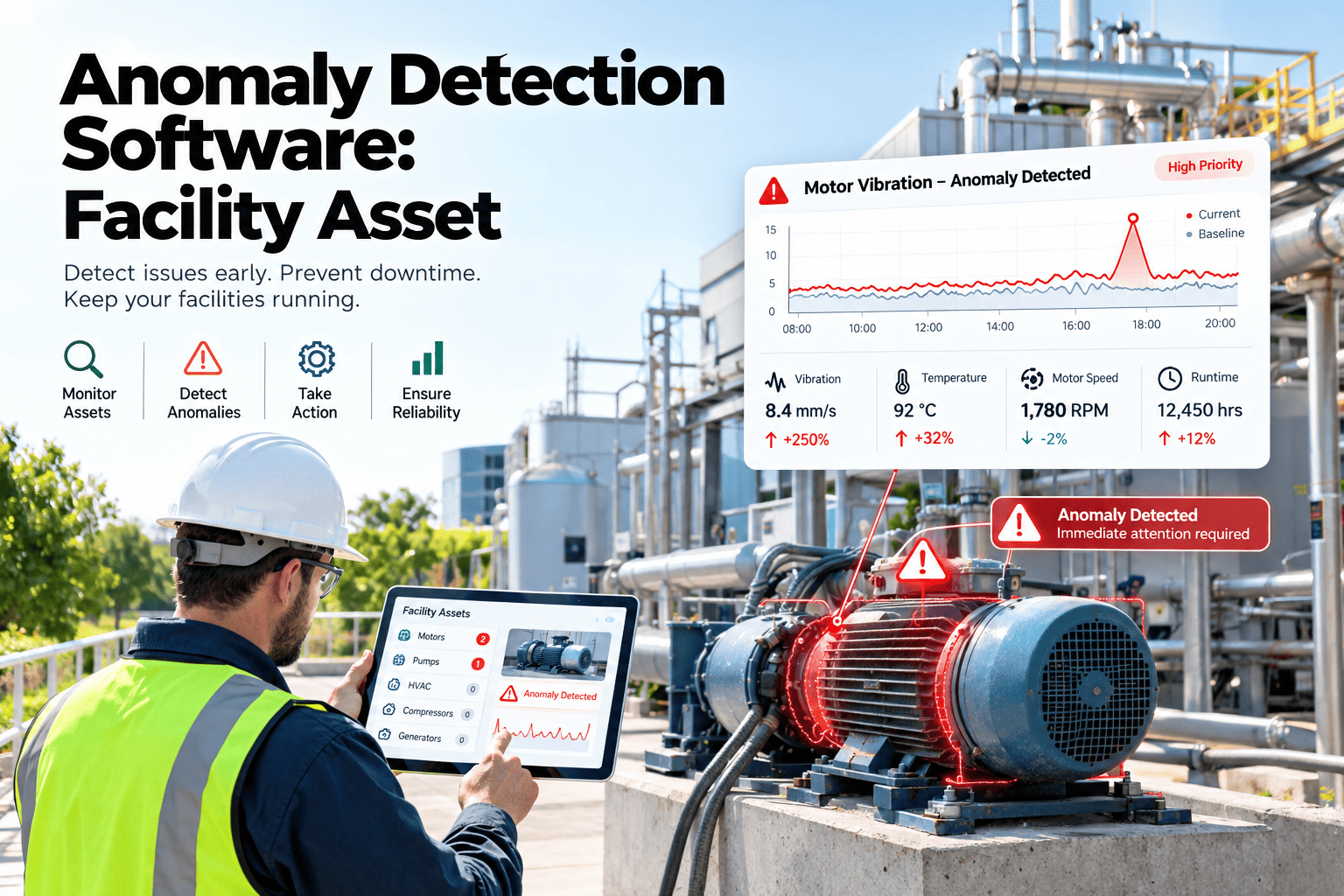
Vibration signatures shift in frequency composition weeks before a bearing fails audibly. An autoencoder trained on the healthy vibration waveform reconstructs it poorly once wear introduces new frequency content, raising a reconstruction-error alert long before the fault becomes a fixed-threshold vibration alarm.
Refrigerant Loss in Chillers
A slow refrigerant leak shows up as a combination of small shifts across suction pressure, superheat, and compressor current rather than one variable moving alone. Isolation forest is built for exactly this — separating a point that is unusual across several correlated readings even when none of them individually crosses an alarm line.
Belt Slip and Drive Degradation
A slipping belt changes the timing relationship between motor current draw and fan speed across a duty cycle. Because this is a sequence-level pattern rather than a single-point deviation, an LSTM trained on the normal start-up and load-following curve is far more likely to catch it than a static current threshold.
Motor Winding Degradation
Insulation breakdown in a motor winding produces subtle harmonic distortion in current draw well before thermal alarms trigger. An autoencoder trained on healthy current waveforms flags the distortion as an anomaly, giving planners time to schedule a motor replacement during a planned outage instead of an emergency shutdown.
Keeping The Model Honest
Building And Maintaining The Detection Pipeline
A model is not a one-time deployment. Facility conditions change — new equipment is installed, setpoints are adjusted, occupancy patterns shift — and the pipeline around the model has to account for that drift in the data itself, separate from drift in the equipment.
- Baseline retraining. A model trained once on a single season of data will start flagging normal seasonal variation as anomalous; most facility deployments retrain the baseline quarterly or after any major setpoint change.
- Sensor validation. A drifting or fouled sensor produces the same kind of anomalous signal as a failing asset, so the pipeline needs a way to distinguish a sensor problem from an equipment problem before it reaches a technician.
- Feedback loops. When a technician closes a work order as a false alarm or confirms a real fault, that outcome should feed back into the model's confidence scoring so the alert threshold improves over time rather than staying static.
- Asset prioritization. Not every asset needs the same model. Critical, expensive-to-fail equipment justifies the investment in a trained neural network approach, while lower-criticality assets may only need a simpler isolation forest pass, keeping the overall computational and maintenance overhead of the pipeline proportional to the risk each asset actually represents.
See It On Your Own Assets
Model Output Is Only Useful If It Reaches a Technician
An anomaly score sitting in a data science dashboard changes nothing on the floor. Sign up for Oxmaint to route flagged anomalies straight into a scoped, assigned work order the moment the model raises a confident alert.
Choosing The Right Fit
Comparing The Three Models
None of these three approaches is universally "better" — each trades off data requirements, computational cost, and the type of anomaly it is built to catch. Facility teams evaluating a predictive maintenance platform should ask which model backs each asset class rather than accepting a single generic "AI-powered" label at face value.
| Model | Data Requirement | Best Suited To | Detects |
|---|---|---|---|
| Isolation Forest | Unlabeled multi-sensor data, no failure history needed | Pumps, fans, rooftop units with scarce failure examples | Point anomalies across several variables at once |
| Autoencoder | Larger volume of normal-condition sensor data | Chillers, large motors, rotating equipment | Subtle waveform or pattern shifts in vibration and current |
| LSTM | Sequential time-series history across duty cycles | Boilers, chillers with variable load cycles | Changes in the shape or timing of a trend over time |
Why It's Worth Building
What Facility Teams Typically See
Published NIST and industry research on machine-learning-based condition monitoring consistently points to two outcomes once a facility moves from fixed thresholds to a trained anomaly model. Facility teams that track alert outcomes over a full year tend to see the gains compound as the model's confidence band is refined by technician feedback.
-
Fewer False Alarms
A model trained on an asset's own history distinguishes a genuine departure from normal seasonal or load-driven variation, cutting nuisance alerts that erode technician trust in the system.
-
Longer Lead Time
Because the model reacts to drift rather than a crossed line, alerts typically arrive while a fault is still developing, giving planners days or weeks to schedule the repair instead of reacting to a shutdown.
-
Higher Alert Confidence
Sustained anomaly scores rather than single-point spikes mean fewer work orders opened on noise, so technicians spend dispatched hours on real issues.
Before You Start
Is Your Facility Ready For AI Anomaly Detection?
Rolling out a trained anomaly model does not require instrumenting the entire building on day one. Most successful deployments start with a short readiness pass on a handful of critical assets, confirm the model produces alerts the maintenance team trusts, and only then expand coverage across the rest of the portfolio.
- ✓At least six to twelve months of historical sensor or BMS trend data exists for the target assets
- ✓Sensors report at a frequency fine enough to capture drift, not just daily snapshots
- ✓A CMMS or work order system exists to receive and act on an alert once it fires
- ✓Maintenance staff are available to validate early alerts so the model's confidence band can be tuned
- ✓Critical assets are prioritized first rather than instrumenting every asset on day one
Frequently Asked
AI Anomaly Detection Questions
How is AI anomaly detection different from a fixed alarm threshold?
A fixed threshold applies one static value to every asset regardless of age or load. An anomaly detection model learns a normal pattern specific to each asset from its own history and flags departures from that pattern, catching drift long before a single reading would cross a static line.
Do I need a data science team to run these models?
No — the models described here are built into predictive maintenance platforms and run automatically once sensor data is connected. Sign up for Oxmaint to connect BMS and IoT data without building or maintaining the models yourself.
Which assets benefit most from anomaly detection first?
Rotating and cycling equipment with continuous sensor data — chillers, large motors, pumps, and AHUs — sees the clearest benefit, since these assets show measurable drift patterns well before failure that a fixed threshold typically misses.
How much sensor history is needed before a model works well?
Most facility models need at least six to twelve months of normal-condition data to learn a reliable baseline, though isolation forest can begin producing useful signal with a smaller dataset than a neural network approach.
What happens after the model flags an anomaly?
The alert should open a work order automatically with the trend and asset context attached rather than sitting in a separate dashboard. Book a demo to see that handoff from alert to assigned work order in Oxmaint.
Model-Driven · Not Threshold-Bound
Stop Waiting For A Line To Be Crossed
Isolation forest, autoencoder, and LSTM models exist to give facility teams the lead time a fixed threshold can never provide. Oxmaint connects your BMS and IoT data to these models and turns every confident anomaly into a work order your team can act on immediately — without needing an in-house data science team to build or maintain the pipeline.

.jpeg)

