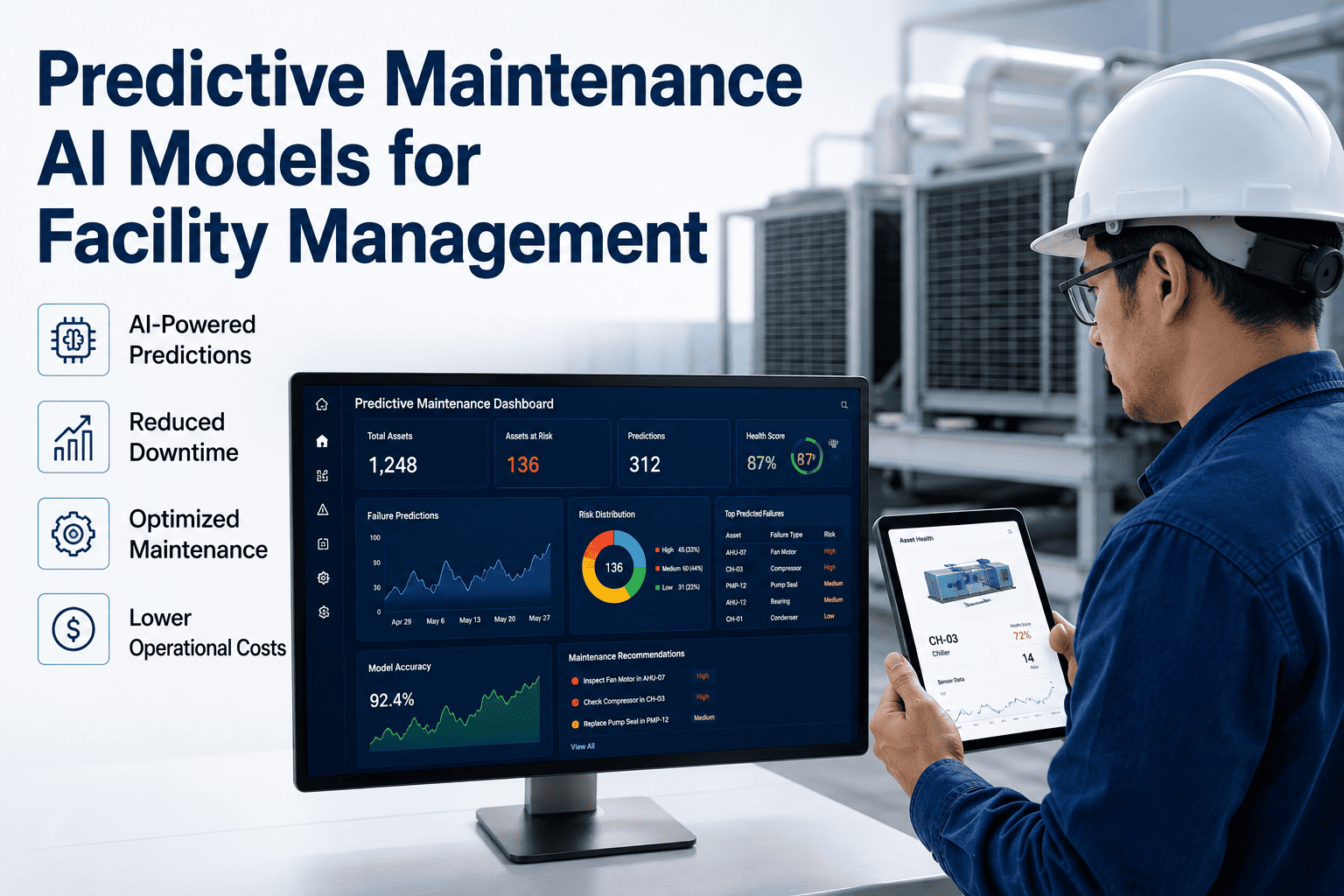
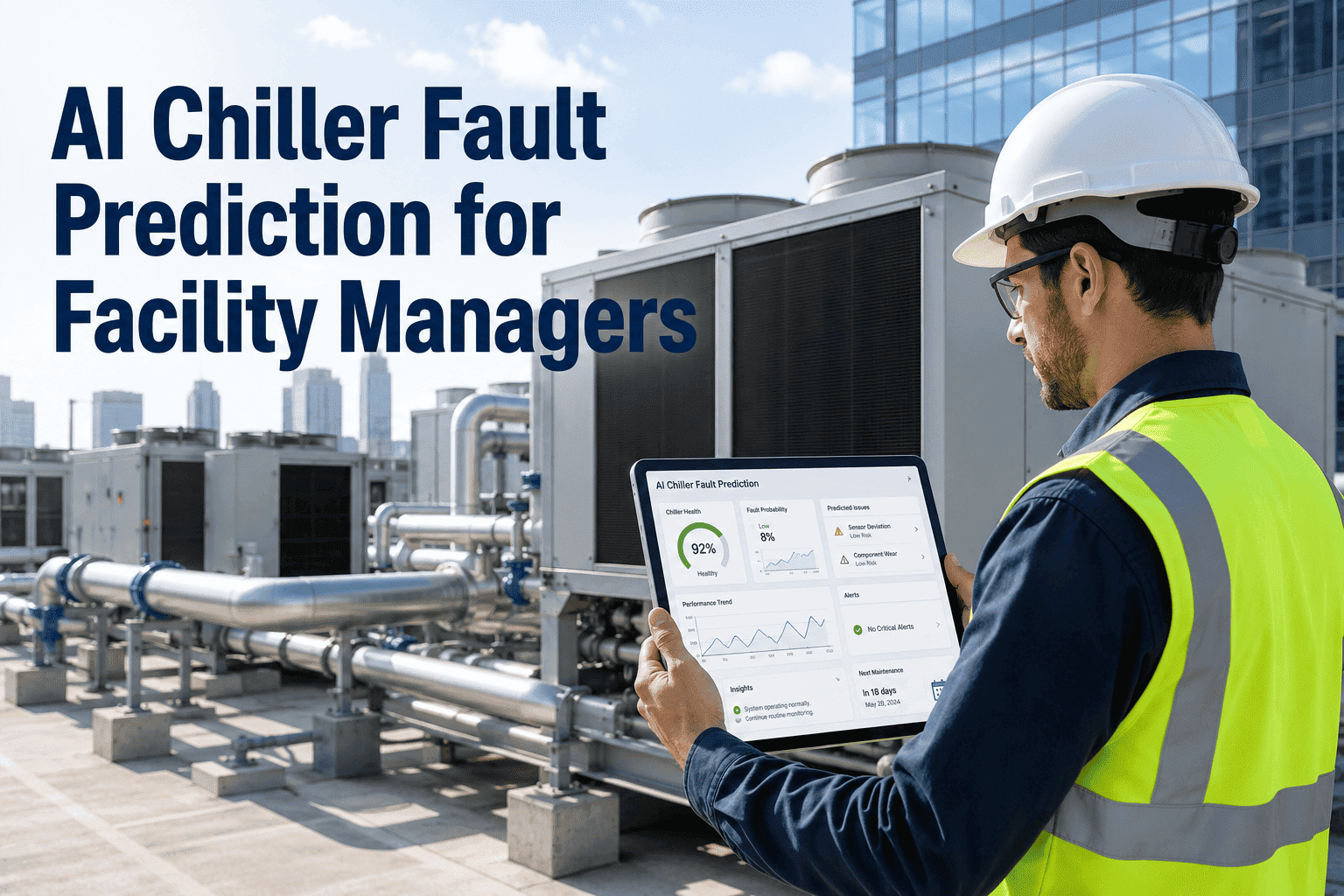
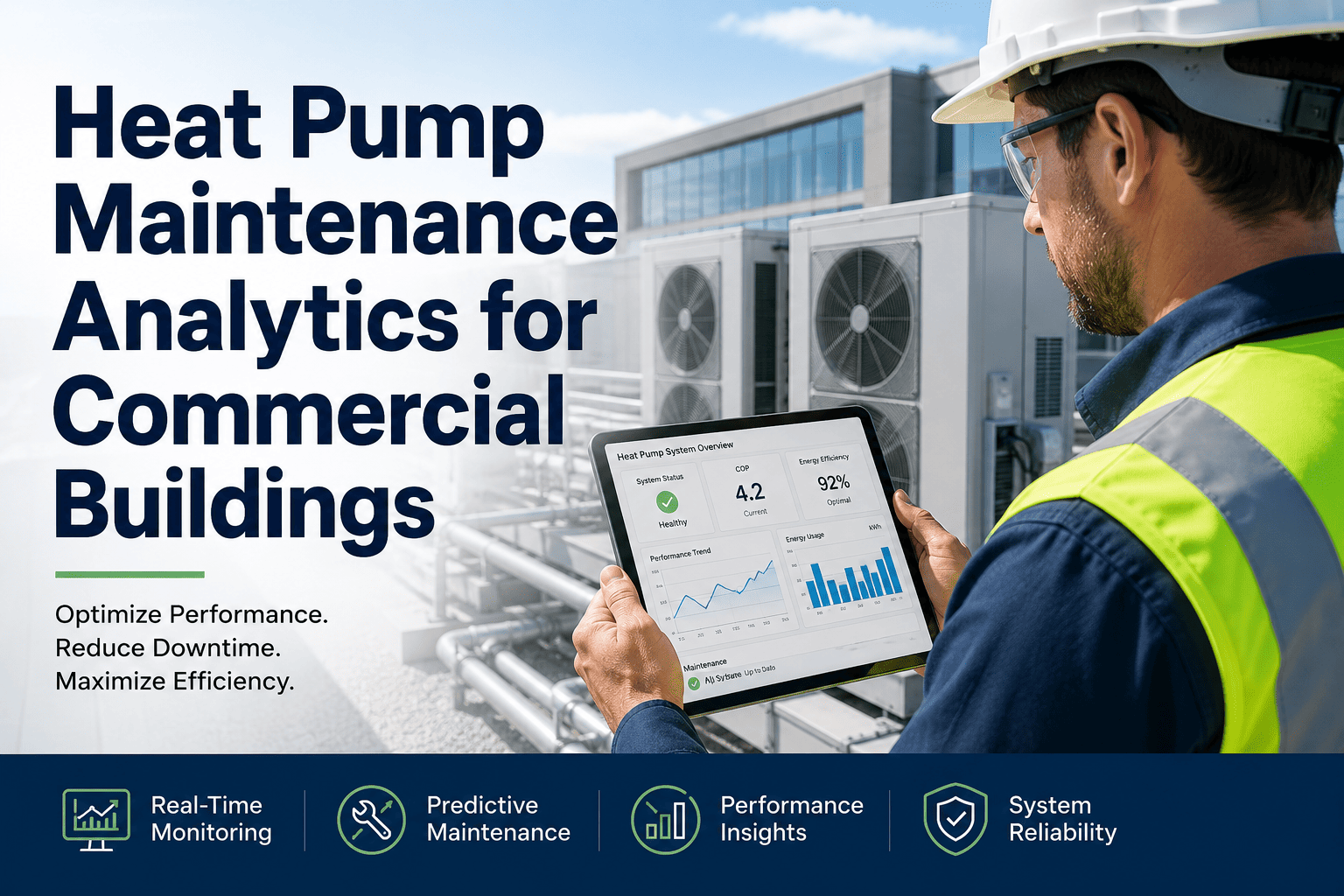
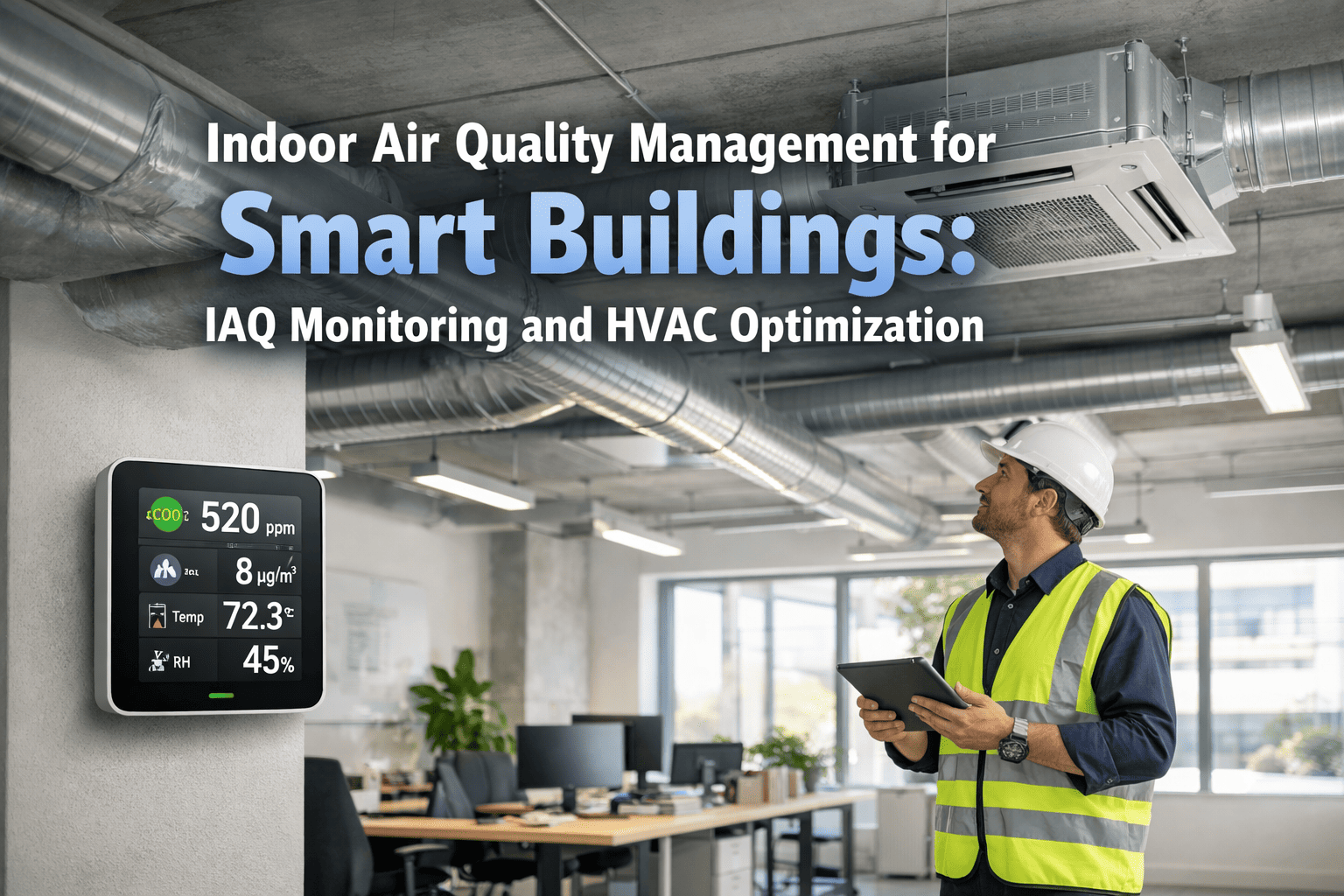
Facility managers overseeing commercial office towers, healthcare campuses, retail portfolios, and mixed-use developments are now sitting on more equipment sensor data than any previous generation — yet most of it still does nothing. A chiller's vibration sensor fires an alarm when the bearing has already failed, not six weeks earlier when the degradation pattern first became detectable. An elevator motor's current draw drifts 8% above baseline for 40 days before anyone notices, and by then the repair is a replacement. The gap between data collected and value delivered is not a sensor problem — it is the absence of an AI model layer that translates raw readings into actionable maintenance predictions before failure occurs. OxMaint's Predictive Maintenance AI applies machine learning models trained on HVAC, pump, motor, elevator, generator, and electrical system failure patterns to your building's sensor streams — surfacing predicted failures 2–8 weeks before they occur and auto-generating PM work orders at the optimal intervention window.
Article · Predictive Maintenance · Facility Management · AI Models
Predictive Maintenance AI Models for Facility Management
How AI failure prediction models for HVAC, pumps, motors, elevators, generators, and electrical systems are replacing reactive repair programmes — and what facility teams need to deploy them effectively.
82%
Reduction in unplanned downtime reported by facilities using IoT-connected predictive maintenance (McKinsey)
25–30%
Reduction in total maintenance costs vs reactive programmes (U.S. DOE)
5–10x
ROI on predictive maintenance investment in commercial building portfolios (Deloitte)
2–8 wks
Advance warning window delivered by AI anomaly detection before failure event
What This Guide Covers
01 · How AI Prediction Models Work
02 · HVAC Failure Prediction
03 · Pumps & Motors
04 · Elevators & Generators
05 · Live KPI Dashboard
06 · Before vs After
07 · Expert Review
08 · FAQs
How AI Prediction Models Work in Facility Management
Predictive maintenance AI for buildings operates on three sequential layers: data ingestion from sensors and CMMS work orders, anomaly classification against equipment-specific failure signatures, and remaining useful life (RUL) estimation that determines the optimal maintenance intervention window. The models that perform best in facility environments are not general-purpose ML models — they are trained specifically on the failure patterns of commercial building equipment classes, where failure signatures differ substantially from industrial machinery models.
Layer 1
Multi-Source Data Ingestion
Sensor streams (BACnet, MQTT, Modbus), CMMS work order history, energy meter data, and manual inspection readings are combined into a unified equipment data record. Data quality validation filters noise and sensor drift before model processing.
HVAC sensorsTemperature, pressure, vibration, current draw, flow rate
Update intervalEvery 15–60 seconds per parameter
Layer 2
Anomaly Classification Engine
Machine learning classifiers compare incoming sensor patterns against a library of known failure signatures for each equipment type. Classification produces a fault type probability score — distinguishing bearing wear from refrigerant loss from fouled coil, for example, within the same HVAC unit.
Model typeLSTM + random forest ensemble per asset class
Calibration period30 days of baseline data before alert activation
Layer 3
Remaining Useful Life Estimation
Once a degradation pattern is confirmed, the RUL model estimates time to failure based on degradation rate, historical failure data for the asset class, and current operational load. The result is a maintenance intervention recommendation with a specific time window — not just an alarm.
OutputPredicted failure date range + confidence %
Auto-actionPM work order generated at optimal intervention point
Live Predictive Alert Feed — OxMaint AI Dashboard
Simulated · Refreshed continuously
CRITICAL — 87% CONFIDENCE
Chiller CH-02 · Tower B Plant Room
Compressor bearing degradation pattern detected. Vibration amplitude at 6.8 mm/s RMS (threshold 5.6). Current draw trending +11% above baseline for 18 days. Predicted failure window: 12–18 days. PM WO #6241 auto-generated.
Detected 3h ago · AI Anomaly Engine
WARNING — 71% CONFIDENCE
AHU-07 Cooling Coil · Floor 8 East
Coil fouling signature detected. Supply air temperature deviation +1.8°C from setpoint persisting 6 days. Energy draw +14% above seasonal baseline. Recommended action: coil cleaning within 3 weeks.
Detected 1 day ago · Energy Anomaly Model
PREDICTED — 63% CONFIDENCE
Lift M-04 Traction Motor · North Core
Motor current signature showing early bearing race wear pattern. No performance impact yet. Predicted failure window: 5–9 weeks. Scheduled PM WO generated for Week 6 intervention — within manufacturer warranty service window.
Detected 4 days ago · Motor Health Model
RESOLVED
DG Set DG-01 · Basement Generator Room
Fuel injector degradation alert resolved. Injector replaced per WO #6198. Post-repair sensor pattern confirms normal operating signature. Asset health score restored to 94/100. MTTR: 2h 35min.
4h ago · Auto-closed
HVAC Failure Prediction — The Highest-Value Asset Class in Facility AI
HVAC systems account for 39–50% of total building energy consumption and generate the highest volume of maintenance events of any facility asset class. They are also the asset class with the most mature predictive AI model development, with well-characterised failure signatures for the six most common HVAC failure modes. The table below maps HVAC failure modes to their detectable sensor signatures, prediction lead times, and the cost differential between predicted vs reactive repair.
| HVAC Failure Mode |
Detectable Sensor Signature |
AI Lead Time |
Reactive Repair Cost |
Planned Repair Cost |
Saving |
| Compressor bearing failure |
Vibration amplitude, current draw spike, discharge temperature rise |
3–6 weeks |
$18,000–$45,000 |
$3,500–$8,000 |
Up to 80% |
| Cooling coil fouling |
Supply air temp deviation, energy draw increase, delta-T reduction |
2–4 weeks |
$4,000–$12,000 (+ energy waste) |
$800–$2,200 |
Up to 70% |
| Refrigerant leak |
Suction pressure drop, superheat increase, compressor runtime extension |
1–3 weeks |
$6,000–$22,000 |
$1,200–$4,500 |
Up to 75% |
| Condenser fouling |
Condensing pressure rise, outdoor unit current draw, EER deviation |
2–5 weeks |
$5,000–$18,000 |
$600–$1,800 |
Up to 88% |
| Fan belt wear / sheave misalignment |
Vibration frequency signature, airflow reduction, motor amp rise |
2–4 weeks |
$2,500–$9,000 |
$300–$900 |
Up to 90% |
| Chiller tube fouling |
Approach temperature increase, COP decline, kW/ton rise |
3–8 weeks |
$12,000–$35,000 |
$2,500–$6,000 |
Up to 83% |
OxMaint's Predictive Maintenance AI monitors every HVAC failure signature in this table — auto-generating work orders at the optimal maintenance window before failure cost is incurred. Start a free trial to see your facility's HVAC health scores. Book a 30-minute demo to see live failure prediction in action.
Pump, Motor, Elevator, and Generator Prediction Models
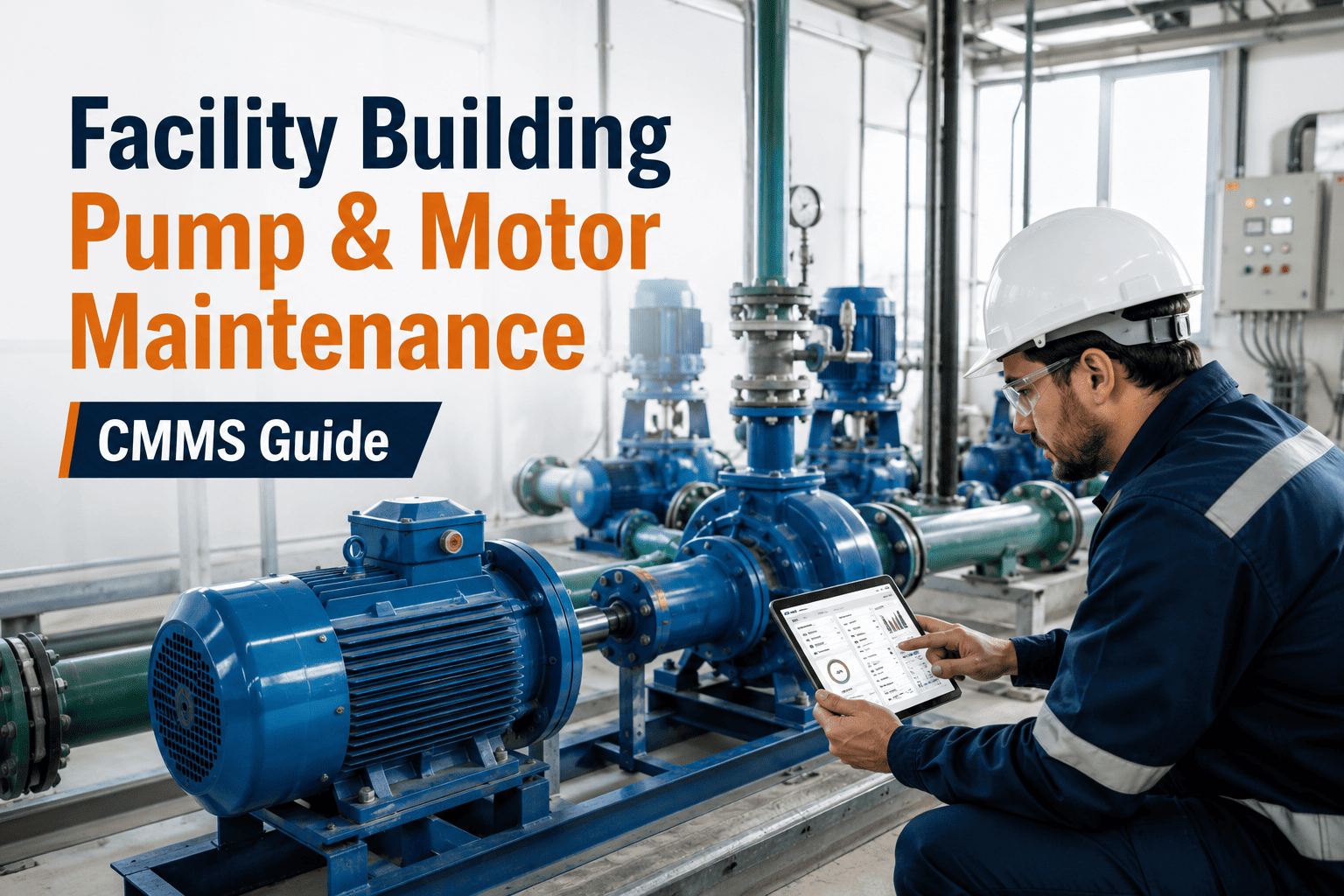
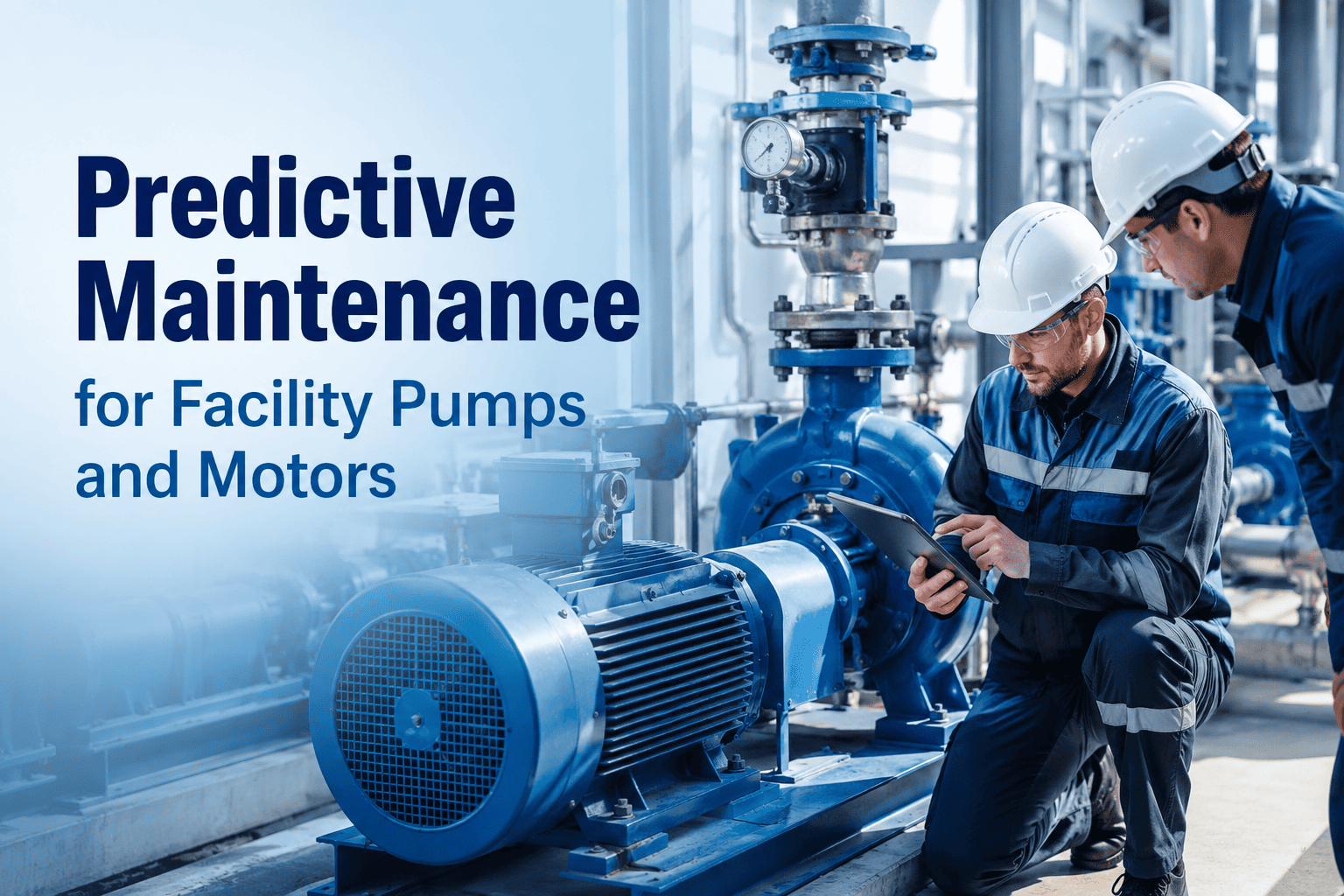
HVAC prediction is the most common entry point, but the highest ROI in a full facility portfolio comes from extending predictive models to pumps, motors, elevators, and standby generators — assets whose failure consequences include life safety impacts (elevator), regulatory non-compliance (generator load test records), and water damage liability (pump). The model parameters differ significantly by asset class.
Key sensorsVibration (bearing), differential pressure, flow rate, motor current, seal temperature
Primary failure modesImpeller cavitation, mechanical seal failure, bearing wear, motor winding degradation
AI lead time2–5 weeks for bearing and seal failures
Failure cost avoided$8,000–$40,000 per event (includes water damage)
Key sensorsCurrent signature analysis (CSA), vibration, winding temperature, insulation resistance
Primary failure modesWinding insulation breakdown, rotor bar cracking, bearing failure, thermal overload
AI lead time3–8 weeks for winding degradation; 2–4 weeks for bearing failure
Failure cost avoided$5,000–$25,000 per motor replacement event
Key sensorsMotor current signature, door cycle time, levelling accuracy, vibration during travel
Primary failure modesRope/belt wear, motor bearing degradation, door operator failure, brake pad wear
AI lead time3–7 weeks; door failures detectable 1–2 weeks before entrapment risk
Failure cost avoided$15,000–$80,000 per major failure + liability exposure
Key sensorsFuel quality analysis, coolant temperature, battery voltage, oil pressure, load bank test performance
Primary failure modesBattery failure (most common), fuel system degradation, cooling system failure, AVR fault
AI lead timeBattery degradation detectable 4–10 weeks before start failure
Failure cost avoided$50,000–$500,000 per power failure event (critical facilities)
Live KPI Dashboard — Facility Predictive Maintenance Performance
OxMaint's predictive maintenance dashboard surfaces asset health scores, prediction accuracy, and financial impact in a single operations view — updated continuously as sensors report and work orders close.
Portfolio Asset Health Score
88/100
+9 pts vs 6-month baseline
Predicted Failures Caught
34
Last 90 days — before failure
Reactive Work Ratio
17%
Down from 38% at baseline
Maintenance Cost Saved (90d)
$84K
vs predicted reactive cost
AI Prediction Accuracy
91%
Post-calibration (30-day period)
Assets Under AI Monitoring
247
Across 6 buildings
Before vs After — Predictive AI Programme Outcomes
A 12-building commercial office portfolio in Singapore (combined 1.4 million sq ft) deployed OxMaint predictive maintenance AI across HVAC, pumps, motors, and elevators. Results measured at 12 months post-deployment versus the prior 12-month baseline.
Before OxMaint AI
Unplanned downtime events / year94 events
Reactive work ratio41%
Mean time to detect degradationAfter failure (reactive)
Total maintenance cost (annual)$2.4M
Energy deviation (HVAC)+19% above baseline
PM compliance rate63%
After OxMaint AI (12 months)
Unplanned downtime events / year17 events (−82%)
Reactive work ratio16% (world-class)
Mean time to detect degradation3.2 weeks before failure
Total maintenance cost (annual)$1.72M (−28%)
Energy deviation (HVAC)+4% above baseline
PM compliance rate93%
PREDICTIVE MAINTENANCE AI
See AI Failure Prediction for Your Building Portfolio
OxMaint connects to your BMS sensors and CMMS work order history, applies asset-class-specific AI models, and surfaces predicted failures 2–8 weeks before they occur — with auto-generated PM work orders at the optimal intervention window. Most facilities see the first predictions within 30 days of go-live.
Deploying Predictive AI — What Facility Teams Need to Start
The most common objection to predictive maintenance AI in facility management is infrastructure readiness. The reality is that most commercial buildings already have the data sources required — the gap is the integration and analytics layer that turns them into predictions. The four requirements below define what is actually needed versus what is often assumed.
Required
Existing BMS or IoT Sensors
Any BACnet, Modbus, MQTT, or OPC-UA data source. Temperature sensors alone can support AHU and chiller fouling detection. Vibration sensors unlock bearing prediction. You do not need a full sensor retrofit to start — begin with what you have and expand incrementally.
Required
CMMS Work Order History
12+ months of historical work order records for the assets being monitored. This history is used to calibrate failure signatures against actual events that occurred on your specific equipment — improving model accuracy from the generic baseline to site-specific within 30–60 days.
Not Required
Full Sensor Retrofit
You do not need to sensor every asset before starting. OxMaint's AI models work on partial sensor coverage — starting with your highest-criticality assets (main chillers, primary AHUs, standby generators, main water pumps) and expanding as ROI justifies sensor additions.
Not Required
Dedicated Data Science Team
OxMaint's AI layer is pre-trained on facility equipment failure patterns and calibrates automatically to your building's operating profile during the 30-day baseline period. No data science expertise is required from your team — the system surfaces predictions as actionable work orders in plain language.
Expert Review
NK
Nikhil Krishnan
Director of Smart Building Technologies · 18 years · IFMA Certified Facility Manager · IIT Delhi, Mechanical Engineering · Advisory Board Member, Smart Building Consortium Asia-Pacific
The facilities industry has been discussing predictive maintenance for 15 years but deploying it at scale for about 3. The gap between discussion and deployment closed when two things happened: first, BACnet IP and MQTT made sensor data accessible without custom integration projects; second, cloud-based AI platforms like OxMaint removed the requirement for on-premises data science infrastructure that was the practical barrier for most facility teams. What I tell facility directors who are evaluating this decision is simple: the question is not whether predictive AI delivers ROI — the data on that is clear at 5–10x investment. The question is whether your current sensor coverage and CMMS data quality are sufficient to start. In my experience, 80% of commercial buildings over 50,000 sq ft already have what they need. The remaining 20% need a sensor conversation first, and that conversation is typically much cheaper than the next reactive chiller failure.
Frequently Asked Questions
What is the minimum sensor infrastructure needed to start predictive maintenance AI for HVAC?
For HVAC systems, the minimum viable sensor set to begin predictive modelling is supply air temperature, return air temperature, and motor current draw — data that most commercial building BMS systems already record. This combination enables fouling detection on cooling coils, degradation monitoring on AHU motors, and energy deviation tracking. Adding vibration sensors on compressors and fan motor bearings opens bearing wear prediction with 3–6 week lead times. OxMaint connects to existing BMS data via BACnet, MQTT, or API without requiring a new sensor infrastructure.
Start a free trial to see what predictions are possible from your current data sources.
How accurate are predictive maintenance AI models for building equipment in practice?
Post-calibration accuracy for HVAC failure prediction models in commercial building deployments typically ranges from 85–93% for confirmed degradation patterns, with false positive rates of 3–8% after the 30-day calibration period. Bearing failure prediction for pumps and motors tends to be higher accuracy (88–95%) because the vibration signature is distinctive. Elevator door failure prediction is lower accuracy (75–82%) due to the influence of usage patterns and environmental variables. OxMaint displays confidence percentages with every prediction — so your team can prioritise high-confidence alerts for immediate action while monitoring medium-confidence alerts for developing confirmation.
Book a demo to see confidence scoring in the live dashboard.
How does predictive maintenance AI integrate with existing CMMS work order workflows?
OxMaint's predictive AI layer generates standard CMMS work orders from confirmed anomaly detections — with asset ID, fault description, predicted failure window, recommended action, and priority level pre-populated. The work order goes directly into the maintenance queue and follows the same assignment, completion, and documentation workflow as any other PM task. There is no separate alert management interface — predictions become maintenance work orders automatically. This integration means your team does not need to learn a new system; they just receive better work orders. Work order history also feeds back into the AI model to improve accuracy continuously.
Explore the workflow integration in OxMaint.
What is the typical payback period for predictive maintenance AI investment in a commercial building portfolio?
For a portfolio of 5+ commercial buildings with HVAC, pump, elevator, and generator assets under AI monitoring, most OxMaint customers achieve full ROI within 8–14 months. The primary value drivers are: avoided emergency repair costs (typically $40,000–$200,000 per avoided major failure), energy savings from early detection of fouling and efficiency degradation (typically 8–15% of HVAC energy spend), and reduced reactive labour premium (overtime and emergency contractor rates). A single avoided chiller compressor failure typically pays for 12 months of OxMaint platform cost.
Book a 30-minute demo to get a site-specific ROI estimate based on your portfolio size and asset count.
OXMAINT PREDICTIVE MAINTENANCE AI · FACILITY MANAGEMENT
Stop Reacting to Failures. Start Predicting Them 2–8 Weeks Earlier.
OxMaint connects to your BMS sensors and CMMS history, applies building-specific AI failure prediction models for HVAC, pumps, motors, elevators, and generators, and auto-generates work orders at the optimal maintenance window. Most portfolios see their first predictions within 30 days of integration.