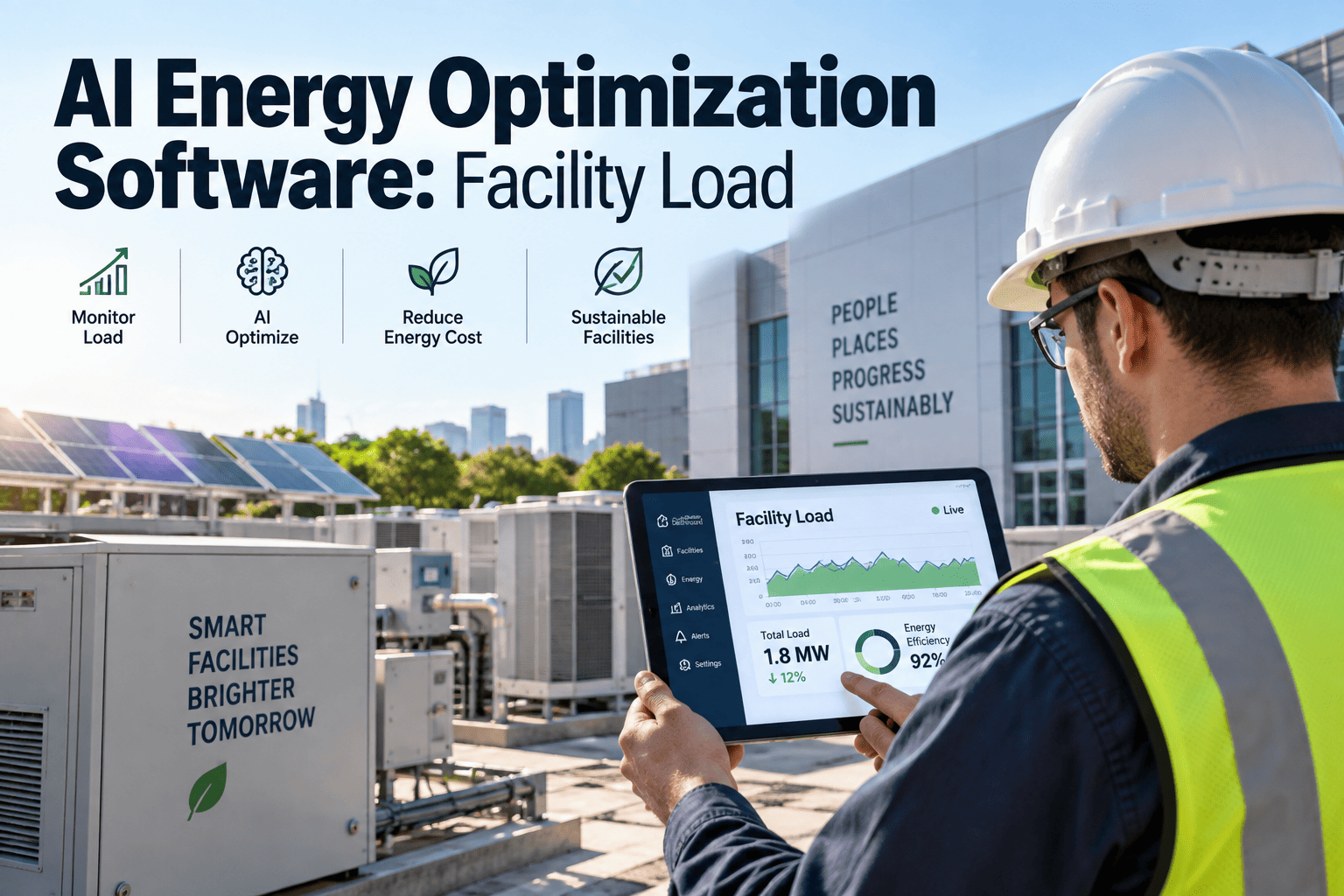
Every facility with rooftop units, chillers, compressors, conveyors, or server racks burns energy against a load curve that shifts hour by hour, yet most buildings still run on fixed schedules and static setpoints configured years ago and never revisited since. AI energy optimization software changes that equation by continuously reading weather forecasts, occupancy patterns, utility tariffs, and live equipment telemetry to predict tomorrow's load and adjust operations before waste happens instead of after the bill arrives. Facility teams across manufacturing plants, data centers, hospitals, warehouses, and commercial real estate are under growing pressure to cut energy use intensity without compromising uptime, comfort, or output, and legacy building management systems were simply never built to learn or forecast anything. OxMaint brings AI-driven load prediction, demand response automation, and setpoint optimization into one maintenance management platform so facility teams see energy waste and equipment risk in the same view instead of juggling five disconnected tools. See how the workflow fits your facility by starting a free trial at app.oxmaint.ai.
Stop Guessing Your Facility's Energy Load — Let AI Predict It Before It Happens
Fixed schedules and manual setpoints cannot keep up with shifting occupancy, weather swings, and time-of-use utility pricing. OxMaint's AI energy optimization software forecasts facility load, automates demand response, and fine-tunes setpoints continuously so your team cuts energy spend without touching a single dashboard every hour.
Why Facility Load Optimization Cannot Wait Until Next Budget Cycle
Energy is no longer a background line item — it is one of the largest controllable costs in facility operations, and the gap between facilities that optimize load intelligently and those that don't is widening every quarter. Static scheduling and rule-based building controls waste a significant share of consumption simply because they cannot react to conditions that change hour to hour. AI energy optimization software closes that gap by learning your facility's real behavior instead of relying on assumptions made at commissioning.
Core Capabilities of AI Energy Optimization Software
Not every energy tool does the same job. Facility teams evaluating AI energy optimization software in 2026 need platforms that combine forecasting, automated response, and maintenance execution — because predicting waste is only useful if someone (or something) actually acts on it. OxMaint organizes these capabilities into one connected workflow rather than separate point solutions.
Load Prediction and Forecasting
Machine learning models ingest weather forecasts, historical consumption, occupancy sensors, and production schedules to predict facility load 24 to 72 hours ahead, giving operators time to plan rather than react after a spike hits the meter.
Automated Demand Response
When utility signals or peak-pricing windows approach, the system automatically curtails non-critical loads, shifts flexible processes, or pre-cools spaces ahead of the peak so facilities avoid demand charges without manual intervention every time.
Dynamic Setpoint Optimization
Instead of fixed temperature and pressure setpoints, AI continuously recalculates the most efficient operating point for chillers, boilers, compressors, and air handlers based on real-time load and comfort constraints, not a static commissioning sheet.
Anomaly and Waste Detection
Sudden consumption spikes, equipment running outside normal patterns, or after-hours loads get flagged automatically, converting invisible energy waste into a work order before it accumulates into a costly utility bill surprise.
Peak Shaving and Demand Charge Management
Demand charges can represent a large share of a facility's monthly utility bill. AI optimization software predicts approaching peaks and sequences equipment operation to shave the top of the load curve before it registers on the meter.
Utility Tariff Intelligence
Time-of-use rates, seasonal pricing, and demand response incentive programs are factored directly into scheduling logic, so equipment runs when electricity is cheapest without a facility manager cross-referencing a rate sheet by hand.
Legacy Building Controls vs AI-Driven Energy Optimization
The difference between a rule-based building management system and an AI-driven optimization layer is not cosmetic — it changes how a facility behaves under real-world variability. This comparison shows what most facility teams experience before and after adopting predictive load optimization.
AI Energy Optimization Capability Reference
Use this reference to compare what each capability actually delivers before selecting an AI energy optimization platform for your facility, whether that facility is a manufacturing plant, hospital, data center, or distribution warehouse.
| Capability | What It Does | Facility Impact |
|---|---|---|
| Load Forecasting | Predicts hourly and daily facility load using weather, occupancy, and historical data | Enables proactive scheduling instead of reactive firefighting |
| Demand Response Automation | Automatically curtails or shifts flexible loads during utility peak events | Reduces demand charges without manual staff intervention |
| Setpoint Optimization | Continuously recalculates efficient operating points for HVAC and process equipment | Cuts energy use while holding comfort and production targets |
| Anomaly Detection | Flags consumption patterns that deviate from expected equipment behavior | Surfaces hidden waste and failing equipment early |
| Peak Shaving | Sequences equipment operation to flatten the top of the load curve | Directly lowers monthly demand charge exposure |
| Tariff Intelligence | Aligns equipment scheduling with time-of-use and seasonal utility rates | Shifts consumption to lower-cost pricing windows automatically |
| Maintenance Integration | Converts detected inefficiency into a scheduled work order automatically | Closes the loop between energy insight and physical repair |
Turn Energy Data Into Action, Not Just Another Dashboard
Most energy monitoring tools stop at visibility. OxMaint goes further by connecting AI load prediction directly to work orders, technician schedules, and asset history so every flagged inefficiency actually gets fixed. See the difference in a live walkthrough of your own facility data.
Three Signs Your Facility Needs AI-Driven Load Optimization
Some facilities already know they are losing money on energy but cannot pinpoint where. These patterns are the clearest early warning signs that manual scheduling has stopped working for your operation.
If monthly consumption jumps without a matching change in production, occupancy, or weather, equipment is likely running outside its optimal setpoint and nobody has noticed yet.
Rising demand charges usually mean equipment is peaking together instead of being staggered, and nobody is forecasting the peak far enough ahead to prevent it.
Static setpoints that were correct five years ago are rarely correct today, especially as equipment ages, occupancy shifts, and utility rate structures change around them.
Case Study: Multi-Site Manufacturing Group Cuts Energy Spend Without Touching Production Targets
A multi-site manufacturing group running three plants across different climate zones struggled with inconsistent energy performance, where one facility ran efficiently while the others quietly bled budget through outdated setpoints and unmanaged peak demand.
Before OxMaint, each plant manager set HVAC and compressor schedules based on gut feeling and whatever the original commissioning documents said years earlier. We had no visibility into which facility was actually wasting energy or why. Once we connected AI load prediction to our maintenance workflow, setpoints started adjusting automatically based on real conditions at each site, and demand charge alerts gave us hours of warning before a peak instead of finding out on the bill. Energy use intensity dropped noticeably within the first two quarters, and our maintenance team finally had a direct line between an energy anomaly and the work order that fixed it, instead of two separate systems that never talked to each other.
— Director of Facilities, Multi-Site Manufacturing Group
AI Energy Optimization Software: Frequently Asked Questions
How is AI energy optimization different from a standard building management system?
Does AI energy optimization work for facilities without smart meters?
Will automated setpoint changes affect occupant comfort or production quality?
How quickly can a facility expect to see energy savings?
Can AI energy optimization connect to our existing maintenance software?
One Platform for Energy Optimization and Maintenance Across Every Facility Type
Managing AI energy optimization across a facility is complex, and OxMaint makes it simple by connecting load prediction directly to maintenance execution. As a cloud-based maintenance management platform, OxMaint gives facility teams the tools to schedule preventive maintenance, run digital inspections, log root cause analyses, track critical asset performance, and generate compliance reports in minutes rather than days.
Built for Manufacturing Facilities
Production lines, compressors, and process equipment get load-aware scheduling that respects output targets while trimming energy waste between shifts and during changeovers.
Built for Data Center Facilities
Cooling load prediction and setpoint optimization work alongside uptime requirements, giving data center teams a way to cut PUE without risking thermal headroom.
Built for Healthcare Facilities
Hospitals and clinics get demand response automation that respects life-safety and critical-care zones while optimizing everything else around them continuously.
Built for Commercial Real Estate
Multi-tenant buildings get occupancy-aware HVAC scheduling that adjusts floor by floor instead of applying one setpoint across an entire property.
Our platform is trusted by facility managers, reliability engineers, and multi-site operations teams because it works everywhere your team does — plant floors, utility rooms, rooftops, server rooms, and remote sites — with mobile access, offline mode, QR asset tags, and IoT integrations built in from day one. Reduce equipment downtime, extend asset life, control repair costs, and stay ahead of every energy audit with OxMaint.
Ready to Turn Facility Load Data Into Real Energy Savings
OxMaint connects AI load prediction, demand response automation, and setpoint optimization to the same platform your maintenance team already uses every day. Stop discovering energy waste on the utility bill and start catching it before it happens.