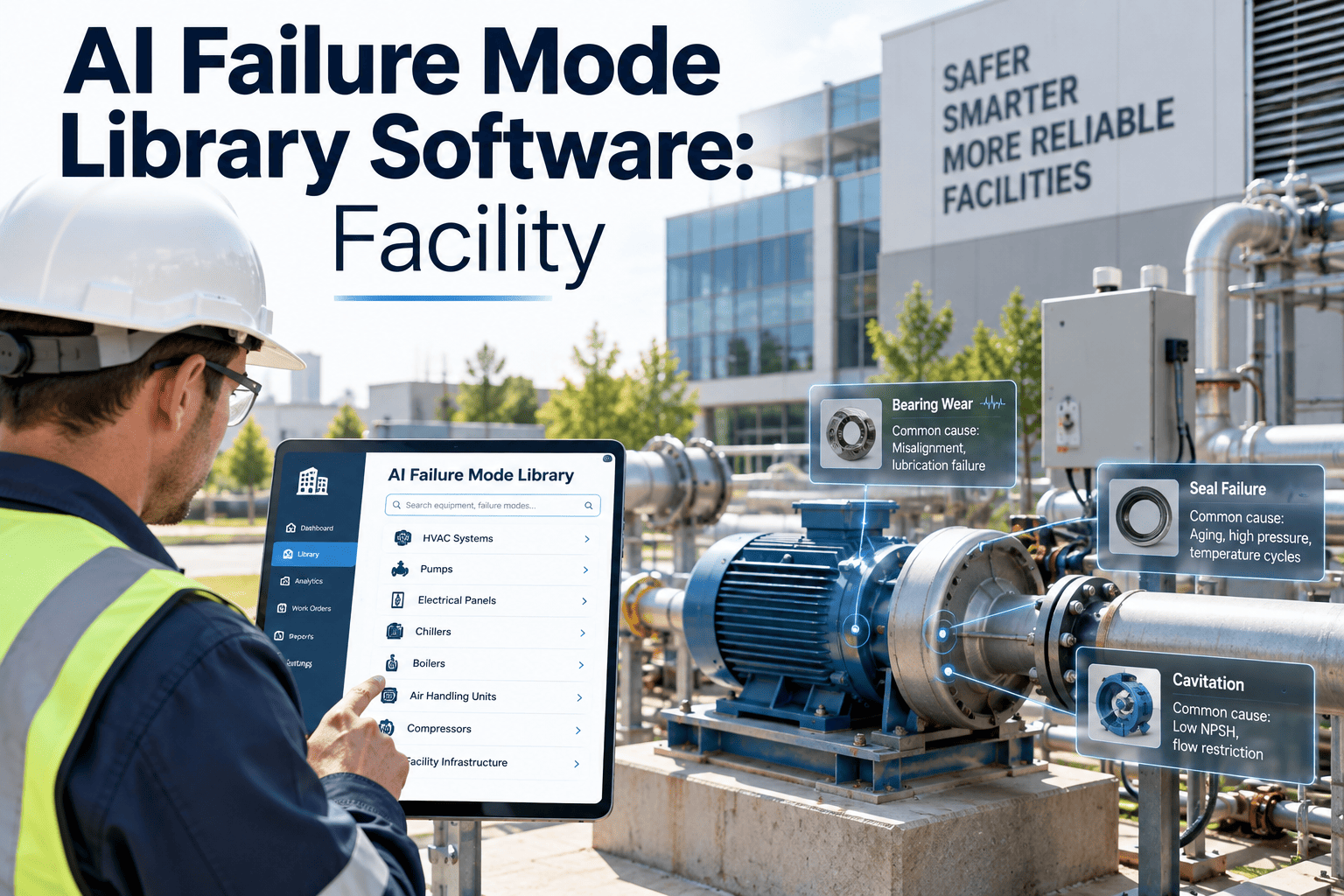
Every breakdown a facility experiences today has already happened somewhere before — the same bearing wear pattern, the same overheating sequence, the same voltage drop right before a motor trips. An AI failure mode library captures those recurring failure fingerprints so machine learning models can recognize them weeks before a technician would ever notice a problem. Most facilities still store this knowledge in scattered spreadsheets, retired technicians' memories, and paper work order stacks that no algorithm can ever read. OxMaint's maintenance management software builds a structured, searchable failure mode library directly from your daily work orders, inspections, and sensor readings, turning routine maintenance records into the training foundation every predictive model needs. Facility teams across manufacturing, healthcare, hospitality, education, and commercial real estate use this library to catch failures earlier and keep equipment running longer, and you can see it work on your own assets with a free trial.
Turn Every Repair Into Reusable Failure Intelligence
Predictive AI is only as smart as the failure data it learns from. OxMaint captures every failure signature, root cause, and repair outcome from your facility's daily work and organizes it into a living failure mode library — the exact fingerprint set your AI models need to predict the next breakdown before it happens.
What an AI Failure Mode Library Actually Stores
An AI failure mode library is not a spreadsheet of breakdown dates. It is a structured record of how each failure actually behaved — the sensor pattern that preceded it, the technician's diagnosis, the part that failed, and the fix that resolved it. OxMaint captures all four layers automatically so your facility builds a genuine training asset instead of another folder of unread PDFs.
Failure Fingerprints
The exact sequence of vibration, temperature, or current readings in the days before a component failed, tagged to the specific asset and failure type so models can match future patterns instantly.
Root Cause Tags
Standardized root cause categories — bearing wear, lubrication failure, misalignment, electrical fault — attached to every closed work order instead of a free-text note nobody searches again.
Repair Outcomes
Parts replaced, labor hours spent, and whether the repair held or recurred within 90 days, giving the library a feedback loop that separates real fixes from temporary patches.
Facilities Without a Failure Library vs Facilities With One
The difference between a facility that predicts failures and one that reacts to them almost never comes down to better sensors. It comes down to whether the historical failure data is structured enough for a model to learn from. OxMaint closes that gap so every past repair strengthens the next prediction.
Failure Mode Library Data Points OxMaint Captures Automatically
Building a usable AI failure mode library depends on capturing consistent data at every step of the maintenance workflow. This table shows what OxMaint records, why each data point matters to a predictive model, and where it comes from inside your daily operations.
| Data Captured | Why AI Models Need It | Source Inside OxMaint |
|---|---|---|
| Vibration and thermal signature | Defines the early-stage pattern that precedes a specific failure type by days or weeks | Connected IoT sensors and condition monitoring feeds |
| Root cause classification | Lets a model group failures by mechanism instead of guessing from free-text notes | Structured dropdown fields on closed work orders |
| Time-to-failure duration | Establishes how long a degradation pattern typically runs before breakdown | Asset history timestamps from open to close |
| Parts consumed and repair action | Confirms which fix actually resolved the failure rather than masking it temporarily | Inventory and work order completion records |
| Recurrence within 90 days | Flags failed repairs so the library does not reinforce a bad fix as a good one | Automated follow-up work order matching |
| Technician diagnosis notes | Adds human context that pure sensor data misses, especially for mechanical wear | Mobile app voice-to-text and structured comments |
| Cross-site failure frequency | Reveals whether a failure mode is asset-specific or a fleet-wide design issue | Multi-site asset comparison dashboards |
Your Work Orders Are Already Writing the Library — Stop Losing Them
Every inspection, repair, and technician note your team files today is potential training data for tomorrow's failure predictions. OxMaint structures it automatically so nothing gets buried in a closed ticket again. See your own asset history converted into a searchable failure library in your first session.
Three Signs Your Facility Is Losing Failure Intelligence
Most facilities do not realize they are throwing away valuable failure data until a predictive maintenance project stalls for lack of usable history. These three warning signs show up long before that point, and each one is fixable with the right structured workflow.
Work Orders Close With One-Line Notes
If technicians close tickets with notes like "fixed" or "replaced part" with no root cause field, that failure event is invisible to any future model, no matter how good your sensors are.
The Same Asset Fails Three Times a Year and Nobody Notices
Without a searchable failure history, repeat failures on the same pump, motor, or unit blend into the general work order backlog instead of triggering a redesign or replacement decision.
Sensor Data and Repair History Live in Separate Systems
If your condition monitoring platform and your CMMS never talk to each other, no model can ever connect a sensor pattern to the failure it actually caused, and predictions stay guesswork.
How OxMaint Builds Your Failure Mode Library Automatically
You do not need a data science team to start building an AI failure mode library. OxMaint structures the data as part of the maintenance workflow your technicians already follow every day, so the library grows without anyone filling out an extra form.
Automatic Failure Tagging
Every closed work order is prompted for a standardized root cause and failure type, so free-text notes turn into structured, searchable failure records without extra technician effort.
Sensor Signature Capture
Vibration, temperature, and current readings from connected IoT sensors attach directly to the asset's failure timeline, linking condition data to the outcome it actually predicted.
Cross-Site Pattern Matching
OxMaint compares failure modes across every site in your portfolio, surfacing fleet-wide issues that would stay invisible if each facility tracked failures in isolation.
Predictive Work Order Generation
Once the library recognizes a failure signature, OxMaint auto-generates a condition-based work order with the recommended fix pulled straight from past repair outcomes.
AI Failure Mode Library: Frequently Asked Questions
How is an AI failure mode library different from a normal maintenance history log?
Do we need IoT sensors installed before we can start building a failure library?
How long before our facility has enough data to train a useful prediction model?
Can our existing historical work orders be converted into the failure library?
Who actually owns the failure mode library data once it is built in OxMaint?
Case Study: A Hospital Facilities Team Cut Repeat Chiller Failures by Half
A regional hospital system managing central plant chillers across four campuses discovered that nearly a third of their emergency work orders were repeat failures on the same three chiller units, each one logged with a different technician's shorthand and no shared root cause record.
Before OxMaint, every chiller failure looked like a new problem because our work order notes were never consistent between shifts. Once we standardized root cause tagging and connected our vibration sensors to the same asset timeline, the pattern became obvious within two months — bearing wear on the same compressor stage was causing over half our repeat failures. We scheduled condition-based replacements before the next breakdown instead of waiting for another emergency callout. Our repeat chiller failures dropped by roughly half in under a year, and our new technicians now open a work order and see the entire failure history before they even walk to the unit.
Facilities Director, Regional Hospital System
Start Building Your Facility's Failure Mode Library Today
The failure fingerprints your AI models need are already sitting in your work order history — they just need structure. OxMaint's maintenance management software organizes root causes, sensor signatures, and repair outcomes into one searchable library so your facility predicts failures instead of chasing them.