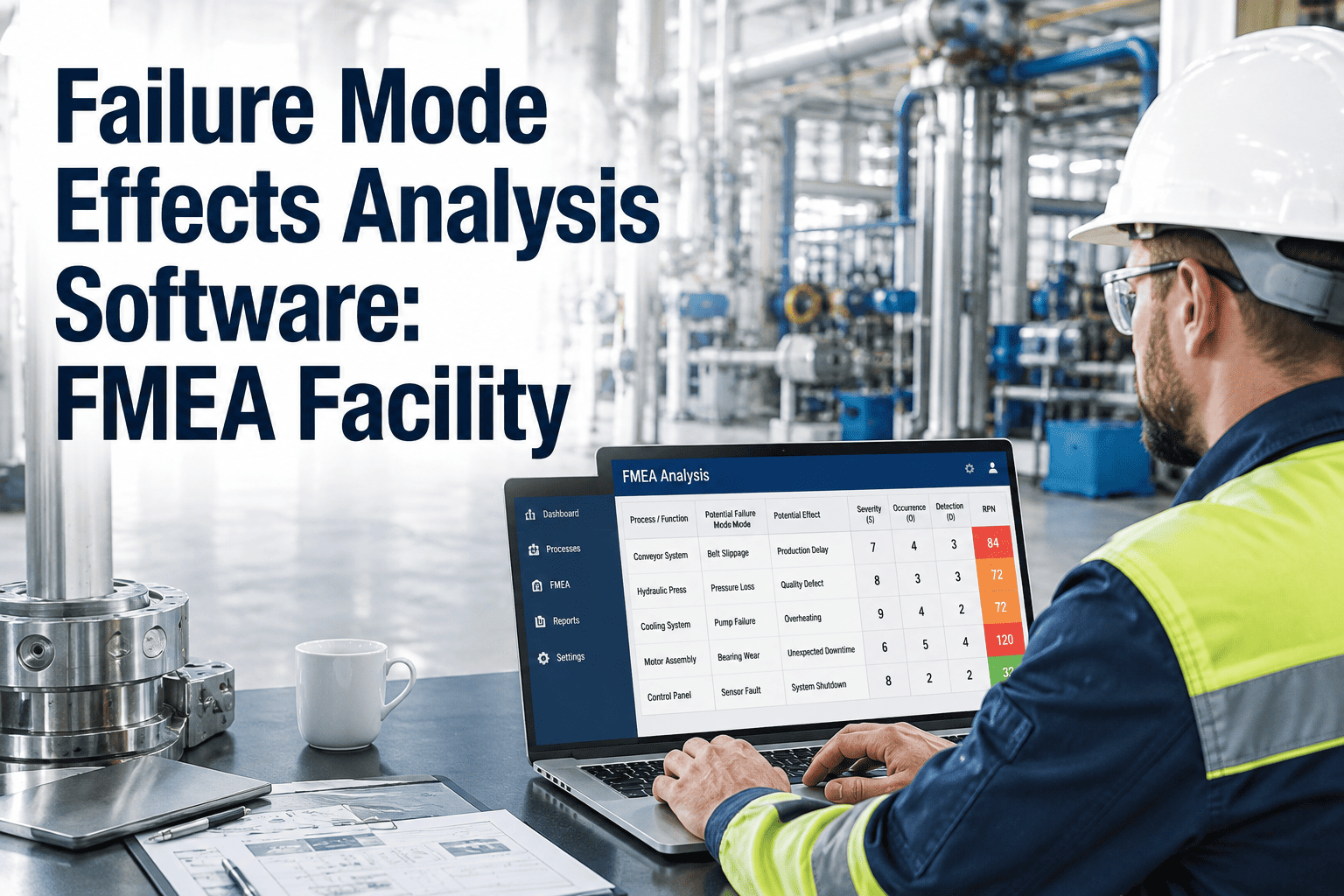
Failure Mode Effects Analysis Software: FMEA Facility

By Corin Hale on August 21, 2026

failure-mode-effects-analysis-software-fmea-facility

When a critical air handling unit fails without warning in the middle of a heatwave, facility teams rarely ask why the compressor broke — they ask why nobody saw it coming. Failure Mode and Effects Analysis exists to answer that second question before the first one happens, scoring every plausible failure mode across severity, occurrence, and detection so maintenance teams know which risks deserve attention now and which can wait. Most facilities still treat FMEA as a one-time spreadsheet exercise filed away after an audit and never opened again, which means the risk data goes stale the moment a new failure mode shows up on the floor. Modern facility CMMS software turns FMEA into a living workflow instead, where every risk score connects to a preventive maintenance task and every closed work order feeds fresh data back into the model. Book a demo to see how OxMaint runs FMEA as a continuous reliability programme, or start free and score your first failure mode today.

Guide · Reliability Engineering · Facility CMMS · 2026

Failure Mode Effects Analysis Software for Facility Teams

A practical breakdown of how facilities run FMEA inside a CMMS in 2026 — scoring failure modes, calculating Risk Priority Numbers, and turning the analysis into preventive maintenance that actually happens, instead of a document that sits in a shared drive.

S × O × D
is the formula every facility FMEA runs on — severity, occurrence, and detection multiplied into one Risk Priority Number
1–10
is the standard scoring scale for each factor, giving facility teams a shared language for comparing wildly different failure modes
0
is how many spreadsheet-based FMEAs update themselves — every score decays the moment a new failure occurs and nobody re-runs the analysis

What FMEA Actually Measures — and Why Facility Teams Get It Wrong

Failure Mode and Effects Analysis is not a compliance form. It is a structured way of asking three questions about every asset in a facility: how bad is it if this fails, how likely is that failure, and how early would we actually catch it. Facility teams that run FMEA once during a reliability audit and stop are answering those three questions for a single moment in time — the day the audit happened — and then treating that answer as permanent. Assets age, run hours accumulate, parts get substituted during emergency repairs, and none of that shows up in a spreadsheet that was closed out eighteen months ago. The result is a document that looks rigorous but drives no real decisions, because the maintenance team stopped trusting it as soon as the first failure mode it ranked "low risk" caused an unplanned shutdown.

The fix is not more FMEA. It is FMEA that lives inside the same system that generates work orders, closes preventive maintenance tasks, and records what technicians actually find in the field. When the analysis and the maintenance execution share one database, the Risk Priority Number for a given failure mode moves when reality moves — a bearing that keeps failing early gets its occurrence score bumped automatically instead of waiting for the next scheduled review.

The RPN Formula: Severity, Occurrence, Detection

Every FMEA score comes down to the same three-factor calculation, and understanding each factor separately is what makes the Risk Priority Number defensible instead of arbitrary.

Severity (S)
How serious is the impact if this failure happens — safety risk, downtime cost, compliance exposure, or damage to connected equipment. Scored 1 (barely noticeable) to 10 (safety-critical or facility-wide shutdown).
Occurrence (O)
How likely is this failure mode to happen, based on run hours, asset age, environmental stress, and documented failure history. Scored 1 (almost never) to 10 (near certain within the maintenance cycle).
Detection (D)
How likely is the current inspection or monitoring routine to catch this failure before it causes damage. Scored 1 (caught every time) to 10 (no current method would detect it in time).
Risk Priority Number = Severity × Occurrence × Detection
A failure mode scored 8 on severity, 6 on occurrence, and 7 on detection produces an RPN of 336 — high enough to trigger an immediate preventive maintenance task rather than sit in a backlog behind lower-risk work.
FMEA · CMMS · RELIABILITY · OXMAINT

Stop Scoring Risk Once a Year. Start Tracking It Every Day.

OxMaint connects your FMEA scoring directly to preventive maintenance scheduling, work order history, and technician inspections — so the Risk Priority Number on every asset reflects what is actually happening on your floor, not what was true at last year's audit.

From Static Spreadsheet to Live CMMS Workflow — Four Steps

Turning FMEA into an operational habit rather than an annual document follows the same basic sequence across facility types, whether the portfolio is a hospital, a manufacturing plant, or a commercial office campus.

01
Identify the Failure Modes
List every plausible way each critical asset can fail — not just the obvious one. A chiller does not just "break," it can lose refrigerant charge, foul its condenser coils, or suffer compressor bearing wear, and each of those has a different severity and detection profile.
02
Score Each Factor With Real Data
Pull occurrence scores from actual maintenance history in the CMMS rather than guesswork, and set severity based on documented downtime cost or safety classification, so the ranking reflects your facility instead of a generic template.
03
Convert High RPN Into a PM Task
Any failure mode above your risk threshold gets an inspection interval, a documented procedure, and an owner assigned automatically, closing the gap between "we identified this risk" and "we are actually doing something about it."
04
Let Closed Work Orders Update the Score
Every completed inspection and repair feeds back into occurrence and detection scoring, so the RPN for a given failure mode rises or falls based on what technicians are actually finding — keeping the analysis current without a manual review cycle.

Spreadsheet FMEA vs FMEA Software Facility Teams Actually Use

The difference between a spreadsheet FMEA and a CMMS-connected FMEA is not formatting — it is whether the analysis can act on itself. The comparison below shows where the two approaches diverge in daily practice.

Capability Spreadsheet FMEA FMEA Software (OxMaint)
RPN calculation Manual entry, prone to formula errors and version drift across copies Automatic, consistent scoring applied across every asset and department
Failure history Relies on whoever remembers to update the file after a breakdown Pulled directly from closed work orders and inspection records
High-risk follow-up Flagged in a cell, easy to overlook once the file is closed Auto-generates a preventive maintenance task with an assigned owner
Multi-site visibility Separate files per site with no consolidated risk view Single dashboard ranking risk across every facility in the portfolio
Audit readiness Static document that may not reflect current asset condition Live record with timestamped scoring history for every asset

FMEA Looks Different Across Facility Types

The failure modes that matter most shift depending on what kind of facility you run — but the discipline of scoring, prioritising, and converting risk into maintenance action stays the same.

Hospitals and Healthcare
Medical gas systems, emergency generators, and sterilisation equipment carry the highest severity scores, since a detection failure can directly affect patient safety and regulatory standing.
Manufacturing Plants
Occurrence scores dominate the risk picture — high-cycle equipment like conveyors and compressors fail predictably, making run-hour tracking the most valuable input into the model.
Data Centres
Detection is the critical factor, since cooling and power redundancy is designed to mask a single failure until a second one compounds it into an outage.
Commercial Real Estate
Elevators, fire suppression, and building automation systems carry tenant-facing severity, where a slow detection cycle turns a minor fault into a liability issue.
Government and Public Facilities
Aging infrastructure raises occurrence scores across the board, while compliance reporting requirements make a documented, current FMEA record a procurement necessity rather than a nice-to-have.
RISK SCORING · PREVENTIVE MAINTENANCE · OXMAINT

Your Highest-Risk Failure Mode Is Already in Your Maintenance History.

OxMaint reads your existing work order and inspection data to help you build a defensible FMEA baseline in days, not months — then keeps every Risk Priority Number current as new maintenance data comes in.

Frequently Asked Questions

What is a good Risk Priority Number threshold for facility maintenance?
Most facility teams set an action threshold between 100 and 150 out of a possible 1,000, adjusting based on how conservative their safety and compliance posture needs to be. Any failure mode above the threshold should automatically generate a preventive maintenance task rather than wait for a scheduled review. Book a demo to see how OxMaint sets and enforces threshold rules automatically.
How is FMEA different from a general preventive maintenance schedule?
A preventive maintenance schedule tells technicians what to do and when. FMEA is the analysis that justifies why — it identifies which failure modes are worth scheduling for and which are low enough risk to leave as run-to-failure, so maintenance effort goes where it actually reduces downtime.
Can FMEA scoring update automatically as new failures happen?
Yes, when FMEA runs inside a CMMS rather than a standalone spreadsheet. Every closed work order and inspection result can feed back into occurrence and detection scoring, so the Risk Priority Number for an asset reflects current conditions instead of a one-time estimate. Start free to see this update in real time on your own asset data.
Who should be involved in scoring severity, occurrence, and detection?
Severity is usually set by facility or safety leadership based on downtime cost and risk classification. Occurrence should come from technicians and maintenance history rather than assumption. Detection is best scored jointly, since it depends on both current inspection routines and how reliably they are actually followed.
Does FMEA software help with compliance reporting?
A live FMEA record with timestamped scoring history gives auditors evidence that risk is being actively managed rather than assumed, which is increasingly expected under reliability-focused standards like ISO 55000. Book a demo to see OxMaint's audit-ready FMEA reporting.
FMEA SOFTWARE · FACILITY CMMS · OXMAINT

Turn Your Next Failure Mode Into a Prevented Failure.

OxMaint gives facility and reliability teams a single platform to score risk, generate preventive maintenance from that scoring, and keep every Risk Priority Number current as real maintenance data comes in — so FMEA stops being a document and starts being a habit.

Share This Story, Choose Your Platform!