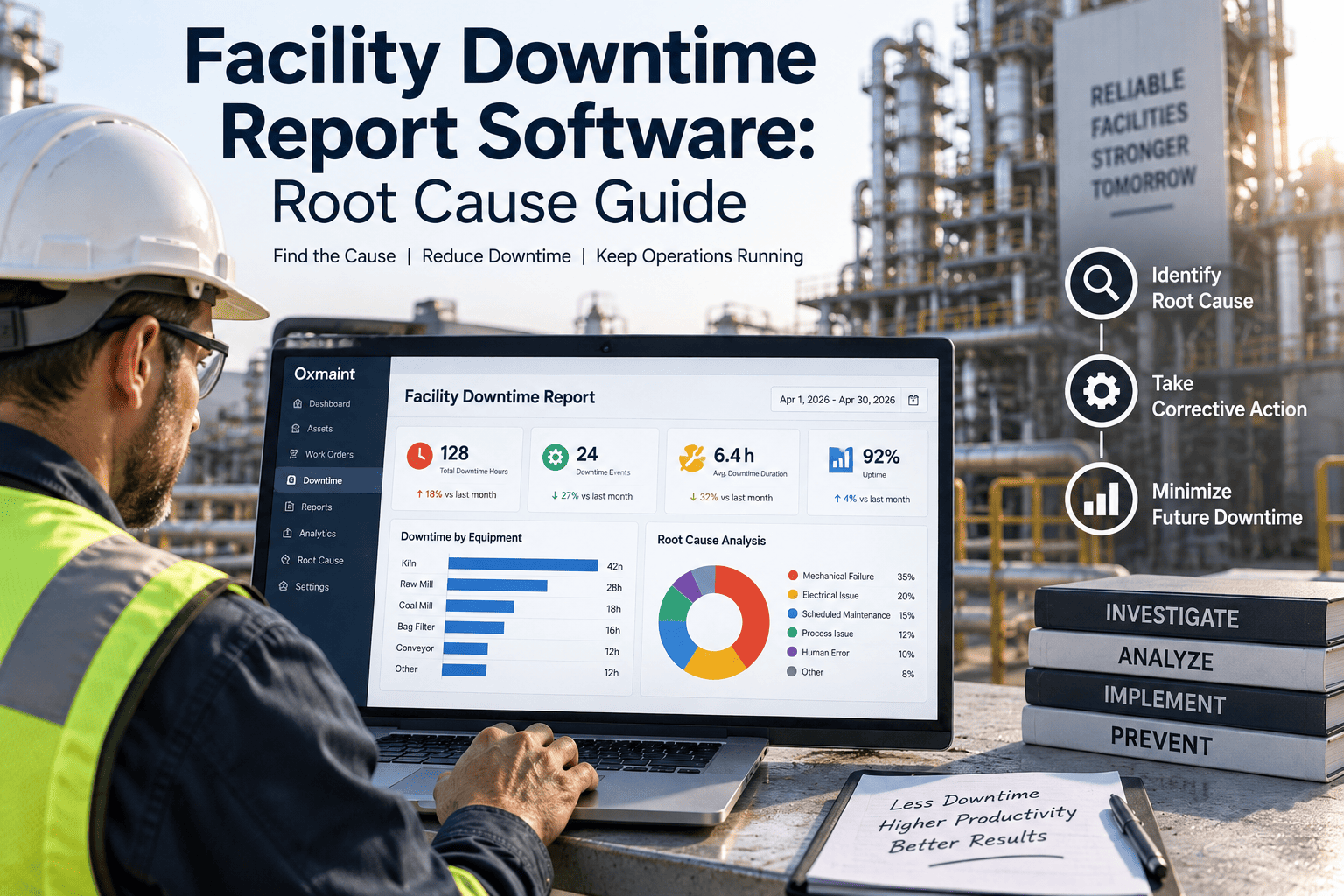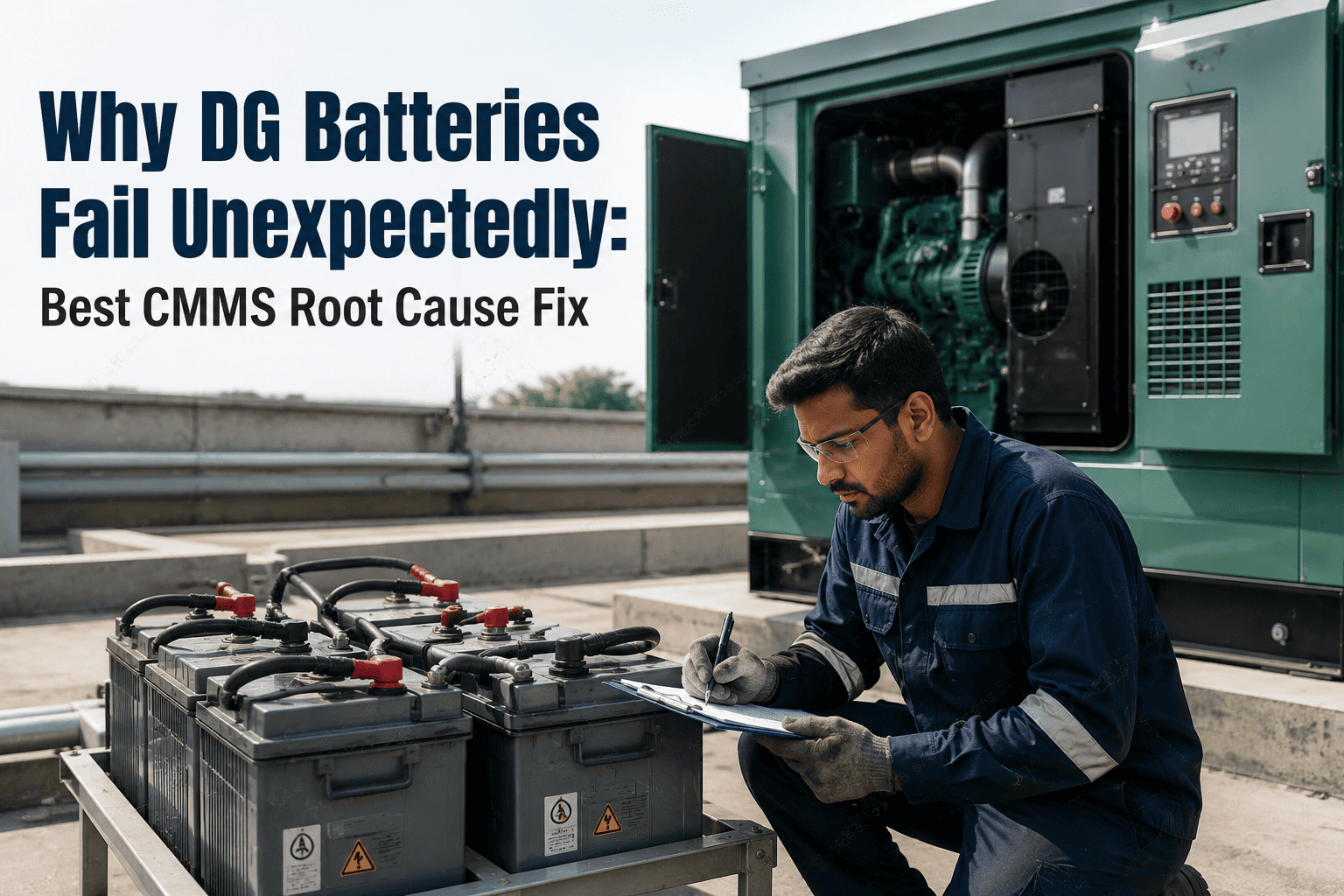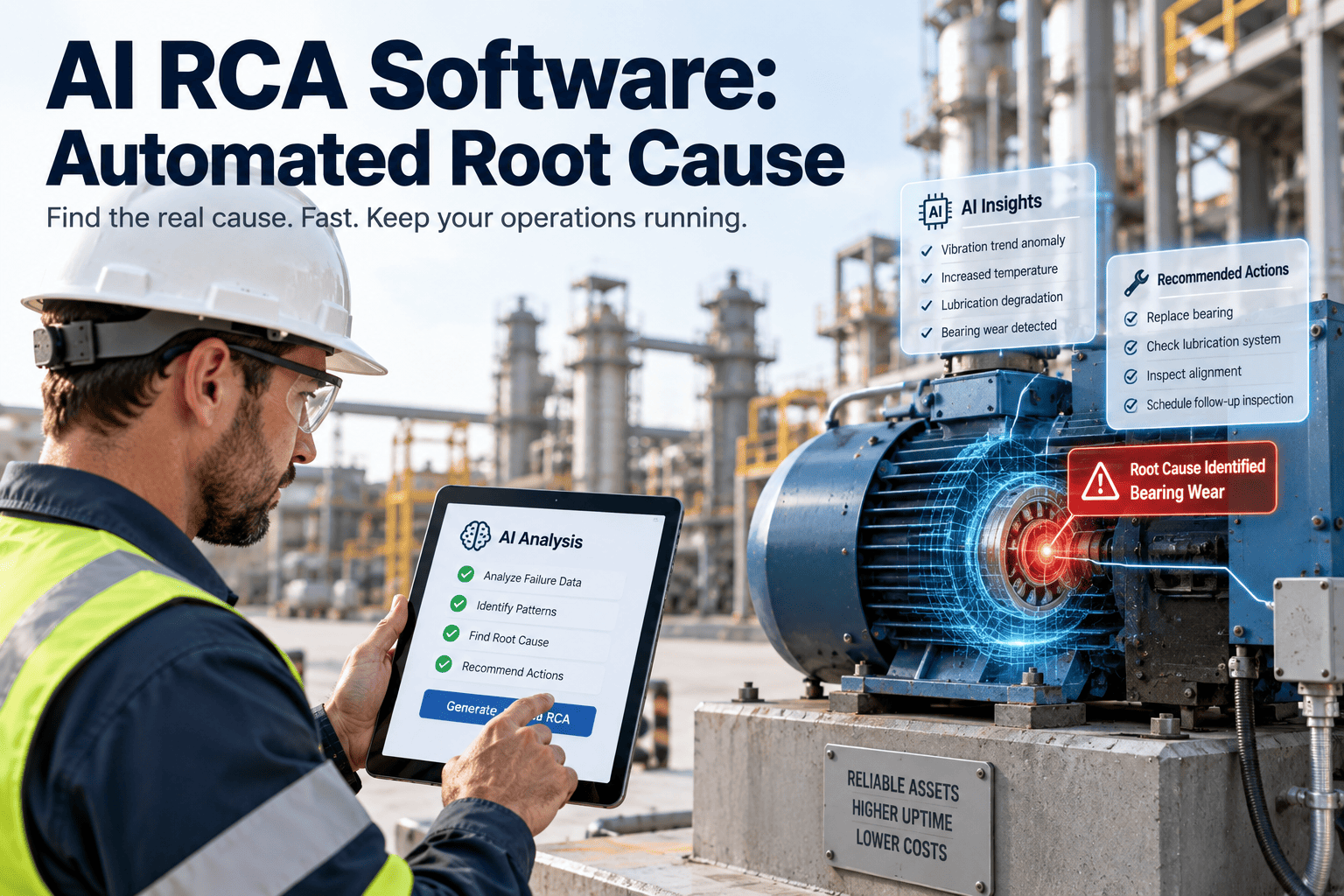
Root cause analysis is the step most facility maintenance teams know they should do and most often skip. A failed pump gets repaired, the work order is closed with "replaced seal," and three months later the same seal fails again. Manual RCA takes hours of meetings, depends on who is in the room and rarely looks across hundreds of past work orders for patterns. AI RCA software changes the starting point by surfacing recurring failures, correlating them with operating conditions and ranking likely causes for engineers to verify. This guide explains how automated root cause analysis works and how to run RCA workflows inside Oxmaint.
AI RCA Software: Find the Pattern Behind Repeat Facility Failures, Then Eliminate It
Use maintenance history, failure codes, sensor trends and inspection results to identify recurring failure patterns, rank probable causes and track corrective actions until the failure stops coming back.
Illustrative causal chain: repeat AHU trips
Why Manual Root Cause Analysis Breaks Down in Facilities
Classic RCA methods are sound. The problem is capacity and data. Facility teams handle thousands of work orders across mixed equipment, and manual analysis cannot keep pace with the volume.
RCA is reserved for major events
Formal investigations happen after big outages, while the chronic small failures that consume most labor never get analyzed.
Work-order data is inconsistent
Free-text notes like "fixed" or "checked and reset" hide the failure mode, so patterns are invisible in reports.
Analysis depends on who attends
Five Whys sessions reflect the experience and assumptions of the people in the room, which introduces bias and gaps.
Cross-site patterns are missed
The same failure on identical equipment at different buildings is treated as separate, unrelated events.
Corrective actions are not tracked
Recommendations are written in a report, then never converted into procedure changes, PM updates or verified fixes.
Findings stop at the physical cause
Teams replace the failed part but rarely reach the human and organizational causes that allowed the failure.
The Three Levels of Root Cause Every Facility RCA Should Reach
A common reason failures return is that analysis stops at the first broken component. Mature RCA practice separates causes into three levels, and corrective actions are needed at each one to stop recurrence.
Physical root cause
The tangible mechanism that failed, such as a worn bearing, a loose termination or a corroded fitting. Replacing the part restores function but rarely prevents the next failure on its own.
Human root cause
A decision or action that allowed the physical cause, such as skipping an alignment check or using the wrong lubricant. The focus is on the action, not on blaming the person.
Latent root cause
The system condition behind the human decision: missing procedures, inadequate training, wrong tools, unclear specifications or PM tasks that never covered the failure mode. Fixing this level is what makes elimination permanent.
Where AI adds value
Pattern analysis is strongest at surfacing physical and procedural clues across many events. Human and latent causes still require interviews, procedure reviews and engineering judgment.
Manual RCA vs. AI-Assisted RCA: What Actually Changes
AI does not replace engineering judgment. It changes how much data is examined, how quickly patterns surface and how consistently findings are recorded. The final root cause is still confirmed by people who know the equipment.
| Aspect | Manual RCA | AI-assisted RCA |
|---|---|---|
| Trigger | Major failures or management request | Automatic flags on repeat failures and unusual patterns |
| Data examined | Recent work orders and team memory | Full work-order history, failure codes, sensor trends and inspections |
| Pattern detection | Limited to what investigators recall | Clusters similar failures across assets, sites and time periods |
| Hypotheses | Generated in the meeting | Ranked candidate causes presented for engineers to test |
| Speed to first insight | Days to weeks, depending on scheduling | Faster initial analysis, followed by human verification |
| Consistency | Varies by facilitator and team | Same structure and data applied to every case |
| Follow-through | Actions tracked separately, often lost | Corrective actions linked to assets and work orders |
| Limitations | Time, bias, limited data review | Depends on data quality; correlation is not proof of cause |
The Data That Automated Root Cause Analysis Uses
Pattern-based RCA is only as strong as its inputs. Facilities that get value from AI RCA software usually connect several of these sources to a common asset record.
Asset record
The shared reference that ties every data source to one piece of equipment.
Work-order history
Descriptions, labor, parts used, dates and closeout notes.
Failure codes
Structured problem, cause and remedy codes, ideally aligned to a taxonomy such as ISO 14224.
Sensor and BAS trends
Temperatures, pressures, vibration, current and run hours before each failure.
Inspection results
Checklist readings, photos and findings from routine rounds.
PM records
When preventive tasks were done, skipped or deferred ahead of a failure.
Parts and vendors
Which replacement parts, batches or suppliers precede repeat failures.
How Pattern-Based Root Cause Identification Works
Automated RCA follows a disciplined sequence. Software handles the heavy data work in the early steps, and engineers take over for verification and corrective action.
Flag recurrence
Identify assets or failure modes that repeat beyond an agreed threshold within a set period.
Cluster similar events
Group failures by asset type, mode, location, text similarity and operating condition.
Correlate conditions
Compare sensor trends, PM timing, parts and season before failures with normal periods.
Rank hypotheses
Present the most likely contributing causes with the evidence behind each one.
Verify the cause
Inspect, test or teardown to confirm or reject each hypothesis with physical evidence.
Act and confirm
Implement corrective actions, update PM tasks and track whether recurrence stops.
Stop Closing the Same Work Order Twice
Log failure codes, run root cause workflows and link every corrective action to the asset in one CMMS your whole team uses.
How AI Augments Traditional RCA Methods
Established techniques remain the backbone of good analysis. AI makes each method faster to start and better informed, without changing its logic.
| Method | What it does | How AI assistance helps | Where people stay essential |
|---|---|---|---|
| Five Whys | Asks why repeatedly until a controllable cause appears | Pre-fills evidence from history for each "why" | Judging when the real root has been reached |
| Fishbone (Ishikawa) | Organizes causes by category such as method, machine, material, people, environment | Suggests candidate causes per category from similar past events | Adding site knowledge the data does not capture |
| Fault tree analysis | Maps logical combinations of events leading to a failure | Supplies event frequencies from maintenance records | Building correct system logic |
| FMEA | Rates failure modes by severity, occurrence and detection, as in IEC 60812 | Updates occurrence ratings from actual failure data | Rating severity and deciding actions |
| Pareto analysis | Ranks failures by frequency, cost or downtime | Generates Pareto views automatically and continuously | Choosing which bar to attack first |
Before and After: A Recurring Pump Seal Failure
The scenario below is a hypothetical composite used to show the workflow, not a customer case study. It reflects a common facility pattern on chilled water and condenser water pumps.
Before: repair and close
- Seal leak reported, seal replaced, work order closed
- Same pump leaks again a few months later
- Each event logged with different free-text notes
- Sister pumps at another building show similar leaks, unnoticed
- Seals blamed as poor quality, supplier changed
After: pattern, verify, eliminate
- Recurrence flag raised on the seal failure code
- Clustering links failures across both buildings
- Correlation points to post-coupling-work vibration rise
- Engineer confirms misalignment with laser alignment check
- Alignment step added to the PM and repair job plan
Recurring Facility Failures Where AI RCA Delivers the Most Value
Automated root cause analysis pays off fastest on failure types that repeat often, leave a data trail and have causes that are hard to see from a single event. These patterns are common across commercial, healthcare, education and industrial facilities.
| Recurring failure | Typical surface explanation | Deeper causes pattern analysis often points toward | Evidence to verify |
|---|---|---|---|
| AHU fan belt and bearing failures | Worn belt, old bearing | Misalignment, over-tensioning, lubrication practice, wrong belt specification | Laser alignment readings, vibration spectra, lubrication records |
| Pump mechanical seal leaks | Poor quality seals | Misalignment after coupling work, running off the best efficiency point, dry running | Alignment checks, pressure and flow trends, installation records |
| Electrical connection hot spots | Aging panel | Improper torque during past work, thermal cycling, overloaded circuits | Infrared surveys under load, torque records, load data |
| Repeated comfort complaints in one zone | Occupant preference | Sensor drift, stuck dampers or valves, control sequence errors | BAS trends, sensor calibration results, damper and valve checks |
| Motor trips on the same circuit | Faulty motor | Voltage imbalance, undersized protection, environmental contamination | Power quality readings, insulation resistance tests, inspection photos |
| Recurring plumbing leaks | Old pipework | Water pressure spikes, water chemistry, dissimilar metal joints | Pressure logs, water treatment records, material inspection |
Common Pitfalls with Automated Root Cause Analysis
AI RCA tools can mislead as easily as they can help if the program is set up carelessly. Watch for these pitfalls from the first day of rollout.
Treating correlation as cause
A failure that follows hot weather may be driven by load, not temperature itself. Every ranked hypothesis needs physical verification before it is recorded.
Feeding poor failure codes
If technicians pick the first code on the list, the analysis will confidently find the wrong pattern. Keep code lists short and train on them.
Using RCA to assign blame
When findings point to people instead of procedures and systems, technicians stop reporting honestly and data quality collapses.
Flagging more than the team can handle
Hundreds of open RCA flags become background noise. Limit automatic triggers to critical assets and true repeats until capacity grows.
Closing analysis without a recurrence check
An RCA is not finished when the report is written. It is finished when data shows the failure stopped returning.
Implementation Checklist for AI RCA Software
A structured rollout avoids the most common outcome of RCA tools: a dashboard full of flags that no one owns. Work through these items in order.
Data foundation
- Define problem, cause and remedy codes and make them mandatory at closeout
- Clean duplicate and misnamed assets in the register
- Connect available sensor or inspection data to asset records
Triggers and scope
- Set recurrence thresholds that open an RCA automatically
- Prioritize RCA on high-criticality assets first
- Agree which events always require a formal investigation
Governance
- Assign an owner for every open RCA
- Require human sign-off before a root cause is recorded
- Record rejected hypotheses so the model and team learn
Follow-through
- Convert each corrective action into a tracked work order or task
- Update PM procedures and checklists where the cause was procedural
- Schedule a recurrence check to confirm the fix worked
KPIs That Prove Root Cause Elimination Is Working
The goal of RCA is fewer repeat failures, not more reports. These measures show whether analysis is changing outcomes on the floor.
Repeat failure rate
Failures recurring on the same asset and mode within a set window.
RCA cycle time
Time from recurrence flag to verified root cause.
Action completion
Share of corrective actions completed by their due dates.
Failure code quality
Share of closed work orders with valid problem, cause and remedy codes.
MTBF on analyzed assets
Trend of mean time between failures after corrective actions.
Reactive labor share
Proportion of hours spent on unplanned repairs over time.
How Oxmaint Supports Root Cause Analysis in Facility Maintenance
Oxmaint gives facility teams the records and workflows that make root cause analysis repeatable, from the first failure report to the verified fix.
Structured work orders
Capture failure details, parts, labor and photos on mobile so history is usable for analysis.
RCA workflows
Log root cause analyses against assets and link findings to the events that triggered them.
Condition data
Bring IoT sensor readings and inspection results next to failure history.
Corrective and preventive updates
Turn findings into corrective work orders and revised PM schedules and checklists.
Dashboards and compliance reports
Show repeat failures, open actions and asset performance across sites for audits and reviews.
AI RCA Software FAQs
What is AI RCA software?
It analyzes maintenance history, failure codes and condition data to spot recurring failure patterns and rank likely causes, which engineers then verify and correct.
Can AI find the root cause without people?
No. AI finds correlations and candidate causes quickly, but confirming a root cause requires physical evidence and engineering judgment from the team.
What data do we need for automated root cause analysis?
Start with consistent failure codes on work orders and a clean asset register. Sensor and inspection data add depth as they become available.
Which failures should trigger an RCA?
Repeat failures on the same asset and mode, failures on critical assets and any safety or compliance event. You can configure RCA workflows in Oxmaint around these triggers.
How do we know a corrective action worked?
Track recurrence on the same asset and mode after the fix. Schedule a demo to see how actions link to follow-up checks.
Turn Every Repeat Failure into a Permanent Fix
Capture better failure data, surface patterns faster and track corrective actions to closure. Pick one recurring problem and run your first structured RCA this week.