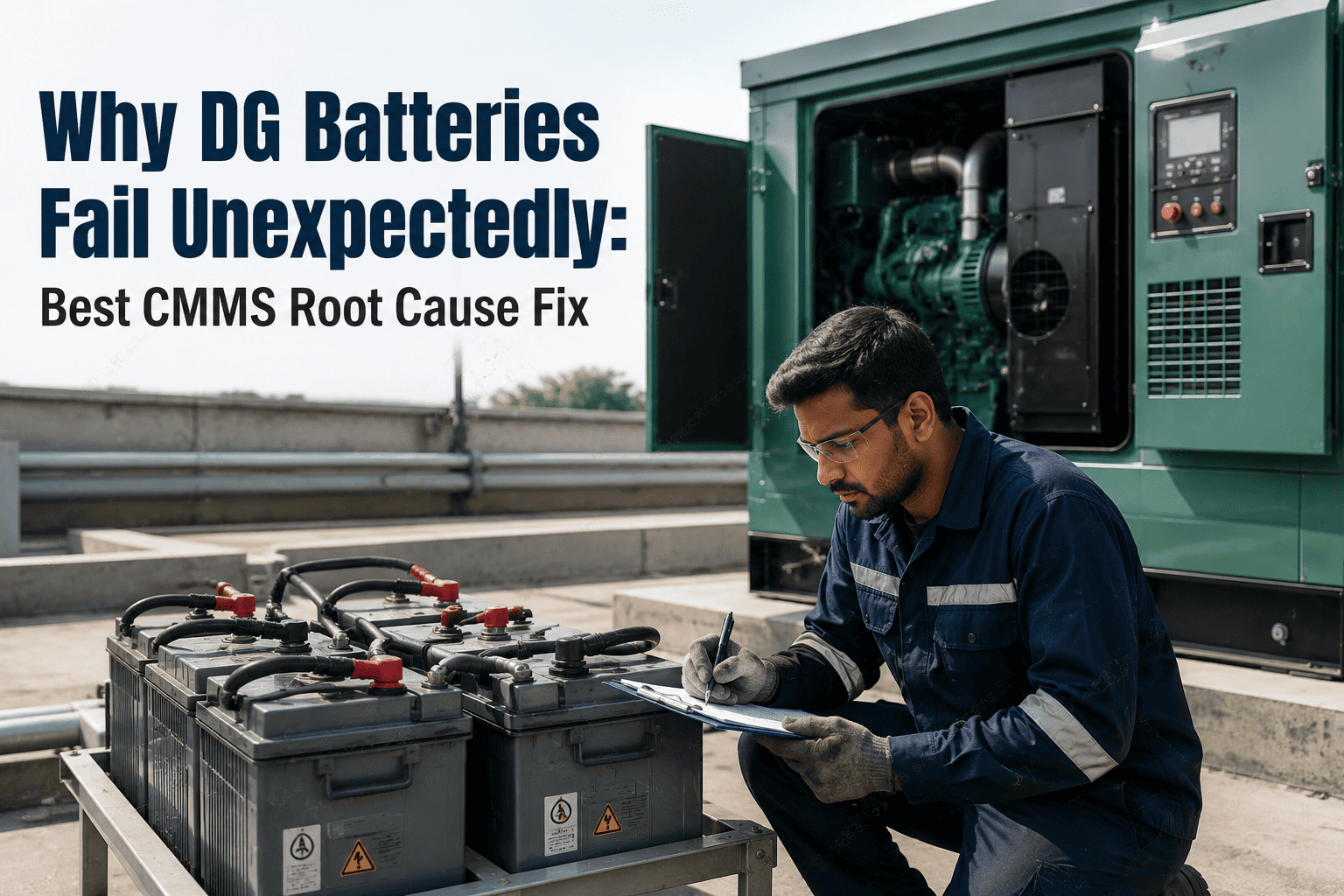
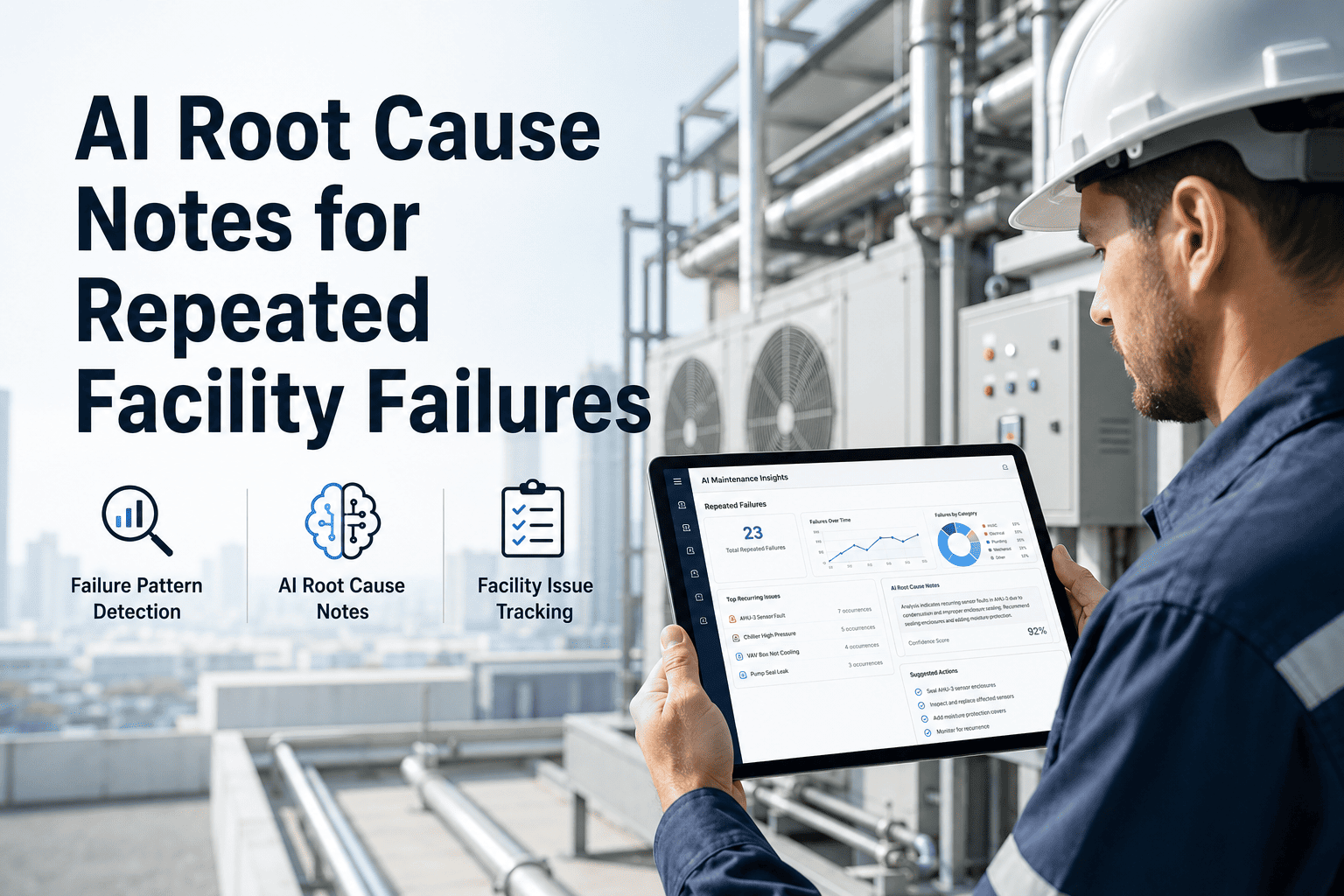
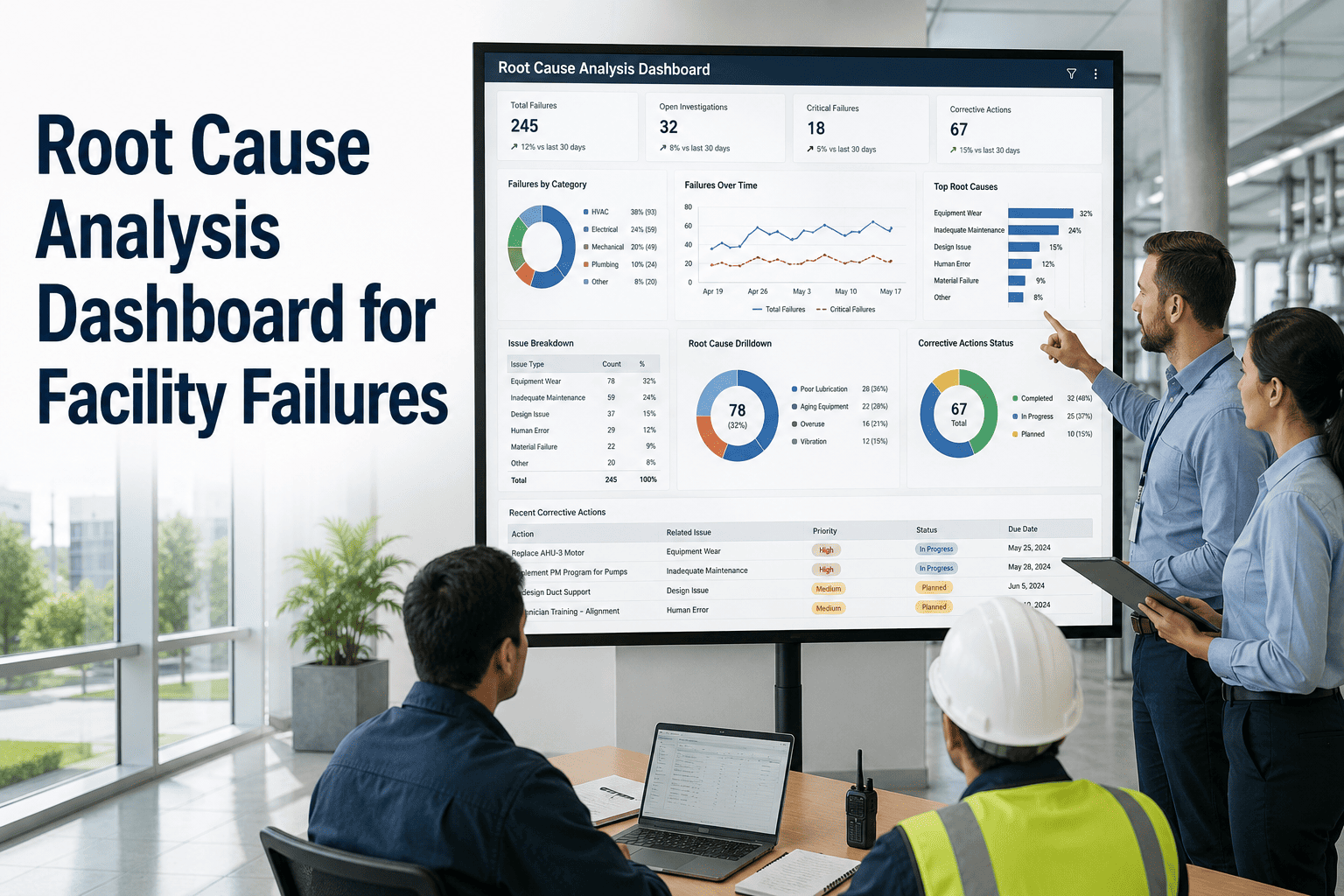
The battery read 25.4 volts on Monday morning. The technician wrote it in the log, ticked the weekly inspection, and moved on. On Thursday the utility dropped, the transfer switch called for the set, the starter drew current, the bus collapsed to eight volts, and the DG never turned over. Nothing failed on Thursday — the battery had been dying for eleven months and every test performed on it was incapable of noticing. That is the uncomfortable truth about DG starting batteries: they almost never fail unexpectedly, they fail invisibly, and the four mechanisms behind it are individually boring and completely predictable. OxMaint turns those four mechanisms into tracked, trending, alarmed data instead of a voltage number in a paper logbook.
Battery failure is the single most frequent generator service call — and roughly 80% of it traces to one mechanism
43–60%
Share of generator no-start events attributed to the battery and charging system across published field studies
80%
Of all battery failures trace to sulfation — lead sulfate crystallising on the plates during chronic undercharge
3–5 yrs
Typical service life of a DG starting battery, which most facilities never track as an asset interval
10 sec
Window a Type 10 emergency system has to start and accept load — no room for a slow crank
Why Voltage Is the Most Misleading Number in the Generator Room
A resting lead-acid battery holds its terminal voltage long after it has lost the ability to deliver current. Open-circuit voltage measures potential, not capacity — a heavily sulfated battery can sit at full nominal voltage and still collapse the moment a starter motor asks it for several hundred amps. This is the single reason DG battery failures feel unexpected: the routine measurement being recorded is structurally incapable of detecting the failure that is developing. Three different measurements exist, and they answer three different questions.
Open-circuit voltage
Answers: is it connected and roughly charged?
Specific gravity
Answers: is each cell actually accepting charge?
Conductance test
Detects plate degradation
Answers: how much usable plate area is left?
Load or crank test
Detects real delivery capability
Answers: will it actually turn the engine over?
On a 24V system a healthy resting bank sits near 25.2V. What matters is the voltage under cranking load — a collapse toward the equivalent of 9V on a 12V system means the cranking amps are gone, whatever the resting reading said.
The Four Reasons DG Batteries Fail — And What Each One Looks Like Early
These are not exotic failure modes. Every one of them produces a signal months before the no-start, and every one of those signals is a number somebody could have been trending. The problem is that the signal lives in a different place from the logbook — in charger output, in ambient temperature, in a torque check, in an install date nobody recorded.
01
Chronic undercharge and sulfation
A charger set slightly low, a tripped AC feed breaker, or a float voltage with no temperature compensation leaves the bank permanently a few percent short of full. Lead sulfate crystallises on the plates and hardens. Usable capacity falls while resting voltage stays convincing.
Early signal
Charger output amperage drifting from its established baseline
Missed because
Nobody records charger current, so there is no baseline to drift from
Time to failure
Months of silent capacity loss before the first hard crank
02
Heat quietly halving the service life
Float life follows a brutal staircase — roughly ten years at 20°C, five at 30°C, two and a half at 40°C. A battery in an unventilated container or a rooftop enclosure is not on a five-year replacement clock; it is on a two-year one, and the maintenance schedule almost never knows that.
Early signal
Sustained enclosure temperature above 30°C through summer months
Missed because
Replacement intervals are copied from the datasheet, not from site conditions
Time to failure
Arrives one to three years earlier than the planned interval
03
Connections, corrosion and parasitic draw
Terminal corrosion and loose cable lugs add resistance exactly where hundreds of cranking amps have to pass. Meanwhile controllers, block heaters and telemetry pull a continuous small load that a marginal charger cannot fully replace. Both faults look like a dead battery and neither one is.
Early signal
Slow crank, warm lugs, visible sulfate bloom, torque falling out of spec
Missed because
Visual inspection has no numeric threshold, so nobody escalates it
Time to failure
Can go from nuisance to total no-start in a single cold night
04
Age tracked nowhere and replaced on failure
Ask most sites how old the DG batteries are and the honest answer is a shrug. Without a recorded install date there is no interval, no budget line and no proactive replacement — so the battery is replaced the day after it fails, which is the one day it was needed.
Early signal
The install date itself — the most predictive data point available
Missed because
The battery is treated as a consumable, not as a tracked asset
Time to failure
Risk rises steeply past year three, sharply past year five
Read those four together and the pattern is obvious. None of them are detected by the measurement most sites perform, and all four are detected by data a maintenance system could be holding. That gap — between what is measured and what is decisive — is the entire root cause. Book a working session with our team and bring one generator's battery history; the missing field is usually visible immediately.
DG Battery Root Cause Tracking — OxMaint
Your Battery Is Not Failing Unexpectedly. It Is Failing Unobserved.
OxMaint holds install date, charger output trend, enclosure temperature, conductance history, torque checks and load test results against the specific generator asset — so degradation is visible as a slope, months before it becomes a no-start.
Heat Is the Multiplier Almost Nobody Logs
Of the four mechanisms, temperature is the one that most reliably invalidates a maintenance plan, because it changes the answer without changing anything visible. The relationship is not linear and it is not gentle. Every ten degrees above the reference temperature approximately halves float service life, which means an enclosure running warm through a long summer is consuming battery life at two to four times the rate the replacement schedule assumes.
Approximate Float Service Life Against Sustained Operating Temperature
There is a matching penalty at the top of the range. Manufacturer data on gel batteries puts a float setting 0.3V above recommendation at roughly a tenth of cycle life lost, and 0.7V above at around 60% lost. Float is not a ceiling to stay under — it is a narrow window, and staying inside it is a settings-and-temperature discipline rather than a maintenance task.
What NFPA 110 Actually Requires of the Battery
For emergency and standby power systems, the battery obligations are explicit and short. They are also frequently performed and almost as frequently unrecorded, which is the same outcome as not performing them when the AHJ asks for evidence.
Interval
Requirement
What Is Actually Being Proven
Field Failure Mode
Weekly
Inspect electrolyte level or battery voltage; inspect the full EPSS
The bank is connected, charging, and not physically deteriorating
Recorded as a tick, not a value — so no trend ever forms
Monthly
Test and record specific gravity; conductance permitted in lieu where applicable
Each cell is genuinely accepting and holding charge
Skipped on sealed banks because the hydrometer will not fit
Monthly
Exercise under load, minimum 30 minutes at not less than 30% of nameplate
The set starts, transfers and carries real load
Run at light load, which hides both wet stacking and weak cranking
Annually
Battery load testing; supplemental load testing where monthly load minimums are not met
Cranking capability under genuine current demand
Deferred in a busy year and never rescheduled
On discovery
Defective batteries replaced immediately
No known-bad component is left in the start circuit
Finding noted verbally, no work order raised, no closure evidence
Every 3 years
Level 1 systems: extended load test at not less than 30% for four continuous hours
Sustained capability across a realistic outage duration
Interval outlives the staff who scheduled it and quietly lapses
Notice that the right-hand column is never a technical failure. It is a records failure, an escalation failure, or an interval-ownership failure. That is precisely the category of problem a maintenance platform exists to remove. Set the intervals once in OxMaint and the work orders generate themselves, with the readings captured as numbers rather than checkmarks.
Choosing a CMMS That Actually Solves Battery Root Cause
Most maintenance platforms in 2026 will schedule a battery inspection. Very few will let you answer the only question that matters after a no-start: what changed, and when did it start changing? Use this as the evaluation checklist when you compare platforms.
Numeric readings, not checkboxes
Voltage, specific gravity, conductance and charger output stored as values against the asset, so a slope can be drawn across cycles rather than a series of passes.
Battery as an asset, not a task
Install date, chemistry, rated cranking amps, enclosure location and replacement interval held on a child asset under the generator, with its own history.
Condition-adjusted intervals
Replacement schedules that can be tightened for hot enclosures instead of applying one datasheet figure to every site regardless of environment.
Finding to work order in one step
A failed reading raises a linked corrective job automatically, carrying the parent inspection reference so the closure evidence forms a chain.
Offline mobile capture
Generator rooms, basements, rooftops and remote sites rarely have signal. Readings entered at the asset are accurate; readings entered later from memory are fiction.
Audit-ready export by asset
Full interval history per generator, retrievable in the format an AHJ, an accreditation surveyor or an insurance underwriter expects to review.
How the Root Cause Loop Runs in OxMaint
Root cause analysis fails in most facilities not because people cannot reason, but because the evidence needed to reason with was never captured. The loop below closes that gap, and it runs continuously rather than only after an incident.
Step 1
Register the battery bank as its own asset
Chemistry, install date, rated capacity, charger model, enclosure and expected life sit under the parent generator with a QR tag on the rack for instant lookup in the field.
Step 2
Schedule the intervals to the standard
Weekly, monthly, annual and three-year requirements pre-configured at asset level, auto-generating work orders and firing overdue alerts before an inspection reveals the gap.
Step 3
Capture values on mobile at the machine
Digital checklists demand a number in every field — resting voltage, cranking voltage, cell gravity or conductance, charger amperage, terminal torque, enclosure temperature.
Step 4
Trend, threshold and alert
Readings plot across cycles. A conductance decline or a charger current drifting off baseline raises a flag while there is still time to act, not after the transfer switch has called.
Step 5
Log the root cause against the asset
Every failure and near miss is recorded with its mechanism, so the next battery on that site inherits the lesson — a hot enclosure gets a shorter interval, a suspect charger gets replaced.
Step 6
Produce the evidence on demand
Interval history, readings, corrective work and signatures export per generator, so compliance is something you can prove rather than something you believe.
Best CMMS for DG Battery Reliability — 2026
A Battery Costs a Few Hundred Dollars. The Outage It Fails To Cover Does Not.
Put every DG battery bank on a tracked interval with numeric readings, trended degradation and automatic corrective work orders — across one site or two hundred.
Frequently Asked Questions
Why did our DG battery fail when the weekly voltage check was always normal?
Resting voltage measures potential, not delivery capability. A sulfated battery can hold nominal voltage and still collapse under a starter's current draw. Conductance or load testing is what detects the loss —
and storing those readings as values is what lets you see it coming.
How often should DG starting batteries be replaced?
Three to five years is the common planning figure, but temperature dominates it. Sustained operation around 40°C can roughly halve life twice over compared with a 20°C reference, so hot enclosures need a materially shorter interval than the datasheet suggests.
Does NFPA 110 allow conductance testing instead of specific gravity?
Yes. Monthly specific gravity testing and recording is the baseline for lead-acid banks, and conductance testing is permitted in lieu where applicable — which is what makes sealed maintenance-free batteries testable at all. Either way, the value must be recorded.
What is the fastest sign that the charger, not the battery, is the problem?
A charger output current that has drifted from its established month-to-month baseline. A healthy charger holds a consistent rate for a given system; a rising or erratic figure points to either the charger or the bank it is feeding. This only works if the baseline exists.
Can a CMMS realistically prevent a no-start event?
It cannot stop a battery ageing, but every mechanism behind a no-start leaves a numeric trail first. Capturing those numbers, trending them and raising corrective work automatically is what converts a surprise into a planned replacement —
a short demo shows the workflow end to end.
OxMaint — DG Battery Failure Analysis
Stop Discovering Battery Condition During an Outage.
4
failure mechanisms, all trackable
Every
reading stored as a value
Register the bank, set the intervals, capture the numbers on mobile, and let the trend tell you when to replace — before the transfer switch asks the question for you.