Most facility teams exploring AI maintenance tools discover the same obstacle: the platform is ready, but their data is not. AI work order automation, predictive maintenance, and intelligent scheduling all require a minimum threshold of clean asset data, consistent work order history, and mobile adoption before they return any value. OxMaint's AI work order automation is built to grow with your data maturity — start with basic workflows and activate advanced features as your readiness improves. Book a readiness consultation to assess where your facility stands, or sign up free to begin building the foundation today.
AI READINESS · FACILITY CMMS · CHECKLIST
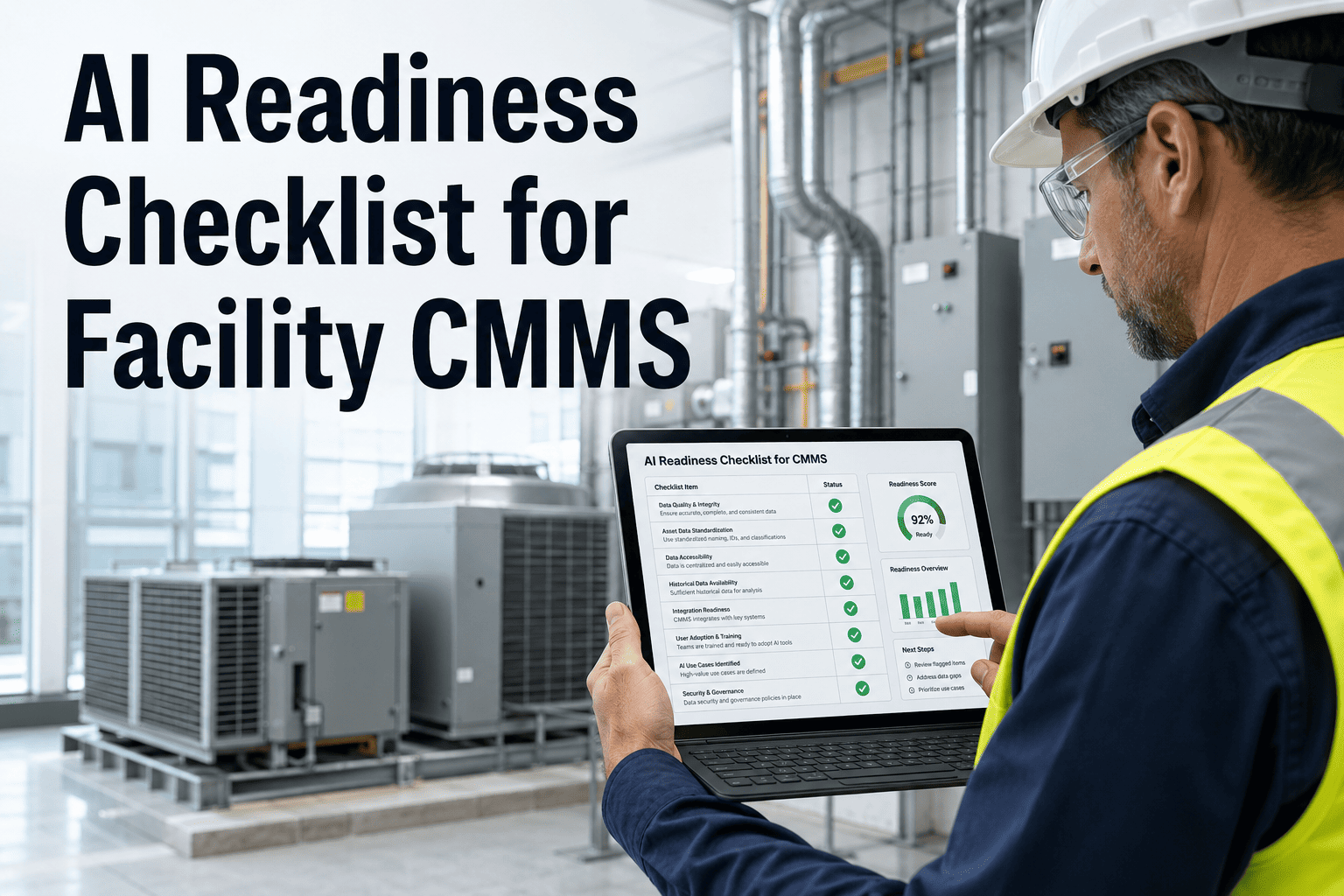
AI Readiness Checklist for Facility CMMS
Before your facility can benefit from AI maintenance workflows, five capability areas must reach minimum threshold. This checklist tells you exactly where you stand — and what to fix first.
READINESS AREAS
Sensor / IoT Coverage
20%
78%
of AI maintenance pilots fail or underperform due to insufficient asset data quality, not platform limitations
12 mo
minimum work order history needed for AI to detect reliable failure patterns in mechanical equipment
85%
mobile work order capture rate required before AI triage recommendations are based on complete field data
READINESS AREA 1 OF 5
Asset Data Quality
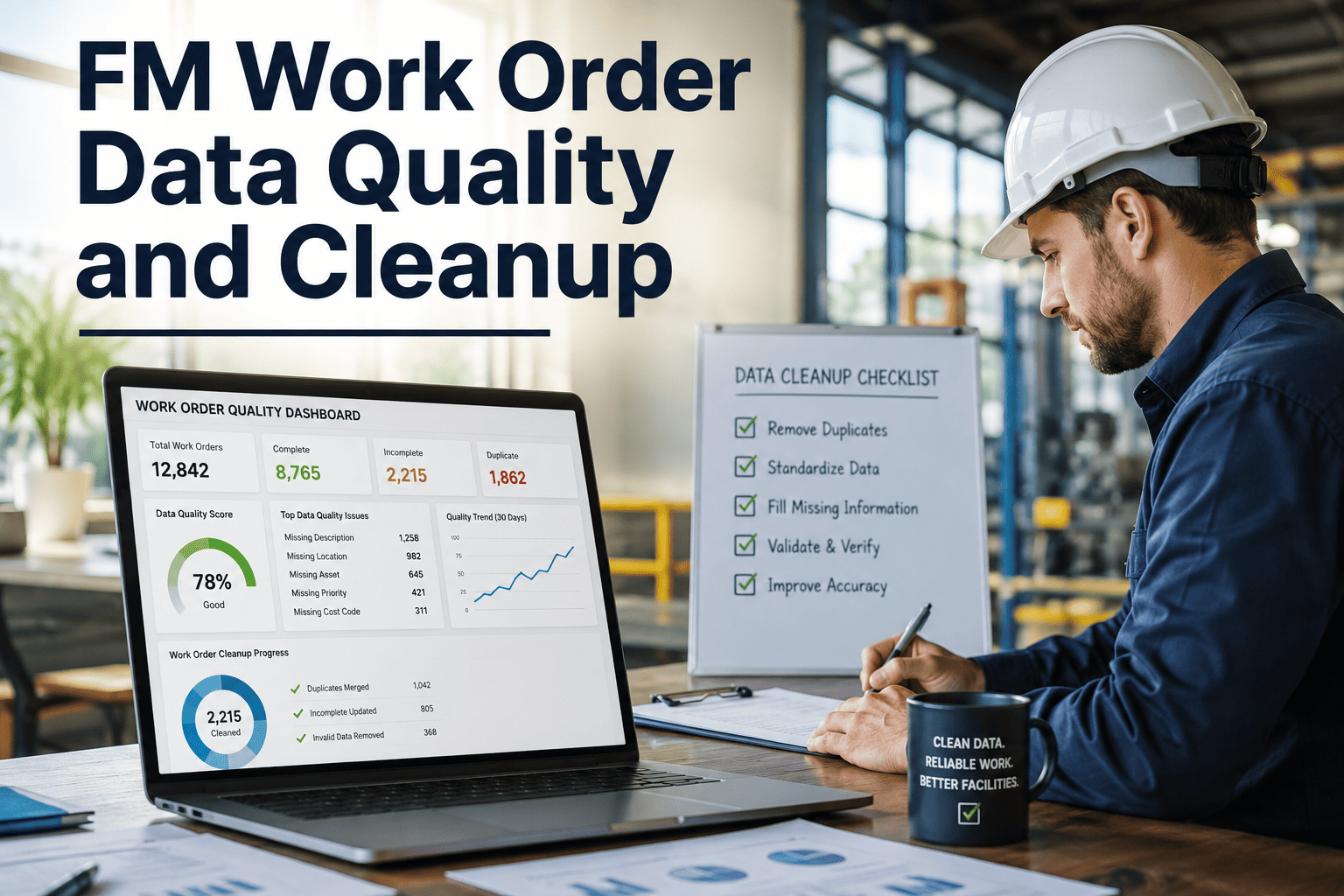
AI work order routing, predictive PM intervals, and failure pattern analysis all run on asset records. Without clean, complete data, AI recommendations reference the wrong equipment, the wrong location, or equipment that no longer exists.
Every active asset has a unique ID, name, location (building/floor/room), and asset class
100% of active assets
Zero confirmed duplicate asset records in the active system
0 duplicates
Criticality rating assigned to all HVAC, mechanical, electrical, and plumbing assets
90%+ of critical assets
Install date or approximate year populated for assets with 5+ years of service history
75%+ of aged assets
READINESS AREA 2 OF 5
Work Order History Depth
AI failure pattern detection requires historical work orders with enough detail to identify recurrence. Sparse, incomplete, or deferred-note work orders produce noise, not signal. Twelve months of consistent data is the minimum; 24 months enables seasonal failure pattern analysis.
At least 12 months of work order data linked to specific assets (not just building-level)
12 months minimum
Work orders include failure description, repair notes, and parts used — not just completion status
70%+ of closed WOs
PM completions are recorded with actual completion date (not just scheduled date)
95%+ of PM records
Unplanned / reactive work orders are distinguishable from planned PM work in the dataset
Work order type field populated
READINESS AREA 3 OF 5
Sensor and IoT Coverage
Real-time sensor data is not required for AI maintenance adoption — but it dramatically expands what AI can predict. Facilities without sensors can still benefit from AI-assisted PM scheduling and work order triage. Sensor integration unlocks condition-based triggering and anomaly detection.
| AI Capability |
Requires Sensors |
Needs Only CMMS Data |
Minimum Readiness Level |
| AI work order triage and routing |
No |
Yes |
Asset data + 6 mo WO history |
| AI-recommended PM interval adjustment |
No |
Yes |
12 mo WO history + PM records |
| Failure pattern detection |
No |
Yes |
18 mo WO history with rich notes |
| Condition-based PM triggering |
Yes |
No |
Sensor integration + baseline data |
| Real-time anomaly alerts |
Yes |
No |
Sensor integration + thresholds set |
Not Sure Where Your Facility Stands on AI Readiness?
OxMaint's onboarding team runs a structured readiness review in your first demo — covering asset data quality, work order history depth, and mobile adoption gaps — and builds a 90-day plan to close them.
READINESS AREAS 4 AND 5
Mobile Adoption and Reporting Baseline
Mobile Work Order Capture
AI triage is only as good as the field data it learns from. If technicians are still recording completions on paper or at a desktop hours after the work, AI models train on incomplete, delayed records. Minimum 80% mobile capture rate before activating AI routing.
Technicians closing work orders from mobile device at the asset
Voice notes or photo capture used in at least 50% of reactive work orders
QR scan at asset used to open or verify work order before closing
Mobile capture rate above 80% for 60+ consecutive days
Reporting Baseline in Place
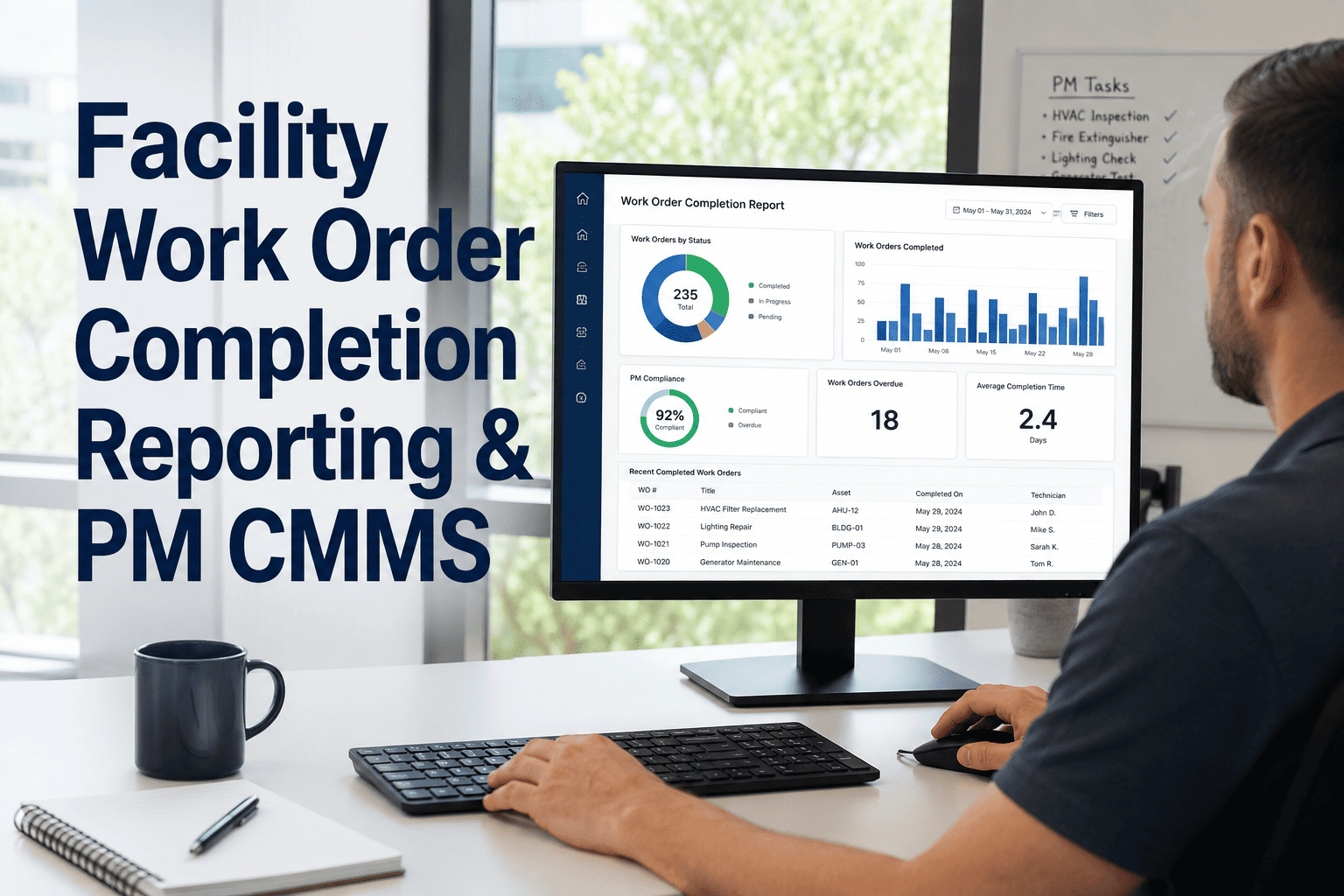
AI maintenance recommendations are meaningless without a reporting baseline to measure against. Before AI, teams need standard KPIs tracked — PM compliance rate, MTTR by asset class, reactive vs planned ratio — so AI improvements are measurable.
PM completion rate tracked and reviewed monthly (target: above 85%)
MTTR (mean time to repair) calculated at asset class level, not just total fleet
Reactive vs planned maintenance ratio calculated per quarter
Backlog aging report reviewed weekly — open WOs older than 30 days flagged
EXPERT REVIEW
AI and Predictive Maintenance Strategist
Director of Digital Maintenance Transformation — Portfolio Facilities and Industrial Operations
The facilities teams that get the most from AI maintenance tools are rarely the ones with the most sophisticated sensor infrastructure. They are the teams with the most disciplined data practices — clean asset records, complete work order notes, and consistent mobile capture in the field. I advise clients to think of AI readiness as a data quality problem first and a technology problem second. Get your asset master clean, get your technicians capturing notes at the equipment, and set a 12-month data baseline before activating AI features. OxMaint's phased feature model is well-suited for this — you activate AI capabilities as your data matures, which means early wins rather than a failed pilot that discredits the entire initiative.
FREQUENTLY ASKED
AI Readiness for Facility CMMS — Common Questions
Can we start using OxMaint's AI features before we have 12 months of work order history?
Yes — OxMaint's AI work order triage and routing activates with as little as 6 months of history linked to specific assets. The recommendations improve as data accumulates. Facilities that start fresh in OxMaint typically reach minimum AI readiness within 6–9 months of consistent use, at which point failure pattern features begin producing actionable insights. The checklist above indicates minimum thresholds for each capability, not all-or-nothing activation.
Sign up free to begin building your data baseline today — every work order you log moves you closer to AI readiness.
Do we need IoT sensors to get value from AI maintenance workflows?
No. The AI triage, PM interval optimization, and failure pattern capabilities in OxMaint run entirely on CMMS data — work order history, asset records, PM completions, and mobile field notes. Sensor integration expands what is possible (condition-based triggering, real-time anomaly alerts) but is not required for significant value from AI work order and scheduling features. Most facilities that lack sensors still see measurable improvements in PM compliance and reactive work reduction within 90 days of activating AI triage.
Book a demo to see a capability demonstration based on your specific data situation.
How do we measure whether AI maintenance features are actually working?
The four metrics that most clearly show AI impact in the first 6 months are: PM compliance rate (should increase as AI scheduling closes overdue PMs), reactive-to-planned ratio (should shift toward planned as AI catches degradation earlier), mean time to repair by asset class (should decrease as AI routes to more qualified technicians), and work order backlog aging (open WOs older than 30 days should decline). Establishing these as baseline KPIs before AI activation — covered in Readiness Area 5 above — makes the improvement measurable rather than anecdotal.
What is the biggest mistake teams make when adopting AI maintenance tools?
Activating AI features on top of incomplete or inconsistent data and then blaming the AI when recommendations are poor. AI does not fix bad data — it amplifies whatever patterns exist in the dataset. A model trained on work orders with missing notes and misrouted asset links will produce unreliable routing suggestions. The correct approach is to use the AI readiness checklist as a gate: complete each readiness area to threshold before activating the corresponding AI capability, and set a 90-day measurement period after each activation to confirm improvement before expanding further.
OXMAINT · AI WORK ORDER AUTOMATION · FACILITY CMMS
Build the Foundation. Activate AI When Your Data Is Ready.
OxMaint's phased AI model lets facility teams start with core CMMS workflows, build a clean data foundation, and activate AI triage, PM optimization, and failure pattern features as readiness milestones are met.