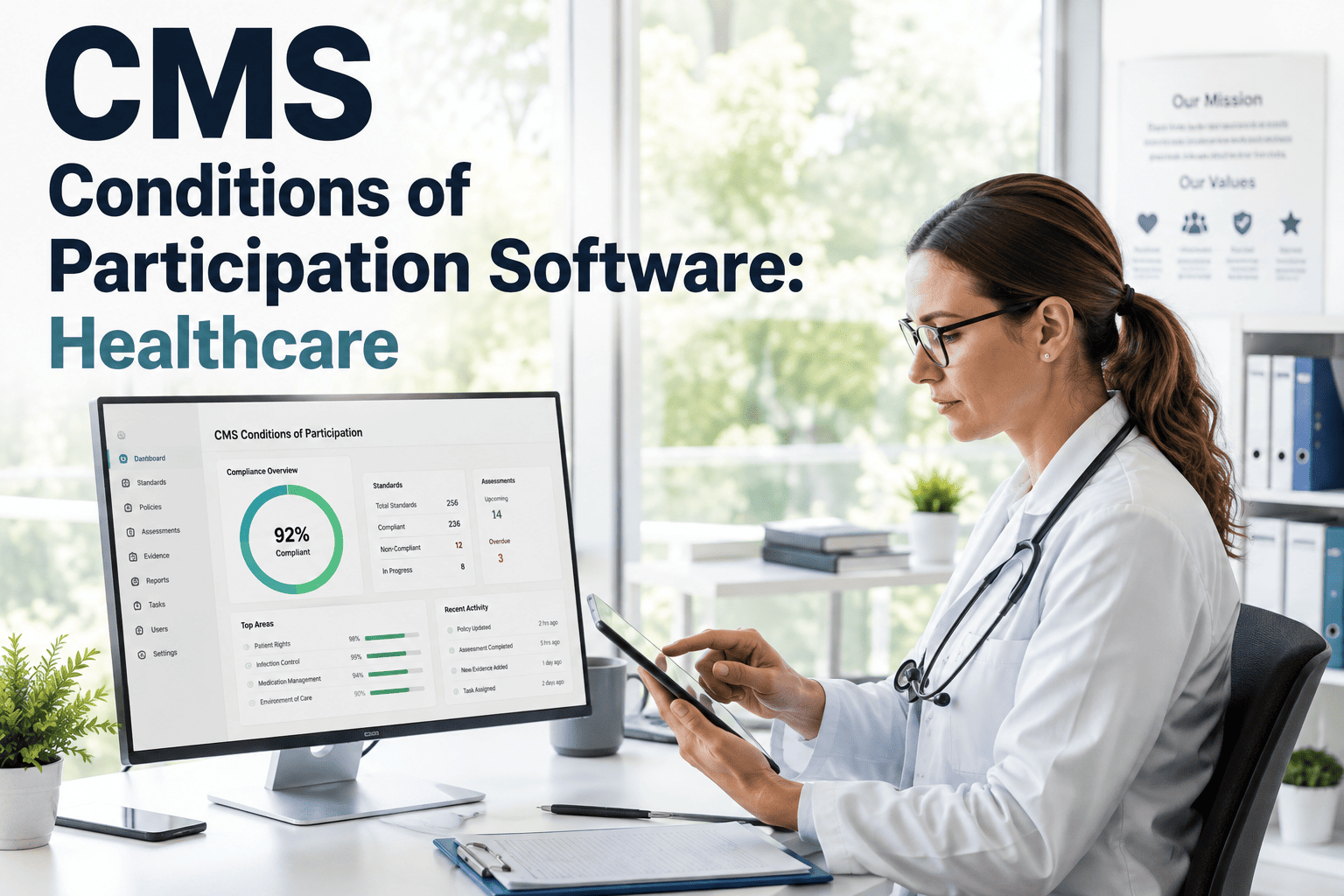
Every hospital that accepts Medicare and Medicaid patients operates under one non-negotiable promise: meet the CMS Conditions of Participation or lose the ability to bill federal programs at all. Among the 24 Conditions a hospital must satisfy, the Physical Environment standard at 42 CFR 482.41 draws the most citations, because surveyors want proof, not just working equipment. Facility teams running on binders, spreadsheets, and disconnected checklists usually discover the gap only when a surveyor asks for a record nobody can produce fast enough. Purpose-built CMS Conditions of Participation software closes that gap by turning every inspection, work order, and certification into a searchable, audit-ready record. See how it works before your next survey window — book a demo and walk through a real survey scenario with our team.
24 / 75
Conditions and Standards CMS enforces across every hospital department, physical plant included
68%
of CMS deficiency citations trace back to the Physical Environment condition alone
$93K/day
Maximum civil monetary penalty CMS can impose for an uncorrected Condition-level deficiency
4.8x
Higher cost of reactive repair work compared with a documented preventive maintenance program
Survey-Ready Documentation, Every Day of the Year
Oxmaint keeps every inspection, work order, and certification in one auditable record, so your facility team can hand a surveyor exactly what they ask for without a scramble through file cabinets and shared drives.
Inside the CMS Physical Environment Standard
The Physical Environment condition of participation requires a hospital to maintain its buildings, grounds, utility systems, and equipment in a condition that keeps patients and staff safe. It is not satisfied by a building that happens to be safe on the day of the survey — CMS requires documented evidence of ongoing inspection, testing, and correction across fire protection, emergency power, medical gas, ventilation, and general facility upkeep. Because roughly 4,900 hospital surveys happen each year, the large majority unannounced, a hospital cannot know in advance which week its documentation will be tested. Hospitals that hold deemed status through an approved accrediting organization such as The Joint Commission, DNV Healthcare, or HFAP still answer to CMS validation surveys, and the Life Safety Code Survey Report Form is the tool surveyors use to score physical plant compliance against the National Fire Protection Association code edition CMS has adopted.
Binder and Spreadsheet Tracking
Manual logs, shared drives, paper checklists
Records fire drills and inspections once someone remembers to file the paperwork
Stores signed certificates in a folder somewhere on site or in email
Cannot show a surveyor a complete generator testing history in minutes
Cannot flag an overdue medical gas inspection before it becomes a deficiency
Cannot cross-reference a water management log against a Legionella test result
Cannot prove a completed corrective action tied to a prior citation
62%
of hospital surveys uncover at least one physical environment documentation gap, even when the actual maintenance work was performed on time
VS
Oxmaint CMMS Compliance Record
Digital, timestamped, always retrievable
Everything a binder captures, plus a permanent timestamped audit trail
Automated preventive maintenance scheduling for every regulated asset
Mobile inspection forms that push data straight into the compliance record
Automatic alerts before certifications, tests, or inspections fall overdue
Corrective action tracking linked directly to the original citation or finding
One dashboard view across every building in a multi-site health system
Minutes, not days
Typical time facility teams report to pull any requested record once documentation lives in a single searchable CMMS
Five Physical Environment Domains Every Survey Touches
Surveyors do not review the physical plant as one item on a checklist — they move system by system, and each system carries its own documentation expectation. The categories below cover the domains that generate the majority of Physical Environment citations, along with the records a facility team needs on hand to answer for each one.
High Citation Risk
Fire and Life Safety Systems
Covers written fire control plans, sprinkler and alarm testing, smoke barrier integrity, and the ten-hour rule requiring evacuation or a documented fire watch when a sprinkler system goes down. Surveyors expect written evidence of regular inspection by state or local fire authorities.
Fire drill logs, sprinkler and alarm test records, smoke damper inspections, fire watch documentation, egress and exit signage checks
High Citation Risk
Utility Systems and Emergency Power
Emergency power and lighting must reach operating rooms, recovery, intensive care, the emergency department, and stairwells at minimum, with battery lamps available elsewhere. Generator load testing, transfer switch checks, and medical gas and vacuum system verification all fall under this domain.
Generator run and load test logs, transfer switch testing, medical gas pressure checks, electrical distribution inspections, HVAC system logs
Rising Priority
Infection Control and Water Management
Water management programs addressing Legionella and other waterborne pathogens now sit alongside the traditional Physical Environment items, connecting facility maintenance directly to the Infection Prevention and Control condition of participation.
Water temperature logs, disinfectant residual testing, cooling tower maintenance, ice machine and eyewash station checks
Rising Priority
Medical Equipment and Asset Records
Facilities, supplies, and equipment must be maintained to an acceptable level of safety and quality, which surveyors interpret as documented preventive maintenance performed according to manufacturer instructions for use, not merely functional equipment on the day of the visit.
Biomedical equipment PM schedules, calibration certificates, manufacturer instructions for use on file, equipment inventory with service history
Ongoing
General Safety and Facility Condition
Trash storage and disposal procedures, ventilation, lighting, temperature control, and general building upkeep round out the standard. These items are easy to overlook individually but accumulate quickly into a pattern of findings if left undocumented.
Housekeeping and pest control logs, temperature and humidity monitoring, condition assessments, grounds and building repair tickets
One Dashboard for Every CMS-Regulated System
Fire safety, utilities, water management, and biomedical equipment usually live in separate spreadsheets and separate departments. Oxmaint brings them into a single facility record that any authorized team member can pull up the moment a surveyor asks.
Deemed Status Compliance Framework
A hospital rarely answers to just one regulator. Federal certification, accreditation, and state licensure requirements overlap, and each one expects a different cut of the same underlying maintenance data. The table below maps the major bodies a US hospital facility team typically reports to for physical environment compliance.
| Regulatory Body |
Governing Standard |
Survey Frequency |
What It Reviews |
| CMS |
42 CFR 482.41 Physical Environment |
Unannounced, ongoing |
Life safety, utilities, general facility condition tied to Medicare certification |
| The Joint Commission |
Physical Environment chapter, Accreditation 360 |
Triennial, unannounced window |
Environment of care and life safety elements of performance under deemed status |
| DNV Healthcare |
NIAHO integrated standards |
Annual |
Physical environment folded into an integrated quality and safety survey |
| HFAP |
Life Safety and Physical Environment chapters |
Biennial |
Facility condition, fire safety, and equipment maintenance documentation |
| State Health Departments |
State licensure codes, often adopting NFPA references |
Varies by state |
State-specific fire, building, and facility licensure requirements |
Compliance KPIs Hospital Facility Teams Should Track
A facility team that only reacts to survey results is always one visit behind. These are the metrics compliance-minded hospitals track continuously, well before a surveyor ever walks through the door.
Under 10 min
Documentation Retrieval Time
Time it takes to produce any requested inspection or maintenance record during a live survey
95%+
Preventive Maintenance Completion
Share of scheduled PM tasks completed on time across life safety and utility assets
100%
Life Safety Inspection Currency
Fire, sprinkler, and alarm inspections current against required testing intervals
0
Open Corrective Actions Past Due
Citation or finding follow-ups still open beyond their committed resolution date
30 days
Average Corrective Action Closure
Time from an identified deficiency to a documented, verified fix
100%
Equipment Certification Currency
Biomedical and utility equipment with an active, unexpired certification on file
Frequently Asked Questions
What is the CMS Condition of Participation for Physical Environment?
It is the standard set out at 42 CFR 482.41 requiring hospitals to keep buildings, utilities, and equipment safe and well maintained, with documented inspection and testing evidence. It is consistently among the most cited conditions during CMS surveys. Tools like Oxmaint help teams keep that evidence organized and ready year-round.
How often does CMS survey hospitals for Physical Environment compliance?
CMS and its deemed-status accrediting partners conduct thousands of hospital surveys each year, and most arrive unannounced. A hospital cannot predict the exact week, which is why continuous documentation matters more than a pre-survey scramble. You can
book a demo to see a survey-day workflow in action.
What happens if a hospital fails a CMS Physical Environment survey?
Condition-level deficiencies can trigger a plan of correction, follow-up survey, civil monetary penalties, and in serious or repeated cases, termination from Medicare and Medicaid participation. Even standard-level findings damage a hospital's public deficiency record and accreditation standing.
Does Joint Commission or DNV accreditation replace CMS Conditions of Participation?
Deemed status through an approved accrediting organization satisfies CMS certification requirements, but CMS retains the right to conduct validation surveys at any time. Facility documentation still needs to hold up against both the accreditor's standards and the underlying CMS condition.
How does CMMS software help a hospital pass a CMS survey?
A CMMS turns scattered paperwork into one searchable, timestamped record of every inspection, work order, and certificate, so a facility team can answer any surveyor question in minutes instead of days.
Sign up free to start building that record today.
Stop Preparing for Surveys. Stay Ready for Them.
Oxmaint gives hospital facility teams one place to schedule preventive maintenance, log inspections, track certifications, and produce audit-ready records the moment a surveyor asks — on desktop or mobile, across every building you manage.