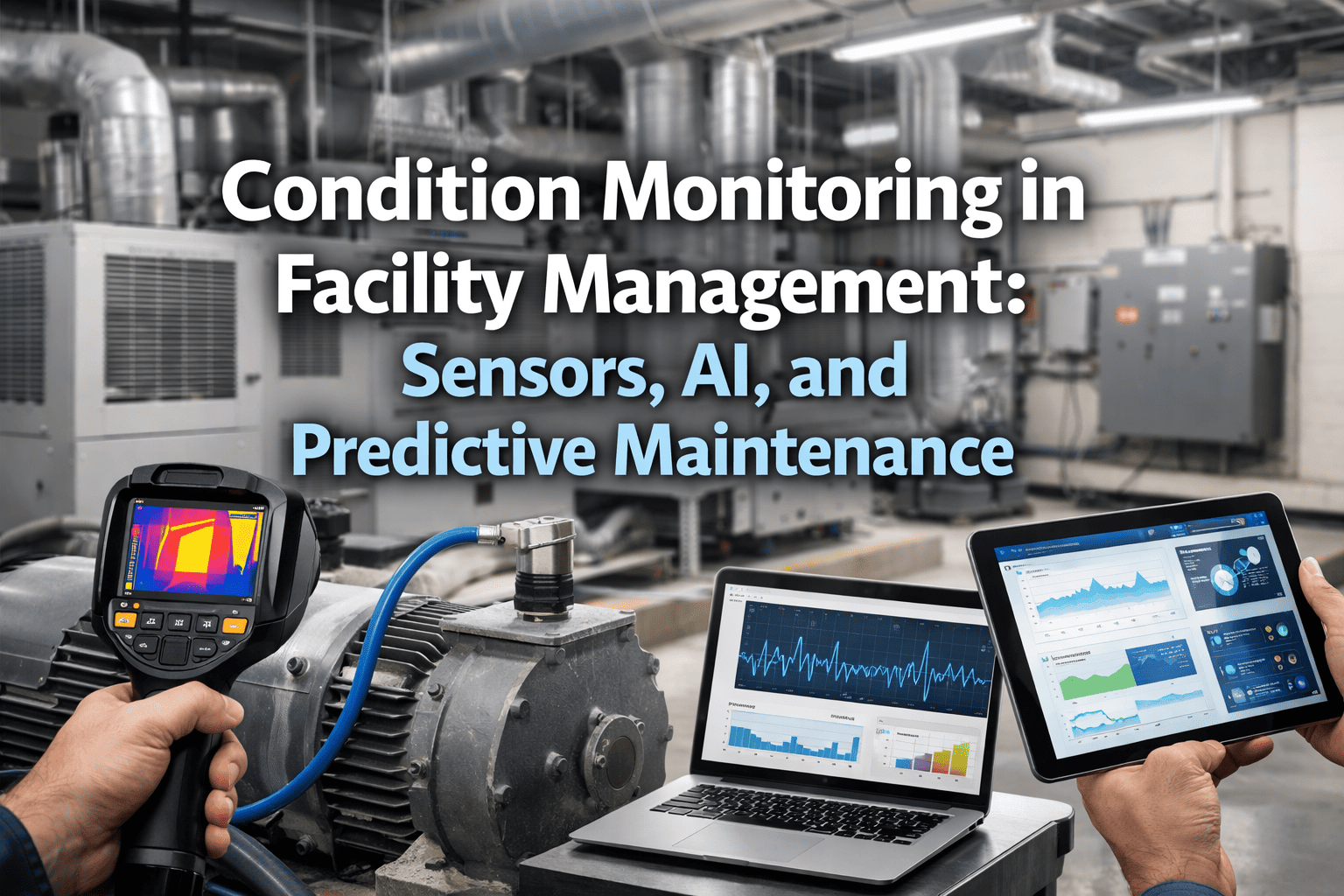
The average industrial fixed asset is now 24 years old — the oldest average age in nearly 70 years. Mean time to repair has increased from 49 minutes to 81 minutes industry-wide, driven largely by skills gaps and the increasing complexity of aging equipment. Traditional maintenance approaches — reactive repair and fixed-interval PM — cannot bridge that gap. Condition monitoring closes it by continuously observing the vital signs of equipment and flagging degradation before it becomes failure. When IoT sensors, vibration analysis, thermography, and AI are connected to a CMMS, facilities report 25% reduction in maintenance costs and 10–20% improvement in uptime — outcomes that calendar-based PM alone cannot deliver. This guide covers the complete condition monitoring toolkit for facility managers in 2026: sensor technologies, what each one detects, where to deploy them, and how AI turns raw sensor data into maintenance decisions. Book a demo to see how Oxmaint integrates condition monitoring with automated work order dispatch.
Equipment & Asset Management
Predictive Maintenance AI
IoT + Sensors
24 yrs
Avg age of industrial fixed assets — oldest in 70 years
81 min
Avg MTTR — up from 49 min — skills gap and aging assets
25%
Maintenance cost reduction with predictive monitoring
10–20%
Uptime improvement — predictive vs. calendar PM
Core Concept
The Three Maintenance Approaches — and Where Condition Monitoring Sits
Reactive
Run-to-Failure
Fix equipment after it breaks. Appropriate only for non-critical, easily replaceable assets with low consequence of failure.
Cost: Lowest PM spend, highest failure cost
Preventive
Time-Based PM
Maintain on fixed calendar intervals. Produces over-maintenance on some assets and under-maintenance on others. Cannot adapt to actual equipment condition.
Cost: Predictable PM spend, significant waste
Predictive
Condition-Based
Maintain based on actual equipment health signals. Intervene when degradation reaches a defined threshold — not before, not after. Maximum efficiency, minimum unplanned failure.
Cost: Lowest total life-cycle maintenance cost
Sensor Technologies
The Condition Monitoring Toolkit — 6 Technologies and What Each Detects
01
Vibration Analysis
Rotating Equipment
Piezoelectric accelerometers mounted on bearing housings detect imbalance, misalignment, looseness, and bearing defects through frequency spectrum analysis. Typical detection lead time: 2–6 weeks before bearing failure.
Best for: HVAC fans, pumps, compressors, motors, cooling towers
02
Infrared Thermography
Electrical + Mechanical
IR cameras detect thermal anomalies in electrical connections, panel hot spots, overloaded circuits, refractory degradation, and bearing overheating before they cause failure or fire. Most valuable finding: loose connections before arc flash events.
Best for: Electrical panels, switchgear, transformers, motors, boilers
03
Ultrasonic Testing
Leaks + Early Bearing Wear
High-frequency acoustic sensors detect compressed air leaks, steam trap failures, early-stage bearing wear (before vibration sensors activate), and electrical arcing in enclosed panels. Typical compressed air leak saving: $8,000–$25,000/yr per facility.
Best for: Compressed air systems, steam traps, valves, early bearing detection
04
Oil Analysis
Lubricated Equipment
Spectrographic analysis of oil samples identifies metal particles from component wear, water contamination, oxidation, and viscosity degradation. Each finding identifies both the failure mode (particle type) and the affected component (particle chemistry).
Best for: Gearboxes, hydraulic systems, turbines, compressors, transformers
05
Motor Current Signature Analysis
Electrical Motors
Analyzes current waveform harmonics to detect rotor bar cracks, eccentricity, winding faults, and mechanical load variations — all without physical contact or equipment shutdown. Detection lead time: 4–12 weeks before motor failure.
Best for: Induction motors, VFD-driven equipment, pumps, fans, conveyors
06
IoT Temperature + Humidity Sensors
Environmental Monitoring
Continuous wireless monitoring of ambient conditions, equipment surface temperatures, and coolant temperatures across all building zones. Enables HVAC efficiency trending, chiller COP monitoring, and environmental compliance for data centers and labs.
Best for: HVAC systems, chillers, data centers, clean rooms, cold storage
Connect Your Sensors to Automated Work Order Dispatch in Oxmaint
Oxmaint integrates with vibration sensors, IoT temperature networks, oil analysis systems, and BMS data feeds — converting every anomaly into an auto-assigned work order with the diagnostic context, asset history, and parts recommendation already attached.
Deployment Matrix
Which Condition Monitoring Technology for Which Facility Asset
Expert Review
What Facility Maintenance Professionals Say
"The biggest mistake facility teams make with condition monitoring is treating it as an alarm system. An alarm tells you something has already gone wrong. Condition monitoring done correctly tells you that something is going wrong — 2, 4, or 8 weeks before failure. That lead time is what lets you schedule the repair during a planned window, order the correct parts in advance, and avoid the 3× premium of emergency contractor callout. The sensor is not the product. The maintenance decision enabled by the trend is the product."
Reliability Engineer — Building Systems
Commercial Real Estate — 28 Properties, 6.2M sq ft
"Vibration analysis on HVAC rotating equipment pays for itself in the first bearing failure it prevents. A chiller compressor bearing replacement caught by trending vibration costs $4,000–$8,000 in planned work. The same bearing allowed to fail takes the compressor shaft with it — $80,000–$150,000 repair plus summer season downtime. The sensor cost is irrelevant. The decision quality it enables is the entire business case. Any facility running critical equipment without vibration monitoring is accepting unnecessary risk."
Chief Engineer
Healthcare Campus — 4 Buildings, 1.8M sq ft, Mid-Atlantic U.S.
Frequently Asked Questions
Condition Monitoring in Facility Management — Common Questions
How does condition monitoring differ from preventive maintenance?
Preventive maintenance services equipment on fixed time or usage intervals regardless of actual condition. Condition monitoring measures actual equipment health continuously and triggers maintenance only when a degradation signal crosses a defined threshold — neither too early (wasting labor on healthy equipment) nor too late (allowing failure to develop). The result is lower total maintenance cost, fewer unnecessary interventions, and fewer unplanned failures simultaneously.
Start a free trial to configure condition-based PM triggers for your facility's critical assets in Oxmaint.
Which facility assets should be prioritized for condition monitoring deployment?
Prioritize assets where: (1) failure has high operational consequence — chillers, main electrical distribution, emergency generators, and boilers; (2) failure cost is significantly higher than monitoring cost — typically assets above $50,000 replacement value or those whose failure triggers emergency contractor callout; (3) degradation is detectable before failure — most rotating equipment, transformers, and pressurized systems meet this criterion. Lighting and minor HVAC controls typically do not warrant condition monitoring.
Book a demo to walk through an asset criticality assessment for your facility's monitoring deployment plan.
How does Oxmaint integrate IoT sensor data with maintenance workflows?
Oxmaint connects to IoT sensor platforms, BMS data feeds, and vibration monitoring systems via API and OPC-UA. When a sensor reading crosses a configured threshold — vibration above 4.5 mm/s, bearing temperature above 80°C ambient rise, or chiller COP dropping below baseline — Oxmaint automatically generates a condition-based work order with the sensor evidence, asset history, last PM date, and recommended action attached. The technician receives full diagnostic context before leaving the control room.
Start a free trial to connect your first sensor feed to Oxmaint's condition monitoring dashboard.
What does AI add to condition monitoring that basic threshold alarms cannot provide?
Basic threshold alarms fire when a measurement crosses a fixed limit — by definition, after the degradation is already significant. AI models establish a dynamic baseline for each individual asset under its actual operating conditions and detect statistically significant deviations from that baseline weeks before any fixed threshold is approached. AI also classifies the failure mode from the sensor signature — distinguishing between bearing wear, imbalance, and misalignment from the same vibration sensor — so technicians arrive with the correct diagnostic hypothesis and parts, not just an alert that "something is wrong."
Book a demo to see Oxmaint's AI condition monitoring baseline engine in action.
Stop Waiting for Equipment to Tell You It Failed. Start Listening While It's Still Healthy.
Oxmaint connects your IoT sensors, vibration monitors, and BMS data to automated condition-based work orders — so every degradation signal becomes a planned maintenance event, not an emergency. Built for facility teams managing aging assets with lean teams.