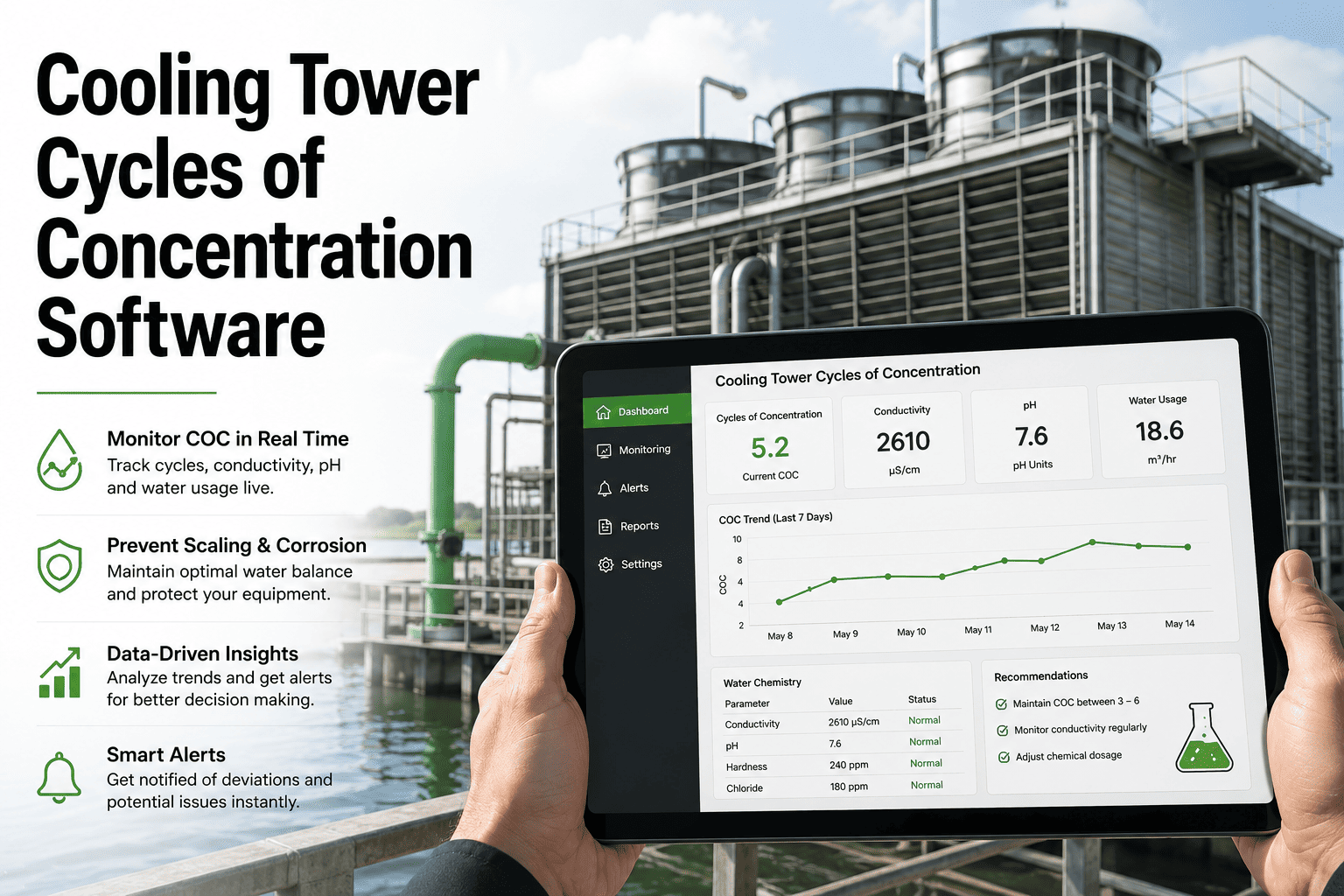
Cooling tower cycles of concentration software helps water and facility managers balance water conservation against scaling risk by tracking conductivity, blowdown, and chemistry in real time — and the best cycles CMMS platforms in 2026 automate that balance instead of leaving it to spreadsheets. When cycles drift too low, you waste thousands of gallons and dollars on makeup water and treatment chemicals; when they climb too high, scale, corrosion, and Legionella risk compound fast. This guide breaks down how cycles of concentration work, what the top cycles platform features look like, and how a purpose-built cooling cycles CMMS like OxMaint turns a manual water-balancing act into an automated, audit-ready program. You can Start Free Trial today, or read on for the full cycles concentration guide.
Are your cooling towers running at 3 cycles when they could safely run at 6?
Every extra cycle of concentration cuts blowdown volume — a tower moving from 3 to 6 cycles can reduce makeup water demand by roughly 20–25% and shrink chemical spend proportionally. The best cycles CMMS platforms make that jump safe, tracked, and provable.
What are cycles of concentration — and why do they make or break your water budget?
Cycles of concentration (COC) measure how many times dissolved minerals in your makeup water have been concentrated in the circulating loop. A tower at 5 cycles holds five times the mineral content of its feed water. The formula is simple; managing it across dozens of towers, seasons, and operators is not.
Push cycles too high without control and calcium carbonate scale forms on fill and heat exchangers — a 1/16-inch scale layer can cut heat transfer efficiency by 10–12%. Run too low and a 1,000-ton tower can bleed an extra 3–5 GPM of treated water straight to drain, costing $15K–$40K per year in water, sewer, and chemistry. Facility cycles software exists to hold that narrow optimal band automatically.
What does poor cycles management actually cost a facility?
A mid-size plant running three 500-ton towers with manual conductivity checks typically loses money in four places at once — and most of it never appears on a single line item.
A 180-asset food plant spending $42K/yr on tower water and chemicals deployed a cycles of concentration CMMS with conductivity-triggered work orders. Within 9 months it raised average COC from 3.2 to 5.6, cut blowdown 22%, and eliminated two scale-related chiller cleanings — a combined $31K annual saving against a software cost under $6K. Payback: under 10 weeks.
What should the best cycles of concentration CMMS include in 2026?
Not every facility cycles CMMS is built for water treatment realities. The top cycles 2026 platforms share six non-negotiable capabilities — use this as your evaluation checklist.
Sensor & IoT Integration
- Live conductivity, pH, ORP feeds
- Auto-calculated COC dashboards
- Threshold alarms before scaling range
Automated Work Orders
- Blowdown valve checks on trigger
- Chemical dosing verification tasks
- Escalation when COC drifts ±10%
Preventive Maintenance Scheduling
- Seasonal tower cleanings & inspections
- Drift eliminator and fill checks
- Water treatment vendor visit tracking
Compliance & Audit Trail
- ASHRAE 188 / Legionella documentation
- Time-stamped digital water logs
- One-click audit export reports
Asset & Parts Tracking
- Tower, pump & valve asset histories
- Chemical & spare-parts inventory
- Cost-per-tower rollups
Analytics & Water KPIs
- COC trend lines per tower
- Water cost per ton-hour of cooling
- Multi-site benchmarking views
Spreadsheets vs. standalone controllers vs. a full cycles CMMS
Most water managers sit on one of three approaches. Only one connects water chemistry to the maintenance work that actually fixes drift.
| Capability | Spreadsheet Logs | Standalone Controller | OxMaint Cycles CMMS |
|---|---|---|---|
| Real-time COC tracking | No — manual entry | Yes, siloed | Yes, linked to assets |
| Auto work orders on drift | No | Alarm only | Yes, with escalation |
| Preventive maintenance scheduling | Manual calendar | No | Full PM engine |
| Legionella / audit documentation | Fragmented paper | Limited export | One-click audit trail |
| Multi-site benchmarking | No | No | Portfolio dashboards |
| Typical COC improvement | +0.3 cycles | +0.8 cycles | +1.5–2.5 cycles |
How OxMaint works as your cycles of concentration software
OxMaint is an AI-powered CMMS + EAM platform that ties water chemistry signals directly to maintenance execution — so a drifting tower becomes a closed work order, not a scaling emergency.
IoT-Triggered Work Orders
Connect conductivity and pH sensors; when COC leaves your target band, OxMaint auto-generates prioritized work orders. Teams respond 60–70% faster than with alarm-only controllers.
Preventive Maintenance Engine
Schedule tower cleanings, dosing checks, and seasonal inspections by calendar, runtime, or sensor condition — cutting unplanned water-system downtime 30–50%.
Audit-Ready Water Logs
Every test, dose, and blowdown event is time-stamped and exportable — ASHRAE 188 and local health-department audits go from days of prep to minutes.
Water & Cost Analytics
Track COC trends, water cost per ton-hour, and chemical spend per tower across your whole portfolio — most sites find 15–25% water savings in the first year.
Book a 30-minute demo and see your cycles data in OxMaint
Bring one tower's numbers — we'll show you the work orders, dashboards, and audit trail your team would run on day one.
Cycles of concentration software — FAQs
What is a good cycles of concentration target for a cooling tower?
Most towers run optimally between 4 and 7 cycles, depending on makeup water hardness and treatment chemistry. Below 3 you waste water; above 8, scaling risk usually outweighs savings without softening or side-stream filtration.
How do you calculate cycles of concentration?
Divide the conductivity of circulating water by the conductivity of makeup water (COC = circulating ÷ makeup). You can also use chloride or silica ratios. A cycles CMMS calculates this continuously from live sensor feeds instead of weekly dip tests.
How much water can raising cycles actually save?
Moving from 3 to 6 cycles cuts blowdown roughly in half and reduces total makeup demand by 20–25%. For a 1,000-ton tower, that is commonly $15K–$40K per year in combined water, sewer, and chemical costs. Start Free Trial to model it on your own towers.
Can a CMMS replace my water treatment controller?
No — they complement each other. The controller doses chemicals and opens blowdown valves; the cycles CMMS turns its data into scheduled maintenance, verified work orders, asset history, and audit documentation. OxMaint integrates with common controllers and IoT sensors.
How does cycles software help with Legionella compliance?
It creates a continuous, time-stamped digital record of temperatures, biocide dosing, and verification tasks required by ASHRAE 188 water management programs. When an auditor or health inspector asks, you export the trail in minutes — Book a Demo to see the compliance reports.
Stop guessing your cycles — run them on OxMaint
Join facility and water managers who cut tower water costs 15–25% in year one with automated work orders, live COC tracking, and audit-ready logs.
Free 14-day trial · No credit card · Set up your first tower in under an hour