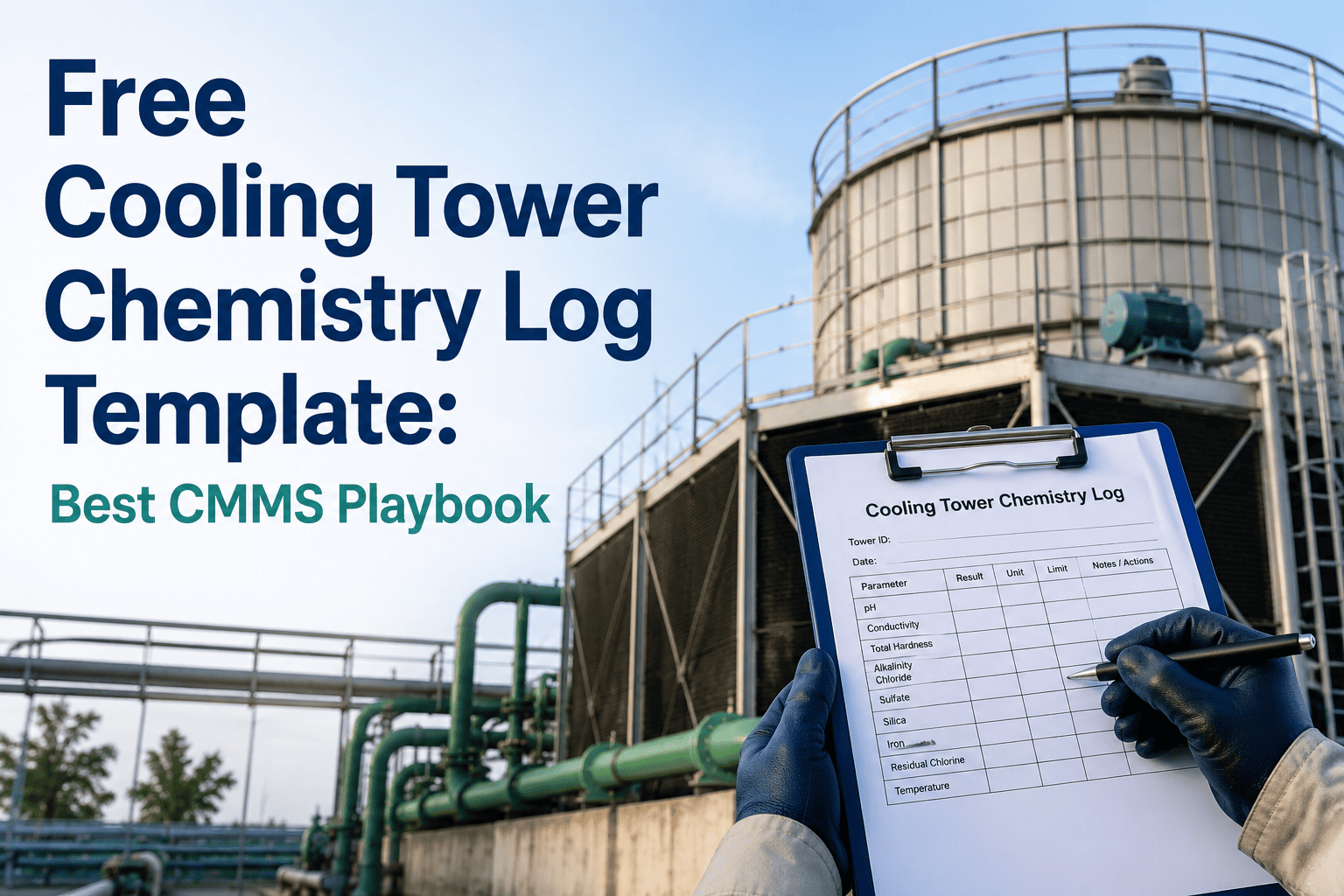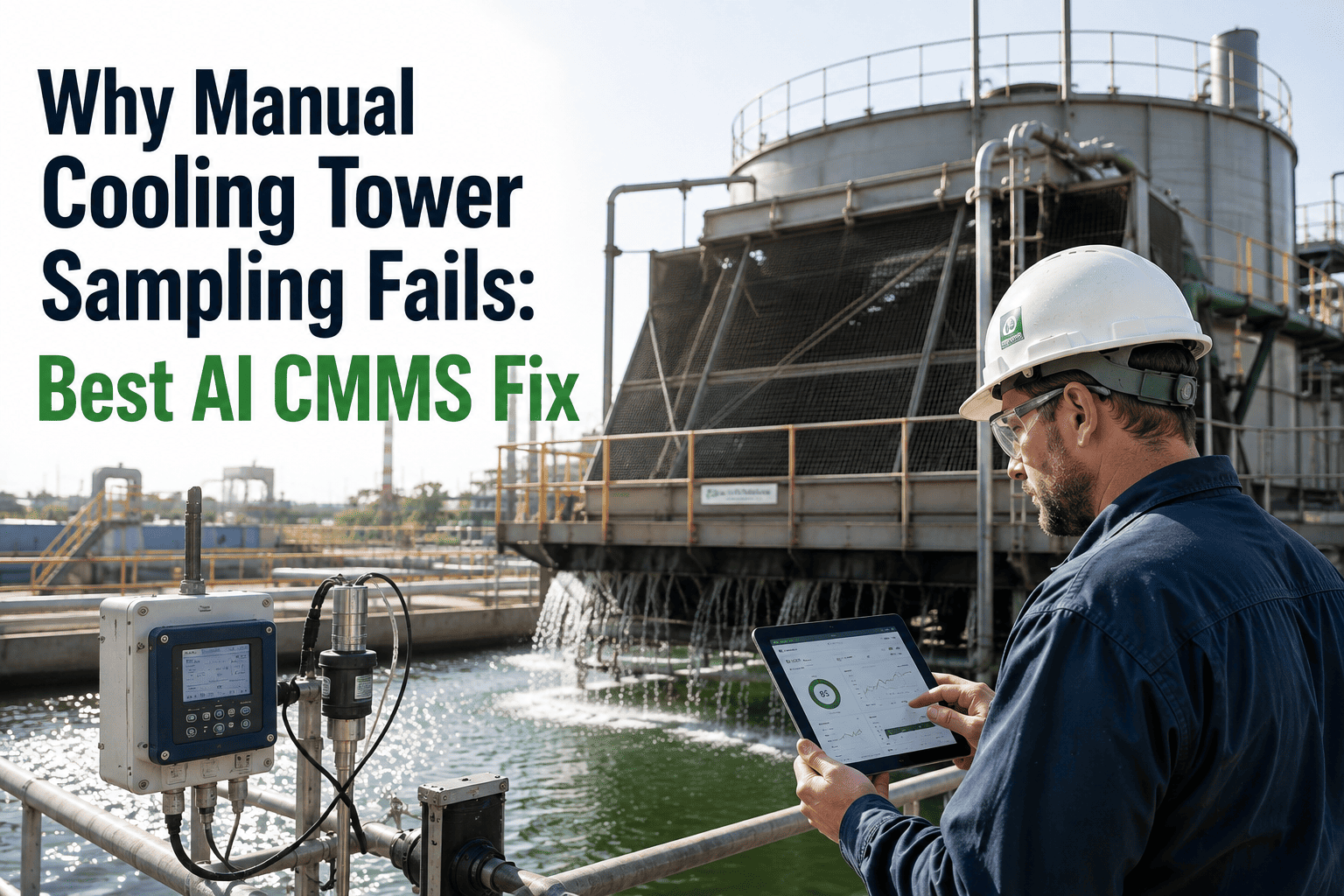
A cooling tower technician pulls a grab sample every Monday morning, tests pH and conductivity, writes the numbers on a clipboard, and moves to the next tower. Between that reading and the next one seven days later, biocide residual can crash, conductivity can spike past cycle limits, and a biofilm layer can establish itself across the fill media — all invisible until the following Monday, or until a Legionella culture comes back positive weeks later. Facilities are not losing the compliance fight because operators are careless; they are losing it because a once-a-week snapshot cannot describe a system that changes hourly, which is exactly the gap OxMaint's AI-driven cooling tower CMMS was built to close.
Cooling Tower Compliance · AI CMMS · OxMaint
Weekly Grab Samples Cannot See What Happens On Tuesday, Wednesday, Or Thursday. Your Water Chemistry Doesn't Wait For Monday.
Manual sampling gives you one data point in a seven-day window. OxMaint's AI-powered CMMS turns every reading, alert, and corrective action into a continuous, audit-ready record — the difference between finding an excursion and preventing one.
7 Days
Typical gap between manual grab samples — long enough for biocide residual to fall to zero unnoticed
1,000 CFU/mL
Legionella result that triggers mandatory 24-hour health department notification in most states
30 Days
Maximum interval New York now requires between bacterial culture samples on registered towers
68%
Of culture-negative samples that tested positive by qPCR — proof one method alone leaves gaps
The Sampling Gap
Between Two Grab Samples, A Tower Can Go From Compliant To A Reportable Event
A weekly reading tells you what the water looked like at 8 a.m. on Monday. It says nothing about the 164 hours that followed — the afternoon a make-up water valve stuck open and diluted biocide feed, the weekend a chemical pump lost prime, or the three days a fill media section grew a biofilm layer before anyone walked past it again. Manual sampling programs are not wrong; they are simply too infrequent to catch a system that moves this fast.
What A Weekly Grab Sample Program Looks Like
One pH and conductivity reading per week · biocide residual checked on the same fixed day · excursions discovered days after they started · Legionella culture results returned 7 to 10 days after the water already changed.
What Continuous AI-Monitored CMMS Looks Like
pH, conductivity, ORP, and biocide residual logged automatically around the clock · threshold alerts fire the moment a reading drifts · every excursion opens a work order the instant it happens · culture and qPCR results attach straight to the asset record.
Six Places Manual Sampling Loses The Compliance Trail
Every cooling tower water management plan under ASHRAE 188 depends on data density. These are the six points where a paper or spreadsheet program most often falls behind the standard it claims to follow.
01
Biocide Residual Blind Spots
A pump losing prime between Monday and Thursday means three days of near-zero biocide residual — the exact window Legionella and other biofilm organisms need to establish a colony, and a weekly log will show it as a single low reading after the fact.
02
Conductivity Drift And Scale Formation
Cycles of concentration creeping past the control limit for days before the next test is read directly feeds scale onto fill media and heat transfer surfaces, quietly cutting tower efficiency long before anyone opens the logbook.
03
Culture Result Lag
Legionella culture results typically return 7 to 10 days after sampling. A tower can be actively amplifying bacteria for the entire lag period while the last report on file still reads clean.
04
Seasonal Startup And Shutdown Gaps
Regulations requiring sampling within days of seasonal startup are easy to miss when the trigger depends on someone remembering to schedule it, rather than the equipment status automatically opening the work order.
05
Fragmented Records Across Vendors
Water treatment vendor logs, in-house readings, and lab culture reports frequently live in three separate systems, so reconstructing a single tower's full chemistry history for an audit becomes a multi-day search.
06
No Trend Line, Only Snapshots
A weekly number tells you where the water was at that moment; it cannot show a slow upward drift in conductivity or a downward slide in biocide residual, which is exactly the pattern that predicts an excursion before it happens.
OxMaint · Continuous Cooling Tower Compliance
Every Reading Becomes A Work Order. Every Work Order Becomes A Record. Nothing Waits For Monday.
Threshold alerts, automated sampling schedules, and a single asset-level compliance history replace the clipboard — so the gap between two grab samples stops being where problems hide.
Manual Sampling Program Versus OxMaint AI CMMS
Compliance Task
Manual Or Spreadsheet Program
OxMaint AI CMMS
Chemistry readings
Weekly grab sample, hand-recorded
Continuous telemetry logged automatically
Excursion detection
Discovered on the next scheduled visit
Threshold alert fires the moment it happens
Legionella and qPCR results
Filed in a separate lab report folder
Attached directly to the tower asset record
Seasonal startup sampling
Relies on someone remembering the date
Auto-scheduled work order on equipment status change
WMP annual review
Tracked on a separate calendar, often missed
Recurring compliance task with pre-due alerts
Audit-day record retrieval
Hours pulling files from multiple sources
Single export by asset or date range
What A Best-In-Class AI Cooling Tower CMMS Actually Does
Continuous Chemistry, Not Weekly Snapshots
pH, conductivity, ORP, and biocide residual stream into the asset record around the clock, so a mid-week excursion is caught the day it starts instead of the following Monday.
Threshold Alerts That Open Work Orders Automatically
A reading that crosses the water management plan's control limit generates a corrective-action work order immediately, with the responsible technician assigned before the shift ends.
Culture And qPCR Results Attached To The Tower
Lab results land on the same asset record as the chemistry log and PM history, so a single tower's complete compliance picture never lives in three different places.
Risk-Based Schedules Built From The WMP
Sampling frequency, biocide alternation, and culture cadence follow the intervals defined in the water management plan, generated as recurring work orders instead of a calendar someone has to remember.
Trend Lines That Predict Excursions Early
A slow drift in conductivity or a declining biocide curve shows up as a trend before it crosses the limit, giving the team days of warning a single weekly number could never provide.
One-Click Compliance Export By Tower Or Date
Every chemistry reading, lab result, cleaning record, and corrective action for one tower exports as a single timestamped file, ready the moment a health department or Joint Commission surveyor asks.
The Continuously Monitored Tower
What Facilities Look Like After Moving Off The Weekly Clipboard
24/7
Chemistry visibility instead of one reading every seven days
Minutes
From threshold breach to an assigned corrective action work order
One File
Complete tower compliance history exported for an auditor or surveyor
Zero
Missed seasonal startup or WMP annual review dates
Frequently Asked Questions
Why isn't weekly grab sampling considered enough for cooling tower compliance anymore?
Chemistry and microbial conditions can shift significantly within days, so a once-a-week reading only confirms what the water looked like at that single moment. Continuous monitoring through an AI-powered CMMS closes that gap by logging conditions around the clock.
Does continuous monitoring replace Legionella culture testing?
No. Culture testing remains the regulatory standard for confirming Legionella presence, but continuous chemistry telemetry catches the conditions that let bacteria amplify long before the next scheduled culture is due.
How quickly can OxMaint produce a full compliance history for one cooling tower?
A single export pulls every chemistry reading, lab result, cleaning record, and corrective action tied to that tower into one timestamped file, ready before an inspector finishes the walk-through.
What happens when a chemistry reading crosses the water management plan's limit?
The threshold breach automatically opens a corrective-action work order and assigns it to a technician, so the response is logged the moment the excursion happens rather than discovered days later.
Can OxMaint schedule sampling frequency to match state-specific requirements like New York's rules?
Yes. Sampling cadence is configured from the water management plan, so jurisdiction-specific intervals generate as recurring work orders automatically. Book a demo to see a jurisdiction-matched schedule built live.
Live In 14 Days · Continuous Monitoring From Day One
Stop Waiting For Monday To Find Out What Happened On Tuesday.
Continuous chemistry telemetry · automatic threshold work orders · culture results on the asset record · one-click compliance export for every tower.