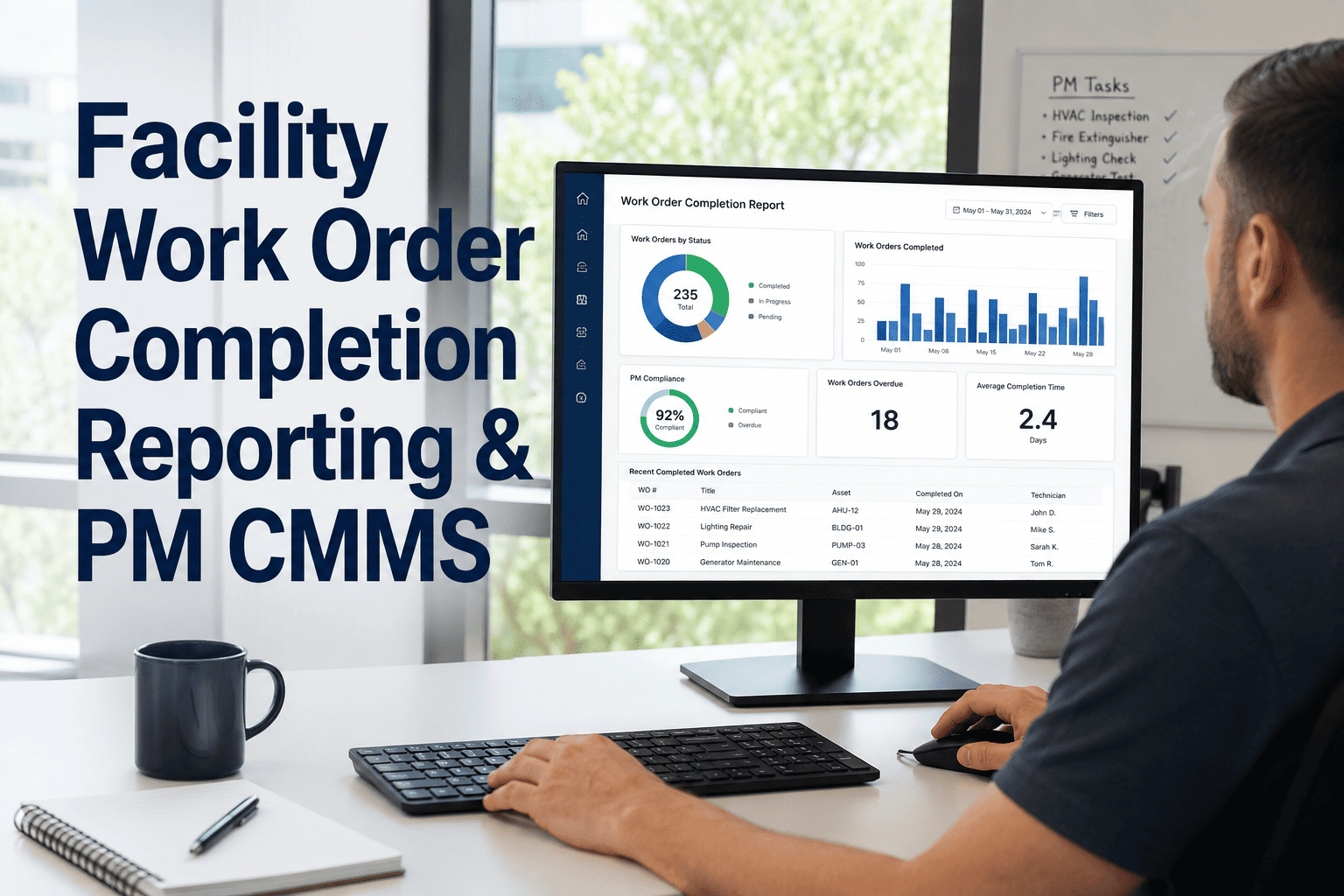
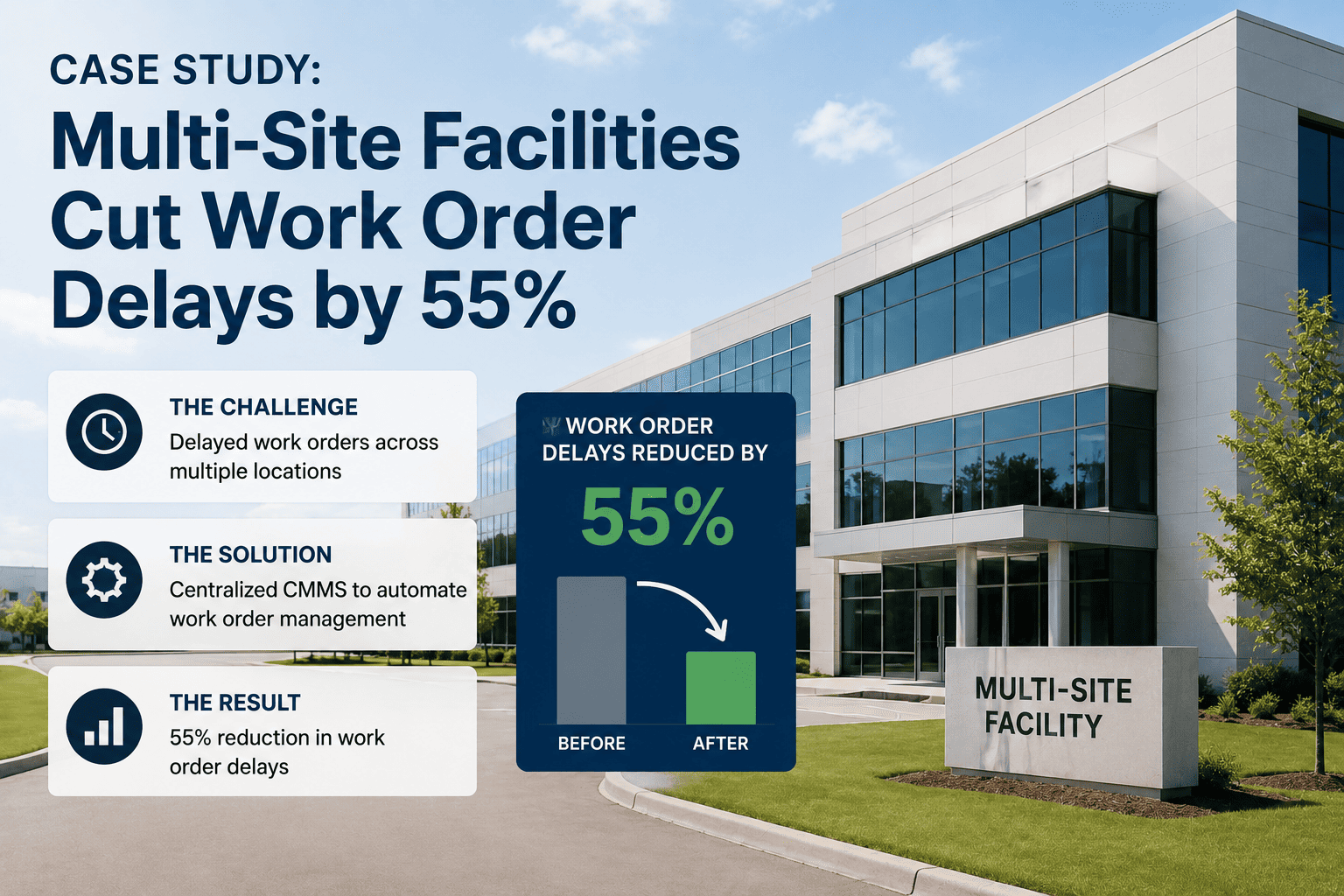
A 650,000 square foot corporate campus in the Pacific Northwest was spending nearly a third of its annual maintenance budget on emergency repairs — equipment failures that interrupted operations, pulled technicians off scheduled work, and generated overtime costs that senior leadership had stopped questioning because they had become predictable. The campus facilities director brought in Oxmaint's AI-powered preventive maintenance scheduling in Q1, and by Q4 of the same year, emergency work orders had dropped 58% and the facility had saved $280,000 in maintenance costs. Book a demo to see how Oxmaint's preventive maintenance AI would work for your corporate campus, or start a free trial and connect your first assets today.
How a Corporate Campus Reduced Emergency Work Orders by 58% Using Oxmaint CMMS
A 650,000 sq ft corporate campus cut emergency work orders by 58% and saved $280,000 annually after switching to Oxmaint's AI-powered preventive maintenance scheduling. Here is exactly how they did it.
The Campus Before Oxmaint
The campus housed 4,200 employees across 14 buildings — a mix of offices, data center support spaces, laboratories, and a central plant serving the entire site. The maintenance team of 22 technicians managed over 1,100 assets including chillers, AHUs, generators, elevators, and building automation systems. Work orders arrived by phone, email, and a paper request form at the facilities desk.
PM compliance sat at 54% — not because the team lacked skill, but because scheduling was done manually in spreadsheets that were not updated consistently between shifts. When a technician finished a job, closing the work order required returning to the facilities office to log it. Many jobs were completed but never formally recorded. Emergency calls consumed 41% of all maintenance labor hours, leaving insufficient time for the planned maintenance work that would have prevented those calls.
Three Reasons Emergency Work Orders Were at 41%
PM tasks existed in spreadsheets but were not connected to specific asset records. When a technician completed a PM, there was no automated trigger to schedule the next one. Intervals slipped without anyone noticing until an equipment failure occurred — at which point the missing PM history made root cause analysis impossible.
Technicians completed jobs on the floor but closed work orders later — or not at all. The maintenance record was always 4–24 hours behind reality. Supervisors scheduled new PMs based on stale data, dispatched crews to assets already serviced, and had no real-time view of team productivity or open task counts.
The campus had BMS sensor data available for 280 assets but no system to translate sensor readings into maintenance actions. Anomalies flagged by the BMS sat in an alarm queue reviewed manually each morning — by which time several had already escalated to failures requiring emergency response. The data existed. The workflow to act on it did not.
What Was Deployed and How Fast
All 1,100 assets imported from existing spreadsheets into Oxmaint's asset hierarchy. PM schedules configured by asset class with operating-hour and calendar triggers. AI-generated PM interval recommendations applied to 340 assets where historical failure data was available. Each asset assigned a criticality rating to prioritize work order routing.
All technicians trained on Oxmaint mobile app in two half-day sessions. Work order creation, assignment, and closure moved entirely to mobile — eliminating the return-to-office step that was causing record gaps. QR asset tags applied to 280 priority assets for instant identification and history access on the floor.
Oxmaint connected to the campus BAS via BACnet integration. 280 sensor data streams mapped to corresponding assets. Alert thresholds configured for 18 failure mode signatures across chiller, AHU, pump, and generator asset classes. First automated predictive work orders generated within 48 hours of integration go-live.
All three supervisors trained on the management dashboard — live PM compliance, open work order queue, technician utilization, and MTTR trending. Weekly KPI report automated and delivered to facilities director and VP of Real Estate. Manual spreadsheet reporting eliminated from day one of dashboard go-live.
Before vs After — The Full Performance Picture
| KPI | Before Oxmaint | 12 Months Later | Change |
|---|---|---|---|
| Emergency work orders | 41% of all work orders | 17% of all work orders | -58% |
| PM compliance rate | 54% | 91% | +37 pts |
| Mean time to repair (MTTR) | 4.6 hours | 88 minutes | -68% |
| Annual maintenance spend | $1.4M | $1.12M | -$280K |
| Work order closure on mobile | 0% (paper/office) | 94% on mobile at asset | Full digital |
| First-time fix rate | 62% | 86% | +24 pts |
| Manual reporting hours/week | 11 hrs/week (supervisors) | Automated — zero manual | 11 hrs/week recovered |
Book a 30-minute demo. We configure a live example using your building count, asset mix, and team size — and show you exactly which Oxmaint features drove each result in this case study.
What Corporate Facilities Leaders Say About This Outcome
A 58% reduction in emergency work orders in 12 months is not unusual when a campus transitions from spreadsheet-based scheduling to AI-driven PM — but it requires two things that many implementations miss. First, the PM schedule must be connected to actual asset records, not just a generic calendar. An AHU that runs 18 hours a day needs more frequent PM than one running 8 hours. The AI interval optimization that Oxmaint applies is the difference between a PM schedule that looks good on paper and one that actually prevents the failures your team keeps responding to at midnight. Second, mobile closure must be non-optional. Work orders that are completed but not recorded in real time are invisible to the system — the AI cannot learn from them, the supervisor cannot trust the compliance numbers, and the maintenance history that every technician needs before they touch a piece of equipment is incomplete. When both conditions are met — accurate asset-linked PM schedules and real-time mobile closure — the reactive work ratio drop is reliable and the savings number takes care of itself.
Frequently Asked Questions
How does Oxmaint's AI determine the optimal PM interval for each asset?
Oxmaint's AI PM optimization engine analyzes three data sources: OEM-recommended intervals as the baseline, historical work order data from similar asset classes in the Oxmaint customer database, and the specific asset's operating hours, runtime patterns, and fault history recorded in your system. For assets with 3 or more inspection cycles in Oxmaint, the AI recalibrates intervals based on actual condition trend data — tightening intervals for assets showing faster-than-expected degradation and extending intervals for assets consistently found in good condition. This moves PM scheduling from a static OEM calendar to a dynamic, evidence-based schedule unique to each asset. Book a demo to see the AI interval optimization in action.
What is a realistic PM compliance improvement timeline for a 1,000+ asset campus?
Campuses deploying Oxmaint with active mobile work order closure typically move from their starting compliance rate to above 80% within 60–90 days, and reach 85–92% within 6 months. The primary driver is the elimination of scheduling gaps that come from manual spreadsheet PM management — when PM work orders are automatically generated and pushed to technician mobile queues, the friction of identifying what needs to be done and when disappears entirely. The secondary driver is the AI interval calibration, which reduces unnecessary PM tasks and frees technician time for higher-priority work. Start free and track your PM compliance improvement from day one.
How long did the BMS integration take in this deployment?
The BMS integration in this case study was completed in 8 days from API credentials to first automated work order generation — a timeline representative of standard campus BAS deployments using BACnet or Modbus protocols. Oxmaint's integration team provides a pre-configured connector for the major BAS platforms including Johnson Controls, Siemens, Honeywell, and Schneider Electric. For campus environments with custom or legacy BAS installations, integration typically adds 2–3 weeks. The first predictive work orders fire within 24–48 hours of integration go-live once alert thresholds are configured. Book a session to review BMS integration options for your campus.
Was the $280,000 in savings verified independently or self-reported?
The $280,000 figure is derived from four quantified components: reduction in emergency contractor callout costs (tracked via invoice comparison year-over-year), overtime labor reduction (documented via payroll records), parts cost reduction from fewer unplanned component failures (tracked via purchase orders), and energy cost reduction from equipment running at maintained design efficiency (tracked via utility invoices). The campus facilities director provided these figures to Oxmaint's customer success team with source documentation 14 months after deployment. All customer outcome figures referenced in Oxmaint case studies are based on customer-reported data with source documentation on file. Start a free trial and begin tracking your own baseline today.
Oxmaint's AI preventive maintenance scheduling works for any corporate campus managing 500+ assets. Book a demo and we build a custom projection for your site using the same framework that produced these results.