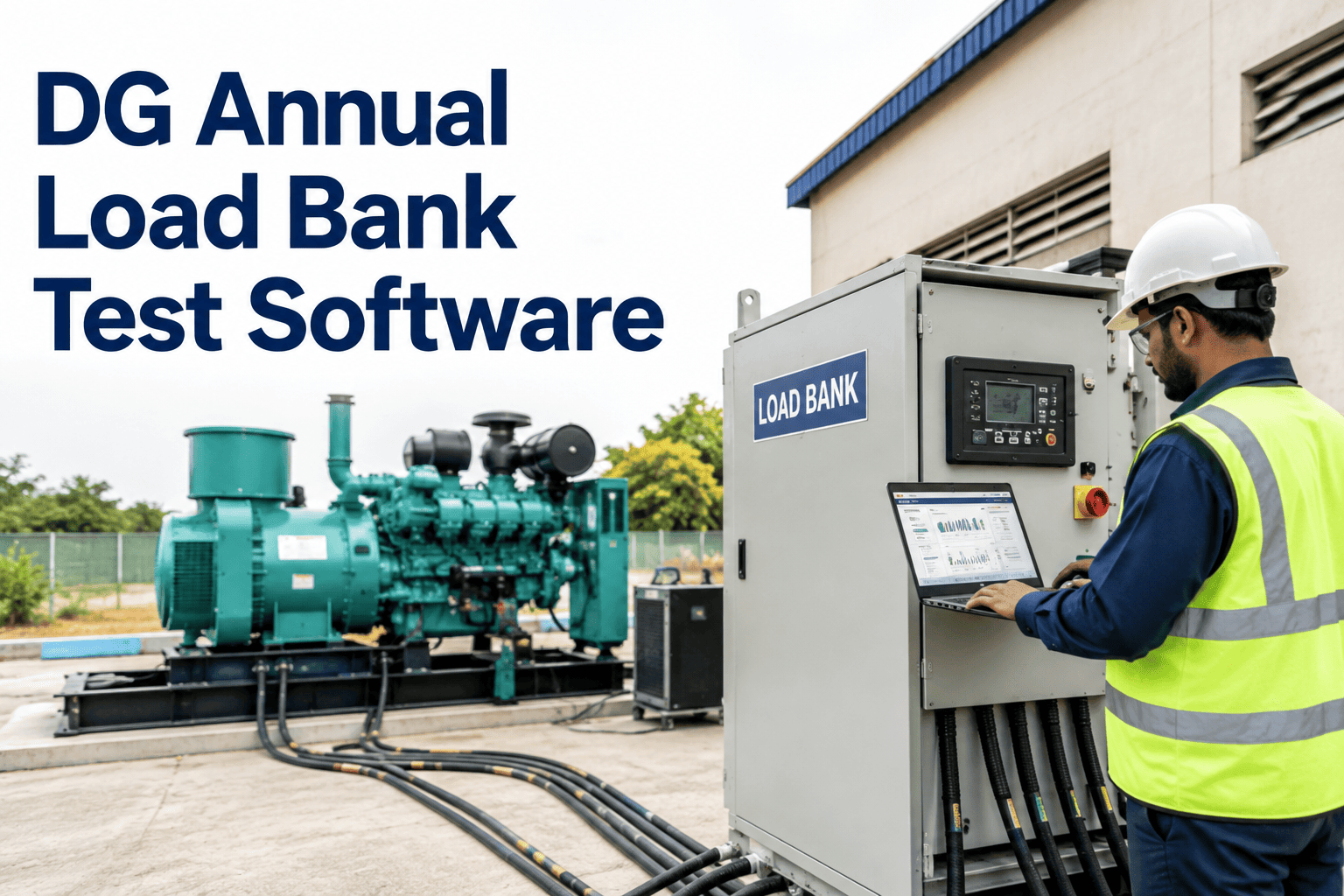
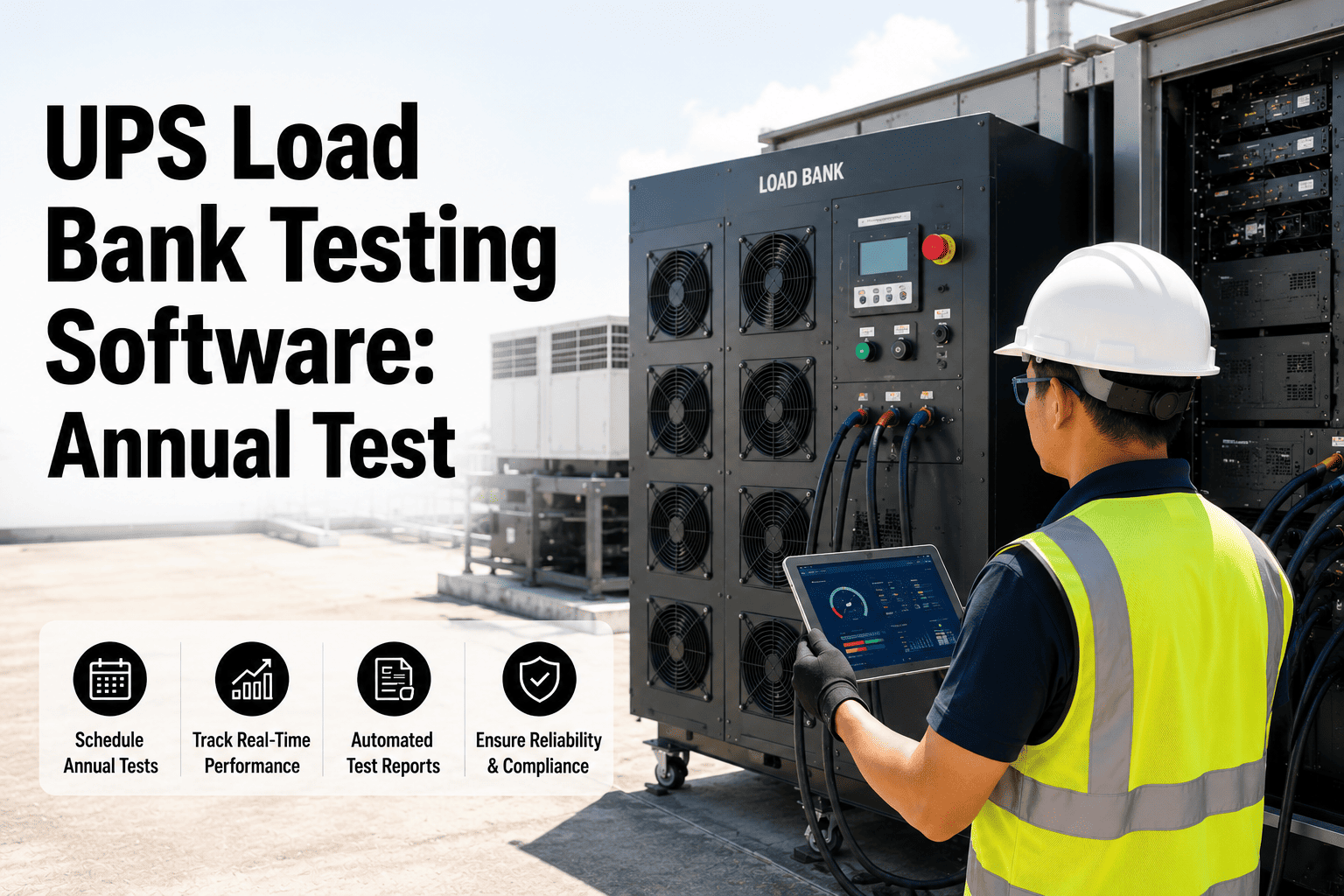
Most diesel generators never fail because the engine is bad — they fail because nobody loaded them hard enough to notice the problem building underneath. Monthly exercise runs rarely pull a standby unit past 20-25% of its nameplate rating, which is well below the threshold needed to burn fuel cleanly, so carbon deposits, glazed cylinder walls, and fouled injectors accumulate quietly for months. NFPA 110 exists specifically to catch this: it requires an annual supplemental load bank test that pushes the generator to 50% and then 75% of rated output for a sustained run, proving the unit can actually carry a real outage rather than just start and idle. Facilities that still track this on a clipboard or a shared spreadsheet routinely lose the exact load-step timestamps, exhaust readings, or technician sign-off the moment an inspector asks to see them, and a missing record reads the same as a missed test to most authorities having jurisdiction. See how a dedicated DG load bank test workflow inside OxMaint turns that clipboard into a timestamped, audit-ready compliance record automatically.
Stop Rebuilding Your Load Bank Paperwork Before Every Inspection
Digital pre-test checklists, live parameter logging at every load step, and a one-click compliance report — built into OxMaint's facility CMMS
30%
Minimum nameplate load a diesel EPS must carry every month before the annual supplemental load bank test can be waived under NFPA 110
1.5 Hrs
Current annual load bank protocol under the 2025 edition — 50% of nameplate for 30 minutes, then 75% for a continuous 60 minutes
36 Mo.
How often Level 1 emergency power systems need a full continuous load test regardless of how the monthly exercise performs
What NFPA 110 Actually Requires From an Annual Load Bank Test
Load bank testing requirements are one of the most commonly misquoted parts of NFPA 110, mainly because the protocol has changed between editions and most local authorities are still catching up unevenly. The rule is straightforward in principle: if your diesel generator's monthly exercise run cannot reach 30% of its nameplate kW rating using the building's actual connected load, you owe it an annual supplemental load bank test using external load banks. Level 1 systems — hospitals, life-safety branches, and other critical installations — carry an added obligation regardless of monthly performance, a full continuous load test at least once every 36 months. The table below lays out every tier so your facility team, your service contractor, and your AHJ are reading from the same numbers before the next test date arrives.
Test Type
Trigger
Load Steps
Total Duration
Frequency
Monthly Exercise
Standard operational testing
30% of nameplate or manufacturer exhaust temp
30 minutes minimum
Every month
Annual Supplemental (2025 edition)
Monthly test can't reach 30% load
50% for 30 min, then 75% for 60 min
1.5 hours
Annually
Legacy Protocol (pre-2025 editions)
AHJ still enforcing older edition
25% / 50% / 75% of nameplate, 30 min each
2 hours
Annually
Level 1 Triennial Test
Mandatory, independent of monthly results
Continuous run at full connected load
4 hours
Every 36 months
Healthcare (NFPA 99)
Same 30% shortfall trigger as NFPA 110
50% for 30 min, then 75% for 60 min
1.5 hours
Annually, plus 12 monthly runs
Because the 2025 edition shortened the annual protocol from a three-step, two-hour test to a two-step, 90-minute test, it is worth confirming in writing which edition your local AHJ has adopted before you schedule a technician or sign off on a test plan — a report built to the wrong edition can still get flagged even if the generator performed perfectly.
Why Skipping the Load Bank Test Costs More Than the Test Itself
Standby generators are the exact opposite of a continuous-duty engine: they sit idle for months and then run, when exercised, under a fraction of their rated load. That pattern is precisely what causes wet stacking — unburned diesel fuel and carbon residue building up in the exhaust manifold, turbocharger, cylinder walls, and even the lubricating oil because the engine never gets hot enough to burn fuel completely. Left unaddressed, wet stacking fouls injector nozzles, glazes cylinder liners, reduces turbo efficiency, dilutes crankcase oil, and can measurably cut the power the generator is able to deliver — which is precisely the moment it matters least to discover a shortfall. Manufacturers know this pattern well enough that wet-stacking damage is frequently excluded from engine warranties outright. A properly executed load bank test at 50-75% of rated capacity raises cylinder pressure and exhaust temperature enough to burn off those deposits and confirm, on paper, that the unit can carry its full emergency load.
6 Data Points Every Load Bank Test Report Must Capture
1
Load Step Percentage and Duration
Each stage — 50% for 30 minutes, 75% for 60 minutes under the current protocol — needs its own start time, end time, and confirmed load percentage, not a single end-of-test summary line.
2
Voltage and Frequency Stability
Output voltage and frequency should stay within the generator's rated tolerance at every load step; drift under load is often the earliest sign of a governor or AVR problem.
3
Exhaust Gas Temperature
This is the direct indicator of whether the load applied was actually enough to burn fuel cleanly and reach the manufacturer's recommended combustion temperature.
4
Oil Pressure and Coolant Temperature Trend
Logged continuously rather than as a single reading, so a slow drift toward an out-of-range value is caught during the test instead of during the next real outage.
5
Deficiencies and Wet Stacking Indicators
Visible smoke, oily residue at the exhaust stack, or reduced power pickup at a given load step all need to be written down with the load condition present at the time.
6
Technician Sign-Off and Timestamp
A pass or fail determination tied to a named, qualified individual and a date — the single detail most commonly missing when a paper report is pulled for an audit.
5 Mistakes That Turn a Passed Test Into a Failed Audit
A generator can carry its full load perfectly and still generate an audit finding, because inspectors are often checking the documentation trail as closely as the mechanical result. These are the gaps that show up most often when a facility's load bank records get pulled.
1
Testing to the Wrong Edition
Running the older three-step, two-hour protocol when the local AHJ has already adopted the 2025 edition's two-step, 90-minute protocol, or the reverse.
2
Missing Load-Step Timestamps
A report that states an average load instead of a per-step, timestamped record does not satisfy most AHJ documentation expectations.
3
No Link Between the Report and the Asset Record
A PDF sitting in a shared drive, disconnected from the generator's maintenance history, is far harder to retrieve on demand than one attached directly to the asset.
4
Confusing the Monthly Exercise With the Annual Test
A monthly run at 30% load is not a substitute for the annual supplemental test once that monthly threshold has already been missed even once.
5
No Corrective Action Trail
A deficiency noted with no linked work order, part replacement, or re-test date signals to an inspector that the issue may still be unresolved.
From Paper Logbook to Digital Compliance Record
The mechanical part of a load bank test — connecting the bank, stepping through the load stages, watching the gauges — has not changed much in decades. What has changed is what happens to that data the moment the test ends. A digital workflow closes the gap between "the test happened" and "the test is provable," which is the exact gap an auditor is trained to look for.
1
Before
Test Scheduled Against the Right Protocol
OxMaint schedules the annual load bank test against the generator's asset record, flags whether the monthly exercise met the 30% threshold, and confirms which edition's load-step protocol applies.
2
Pre-Test
Digital Checklist Opens on Site
The technician opens a mobile checklist covering load bank connection, baseline readings, and safety steps before load is ever applied — no paper form to lose or misplace.
3
During
Every Load Step Logged in Real Time
Load percentage, duration, voltage, frequency, exhaust temperature, oil pressure, and coolant temperature are entered per step as they happen, each one timestamped automatically.
4
After
Compliance Report Generated Automatically
A pass or fail report assembles itself from the logged data, complete with technician sign-off, deficiencies noted, and any corrective work order linked directly to the record.
5
Archive
Record Attached to the Asset, Ready for Any Inspection
Every past load bank report, coaching note, and repair sits on the generator's own history in OxMaint, retrievable in minutes instead of a search through file cabinets or old emails.
DG Load Bank Software — OxMaint
Turn Every Load Bank Test Into a Closed Compliance Loop
Scheduling, digital checklists, real-time parameter logging, and automatic audit-ready reports — for every generator across every site, in one facility CMMS.
What Getting This Wrong Actually Costs a Facility
The load bank test itself is a small line item next to what a facility risks by skipping it, delaying it, or losing the paperwork that proves it happened. These three cost categories are where the real exposure sits.
Deferred Maintenance Cost
Wet stacking left unaddressed
Common symptoms
Fouled injectors, glazed liners
Engine impact
Reduced power output
Warranty status
Often excluded by manufacturers
Worst-case outcome
Failure to pick up load in an outage
Manual Tracking Cost
Spreadsheets and paper logs
Time to find a report
Hours, across file systems
Multi-site visibility
No single source of truth
Edition tracking
Manual, easy to miss updates
Sign-off trail
Frequently incomplete
Digital Compliance Cost
Load bank workflow in OxMaint
Time to produce a report
Minutes, on demand
Multi-site visibility
One dashboard, every generator
Edition tracking
Built into the schedule
Sign-off trail
Captured automatically
Before OxMaint our load bank records lived in three different places depending on which technician ran the test that year. When our AHJ asked for two years of history on one generator during a routine inspection, we had it pulled up and exported before the walk-through was even finished. That single change removed the part of our compliance process that used to keep our facilities director up at night.
Facilities Operations Manager, Multi-Site Healthcare System
Frequently Asked Questions
What is a DG annual load bank test and why is it required?
It is a controlled load applied to a diesel generator by external equipment to prove it can carry a real electrical load, required under NFPA 110 whenever a generator's monthly exercise cannot reach 30% of nameplate kW using the building's own connected load.
How long does the current annual load bank test take?
Under the 2025 edition, the standard annual protocol is 1.5 continuous hours — 50% of nameplate load for 30 minutes, followed by 75% of nameplate load for 60 minutes. Older editions used a three-step, two-hour test, so always confirm which edition your AHJ enforces.
What happens if a generator fails its load bank test?
The deficiency gets documented, corrective work such as injector service or a repair is scheduled, and the unit is typically re-tested once the work is complete. A
digital work order linked to the test record keeps that corrective loop from getting lost.
Does OxMaint work with the generators and load banks we already have?
Yes — OxMaint is not a load bank itself, it is the scheduling, checklist, and reporting layer that sits on top of whatever generators and load bank equipment your facility or contractor already uses.
How is load bank test data documented for audits inside OxMaint?
Every load step, reading, and deficiency is timestamped and attached to the generator's own asset record, so a full test history can be exported for any AHJ or insurance review in minutes.
Book a walkthrough to see a sample report.
Facility CMMS — OxMaint
Never Chase a Load Bank Report Before an Inspection Again
Schedule the test, log every load step as it happens, and hand an inspector a complete record without opening a single spreadsheet. Set up your first generator in OxMaint today.