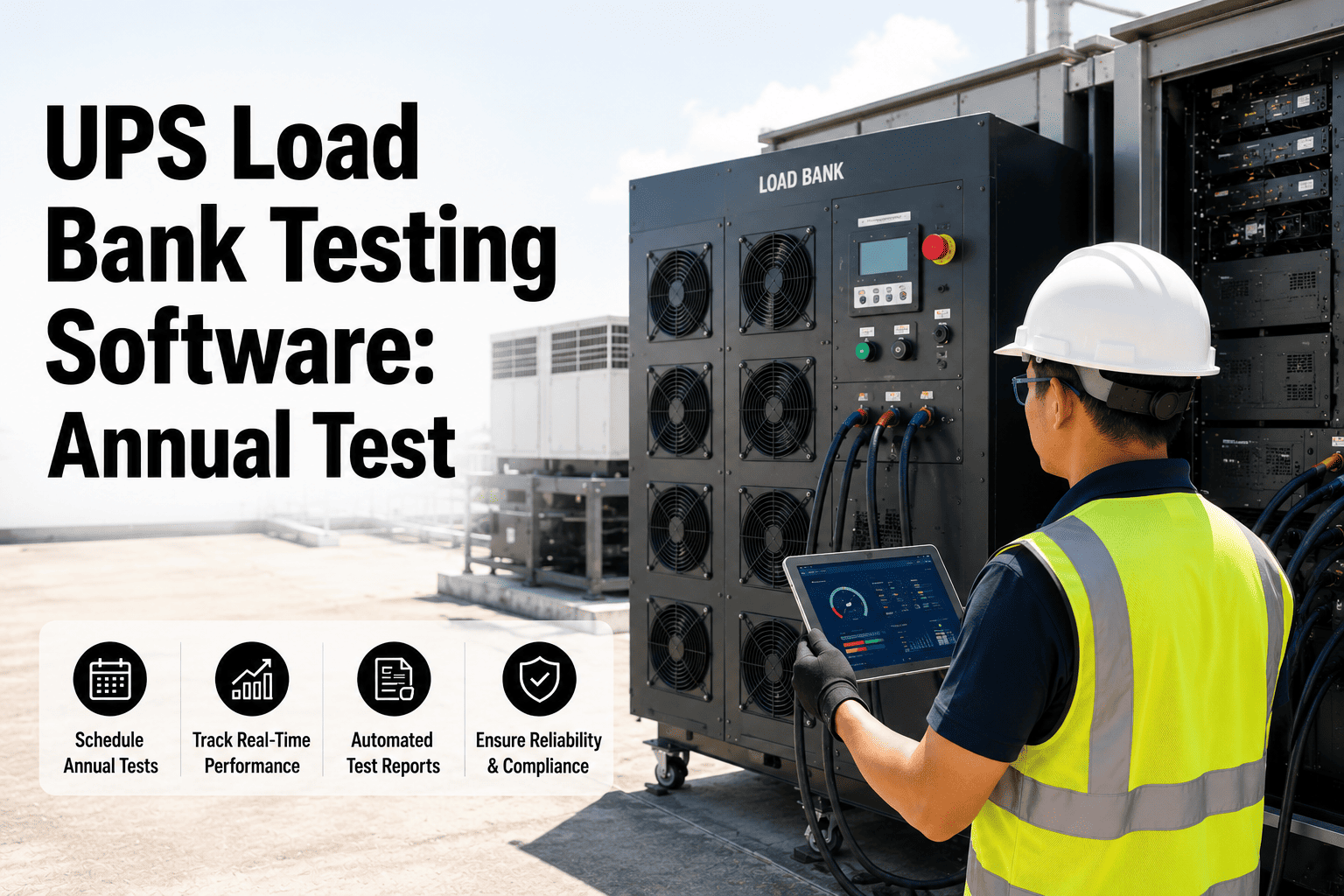
Every UPS battery string looks fine right up until the moment a facility actually needs it, and that is exactly the gap that annual load bank testing exists to close. A load bank forces the UPS battery system to deliver real current under a sustained, measured discharge, exposing capacity loss that a simple voltage check will never reveal. Facilities that treat this as a once-a-year paperwork exercise usually discover the weak string during an outage instead of during a scheduled test window. The teams that get it right run load bank testing on a fixed annual cadence, log every voltage, current, and runtime reading against the manufacturer's rated capacity, and keep that record ready for the next audit. Sign in to OxMaint to see how a structured CMMS turns that annual test from a scramble into a scheduled, documented routine.
UPS Load Bank Testing · Annual Battery Discharge Test · CMMS Software
Annual Load Bank Tests Scheduled Automatically. Discharge Results Logged Against Rated Capacity. Audit-Ready Records in Minutes, Not a Frantic Week Before the Inspection.
OxMaint UPS load bank testing software schedules the annual discharge test for every battery string in your facility, captures voltage and runtime readings against manufacturer capacity curves, flags strings trending toward failure, and produces the defensible documentation your compliance team needs on demand.
1x / yr
minimum load bank or discharge test cadence most critical-power programs run for UPS battery strings, aligned to the same annual rhythm used for backup generator testing
3 stages
typical staged load profile — a controlled ramp through partial and near-full load before sustained discharge, so the string is stressed the way an actual outage would stress it
Minutes
the time it should take to pull a complete UPS test history for one string during an audit — not days spent searching binders and spreadsheets
100%
A UPS battery string that has never been discharge-tested under load has an unknown real capacity, no matter how healthy its float voltage looks. Voltage and internal-resistance checks catch some degradation, but a full load bank discharge is the only test that proves the string can actually carry the connected load for the runtime it is rated for. Skipping the annual test does not remove the risk — it just moves the discovery moment from a scheduled Tuesday morning to the middle of a real outage.
The Annual Load Bank Test, Stage by Stage
1
Pre-Test Inspection and Baseline Reading
Technicians record float voltage, ambient temperature, and connection integrity for every jar or block in the string before any load is applied, giving the test a documented starting point to compare against.
2
Staged Load Application
The load bank is brought on in steps rather than all at once, letting technicians watch how voltage responds at each increment and catch a weak block before it drags the whole string down under full load.
3
Sustained Discharge at Rated Load
The string is held at or near its rated discharge current for the runtime the UPS is specified to deliver, with voltage and current logged at regular intervals so the actual runtime can be compared against the nameplate figure.
4
Recovery and Recharge Verification
After the load is removed, the string is returned to float charge and monitored to confirm it recharges normally, since a string that recovers poorly is often already signaling the failure the discharge test just missed.
5
Results Logged Against Capacity Curve
Every reading is compared to the manufacturer's rated capacity for that battery age, and any string testing below the acceptable percentage is flagged for replacement planning rather than left as a line item in a report nobody reopens.
Most UPS load bank test failures were visible in the data long before the string actually failed. The problem was never the absence of a test — it was that the results sat in a PDF nobody trended.
OxMaint schedules the test, captures the readings against the capacity curve, and tells you which string needs attention before it becomes an outage.
What OxMaint UPS Load Bank Software Tracks for Every String
Annual Test Scheduling and Escalating Reminders
Every UPS battery string on site gets its own test date, calculated from the last completed discharge test rather than a generic calendar reminder. As the date approaches, OxMaint escalates the alert from the technician to the facility manager if the test has not been scheduled, so an annual requirement never quietly slips into an eighteen-month gap.
Discharge Result Logging by String and Block
Voltage, current, runtime, and ambient temperature are recorded at the string level and, where it matters, at the individual block level, so a technician can see exactly which unit in a forty-block string is dragging the average down instead of only seeing a pass or fail for the whole cabinet.
Capacity Trend Analysis Across Test Cycles
Each annual result is plotted against the string's prior tests and against the manufacturer's expected capacity fade curve for its age, turning a single point-in-time reading into a trend line that shows whether the string is degrading faster than expected and needs earlier replacement.
Replacement Planning Before Failure
When a string's tested capacity drops below the threshold your program sets, OxMaint generates a replacement work order and a budget flag automatically, giving facility and finance teams weeks of lead time to plan the swap instead of an emergency purchase order after a failed discharge test.
Defensible Documentation on Demand
Every test date, technician, reading, and follow-up action is retained in one record per string, formatted for handover to an auditor, an insurer, or an accreditation reviewer without anyone digging through a shared drive of scanned PDFs the night before the review.
Multi-Site UPS Fleet Rollup
Facility operators managing UPS systems across several buildings or a data center campus get one dashboard showing test status, upcoming due dates, and flagged strings across every site, rather than reconciling separate spreadsheets from separate facility teams.
What Skipping or Mishandling the Annual Test Actually Costs
High Impact
Runtime Shortfall Discovered Mid-Outage
A string that has never been discharge-tested can look healthy on a voltage reading and still fail to carry load for the rated runtime, and the only time that gap becomes visible is during an actual power event — precisely when there is no room for surprises.
High Impact
Missing or Incomplete Test Records
In an audit, an accreditation review, or a post-incident investigation, a battery string without a current discharge test record is treated the same as a string that was never inspected at all, regardless of its actual physical condition.
Elevated
One Weak Block Hidden Inside a Passing String
String-level pass/fail reporting without block-level readings can let a single degraded unit hide inside an average that still looks acceptable, until that block finally fails and takes the runtime of the whole string down with it.
Elevated
Reactive, Emergency Battery Replacement
Without a capacity trend line, replacement decisions get made only after a string fails a test outright, which usually means an emergency purchase at a worse price and an unplanned outage window instead of a budgeted, scheduled swap.
Annual UPS Load Bank Testing — What Good Programs Track
Outcomes Facilities Report After Structuring UPS Testing in OxMaint
Zero
missed annual test dates across tracked UPS strings once scheduling moved from a shared calendar reminder to an automated per-string schedule
Weeks
of advance notice before a degrading string reaches replacement threshold, instead of discovering the failure at the next annual test
Minutes
to hand a complete, per-string discharge history to an auditor instead of reconstructing it from scanned service reports
We had a UPS string pass its annual test at 94 percent capacity two years in a row and nobody noticed the trend, because each report only compared that year against the nameplate rating, not against the string's own history. Once we started trending capacity year over year in OxMaint, we caught a second string fading fast enough to schedule replacement four months before it would have failed its next test outright.
— Critical Facilities Manager, Colocation Data Center Operator
Frequently Asked Questions — UPS Load Bank Testing Software
How often should a UPS battery string actually be load bank tested?
Most critical-power programs run a full discharge or load bank test annually, alongside monthly visual and voltage checks.
Sign in to OxMaint to set per-string schedules that match your facility's actual program rather than a generic default.
Does OxMaint replace the physical load bank equipment or the technician doing the test?
No. OxMaint schedules the test, captures the readings your technician or contractor records during the discharge, and manages the resulting data and documentation — the physical test still runs on your load bank hardware.
Can OxMaint track UPS strings across multiple buildings or a whole data center campus?
Yes. Every string is tracked individually with its own test history, and a rollup view shows test status and flagged strings across every site your team manages.
Book a demo to see the multi-site view.
What happens when a string tests below its expected capacity?
OxMaint flags the string and can generate a replacement work order automatically, so the finding turns into a planned action rather than a note in a report that nobody follows up on.
Can I pull a full discharge test history for one UPS string during an audit?
Yes, a complete per-string record — every test date, reading, technician, and follow-up action — is available in minutes.
Start a free trial to see the export format.
The Annual Load Bank Test Only Protects You If Someone Trends the Results. OxMaint Schedules the Test, Logs the Discharge Data, and Tells You Which String Needs Attention Before It Fails.
Per-string scheduling. Block-level discharge logging. Capacity trend analysis. Replacement planning before failure. Audit-ready records on demand. OxMaint turns your annual UPS test into a program instead of a once-a-year scramble.