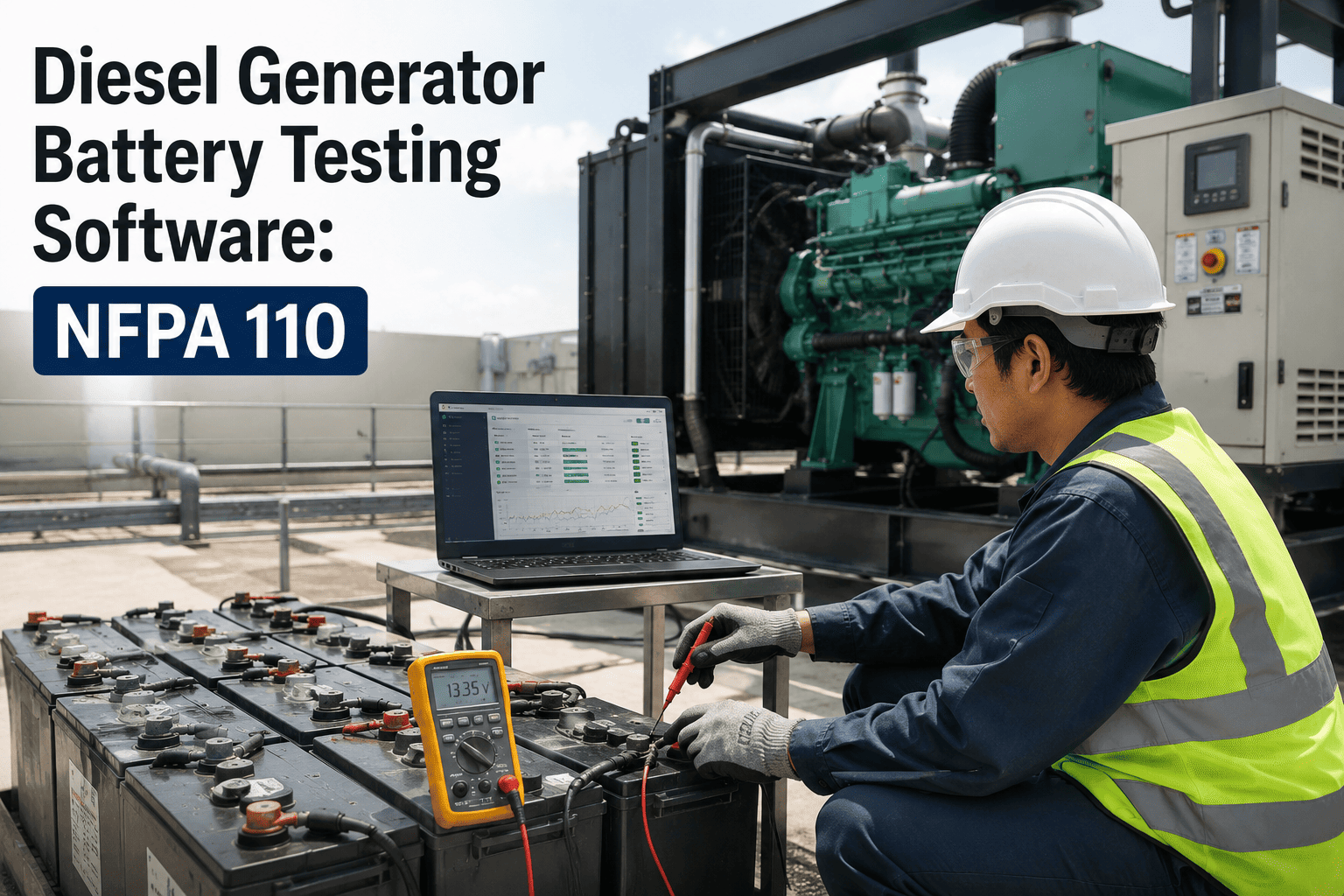
The grid fails at 11:47 PM on a Friday. Your diesel generator receives the start signal—and nothing happens. The investigation reveals a battery that failed silently three weeks ago, documented nowhere because the last inspection report was a handwritten note that got lost. According to industry data, battery failure causes 43% of generator malfunctions, with 80% of those failures linked to sulfation buildup that proper inspection would have caught. An NREL study found that well-maintained generators achieve 99.87% startup reliability while poorly maintained units drop to 98.35%—a difference that becomes catastrophic when backup power is critical. A structured inspection and load test reporting template transforms random observations into actionable intelligence that keeps your generator ready.
Well-Maintained
99.87%
Startup Reliability
Average Maintenance
99.34%
Startup Reliability
Poorly Maintained
98.35%
Startup Reliability
That 1.5% difference represents the gap between power when you need it and failure when it matters most.
NFPA 110 mandates weekly inspections and monthly load testing for emergency power supply systems (EPSS). Records must be created and maintained for all inspections, tests, and repairs—available to the Authority Having Jurisdiction on request. Facilities that implement digital inspection workflows reduce documentation errors by 41% while creating the audit trail that proves compliance.
What Your Inspection Report Must Capture
A complete diesel generator inspection report documents more than pass/fail checkmarks. It captures trending data that reveals degradation before failure occurs.
1
Asset Identification
Generator ID / Asset Tag
Location / Building
Make / Model / Serial
kW Rating / Voltage
Run Hours (Current)
2
Inspection Details
Inspection Date / Time
Inspector Name / ID
Inspection Type
Ambient Temperature
3
System Readings
Battery Voltage (V)
Coolant Temp (°F)
Oil Pressure (psi)
Fuel Level (%)
Load Test Reporting: The Critical Numbers
NFPA 110 requires diesel generators to run under load for minimum 30 minutes monthly, achieving at least 30% of nameplate kW rating—or reaching manufacturer-recommended exhaust temperatures. If monthly tests don't reach 30% load, annual load bank testing becomes mandatory.
Run Duration
Min. 30 minutes
_______ min
Load Applied
Min. 30% of kW rating
_______ kW
Exhaust Temp
Per manufacturer spec
_______ °F
Frequency
60 Hz ± 0.5 Hz
_______ Hz
Voltage Output
Within ±5% rated
_______ V
Transfer Time
Within 10 sec (Type 10)
_______ sec
Organizations managing multiple generators across facilities need centralized reporting to compare performance trends. Teams that explore automated load test tracking find that CMMS platforms flag when readings fall outside normal ranges—before failures occur.
Digitize Your Generator Reports
See how OXmaint captures inspection data, tracks load test results, and generates compliance-ready reports automatically.
Top Failure Points to Document
Your inspection report should focus extra attention on the components most likely to cause failure. Data shows where problems originate.
1
Battery System Failure
43%
Check: Voltage, terminals, electrolyte, charge rate
2
Electrical/Wiring Issues
28%
Check: Connections, corrosion, ATS contacts
3
Check: Water content, microbial growth, filters
4
Cooling System Failure
15%
Check: Coolant level, hoses, block heater temp
Expert Perspective: Documentation That Protects You
"Your inspection report isn't just paperwork—it's your legal defense if something goes wrong and your roadmap for preventing failures. I've seen facilities pass every inspection by the book, yet still face equipment failures because they weren't trending the data. When you document that battery voltage dropped from 12.8V to 12.4V over three months, you've identified a problem before it becomes a 2 AM emergency."
Trend, Don't Just Record
A single reading tells you status. Multiple readings over time reveal trajectory. Track every measurement month-over-month.
Document Deficiencies AND Corrections
Finding a problem is half the battle. Recording what you did about it proves due diligence to inspectors and insurers.
Keep Reports Accessible
NFPA 110 requires records be available to the AHJ on request. Digital systems provide instant retrieval during audits.
Facility teams that centralize their generator documentation discover that searchable digital records make compliance verification effortless during inspections.
NFPA 110 Testing Schedule
Weekly
Visual Inspection
Fuel levels, battery charge, coolant temp, control panel status, leaks
Monthly
Load Test (30 min @ 30% load)
Run time, load applied, voltage, frequency, exhaust temp, transfer switch operation
Annual
Load Bank Test (if needed)
50% load for 30 min + 75% load for 60 min, or continuous operation at building load
36-Month
Extended Run Test (Level 1 EPSS)
Continuous operation for system class duration (up to 4 hours) at 30%+ load
Managing these overlapping schedules manually leads to missed tests and compliance gaps. Teams ready to automate their testing calendar ensure every required inspection happens on time, every time.
Simplify Generator Compliance
Join facility teams using OXmaint to automate inspections, capture load test data, and maintain NFPA 110 compliance effortlessly.
Frequently Asked Questions
What must be documented in a diesel generator inspection report?
NFPA 110 requires documentation of the inspection date, inspector name, equipment identification, all readings taken, any deficiencies found, and corrective actions completed. For load tests, record run duration, load applied (kW), voltage output, frequency, exhaust temperature, and transfer switch operation time. Reports must be retained and available to the Authority Having Jurisdiction on request.
How often should diesel generators be load tested per NFPA 110?
NFPA 110 requires monthly load testing for a minimum of 30 minutes. The test must achieve at least 30% of the generator's nameplate kW rating or reach manufacturer-recommended exhaust temperatures. If monthly tests don't achieve 30% load, annual load bank testing becomes mandatory. Level 1 EPSS also requires a 36-month extended run test.
What is wet stacking and how does load testing prevent it?
Wet stacking occurs when diesel generators run below recommended operating temperature and load, causing unburned fuel to accumulate in the exhaust system. This leads to carbon buildup, fouled injectors, reduced efficiency, and shortened engine life. Regular load testing at 30%+ capacity burns off deposits and confirms the engine operates properly under real-world conditions.
Why do batteries cause most generator startup failures?
Battery failure accounts for 43% of generator malfunctions, with 80% caused by sulfation buildup on lead-acid battery plates. This occurs when batteries aren't properly maintained or charged. Inspection reports should track battery voltage, electrolyte levels (specific gravity above 1.225), terminal corrosion, and charge rates over time to identify degradation before failure.
How does CMMS software improve generator inspection reporting?
CMMS platforms automate inspection scheduling, provide digital checklists that ensure no items are missed, capture readings with timestamps and photos, flag values outside normal ranges, and maintain searchable records for instant retrieval during audits. Studies show CMMS reduces documentation errors by 41% while creating trending data that reveals problems before failures occur.