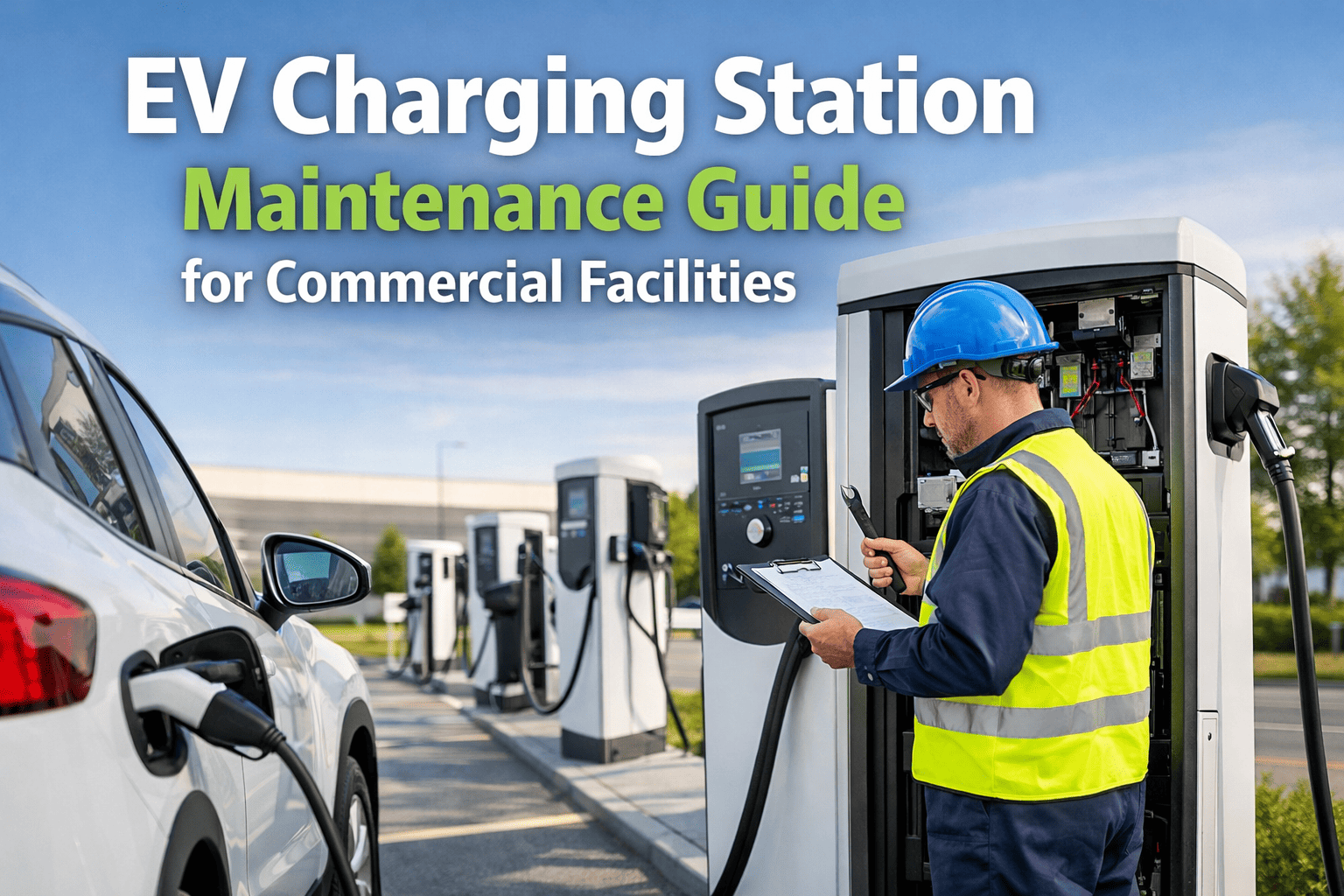
NEVI federal funding mandates 97% uptime on publicly accessible EV chargers — a threshold that is impossible to hit without a structured maintenance programme and OCPP fault monitoring integrated into your CMMS. Yet most commercial facilities treat their chargers as plug-and-forget infrastructure, discovering failures only when drivers complain. Oxmaint's Asset Lifecycle Management platform registers every Level 2 and DC fast charger as a tracked asset, ingests OCPP fault codes automatically, and enforces manufacturer-specific PM intervals — turning charger uptime from a reactive problem into a measurable KPI.
Top Failure Modes — What Actually Stops Commercial Chargers
Charger downtime is not random. The four failure modes below account for the majority of unplanned outages in commercial deployments. Each has a preventive signature that surfaces in OCPP telemetry or visual inspection before the charger stops working entirely. Structured fault detection workflows catch these patterns early.
Cable & Connector Wear
The single most common failure. Thousands of plug cycles per year, plus weather exposure and improper handling, degrade cables faster than most operators track. Frayed sheathing and pin corrosion cause intermittent faults long before hard failure.
Thermal / Cooling System Faults (DC Fast)
Level 3 chargers use liquid-cooled cables and internal cooling loops. Coolant degradation, pump failure, and blocked air filters trigger thermal derating long before OCPP reports a fault — reducing delivered kW without the driver knowing why charging is slow.
Firmware & Communication Failures
Outdated firmware causes OCPP handshake failures, payment processing errors, and cybersecurity exposure. Networked chargers that lose backend connection continue operating but cannot bill, authenticate, or report faults — creating silent downtime.
GFCI & Ground Fault Tripping
Moisture ingress, degraded gaskets, and ageing GFCI modules cause nuisance trips that take chargers offline until manually reset. Common in outdoor deployments without adequate enclosure sealing or drainage.
PM Schedule — By Task and Charger Type
The schedule below reflects industry consensus from U.S. DOT, NREL, and major charger OEMs. Level 2 chargers have simpler PM requirements; Level 3 DC fast chargers add cooling system, power electronics, and transformer checks that drive the bulk of the maintenance effort.
| PM Task | Level 2 AC | Level 3 DC Fast | Performed By | Oxmaint Trigger |
|---|---|---|---|---|
| Visual inspection — cables, enclosure, screen | Weekly | Weekly | Site staff | Weekly checklist |
| Connector pin inspection & cleaning | Monthly | Monthly | Technician | Calendar PM |
| Screen & payment terminal clean | Weekly | Weekly | Site staff | Weekly checklist |
| OCPP error log review | Daily | Daily | Operations | Auto feed |
| Firmware & security patch check | Monthly | Monthly | Operations | Monthly PM |
| Coolant level & pump check | N/A | Monthly | Technician | Monthly PM (L3 only) |
| Air filter cleaning / replacement | Semi-annual | Quarterly | Technician | Calendar PM |
| GFCI function test | Quarterly | Quarterly | Technician | Calendar PM |
| Electrical test — continuity, ground, voltage | Annual | Annual | Licensed electrician | Annual PM + certificate |
| Transformer & switchgear inspection | N/A | Annual | Licensed electrician | Annual PM (L3 only) |
| Uptime & utilisation KPI review | Monthly | Monthly | Operations | Auto dashboard |
Live OCPP Fault Feed — What Remote Monitoring Looks Like
OCPP (Open Charge Point Protocol) is the open standard that lets networked chargers communicate with a central management system. When that feed is piped into Oxmaint, fault codes auto-generate work orders with the full error context, charger asset ID, and recommended action — before a single driver complaint arrives.
Hitting 97% Uptime Is Not Optional. Managing It Manually Is Impossible.
Oxmaint registers every charger as a lifecycle-tracked asset, ingests OCPP faults automatically, and enforces OEM-specific PM intervals — so NEVI uptime compliance becomes a measurable KPI, not a surprise audit finding.
Compliance & Safety Checklist for EV Charger Maintenance
NEVI Uptime Compliance
Publicly accessible chargers funded under NEVI require 97% uptime measured per port, per month. Oxmaint tracks downtime events with OCPP timestamps for audit-ready reporting.
NEC Article 625 Compliance
National Electrical Code Article 625 governs EVSE installation and ongoing inspection. Annual electrical testing and ground fault verification must be documented and retained.
LOTO & Arc Flash PPE
Technicians servicing DC fast chargers must follow lockout/tagout procedures and wear voltage-rated gloves plus arc-rated clothing. Logged per service event in Oxmaint.
EVITP Technician Credentials
The Electric Vehicle Infrastructure Training Program credential is increasingly required for commercial EVSE work. Track certification expiry per assigned contractor in Oxmaint.
“The commercial EV charging market is where HVAC was twenty years ago — the equipment is installed, the demand is real, but the maintenance discipline has not caught up. Site hosts assume chargers are maintenance-free because they have no moving parts in the AC case. The reality is that connector wear, coolant degradation on DC fast units, and firmware drift cause the majority of downtime. When NEVI funding requires 97% uptime per port per month, you cannot hit that number without an asset-level CMMS tracking every charger by serial, every fault by OCPP code, and every PM interval by OEM specification. The sites that treat chargers as proper facility assets hit uptime. The sites that treat them as plug-and-forget hardware lose funding eligibility.”