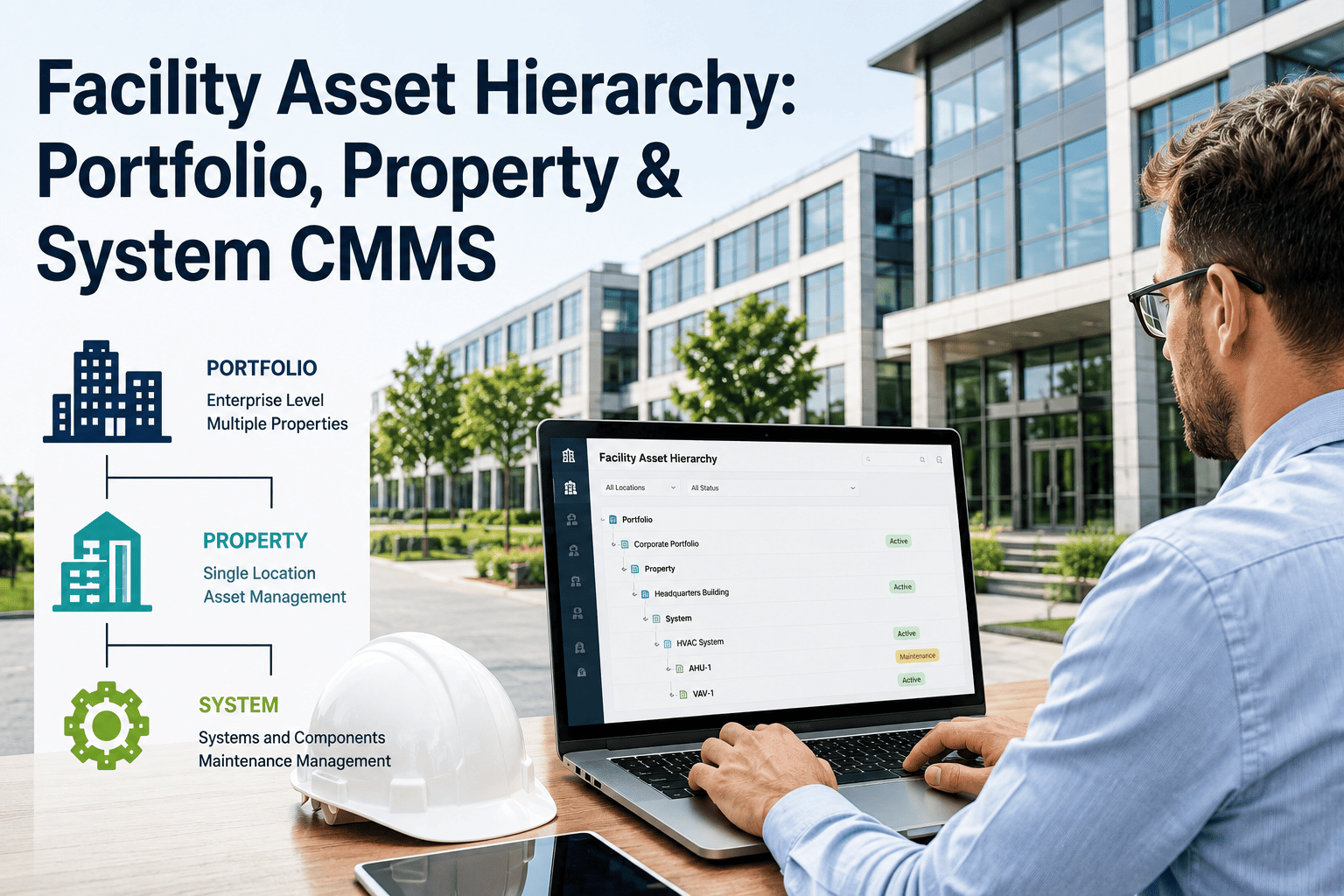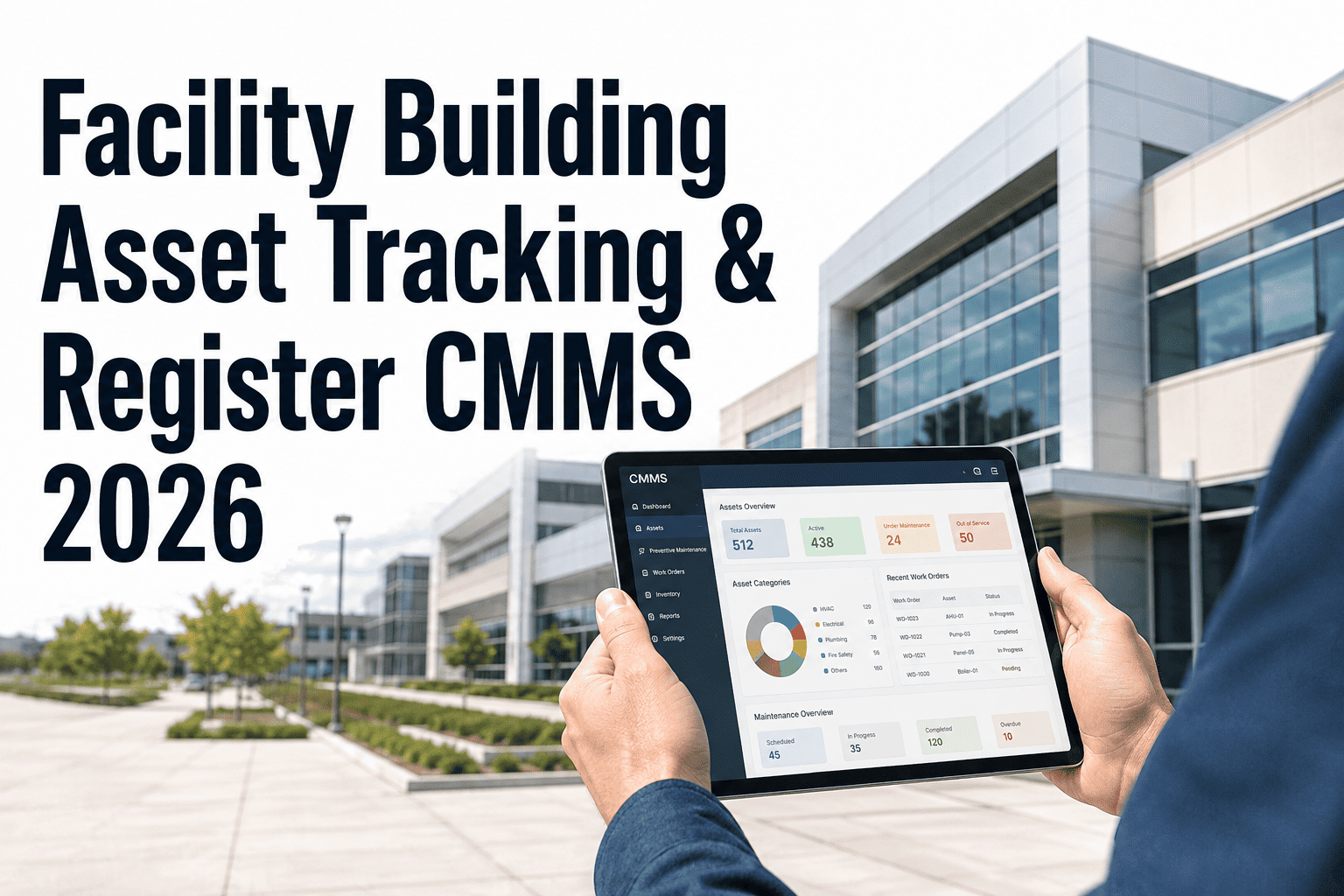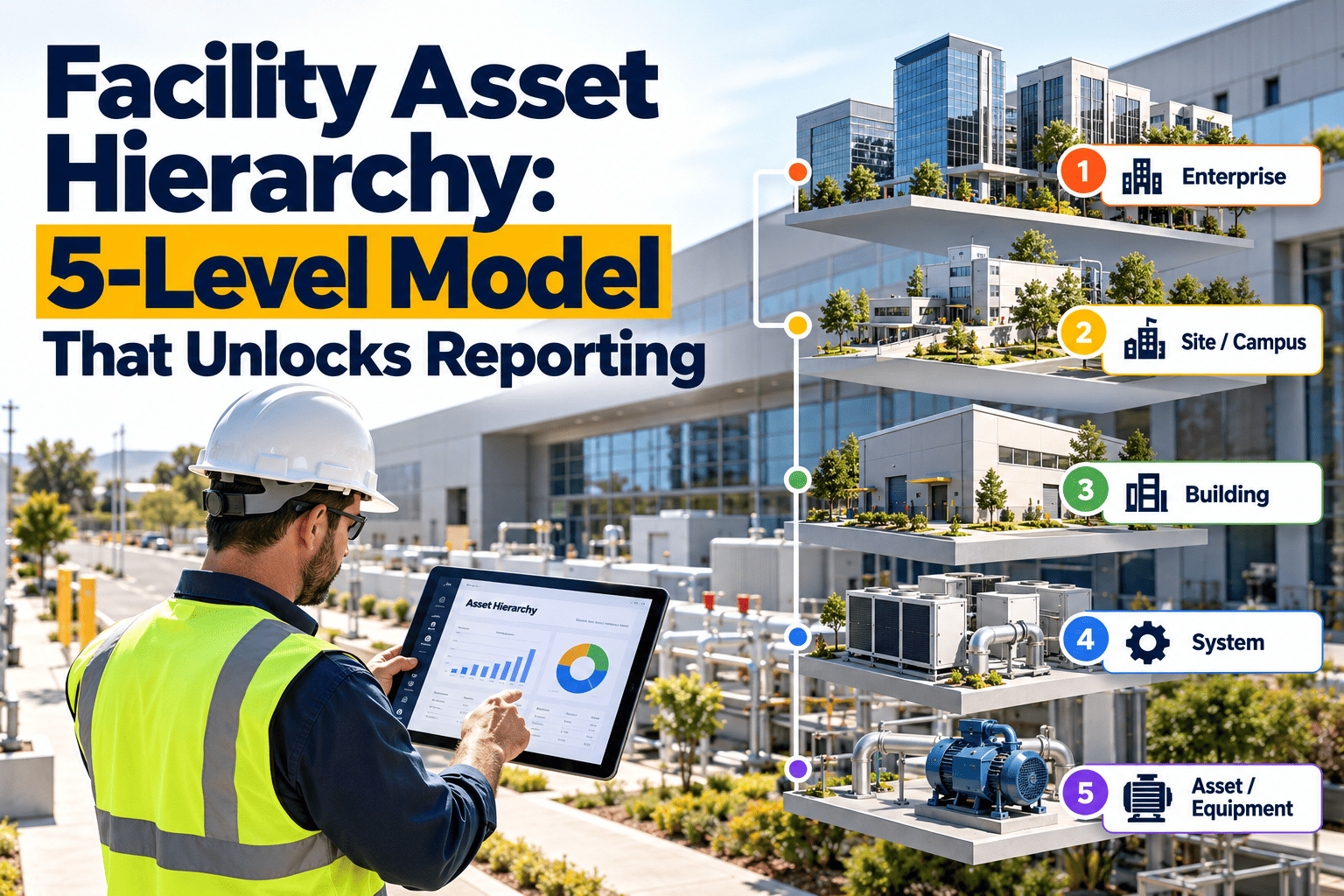
A facility asset hierarchy is the parent-child structure that tells your maintenance system where every piece of equipment lives and what it belongs to. When that structure is shallow, inconsistent, or built differently by each technician, reports stop making sense. You cannot compare chillers across buildings or roll up cost by system. A five-level model fixes this by organizing assets from site down to the individual asset. This guide explains each level, naming rules, and how Oxmaint maintenance management software uses the structure to power reporting.
Facility Asset Hierarchy: The 5-Level Model That Unlocks Reporting
Site, building, floor, system, asset. A clean tree turns a flat equipment list into cost, failure, and compliance reports you can trust.
L1SiteNorthgate Campus
L2BuildingBlock B Office Tower
L3FloorLevel 4 / Plant Room
L4SystemChilled Water
L5AssetChiller CH-02
Why weak hierarchies break facility reporting
Flat or ad hoc tree
- One long list of equipment with no parent
- Names like "AHU old," "Pump 3," "Roof unit"
- Same asset type recorded under different names
- Costs cannot be filtered by building or system
- Audits require manual spreadsheet cleanup
Structured five-level tree
- Every asset has exactly one parent system
- Consistent names and codes at every level
- Work orders inherit location automatically
- Cost and failure roll up at any level
- Audit evidence is filtered in minutes
Reporting is only as good as the structure under it. Dashboards simply aggregate records by hierarchy, so a broken tree produces broken numbers.
The pain points a poor hierarchy creates
Unanswerable management questions
How much did HVAC cost us on Level 4 last year? Without a system level, the answer needs hours of manual sorting, and the result is rarely trusted.Duplicate and orphan assets
Technicians add equipment wherever it is convenient. Duplicates split history in two, and orphans have no location, so nobody inspects them.Preventive maintenance gaps
Schedules are attached to assets. If an asset is missing or misplaced, its inspection simply never appears on a technician's list.Weak replacement planning
Capital plans rely on age, repair cost, and failure history by asset class. Inconsistent records make those comparisons unreliable.Slow audits and compliance checks
Fire, electrical, lift, and water safety records must be found by location and system. A flat list turns each audit into a scavenger hunt.
The five levels explained
1
Site
The geographic or legal location: a campus, a retail center, a hospital, a business park. Site is where portfolio-level reporting begins, such as cost per site or compliance status per site.
Typical fields: site code, address, owner, region, operating hours
2
Building
A distinct structure on the site. Separate buildings often have different ages, construction types, and tenants, so cost and condition should be comparable between them.
Typical fields: building code, year built, gross area, occupancy type
3
Floor or zone
A vertical level, plant room, roof, basement, or defined zone. This level gives technicians a physical address and lets you plan routes and group tasks by area.
Typical fields: floor code, zone, tenant or department, access notes
4
System
The functional group that assets work together to deliver: HVAC, chilled water, fire protection, electrical distribution, domestic water, vertical transport. System is the level most reports depend on.
Typical fields: system type, criticality, regulatory category, responsible team
5
Asset
The maintainable item with its own tag, schedule, and history: a chiller, pump, fire panel, or lift. This is where work orders, meter readings, inspections, and parts are recorded.
Typical fields: asset tag, manufacturer, model, serial number, install date, warranty
Standards behind the model
ISO 14224
Defines a taxonomy with levels from industry down to maintainable item, so reliability data can be collected consistently. It was written for petroleum and process industries, but its principle of nested levels carries over to buildings.
ISO 55001
Sets requirements for an asset management system, including knowing what assets you hold and keeping their information reliable. A defined hierarchy is a practical way to meet that expectation.
These standards do not prescribe exactly five levels for buildings. The five-level model is a practical adaptation that keeps their discipline without excessive depth.
Naming and coding rules that keep the tree clean
| Level | Code pattern | Example | Rule |
|---|---|---|---|
| Site | SITE | NGC | Short, unique, never reused |
| Building | SITE-BLD | NGC-B | Letter or number, never a nickname |
| Floor | SITE-BLD-FLR | NGC-B-L04 | Zero-padded for correct sorting |
| System | SITE-BLD-SYS | NGC-B-CHW | Drawn from a fixed system list |
| Asset | SYS-TYPE-NN | CHW-CH-02 | Type code plus sequence number |
- Use controlled lists for system and asset type so spelling never varies.
- Never encode status or ownership in a name, because those change.
- Match the physical tag on the equipment to the system record exactly.
- Give every asset exactly one parent, even if it serves several areas.
What the hierarchy unlocks in reporting
Site
Portfolio cost, compliance status, backlog
Building
Cost per area, reactive versus planned work
Floor
Technician routes, tenant complaints by zone
System
Failure patterns, spend by discipline, risk
Asset
Repair history, MTBF, replace-or-repair decisions
Reports that become possible
- Maintenance cost per building and per system
- Planned versus reactive work ratio by site
- Repeat failures by asset type across the portfolio
- Preventive maintenance completion by building
- Inspection and certificate status by location
- Asset age profile for capital planning
See your asset tree take shape
Build sites, buildings, floors, systems, and assets in one structured register and watch reports follow.
How to build the hierarchy in six steps
1
Collect existing records
Gather drawings, equipment lists, warranty files, and prior CMMS exports. Note conflicts and gaps before restructuring.
2
Define the reporting questions
List the reports leadership needs. These dictate which attributes and levels matter most.
3
Fix the system and asset type lists
Agree on a controlled vocabulary once, with codes, and lock it to prevent drift.
4
Walk the site and verify
Confirm what physically exists, tag it, and capture manufacturer, model, and serial number with a mobile device.
5
Load, then attach schedules
Import the register, then link preventive maintenance and inspection routines to each asset type.
6
Govern changes
Assign one owner for additions, moves, and retirements so the tree stays accurate after go-live.
Common hierarchy mistakes and their fixes
| Mistake | Consequence | Fix |
|---|---|---|
| Going too deep (eight or nine levels) | Data entry slows and users bypass the tree | Keep five levels; use attributes for detail |
| Organizing by department, not location | Assets move between owners and records break | Use location and system; track ownership as a field |
| Free-text system names | HVAC, Hvac, and Air Con report separately | Use a locked system list |
| Skipping the system level | No discipline-level cost or failure view | Always group assets under a system |
| Registering rooms instead of equipment | Work orders lack history that follows the asset | Track maintainable items as assets |
| No retirement process | Decommissioned assets keep generating tasks | Set status to retired and stop schedules |
Hierarchy readiness checklist
Structure
- Every asset has one parent system
- Every system sits on a floor or zone
- Codes are unique and never reused
- Controlled lists exist for types
Data quality
- Physical tags match the register
- Manufacturer and model are captured
- Install dates are recorded
- Criticality is assigned to each system
Operations
- Schedules are linked to asset types
- Work orders require an asset selection
- One owner governs structural changes
- Reports are validated against the tree
How Oxmaint supports a structured asset hierarchy
- Asset management with parent-child relationships, so each record sits in its correct place in the tree.
- Work orders that inherit site, building, floor, and system from the selected asset.
- Preventive maintenance schedules attached to asset types and generated automatically.
- Mobile inspections and checklists that technicians complete against a specific asset.
- Inventory links between spare parts and the assets that consume them.
- Dashboards and reports filtered by any level of the hierarchy.
- Compliance records stored with the asset, ready for audit retrieval.
Structure first, software second. Oxmaint is most effective when the vocabulary and levels are decided before data is loaded.
Attributes that make each level useful
A hierarchy tells you where an asset sits. Attributes tell you what it is, how critical it is, and what rules apply. Capture both from the start.
| Level | Attributes worth capturing | Reporting value |
|---|---|---|
| Site | Region, owner, operating hours, emergency contacts | Portfolio comparisons and regional budgets |
| Building | Gross area, construction year, occupancy type, tenant | Cost per square meter and age-based planning |
| Floor or zone | Use type, access method, department | Route planning and complaint analysis |
| System | Criticality, regulatory category, responsible team | Risk ranking and compliance filtering |
| Asset | Make, model, serial number, install date, warranty, meter type | Repair history, replacement planning, warranty claims |
Adapting the model to different facility types
Offices and mixed-use buildings
- Floors map cleanly to tenants and suites
- Shared plant sits in a basement or roof zone
- Systems often include HVAC, lifts, fire, and lighting
Healthcare and laboratories
- Zones matter more than floors for infection control areas
- Critical systems include medical gas and emergency power
- Compliance records need strict system-level filtering
Retail and shopping centers
- Many small units share central plant
- Tenant spaces become zones under each floor
- Out-of-hours access affects scheduling
Schools and campuses
- Many low-rise buildings under one site
- Seasonal use drives maintenance windows
- Grounds and playground equipment need their own system
Handling the tricky cases
Equipment that serves several floors
Place a shared asset, such as a rooftop air handler, where it physically sits. Record the areas it serves as an attribute or link rather than giving it multiple parents.
Risers, pipework, and distribution
Group them under the system they belong to. Track only the items you actually inspect or repair, such as valves and isolation points.
Assets versus components
A pump is an asset. Its motor, seal, and bearings are components. Track components as parts or sub-records unless they have their own schedule and history.
Outdoor and grounds equipment
Create a zone such as External or Car Park under the building or site, then attach lighting, gates, barriers, and drainage to appropriate systems.
Tenant-owned equipment
Register it only if your team maintains it. Use an ownership attribute so reports can separate landlord and tenant responsibility.
Hierarchy and compliance records
Statutory inspections are tied to specific equipment in specific places. A clean hierarchy turns audit preparation from a search into a filter.
- Filter all fire protection assets for one building in seconds.
- List every lift, pressure vessel, or backflow device with its last inspection date.
- Show overdue statutory tasks by site and responsible team.
- Attach certificates and reports to the asset they relate to.
Requirements differ by jurisdiction and building type. Confirm the rules that apply to your sites and let the hierarchy organize the evidence.
Governing the hierarchy after go-live
- Name one owner, typically a maintenance planner or data steward, for structural changes.
- Require an asset request form for new equipment before it is added to the tree.
- Review the register against physical walkdowns on a regular cycle.
- Audit for orphaned, duplicate, and retired assets every quarter.
- Record the reasons for moves and retirements so history stays explainable.
- Train new technicians on naming rules during onboarding.
Before and after: one chiller, two records
Before
- Listed as "Chiller old" with no parent
- Repairs logged under three different names
- No link to the chilled water system
- Failure history cannot be counted reliably
- Replacement case relies on memory
After
- Recorded as CHW-CH-02 under Chilled Water
- Located on the Block B plant room floor
- Every repair attached to one asset record
- Failure count and repair cost visible in one view
- Replacement case built from recorded history
Questions the hierarchy should be able to answer
- Which building has the highest maintenance cost per unit of floor area?
- Which system generates the most reactive work orders at each site?
- Which asset types fail repeatedly across the portfolio?
- Which statutory inspections are overdue, and where are they?
- Which assets are approaching the end of their expected life?
- How much planned work is completed compared with reactive work per building?
If your current records cannot answer these questions quickly, the structure, not the reporting tool, is usually the cause.
Keeping the model practical
- Start with critical systems and expand, rather than delaying go-live for a perfect register.
- Prefer fewer, well-defined asset types over dozens of near-duplicates.
- Test the tree by running three or four real reports before loading everything.
Frequently asked questions
How many levels should a facility asset hierarchy have?
Five works for most facilities: site, building, floor, system, asset. Add depth through attributes, not extra levels, to keep entry simple.
Is ISO 14224 required for commercial buildings?
No. It targets process industries, but its nested taxonomy is a useful model. ISO 55001 also values reliable asset information.
Should I organize assets by location or by system?
Both. Location sets the physical address, and system sets the function. The five-level tree combines them. Try it in Oxmaint.
Can I restructure a hierarchy after go-live?
Yes, but moves risk breaking history and schedules. Plan changes carefully. A demo can show safe approaches.
What belongs at the asset level?
Any item that needs its own schedule, history, or warranty tracking, such as a chiller, pump, panel, or lift.
Give your reports a structure they can stand on
Organize sites, buildings, floors, systems, and assets once, and every work order, schedule, and dashboard works from the same clear tree.