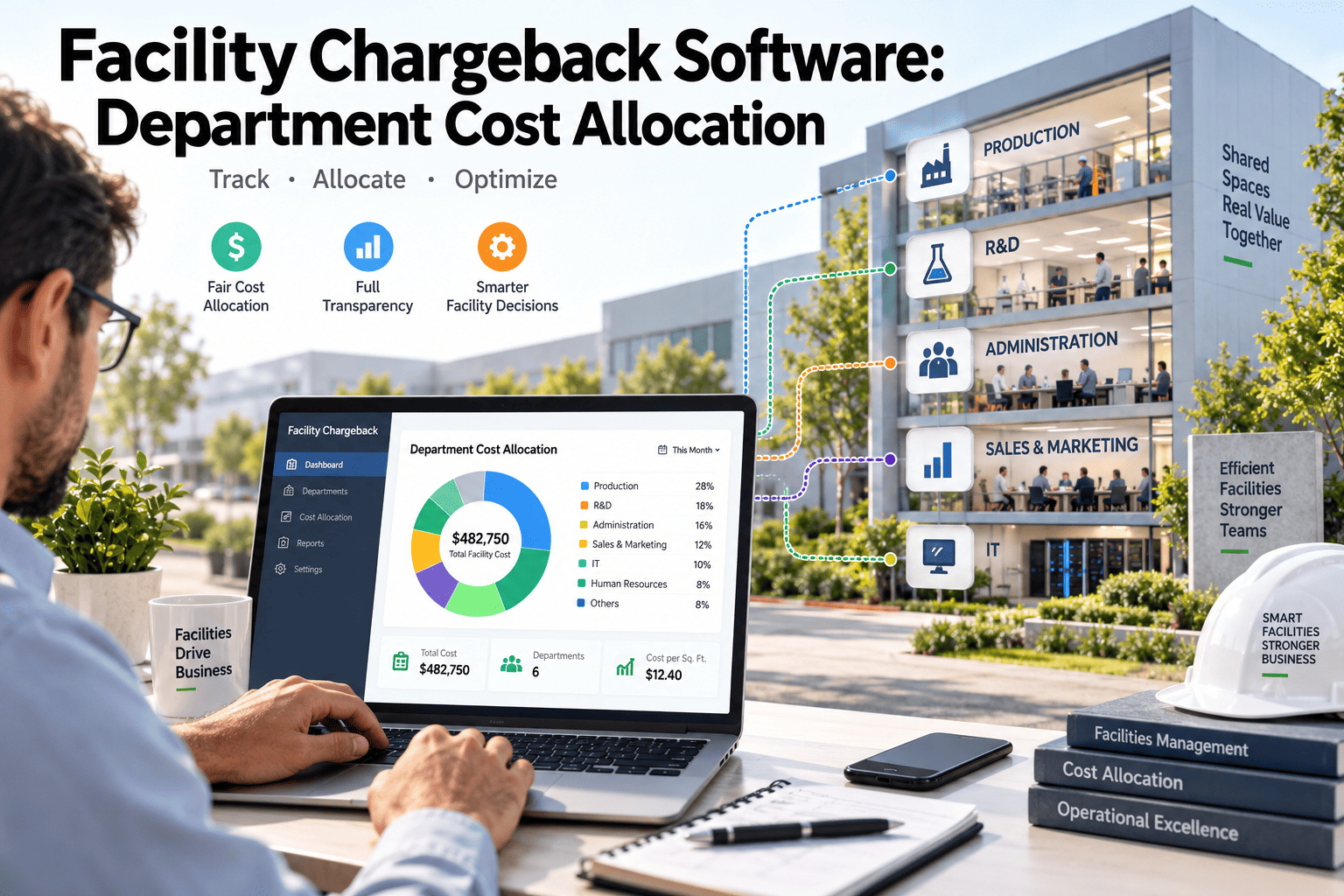
Every facility budget review eventually lands on the same question: which department actually caused this cost. A rush HVAC repair on the fourth floor, an after-hours electrical callout for the lab, an overtime shift to fix a leak in the warehouse — someone has to pay for it, and without a system to trace maintenance cost back to its source, that conversation turns into a guessing game that repeats every single budget cycle. Facility chargeback software gives operations and finance teams a shared, defensible answer by tying every work order to the cost center that generated it, and a platform such as OxMaint AI is built to capture that data from the start.
Stop guessing who owes what on the facility budget
Chargeback and cost allocation only work when every labor hour, part, and contractor invoice is tagged to the right department, building, or cost center as the work happens, not reconstructed weeks later from memory when finance asks for a breakdown of where the maintenance budget actually went.
Why "who pays" turns into a budget-season fight
In most multi-tenant, multi-department, or multi-building operations, maintenance cost is shared infrastructure until something breaks. At that point, whoever requested the work, whoever occupies the space, and whoever owns the equipment can all have a claim, and a legitimate objection, to why they should or should not be the one paying the bill.
No labor time capture
Technician hours are logged in aggregate for the week instead of against the specific work order and department that generated the call.
Shared assets, unclear ownership
A rooftop chiller serving three tenants has no agreed split, so every repair invoice becomes a negotiation instead of a calculation.
Parts costs get lumped
Inventory pulled for a specific repair is deducted from general stock without being tied back to the job or the requesting department.
Three ways facility teams split shared maintenance cost
There is no single correct chargeback model. Most facility organizations blend two or three approaches depending on the asset and the relationship with the department or tenant being billed.
| Model | How It Works | Best Fit |
|---|---|---|
| Direct cost allocation | Actual labor hours, parts, and contractor invoices billed to the requesting department | Dedicated equipment or space used by a single department |
| Usage-based allocation | Cost split by metered usage, square footage occupied, or headcount | Shared HVAC, utilities, and common-area equipment |
| Fixed percentage split | A pre-agreed ratio applied to all costs for a shared asset regardless of who requested the work | Long-term shared infrastructure with stable occupancy |
How cost allocation should flow from request to invoice
Tag the request
Every work order captures the requesting department, building, and cost center at the moment it is created, not after the fact.
Capture labor and parts
Technicians log actual hours and parts consumed directly against that work order as the job is completed.
Apply the allocation model
Shared-asset costs are split automatically using the agreed usage, percentage, or metered allocation rule for that asset.
Generate the chargeback report
Costs roll up by department, building, or cost center into a report finance can reconcile against the budget.
Review and reconcile
Department heads see the underlying work orders behind their charges, turning disputes into a quick record check instead of a standoff, and giving finance a clean, auditable trail for every line item on the report.
Why chargeback programs stall before they start
A facility team can build a technically sound allocation model and still watch it fail politically if the rollout is not handled carefully. The friction usually comes from the same few sources every time.
Departments distrust numbers they cannot verify
If a department is billed a lump sum with no supporting detail, the natural response is to push back, regardless of whether the number is accurate. Giving department heads visibility into the underlying work orders, not just the total, turns skepticism into acceptance far faster than any policy memo.
Allocation rules need to be agreed before they are applied
Retroactively deciding how a shared chiller's cost should be split, after a department has already seen an invoice, guarantees a dispute. Rules for shared assets should be documented and agreed with stakeholders before the first chargeback report goes out, not derived from the first contested bill.
Consistency matters more than precision
A slightly imperfect allocation rule applied consistently every month builds more trust than a highly precise calculation that changes methodology every quarter. Facility teams that pick a defensible model and stick with it see far fewer disputes than those constantly refining the formula.
See department-level chargeback reporting live in OxMaint
Walk through how a single work order flows from request to labor capture to a finance-ready cost allocation report.
What changes when chargeback data is captured at the source
- Labor hours estimated at month-end from memory or a paper timesheet
- Shared asset costs split by a rough guess, revisited every budget cycle
- Department heads dispute charges with no underlying work order to review
- Finance spends days reconciling numbers that do not tie back cleanly
- Labor hours logged against the specific work order as the job happens
- Shared asset costs split automatically using an agreed allocation rule
- Every charge is traceable to a work order, part, and technician
- Finance pulls a department-level report directly, ready to reconcile
What finance actually needs from a chargeback report
A chargeback report that satisfies facility operations is not automatically one finance can use. The two teams often need different views of the same underlying data.
| Report Element | Why Finance Needs It |
|---|---|
| Cost by department or cost center | Feeds directly into departmental budget variance reviews each month |
| Labor cost separated from parts cost | Supports different accounting treatment and capital versus expense classification |
| Allocation method used per line item | Provides an audit trail explaining how a shared cost was split, not just the final number |
| Period-over-period comparison | Flags unusual spend spikes that warrant a conversation before the budget cycle closes |
Building a chargeback program without a long rollout
Facility teams do not need a perfect allocation model on day one. A phased rollout gets useful data flowing quickly while the finer allocation rules are refined with stakeholder input.
Start with direct-cost assets
Equipment used exclusively by a single department is the easiest place to begin, since there is no allocation formula to negotiate. Labor and parts simply bill to the requesting cost center from day one.
Layer in shared-asset rules once trust is established
Once departments see clean, traceable reporting on their dedicated equipment, introducing an agreed allocation rule for shared assets meets far less resistance than trying to solve both problems in the same rollout.
Mistakes that undermine an otherwise sound chargeback model
A well-designed allocation policy can still produce disputed, unreliable numbers if the underlying data collection has gaps. A few recurring mistakes account for most of the trouble facility teams run into.
Estimating instead of logging
Backfilling labor hours from memory at month-end introduces errors that compound every reporting cycle and are nearly impossible to audit later.
Changing rules mid-year
Adjusting an allocation formula partway through a budget cycle without informing affected departments erodes trust even when the change is technically justified.
No single source of truth
Running chargeback calculations in a spreadsheet separate from the work order system guarantees the two will eventually disagree, and nobody will know which one is right.
Each of these mistakes is avoidable with the same fix: capture cost data once, at the point the work happens, in a system every stakeholder can see. That single change removes most of the reconciliation work finance teams currently absorb every budget cycle, and it gives department heads a reason to trust the number on their invoice instead of contesting it by default, which is ultimately what makes a chargeback program sustainable year after year.
Turning maintenance activity into clean cost data
OxMaint does not set your chargeback policy. It gives facility and finance teams the work order, labor, and inventory data needed to apply that policy consistently, work order by work order.
Cost Center Tagging
Every work order captures department, building, and cost center at creation, so allocation data exists from the first click, not a later reconstruction.
Labor and Parts Tracking
Technician hours and inventory pulled for a job are logged against that specific work order, with real cost, not estimated cost.
Configurable Allocation Rules
Shared assets can be split by usage-based, percentage, or direct allocation rules that match your organization's agreed policy.
Department-Level Dashboards
Finance and department heads see a live breakdown of maintenance spend by cost center, exportable for budget reviews and audits.
Facility chargeback and cost allocation questions
What is facility chargeback in maintenance management?
It is the practice of billing maintenance labor, parts, and contractor costs back to the department, tenant, or cost center responsible for the asset or the request, rather than absorbing it into a general facilities budget.
How do you split costs for shared equipment fairly?
Most organizations use a usage-based or fixed percentage model for shared assets like rooftop HVAC, agreed in advance so cost splits are consistent rather than renegotiated after every repair.
Why do chargeback numbers so often get disputed?
Disputes usually come from a lack of traceable detail. When a department cannot see the work order, labor hours, and parts behind a charge, they have no way to verify it, see how CMMS-backed detail changes that at Calendly.
Can chargeback reporting integrate with finance systems?
Cost allocation reports generated from work order data can be exported in formats finance teams use for reconciliation, reducing the manual re-entry that typically causes discrepancies.
How quickly can a facility start tracking chargeback data?
Most teams configure cost centers and allocation rules within one to two weeks. Start a free trial at OxMaint to set up your first department tags.
Chargeback gets harder once tenants or multiple entities are involved
Property managers billing tenants for maintenance, and universities or campuses allocating cost across colleges and research units, face a stricter version of this problem than a single-owner facility does.
Lease terms often define the allocation method already
Commercial leases frequently specify how common area maintenance costs are shared, whether by square footage, headcount, or a negotiated fixed percentage. The challenge is rarely defining the formula; it is consistently applying it to every work order without a manual recalculation each billing cycle.
Research and grant-funded units need especially clean records
Universities allocating maintenance cost to grant-funded labs or research units often face compliance requirements around how those costs are documented and justified. A traceable work order record, tied to labor hours and parts actually consumed, holds up far better under a grant audit than an estimated allocation.
Tenant disputes are resolved faster with source documents on hand
When a tenant questions a common area maintenance charge, being able to produce the underlying work orders, labor hours, and allocation calculation immediately, rather than promising to look into it, changes the tone of that conversation considerably.
Turning historical chargeback data into next year's forecast
Once a department or building has two or three years of clean, traceable maintenance cost history, that data becomes useful for something beyond settling disputes: forecasting next year's facilities budget with real evidence instead of a flat percentage increase.
Trend lines reveal which assets are becoming expensive
A piece of equipment whose chargeback total climbs steadily year over year is often signaling that it is approaching the end of its useful life. That trend, visible only when cost data is consistently tagged and tracked, gives facility teams a much stronger case for a capital replacement request than a subjective assessment alone, backed by actual dollars rather than an educated guess.
Departments can plan around predictable maintenance spend
When a department has two years of consistent chargeback data for its dedicated equipment, its budget owner can plan for that cost with confidence rather than treating every maintenance bill as a surprise variance to explain to their own leadership.
Facilities leadership gains a stronger negotiating position
A facilities director walking into a capital planning meeting with traceable, department-level cost history behind every request is in a fundamentally different position than one presenting a lump-sum estimate. The data itself becomes the argument.
Forecast accuracy improves the allocation model itself
Reviewing forecast versus actual chargeback totals at year-end often reveals that a usage-based split needs adjusting, or that an asset originally treated as shared has effectively become dedicated to one department. That feedback loop is only possible when the underlying data was captured consistently in the first place.
Make every maintenance dollar traceable to its source
Clean chargeback data starts at the work order, not at budget season. Build that foundation with OxMaint before the next review cycle.
Free 14-day trial · No credit card