Every commercial facility in North America operates under an active fire code — and every jurisdiction enforces it differently. The 2025 fire code cycle brought escalated penalties, tighter documentation windows, and AHJ inspection frequencies that most facility teams are already behind on. In Fiscal Year 2025, the FDNY Bureau of Fire Prevention alone issued 47,522 violation orders — a 22% jump over the previous year — and closed control valves still account for 61% of all sprinkler activation failures nationwide. Fire code compliance is no longer a once-a-year event; it is a continuous discipline of scheduled inspections, timestamped documentation, and provable maintenance history. OxMaint's compliance workflow module turns NFPA 25, NFPA 72, and IFC requirements into automated work orders, digital records, and inspector-ready reports before your next AHJ visit.
Compliance Audits · Fire Code · Facility Management
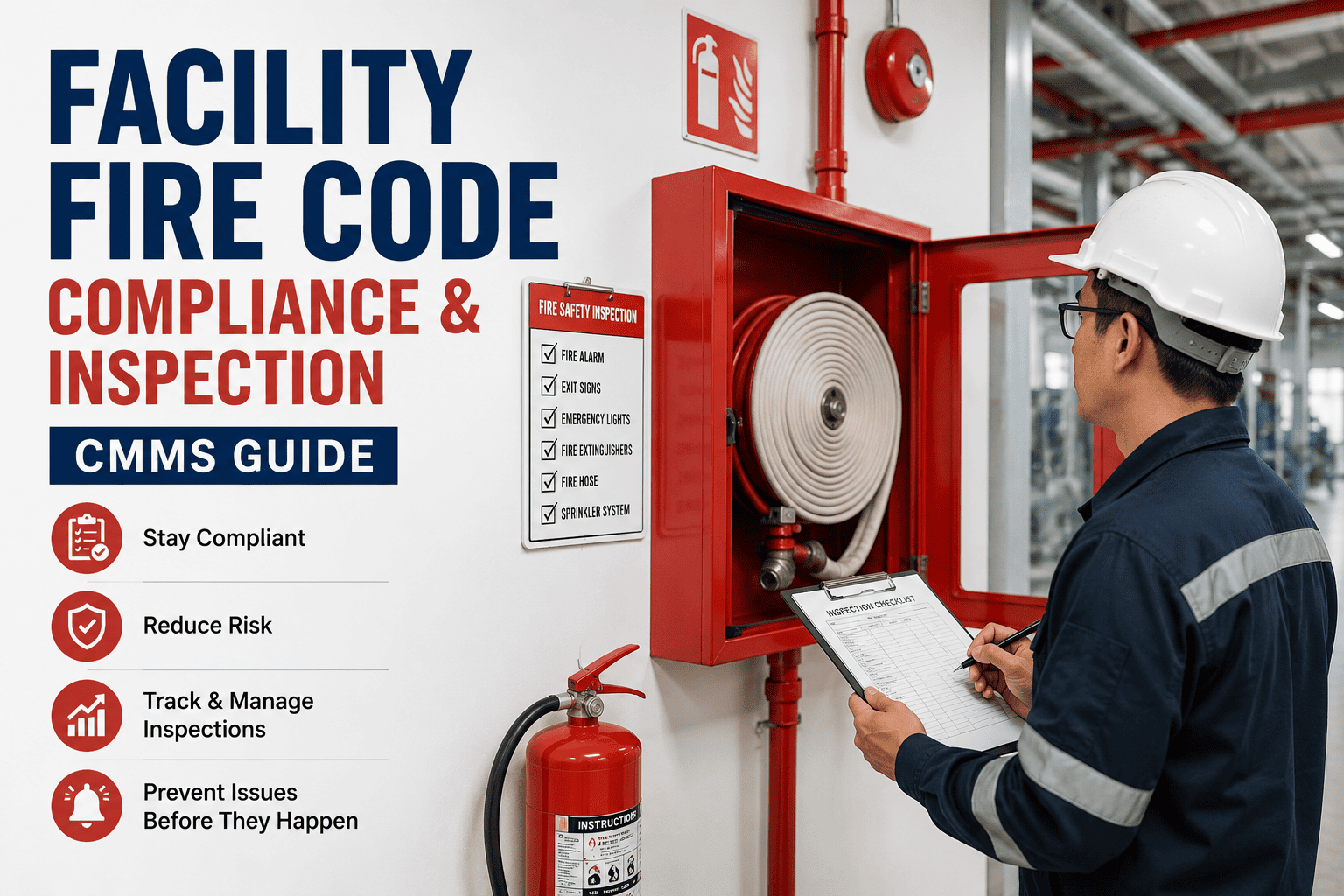
Facility Fire Code Compliance & Inspection CMMS Guide
The 2026 field playbook for facility managers preparing for AHJ inspections — NFPA 25 sprinkler frequencies, NFPA 72 alarm testing, IFC documentation rules, and the CMMS workflow that keeps every record defensible.
47,522
FDNY violation orders issued in FY 2025 alone — up 22% year over year
61%
of sprinkler activation failures trace to a single cause: closed control valves
$5,000
Repeat FDNY violation ceiling per instance — plus daily fines until corrected
73.7%
Sprinkler documentation compliance found in a Chicago OIG audit — one in four fell short
The Anatomy of a Failed Fire Code Inspection
A failed inspection almost never comes from a system that does not work — it comes from a system that cannot be proven to work. The AHJ inspector arrives with a clipboard, asks for the most recent test records, and the compliance case collapses on documentation, not hardware. The five failure patterns below cover the majority of citations issued in commercial facilities in 2024 and 2025.
01
Missing Inspection Tags
Sprinkler, alarm, extinguisher, and kitchen suppression tags out of date, missing, or illegible. The single most common finding in walkthrough audits — and one that can be corrected in hours but generates an automatic citation.
02
Closed Control Valves
A control valve left closed after maintenance — 61% of sprinkler activation failures nationwide. NFPA 25 §13.3.2.1 requires weekly visual inspection of every unsupervised valve to eliminate this exact failure mode.
03
Undocumented Testing
Tests performed but records lost, unsigned, or stored across email chains and paper binders. During audits, undocumented tests are treated as missed tests — the fine is the same either way.
04
Blocked Exits & Egress
Storage, equipment, or debris in exit corridors and fire door swing paths. A five-minute walkthrough finding that generates immediate citations and, in serious cases, occupancy restriction until cleared.
05
Expired Spare Sprinklers
NFPA 25 §5.2.1.5 requires a documented on-site supply of spare sprinklers — 6, 12, or 24 heads based on system size, plus manufacturer wrench. Missing or wrong-size spares create an immediate impairment.
06
FACP Trouble Signals
Active trouble condition on the fire alarm control panel at the moment of inspection — ground faults, low battery, communication loss. A trouble signal at inspection time is an automatic finding regardless of cause.
NFPA 25 & NFPA 72: The Master Frequency Matrix
Two standards govern the majority of facility fire code testing: NFPA 25 for water-based fire protection (sprinklers, standpipes, fire pumps) and NFPA 72 for alarms and signaling. Together they define a seven-tier inspection schedule from weekly to 10-year intervals. The table below is the field reference — the tasks a facility team must schedule, document, and produce on demand.
| Interval |
NFPA 25 — Water-Based Systems |
NFPA 72 — Alarm & Signaling |
Who Performs |
CMMS Trigger |
| Weekly |
Unsupervised control valve position · Dry-pipe gauge pressure · Enclosure temperature (freeze protection) |
FACP visual — trouble signal check · AC power and battery indicators |
Trained facility staff |
Auto-generated weekly PM work order per system |
| Monthly |
Wet-pipe gauge pressure · Fire pump run test (electric, no-flow) · Sprinkler valve exterior |
Notification appliances unobstructed · Pull stations · Panel LEDs and fuses |
Trained facility staff |
Monthly PM cycle with photo capture on completion |
| Quarterly |
Waterflow alarm test · Fire department connection · Main drain test · Supervised valve position |
Off-premises transmission equipment · Duct detectors · Waterflow supervisory |
Facility staff or licensed contractor |
Alerts triggered 14 days before due date |
| Semi-Annual |
Tamper switch operational test · Deluge and pre-action low-air alarm test |
Batteries — sealed lead-acid load test · DACT and communication paths |
Licensed contractor |
Contractor work order with report upload requirement |
| Annual |
Full sprinkler system inspection · Fire pump full flow (churn, 100%, 150%) · Antifreeze concentration · Standpipe flow |
Comprehensive functional test — every initiating device · Battery replacement per manufacturer |
NICET-certified contractor |
Annual compliance package generated for AHJ |
| 3-Year |
Dry-pipe valve full trip test · Deluge full trip test · Standpipe hydrostatic (occupant hose) |
Waterflow alarm physical flowing-water test (post-2023 self-test provision) |
Licensed contractor |
Multi-year PM trigger with 90-day advance alert |
| 5-Year |
Internal pipe obstruction investigation · Backflow preventer internal inspection · Standpipe hydrostatic |
Smoke detector sensitivity test (unless continuously monitored by panel) |
Licensed contractor |
5-year interval task in asset lifecycle plan |
| 10-Year |
Fast-response sprinkler sample test (25 years for ESFR/CMSA — 2023 edition) · Standard sprinkler at 50 years |
Dry sprinkler system replacement or laboratory test |
Licensed contractor + laboratory |
Long-cycle PM linked to asset install date |
Every interval above becomes an auto-generated work order in OxMaint.
Weekly PMs assigned to trained staff. Quarterly and annual tests routed to your licensed contractor. Every completion timestamped, photographed, and stored in a format the AHJ can review on demand.
The Cost of Non-Compliance — Real Numbers, Real Jurisdictions
Fire code fines are not uniform across the country — but the pattern is consistent: penalties escalate with time, repeat violations multiply, and jurisdictions with the highest enforcement volumes carry the highest per-violation ceilings. The map below shows what facilities in six major jurisdictions actually pay when an inspection reveals uncorrected findings.
New York City · FDNY
$800 – $5,000+
Per violation. Repeat violations multiply. Daily fines until corrected. 47,522 violations issued FY 2025.
San Francisco · SFFD
$1,000 / day
Civil penalty per day of non-compliance under the 2025 SF Fire Code. Joint review with DBI required.
Los Angeles · LAFD
$1,000 + jail
Misdemeanor per §57.110.4 — up to $1,000 or six months imprisonment. Each day is a separate offense.
California · Title 19
$500 – $5,000
Per violation. 30–90 day correction window. Repeat offenders face escalating penalties and closure orders.
Chicago · CFD
$8M+ recorded
OSHA penalties in major construction safety cases. OIG found only 73.7% sprinkler documentation compliance.
Insurance Impact
Claim denial
Documented gaps in NFPA 25/72 records routinely cited by carriers as grounds for claim denial or non-renewal.
The 6-Step Fire Code Readiness Workflow in OxMaint
Compliance is a process, not an event. The workflow below is how facility teams using OxMaint prepare for AHJ inspections — every step maps to a specific NFPA requirement, and every completion generates a timestamped record the inspector can review on the spot.
1
Build the Fire Asset Register
Every sprinkler zone, alarm panel, fire pump, extinguisher, and standpipe entered as an asset with make, model, install date, and serial number. Assets without full metadata cannot be reliably scheduled for interval-based PM.
2
Map NFPA Frequency to Each Asset
Configure the seven-tier interval schedule per asset class — weekly, monthly, quarterly, semi-annual, annual, 3-year, 5-year, 10-year. OxMaint auto-generates the recurring work order calendar from the asset register.
3
Assign to Qualified Personnel
Weekly and monthly visual inspections routed to trained facility staff. Quarterly, annual, and multi-year tests routed to NICET-certified contractors with credential capture on completion — who performed the work is part of the record.
4
Capture Completion Evidence
Every work order requires timestamp, technician name, photo of the tag or reading, and pass/fail status. Failed items automatically generate a deficiency ticket with a correction deadline aligned to AHJ policy.
5
Track Deficiency Correction
Open deficiencies visible on the compliance dashboard with days-to-deadline countdown. Automated escalation to facility manager and contractor at 14, 7, and 2 days before the AHJ correction window closes.
6
Generate Inspector-Ready Reports
One-click compliance package — annual NFPA 25 and NFPA 72 test summary, deficiency log with correction dates, spare sprinkler inventory verification, and full audit trail. Handed to the AHJ inspector during the visit.
Documentation That Actually Holds Up in an Audit
A compliance record is only useful if it can be produced immediately, is signed by the person who performed the work, and matches the required interval. The infographic below shows the six data points that must be captured on every single fire code test — miss any one and the record is challenged during an audit.
Date & Time
Timestamp of when the test was actually performed — not when the paperwork was filed. AHJ inspectors look for continuous interval history without gaps.
Technician & Credential
Name of the person who performed the work plus their qualification — NICET level for annual tests, in-house training record for weekly checks.
Asset & Location
Specific system, zone, panel, or riser tested — mapped to the fire asset register. Generic "building sprinkler" entries are insufficient during audits.
NFPA Reference
Standard and section reference — NFPA 25 §5.3.1 for waterflow alarm test, NFPA 72 §14.4 for functional test — proves the correct procedure was followed.
Pass / Fail & Reading
Result plus numeric reading where applicable — pump pressure at 100% and 150% flow, battery voltage, main drain residual. Boolean pass alone is not enough.
Deficiency Action
If failed — the corrective ticket number, assignee, deadline, and closure record. Open deficiencies without a correction plan trigger escalated citations.
Field note
The single most expensive mistake facility teams make on fire code is treating the annual inspection as the compliance program. It is not. It is the audit of the compliance program — and by the time the inspector arrives, either the weekly checks and quarterly tests have been happening or they have not. I have watched facility directors hand inspectors a beautiful annual report from their fire protection contractor and then get cited on twelve findings because the weekly valve position checks — which are the building's own responsibility, not the contractor's — had no records at all. NFPA 25 does not distinguish between "we didn't do it" and "we did it but didn't write it down." Both are compliance failures. A CMMS that fires the weekly work order, captures the completion evidence, and stores it in an inspector-accessible format is not a nice-to-have — it is the difference between a defensible program and one that only looks defensible until the clipboard shows up.
Priyanka Chaudhary Deshmukh, CFPS, NICET III
Certified Fire Protection Specialist · NICET Level III Inspection & Testing of Water-Based Systems · 14 years commercial and industrial facility compliance · Former Fire Safety Director, mixed-use portfolio (2.8M sq ft, 47 buildings) · Specialist in NFPA 25/72 audit preparation and AHJ liaison programs
Frequently Asked Questions
How does OxMaint schedule NFPA 25 and NFPA 72 tests automatically?
Each fire asset in OxMaint is tagged with its NFPA classification and the system generates recurring work orders on the correct interval — weekly, quarterly, annual, and multi-year. Alerts fire 14 days before due dates so nothing slips into overdue status.
Start your free trial to configure the seven-tier schedule for your building.
Can in-house facility staff perform any fire code inspections?
Yes — weekly and monthly visual inspections (valve position, gauge readings, FACP trouble signals, notification appliance obstruction) can be performed by trained facility staff. Functional testing, sensitivity testing, and the annual comprehensive inspection require a NICET-certified licensed technician with calibrated equipment.
What documentation does an AHJ inspector typically ask for on-site?
Current annual NFPA 25 and NFPA 72 reports, deficiency correction records, spare sprinkler inventory, contractor credentials, and interim inspection logs. OxMaint compiles this into a one-click compliance package ready for the inspector.
Book a demo to see the AHJ report format.
What happens if a fire code violation is not corrected within the AHJ deadline?
Daily fines accrue until correction, re-inspection fees are added, and repeat non-compliance can escalate to occupancy restriction, criminal referral for willful violations, or referral to the building department. Insurance carriers routinely cite uncorrected violations as grounds for premium increases or claim denial.
How does OxMaint track fire code compliance across a multi-building portfolio?
The portfolio compliance dashboard shows every building's status against every applicable NFPA interval — overdue tests, open deficiencies, days-to-AHJ-deadline. Facility directors see the entire network's risk exposure on one screen and drill into any building's full audit trail.
Start your free trial to configure multi-site compliance tracking.
Fire Code Compliance · Inspection Workflow · OxMaint
Your Next AHJ Inspection Is Already on the Calendar. The Question Is What Your Records Will Show.
OxMaint turns NFPA 25, NFPA 72, and IFC requirements into scheduled work orders, timestamped evidence, and inspector-ready reports. Every test on the correct interval. Every technician credentialed. Every deficiency tracked to closure. Every record produced in seconds when the clipboard arrives.