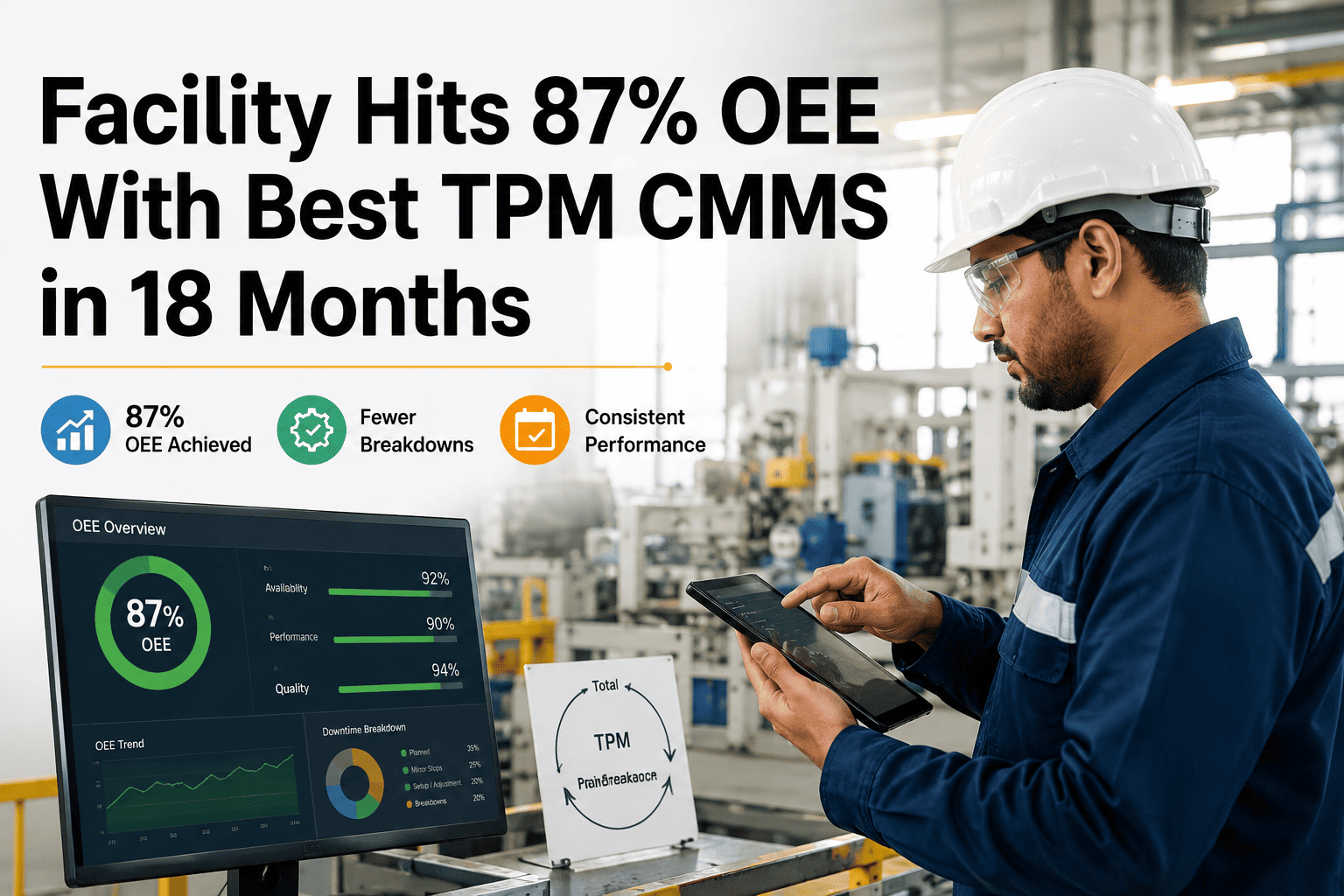
Most facility teams chase OEE improvements with spreadsheets, tribal knowledge, and a maintenance calendar nobody actually follows. One multi-building campus facility started 2025 at a 61% OEE score, well below the 85% world-class benchmark that reliability engineers use as the finish line. Eighteen months later, the same facility hit 87% OEE — not through new equipment, not through headcount growth, but through a structured Total Productive Maintenance rollout built on a single CMMS platform. This case study breaks down exactly what changed, month by month, and why the documentation and workflow discipline mattered more than any single repair. If your facility is still tracking maintenance on paper or spreadsheets, start a free trial with OxMaint to see the platform behind this result.
Case Study · TPM Rollout · 87% OEE
How a Campus Facility Hit 87% OEE With the Best TPM CMMS in 18 Months
A month-by-month breakdown of the rollout, the eight TPM pillars deployed, and the exact CMMS workflows that took a struggling facility from 61% to 87% overall equipment effectiveness.
61% → 87%
OEE growth across the 18-month rollout period
42%
Reduction in unplanned downtime hours year over year
8
TPM pillars deployed across the facility maintenance program
3.1x
Increase in completed preventive maintenance tasks per month
The Starting Point
A Facility Losing Nearly Forty Percent of Its Productive Capacity
The facility operates a mixed portfolio of HVAC plant equipment, packaging lines, and utility systems supporting a mid-size industrial campus. Before the rollout, maintenance was reactive by default. Work orders were logged after failures, not before them. Technicians relied on memory and paper checklists for inspections, and there was no reliable record of when a pump, motor, or compressor had last been serviced. Availability losses from breakdowns, performance losses from unplanned slowdowns, and quality losses from equipment drift combined to hold OEE at 61% — a number the facility director described as invisible until it was measured consistently for the first time.
The turning point was not a new piece of equipment. It was the decision to measure OEE consistently, assign ownership for each loss category, and give operators and technicians a single system to log, track, and close every maintenance event. That system became the backbone of the entire 18-month program.
The Framework
Eight TPM Pillars Deployed Inside a Single CMMS
Total Productive Maintenance succeeds or fails on consistency, not intensity. The facility rolled out all eight classic TPM pillars in sequence, using OxMaint as the system of record for every pillar rather than running separate spreadsheets or paper programs for each one.
01
Autonomous Maintenance
Operators took ownership of daily cleaning, inspection, and lubrication checks logged directly in the CMMS mobile app, catching wear before it became a work order.
02
Planned Maintenance
PM schedules were rebuilt from manufacturer intervals and actual runtime data, replacing the fixed calendar approach that had ignored real usage patterns.
03
Quality Maintenance
Equipment-linked quality defects were traced back to specific assets and root causes instead of being logged as isolated production issues.
04
Early Equipment Management
New assets entering the facility were added to the CMMS with maintenance plans built in from day one, rather than being retrofitted months later.
05
Training and Skill Development
Technician certifications and training completion were tracked per asset category, closing the skill gaps that had been slowing repair times.
06
Safety, Health, and Environment
Safety checks were built into inspection workflows so no work order could close without confirming lockout-tagout and PPE compliance steps.
07
Office TPM
Procurement and parts ordering were tied to work order data, cutting the delay between diagnosing a failure and having the part on hand.
08
Focused Improvement
Monthly loss analysis reviews used CMMS downtime data to target the three highest-loss assets for root cause elimination projects.
OxMaint · TPM Ready
Every TPM Pillar Needs a System of Record. OxMaint Is Built to Be It.
From autonomous maintenance checklists to focused improvement dashboards, OxMaint gives every TPM pillar a home in one platform instead of eight disconnected spreadsheets.
The Rollout Timeline
18 Months, Four Phases, One Continuous OEE Climb
Months 1–3
Baseline and Asset Setup
Every asset was logged into OxMaint with criticality ratings, meter tracking, and a documented maintenance history rebuilt from technician interviews. OEE was measured consistently for the first time, establishing the 61% baseline.
Months 4–8
Preventive Maintenance Rebuild
PM schedules were rewritten around manufacturer specs and usage meters. Digital checklists replaced paper forms, and mobile completion tracking gave the facility its first real PM compliance number: 58%, up from an untracked baseline.
Months 9–13
Autonomous Maintenance and Root Cause Work
Operators began daily inspections logged in the CMMS. Downtime data from months 1–8 identified the three highest-loss assets, and root cause analysis projects eliminated two chronic failure modes entirely.
Months 14–18
Optimization and Sustained Gains
PM compliance reached 94%, unplanned downtime dropped 42% year over year, and OEE crossed 87% — sustained for three consecutive months before being formally recorded as the new baseline.
The OEE Climb
Watching the Three OEE Components Move Together
OEE is the product of availability, performance, and quality. The facility's biggest early win came from availability — fewer unplanned breakdowns meant fewer stopped hours. Performance and quality gains followed as autonomous maintenance and root cause work matured in the second half of the program.
Combined OEE at Month 18
87%
Results in Numbers
What Changed by the End of the Program
26 pts
OEE Improvement
From a 61% baseline to a sustained 87% OEE across the facility's critical assets.
42%
Downtime Reduction
Unplanned downtime hours fell by 42% comparing month 18 to the pre-rollout baseline.
94%
PM Compliance
Preventive maintenance completion rate at close of program, tracked automatically in the CMMS.
2
Chronic Failures Eliminated
Root cause projects driven by CMMS downtime data permanently resolved two repeat failure modes.
Facility Team Questions
Common Questions From Teams Considering a TPM Rollout
How long does a TPM rollout typically take to show measurable OEE gains?+
Most facilities see the first measurable OEE movement within 90 to 120 days, once asset data and PM schedules are established in a CMMS. Full-pillar maturity, like the 87% result in this case study, generally takes 12 to 18 months.
Book a demo to map a realistic timeline for your facility.
Do we need new equipment to hit a similar OEE improvement?+
No. This facility used its existing equipment throughout the program. The gains came from planned maintenance discipline, autonomous inspection habits, and root cause elimination — not capital replacement.
What is the single biggest factor that drove the OEE improvement?+
Consistent, logged preventive maintenance completion. PM compliance rising from an untracked baseline to 94% accounted for the largest share of the availability gain that drove overall OEE upward.
Can a smaller facility run the same eight-pillar program?+
Yes. The pillar sequence scales down cleanly for single-site or smaller asset counts. Smaller fleets often move through the phases faster since asset setup and PM rebuild take less time.
Start a free trial to see the setup process firsthand.
How is OEE actually calculated and tracked inside the CMMS?+
OEE is calculated as availability multiplied by performance multiplied by quality, using runtime, output, and defect data logged against each asset. OxMaint calculates this automatically from work order and meter data rather than requiring a manual spreadsheet.
OxMaint · TPM · OEE Growth
The Facilities Hitting 85%+ OEE Are Running One System, Not Eight Spreadsheets
This case study is not an outlier — it is what happens when every TPM pillar shares the same asset data, the same work order history, and the same PM schedule. Start building that foundation for your facility today.