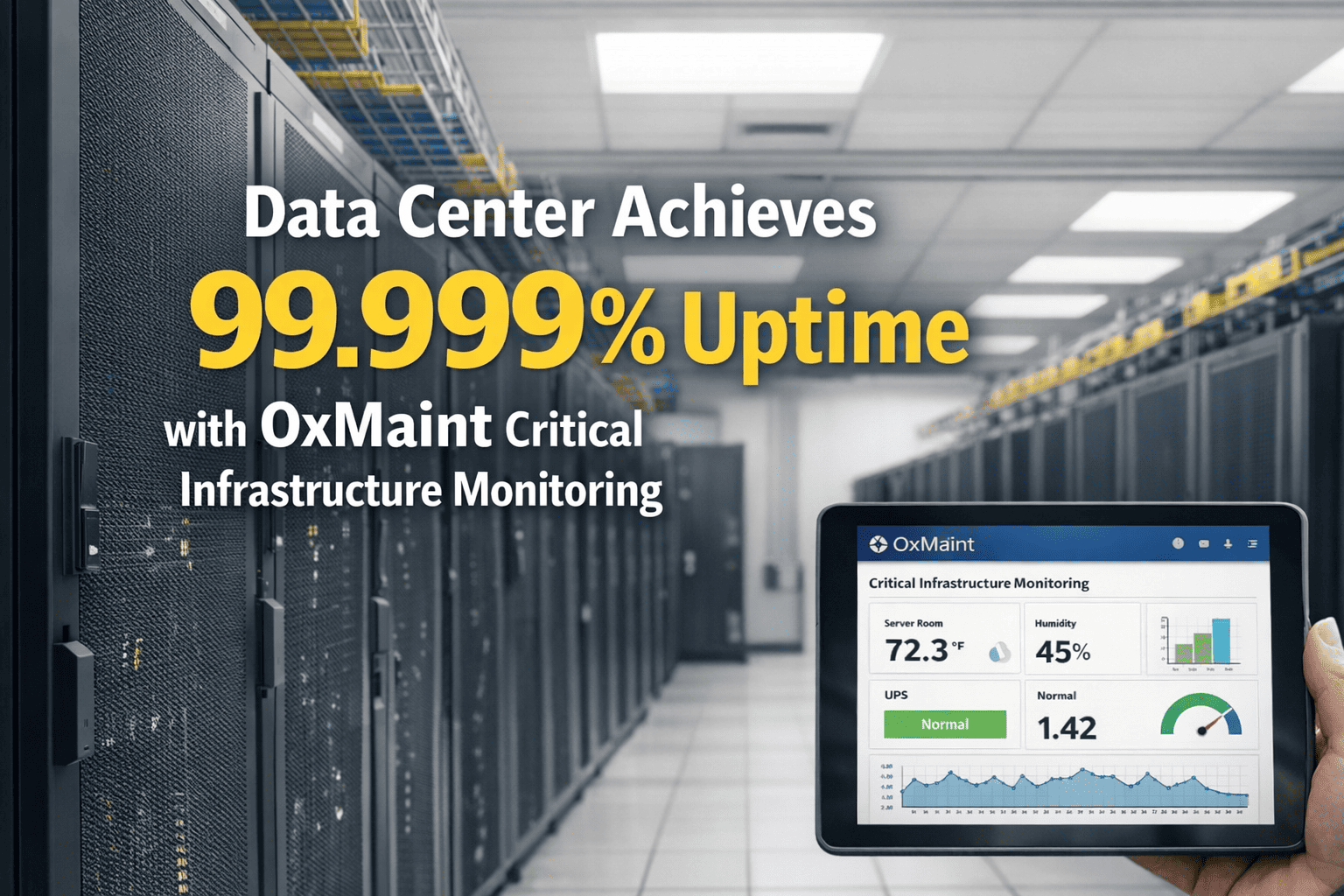
Data centers are no longer back-office infrastructure. They are the operating backbone of AI, cloud, and every digital service that businesses and consumers depend on, and in 2026 they are under more physical and operational pressure than at any point in their history. Rack densities are jumping from 20 kW to 120 kW as AI workloads arrive. Cooling systems designed for 2018 compute loads are failing to keep pace. Power and cooling issues now account for 70% of significant outage incidents, according to the 2024 Uptime Institute report. Regulatory frameworks in the EU, USA, and UAE are tightening reporting requirements. And the global data center cooling market, valued at $18 billion in 2024, is projected to exceed $42 billion by 2032 as the industry scrambles to catch up. The facility manager sitting between all of these pressures needs a CMMS platform built for mission-critical infrastructure, not adapted from manufacturing or commercial real estate. OxMaint's Predictive Maintenance Console delivers real-time asset health, automated PM scheduling, Tier compliance documentation, and PUE tracking in one platform. Sign up free or book a demo to see how OxMaint is engineered for data center operations.
Industry Verticals
Facility Management for Data Centers: Uptime, Cooling and Compliance
9-11 min read
70%
Of significant outage incidents caused by power and cooling failures — 2024 Uptime Institute report
$42B
Projected global data center cooling market by 2032, growing at 12% CAGR from $18B in 2024
120 kW
Per-rack density in AI-native data centers in 2026, up from 20-40 kW in legacy deployments
50%
Projected increase in global power demand from data centers by 2027 — Goldman Sachs forecast
OxMaint Predictive Maintenance Console: Built for Mission-Critical Data Center Operations.
Real-time asset health dashboards, automated cooling PM schedules, Tier I-IV compliance documentation, PUE tracking, and predictive failure alerts for UPS, CRAC, generators, and PDUs. All in one platform. Free to start.
The 2026 Data Center Facility Management Crisis in 4 Numbers
AI workloads are compressing decades of infrastructure evolution into 18-month cycles. Every metric that data center facility managers tracked in 2022 has been disrupted. The four data points below define the crisis that every DC operations leader is navigating right now.
6x
Cooling Demand Multiplier
A single AI training rack at 100 kW generates 6x the heat of a standard server rack at 15 kW. CRAC units sized for 2020 compute loads are now running at 130-160% of rated capacity, directly accelerating compressor wear and refrigerant system stress.
$9,000
Cost Per Minute of Downtime
Average financial impact of data center downtime in 2025, up from $5,600 in 2019. For Tier III and IV colocation providers, SLA breach penalties stack on top of direct production loss, pushing per-incident costs above $500,000 for extended outages.
1.2
Target PUE in 2026
EU Energy Efficiency Directive and major enterprise sustainability frameworks are driving PUE targets to 1.2 or below by 2026. Most legacy data centers run at 1.5-1.8 PUE. Every 0.1 improvement in PUE on a 10 MW facility saves approximately $800,000 per year in energy costs.
5 yr
Power Interconnection Wait
Average grid interconnection delay in major US markets in 2026. Operators managing UPS, generator, and transfer switch PM with precision are the ones keeping existing capacity online while new grid connections wait. Preventive maintenance is now a capacity strategy, not just an operational one.
What Data Center Facility Management Actually Covers
Data center facility management spans four interdependent systems — power, cooling, physical infrastructure, and compliance documentation. A failure in any one creates a cascade. The facility manager's job is to keep all four running within specification simultaneously, while costs rise, densities increase, and regulatory requirements expand.
Power Systems
UPS units, static bypass switches, and battery string management
Generator fuel systems, automatic transfer switches, and load bank testing
PDUs, RPPs, and busbar distribution maintenance
Harmonic analysis and power quality monitoring
Physical Infrastructure
Raised floor integrity, containment seal checks, and cable management
Fire suppression system inspections and agent cylinder pressure
Access control systems, CCTV, and perimeter security PM
Structural assessments for high-density rack weight loads
Cooling Systems
CRAC and CRAH units, compressors, and economizer maintenance
Chiller plant PM, cooling tower water treatment, and condenser inspection
Liquid cooling CDU maintenance and coolant quality monitoring
Airflow management, hot/cold aisle containment integrity checks
Compliance Documentation
Uptime Institute Tier certification maintenance requirements
EU EED PUE and WUE reporting, ASHRAE thermal guidelines
NFPA 75, 76 fire protection inspection records
SOC 2, ISO 27001, and HIPAA physical security maintenance evidence
The 6 Critical Assets That Cause 80% of Data Center Downtime
Power and cooling failures cause 70% of outages. Within those categories, six specific asset classes generate the majority of incidents. Each requires a structured PM regime that standard CMMS calendar scheduling fails to deliver — because the failure modes are condition-driven, not calendar-driven.
38%
UPS Systems
Battery string degradation is invisible until it fails under load. VRLA batteries lose 20% capacity per year after year 4. Without impedance testing and thermal imaging on every string, UPS units that show 100% capacity on self-test fail silently during grid events.
PM triggers: impedance test quarterly, thermal imaging semi-annually, full load test annually
22%
CRAC and CRAH Units
Compressor bearing wear, refrigerant charge loss, and condenser coil fouling are the three leading CRAC failure modes. At 130% loading in AI-dense rows, bearing MTBF drops from 40,000 hours to under 18,000. Most facilities are running CRAC PM on 12-month calendar intervals designed for 60% load conditions.
PM triggers: vibration analysis monthly, coil inspection quarterly, refrigerant charge check semi-annually
16%
Diesel Generators
Fuel quality degradation, injector fouling, and coolant system scale accumulation cause generator start failures at the worst possible moment. Generators tested at 30% load pass the test but fail at 80% actual load during a real grid outage. Load bank testing at rated capacity is non-negotiable.
PM triggers: fuel sample monthly, load bank test at 80% capacity quarterly, full transfer test semi-annually
12%
Chiller Plants
Condenser water tube fouling reduces chiller efficiency by 3-5% per 0.001 inch of scale. A large chiller plant running at 15% reduced efficiency in a 10 MW data center costs $1.2M in excess energy annually before the thermal margin failure that takes the plant down. Vibration monitoring on compressors detects bearing wear 8-12 weeks before failure.
PM triggers: vibration monthly, tube cleaning semi-annually, refrigerant analysis annually
8%
Automatic Transfer Switches
ATS contact degradation causes transfer time creep that exceeds UPS ride-through capacity. A healthy ATS transfers in 100-200ms. A degraded one transfers in 800ms or fails to transfer at all. Contact resistance testing on a fixed schedule catches this before it produces a gap outage.
PM triggers: contact resistance test semi-annually, full operation test quarterly
4%
Liquid Cooling CDUs
Coolant quality degradation, pump cavitation, and heat exchanger fouling are the three CDU failure modes as direct-to-chip cooling becomes mainstream. At 120 kW per rack, a CDU failure in an AI cluster produces thermal shutdown of the entire rack within 2 minutes. Coolant conductivity and pH monitoring are the critical predictive metrics.
PM triggers: coolant analysis monthly, pump vibration quarterly, heat exchanger inspection semi-annually
Reactive vs Predictive Maintenance: The Data Center Cost Gap
Reactive maintenance is not just operationally dangerous in data centers — it is financially catastrophic. The comparison below uses real cost data from Tier III and IV facilities operating in reactive versus structured predictive maintenance programs.
Factor
Reactive Operations
OxMaint Predictive Program
UPS Failure Rate
Battery string failure rate 3x higher — discovered during grid events, not before
Impedance trending detects degrading strings 6-8 weeks before failure threshold
CRAC Uptime
Compressor failure at 18,000 hrs at 130% load — emergency replacement $45,000-$120,000
Vibration trending identifies bearing wear at 12,000 hrs — planned bearing change at $2,400
Generator Reliability
Fuel degradation and injector fouling cause start failures — 28% failure rate at rated load in reactive programs
Monthly fuel sampling and quarterly load bank testing at rated capacity — less than 2% failure rate
PUE Performance
Fouled coils and degraded cooling systems inflate PUE to 1.6-1.9 — $800K-$2.4M excess energy cost annually
PM completion above 90% holds PUE at 1.2-1.35 — sustained against EU EED and ESG targets
Compliance Readiness
2-4 week manual record assembly for Tier certification audits — gaps common, remediation costs $80,000-$200,000
Audit-ready compliance export from OxMaint in under 5 minutes — zero manual record search
Downtime Incidents
4-8 significant incidents per year at $9,000/min average cost — $1.8M-$4.6M annual impact
68% reduction in unplanned incidents documented across OxMaint DC deployments within 12 months
OxMaint Predictive Maintenance Console Transforms Data Center FM Operations from Reactive to Audit-Ready.
UPS battery health trending, CRAC vibration monitoring schedules, generator load test tracking, chiller plant PM automation, and Tier compliance documentation — all unified in one platform. Free to start. Deploys in days without implementation consultants.
PUE Optimization: How Structured Maintenance Reduces Energy Costs
Power Usage Effectiveness is the single most watched efficiency metric in data center operations. Most facility managers know their PUE number. Few have a systematic maintenance program that actually holds it against target as cooling systems age and compute density increases.
PUE Formula
Total Facility Power
÷
IT Equipment Power
=
PUE
Target: 1.2 or below for EU EED compliance and enterprise ESG frameworks in 2026
Annual Savings Per 0.1 PUE Improvement — 10 MW Facility
Moving from 1.8 to 1.3 PUE saves $4M+ annually on a 10 MW facility. Maintenance-linked drift is responsible for 30-40% of PUE degradation in aging facilities.
Tier Compliance: What Each Tier Requires from Your FM Program
Uptime Institute Tier certification is the single most commercially significant compliance framework in data center operations. Maintaining Tier certification requires documented PM completion, redundancy testing evidence, and incident response records — all of which OxMaint generates automatically from live work order data.
Tier I
Basic Capacity
99.671% availability
No redundancy required. Single path for power and cooling. Annual PM acceptable. Most common in enterprise SMB deployments. 28.8 hours downtime per year permissible.
Annual PM documentation, basic inspection records, power and cooling system logs
Tier II
Redundant Components
99.741% availability
N+1 redundancy on power and cooling components. Quarterly PM required. UPS bypass testing and generator run-up documentation mandatory. 22 hours downtime per year.
Quarterly PM records, redundancy test logs, UPS bypass exercise documentation, generator test records
Tier III
Concurrently Maintainable
99.982% availability
All components maintainable without load shutdown. Monthly PM cycles. Full redundancy test evidence. Concurrent maintenance testing required annually. 1.6 hours downtime per year.
Monthly PM completion evidence, concurrent maintenance test records, full redundancy exercise logs, 90-day CM audit trail
Tier IV
Fault Tolerant
99.995% availability
2N redundancy minimum. Any single failure has zero impact on operations. Bi-weekly PM verification. Full fault tolerance test documentation required for certification maintenance. 0.4 hours downtime per year.
Bi-weekly PM verification records, fault tolerance test documentation, independent redundancy path audits, continuous compliance evidence
68%
Reduction in unplanned downtime incidents documented within 12 months of OxMaint deployment in data center operations
0.15
Average PUE improvement documented in data centers running OxMaint structured cooling PM programs over 18 months
5 min
Time to generate audit-ready Tier compliance documentation from OxMaint versus 2-4 weeks of manual record assembly
92%
PM completion rate achieved by data center teams on OxMaint within 60 days versus 58% industry average for reactive programs
OxMaint Delivers Every FM Capability a Data Center Needs to Maintain Tier Certification and Hit PUE Targets.
Predictive maintenance scheduling for UPS, CRAC, generators, and chillers. Automated Tier compliance documentation. PUE and WUE tracking. Cooling PM calendars adjusted for high-density AI workloads. All operational from day one. No implementation consultants. No credit card required to start.
Frequently Asked Questions
QHow does OxMaint handle UPS battery health monitoring to prevent silent capacity failures?
OxMaint schedules impedance testing, thermal imaging, and load capacity verification as PM work orders on defined intervals per UPS unit. Results trend over time to flag strings approaching the 80% capacity threshold before they fail under live load.
Sign up free or
book a demo to see UPS battery PM configuration.
QCan OxMaint generate documentation for Uptime Institute Tier III and Tier IV certification audits?
Yes. Every completed PM work order generates a timestamped, technician-attributed compliance record tagged to the applicable Tier certification requirement. A full audit export is generated in under 5 minutes from live work order data.
Book a demo to see the compliance export in action, or
sign up free today.
QDoes OxMaint support PM scheduling for liquid cooling CDUs as direct-to-chip cooling becomes standard?
Yes. OxMaint includes PM templates for CDU coolant analysis, pump vibration monitoring, heat exchanger inspection, and coolant conductivity and pH tracking on configurable intervals appropriate for high-density AI deployments.
Sign up free or
book a demo to review the liquid cooling PM library.
QHow does OxMaint track and report PUE against EU Energy Efficiency Directive and ESG targets?
OxMaint logs energy consumption data per facility system and calculates PUE and WUE against configurable targets. Automated reports export in EU EED format for compliance submissions. Maintenance events linked to PUE impact are tracked to show ROI from PM programs.
Book a demo or
sign up free to configure PUE tracking today.
Start Managing Your Data Center FM Program with OxMaint — Free, From Day One.
UPS battery trending. CRAC compressor PM scheduling. Generator load test tracking. Chiller vibration monitoring. Tier compliance documentation. PUE reporting for EU EED and ESG. All in one platform. No implementation project. No credit card required.