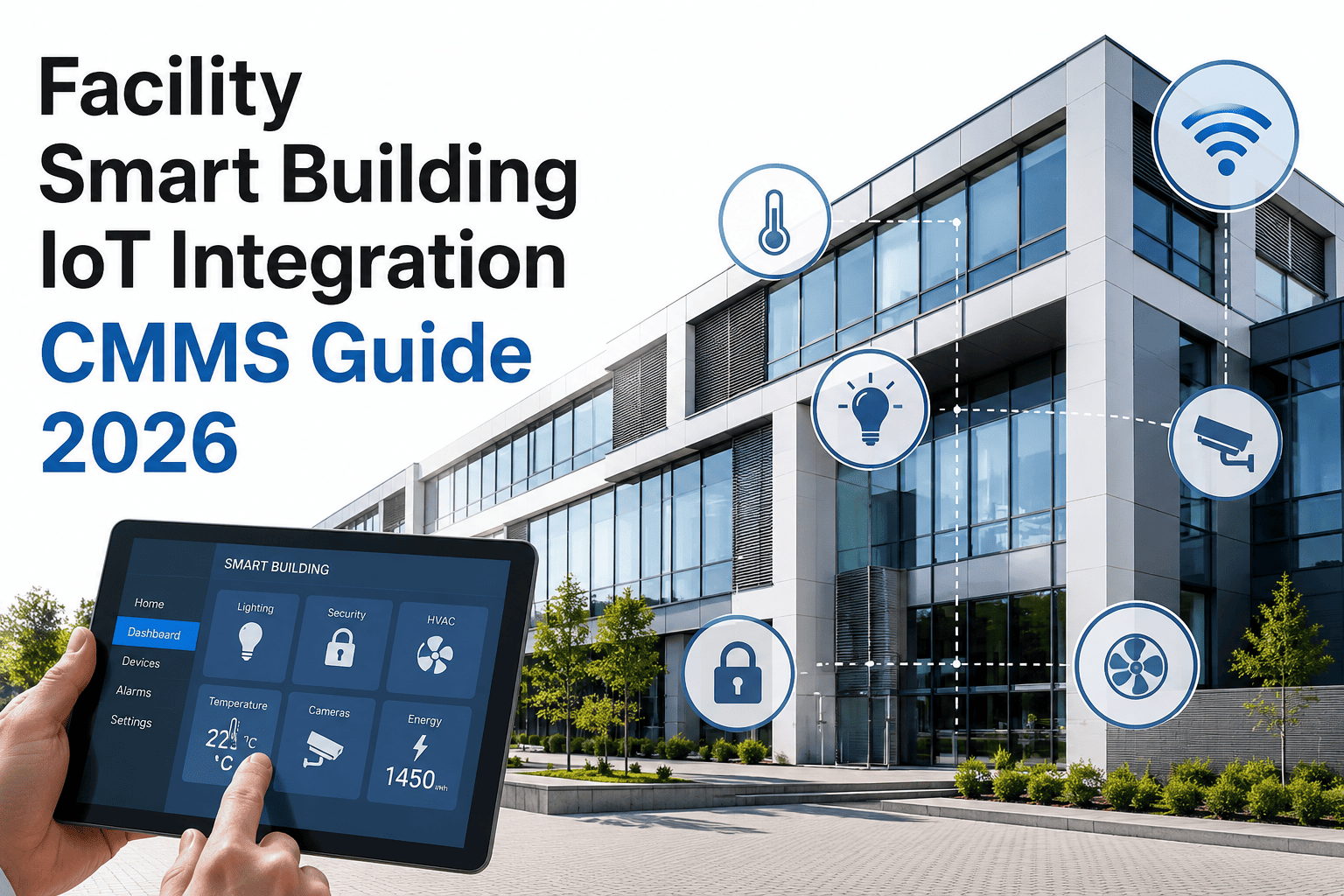
Facility management is undergoing its fastest structural transformation since the shift from reactive to preventive maintenance in the 1990s. In 2026, the convergence of AI-driven predictive systems, IoT sensor infrastructure, ESG compliance mandates, and hybrid workplace redesign is forcing every FM leader to make platform and strategy decisions that will define operational performance for the next decade. The global facility management market is projected to reach $1.9 trillion by 2030 at 8.9% CAGR — but the growth is not distributed evenly. FM operations running AI-powered maintenance, smart building analytics, and integrated CMMS platforms are documenting 35–45% reductions in unplanned downtime and 30% lower total maintenance costs compared to organizations still running disconnected, paper-based, or legacy-system maintenance programs. The seven trends below represent the shifts separating high-performing FM operations from those absorbing preventable costs. Facilities using OxMaint's AI-powered CMMS platform are already operating at the intersection of every trend covered in this guide. Book a demo to see how OxMaint positions your FM operation for 2026 and beyond.
$1.9T
Global FM market by 2030 — 8.9% CAGR driven by AI, IoT, and ESG mandates
45%
Unplanned downtime reduction achieved by FM teams running AI predictive maintenance in 2026
72%
Of Fortune 500 companies now include building performance in ESG reporting — up from 41% in 2023
2026
The year AI-powered CMMS adoption crosses the mainstream threshold in commercial FM globally
OxMaint Is Built for Every FM Trend Reshaping the Industry in 2026.
AI predictive maintenance, IoT sensor integration, ESG reporting, hybrid workplace optimization, and multi-site portfolio management — all in one platform. No implementation consultants. No hardware lock-in. Deploys in days. Free to start.
The 7 Facility Management Trends Defining 2026
These are not emerging technologies. They are production-deployed realities that are already separating top-quartile FM operations from average performers — and the performance gap is widening as early adopters compound their advantages.
01
AI and Predictive Maintenance
AI failure prediction detects equipment deterioration 2–8 weeks before breakdown. Cross-sensor anomaly detection is replacing fixed calendar intervals with condition-triggered maintenance across HVAC, elevators, generators, and electrical systems. Early adopters are documenting 45% fewer unplanned events.
Market impact: $47.4B AI predictive maintenance market by 2031
02
Smart Building IoT Integration
BAS/BMS systems, standalone IoT sensors, and equipment OEM cloud APIs are feeding real-time operational data into CMMS platforms — giving FM teams continuous visibility into asset health without manual inspection cycles. Buildings with full IoT integration reduce energy consumption by 15–25%.
65% of commercial buildings will have IoT-connected systems by end of 2026
03
ESG Compliance and Reporting
Building performance is now a board-level ESG metric. FM teams are required to generate auditable data on energy consumption, carbon emissions, water usage, and waste streams for investor, regulatory, and tenant reporting. CMMS platforms that automate ESG data capture from maintenance records eliminate the manual compilation burden.
72% of Fortune 500 companies include building performance in ESG reporting — up from 41% in 2023
04
Hybrid Workplace Optimization
Variable occupancy patterns in post-pandemic commercial portfolios are forcing FM teams to operate buildings dynamically — adjusting HVAC schedules, cleaning frequencies, and space utilization in response to real-time occupancy data rather than fixed calendar patterns. Hybrid workplace FM reduces per-seat facility cost by 18–32%.
Office occupancy averages 58% of pre-pandemic levels in 2026 — demanding dynamic FM models
05
Data-Driven CapEx Planning
Condition-based asset lifecycle modeling is replacing age-and-gut-feeling CapEx forecasting. CMMS platforms with Remaining Useful Life engines generate rolling 5-year replacement forecasts per asset from actual condition scores — enabling CFO-defensible capital budgets instead of annual emergency allocations driven by unexpected failures.
FM teams using CMMS-driven CapEx models reduce emergency capital expenditure by 38% on average
06
Mobile-First Field Operations
Paper-based work orders and clipboard inspection sheets are disappearing from best-practice FM operations. Mobile-first CMMS platforms enable field technicians to receive work orders, complete inspections, photograph defects, and capture digital signatures from any device — generating audit-ready records without administrative overhead at the end of each shift.
FM teams using mobile CMMS reduce work order processing time by 67% versus paper-based systems
07
Multi-Site Portfolio Intelligence
Commercial real estate portfolios managed as collections of individual buildings are being outperformed by FM operations using portfolio-level dashboards that aggregate asset health, maintenance costs, and compliance status across all properties simultaneously. Cross-property benchmarking identifies underperforming buildings 6–12 months before their costs appear in financial reporting.
Portfolio-level FM visibility reduces total maintenance spend by 22% versus property-by-property management
Trend 1 Deep Dive: AI and Predictive Maintenance in 2026
AI predictive maintenance is the single highest-ROI trend in facility management for 2026. The technology has crossed from early adopter to mainstream deployment — with documented outcomes that make the business case straightforward for any FM operation managing critical equipment.
Traditional Scheduled PM
Fixed Calendar Intervals
Maintenance triggered by dates regardless of actual equipment condition. Over-services healthy assets. Misses between-interval failures. Emergency breakdowns still occur at 30–40% of events.
Average unplanned downtime: 22% of critical equipment hours annually
Condition-Based Maintenance
Manual Sensor Monitoring
Maintenance triggered when a technician physically observes a threshold breach. Better than calendars but requires someone to be present for detection. Failures between inspections still reach breakdown.
Average unplanned downtime: 14% of critical equipment hours annually
AI Predictive Maintenance — 2026
Cross-Sensor Pattern Recognition
AI analyzes multiple sensor streams simultaneously — detecting failure signature patterns 2–8 weeks before any single parameter breaches its individual threshold. Work orders created automatically before breakdown.
Average unplanned downtime: 5% of critical equipment hours — 77% reduction from reactive baseline
OxMaint in 2026
Continuous AI + Auto Work Orders
OxMaint monitors asset health continuously, detects developing failures weeks in advance, and automatically creates maintenance work orders pre-populated with sensor findings, asset history, and technician assignments.
Documented ROI: 220%+ in year one — first prevented failure typically covers platform cost
ESG and Building Performance: The Compliance Landscape in 2026
ESG compliance has moved from voluntary reporting to regulatory obligation in most major markets. FM teams that cannot generate auditable building performance data are now creating financial and legal exposure for their organizations — not just operational inefficiency.
| Market / Region |
Key ESG Building Regulation in 2026 |
FM Compliance Requirement |
OxMaint Coverage |
| USA |
SEC Climate Disclosure Rules, NYC Local Law 97, California SB 253 |
Annual GHG emissions reporting, energy benchmarking, carbon penalty calculations per building |
Energy consumption tracking, maintenance event carbon attribution, audit-ready export reports |
| UK |
MEES (EPC B by 2030), Building Safety Act 2022, TCFD mandatory reporting |
EPC compliance documentation, building safety case files, climate-related risk disclosure |
Inspection scheduling, compliance record archiving, building safety case documentation |
| EU |
EPBD recast 2024, CSRD mandatory sustainability reporting, EU Taxonomy |
Building renovation passports, nearly zero-energy building (NZEB) compliance, sustainability reporting |
Asset lifecycle tracking, energy performance monitoring, maintenance history audit trails |
| UAE |
UAE Net Zero 2050, Dubai Green Building Regulations, LEED certification requirements |
Green building certification maintenance, energy system performance documentation, carbon reporting |
Multi-site compliance dashboards, digital inspection records, sustainability KPI tracking |
| Australia |
NABERS mandatory disclosure, CISC sustainability framework, State government net zero commitments |
NABERS energy and water rating maintenance, building performance benchmarking, annual disclosure |
Asset condition scoring, maintenance cost tracking, performance benchmarking reports |
| Germany |
GEG 2024 (Buildings Energy Act), German Climate Action Plan 2030, EU ETS building inclusion |
Energy system maintenance documentation, heating/cooling efficiency records, carbon allowance tracking |
Scheduled PM compliance records, DIN EN 13306 maintenance documentation, audit-ready archives |
How OxMaint Delivers All 7 FM Trends in One Platform
Most FM technology stacks in 2026 consist of disconnected point solutions — one for work orders, one for IoT monitoring, one for ESG reporting, one for CapEx planning. OxMaint delivers all seven trend capabilities as an integrated platform, eliminating the data silos and manual transfer overhead that make disconnected stacks more expensive than they appear.
AI Predictive Monitoring
Cross-sensor failure pattern detection generates maintenance work orders automatically 2–8 weeks before equipment breakdown. Configurable alert thresholds per asset type with auto-escalation for critical systems.
IoT and BAS Integration
Connects to existing BAS/BMS systems, standalone IoT sensors, and equipment OEM cloud APIs. Consolidates all building data streams into a unified asset health dashboard without replacing existing sensor infrastructure.
ESG Compliance Records
Audit-ready maintenance and inspection records satisfy building compliance documentation requirements across USA, UK, EU, UAE, Australia, and Germany frameworks. Export reports generated automatically from live work order data.
Hybrid Workplace FM Tools
Occupancy-triggered maintenance scheduling adjusts HVAC, cleaning, and inspection cycles based on real-time space utilization data. Dynamic service delivery replaces fixed calendar programs with demand-responsive maintenance.
5-Year CapEx Forecasting
Rolling asset replacement forecasts built from condition scores and maintenance cost trajectories per building. CFO-defensible capital budget documentation replacing annual guesswork with data-driven replacement timing per asset.
Mobile-First Field Operations
Work orders, inspections, defect photography, and digital signatures completed on any mobile device. Records archived automatically against each asset — zero paper, zero manual filing, zero administrative overhead after shift completion.
Portfolio Intelligence Dashboard
Cross-property asset health, maintenance cost, compliance status, and CapEx forecast aggregated across all buildings simultaneously. Cross-site benchmarking identifies underperforming properties before costs appear in financial reporting.
Automated Work Order Workflows
AI alerts, inspection findings, and tenant requests automatically create work orders pre-populated with asset history, technician assignments, and parts recommendations. Zero manual step from detection to maintenance action dispatched.
45%
Reduction in unplanned downtime — documented year one of AI predictive maintenance deployment
30%
Total maintenance cost reduction versus reactive baseline across OxMaint commercial FM deployments
220%+
First-year ROI — the first prevented major failure typically covers the platform cost in full
Days
Deployment timeline — OxMaint reaches full operational function without implementation consultants
FM Trends 2026: Before vs After Structured Platform Adoption
The performance gap between FM operations running integrated platforms and those managing with disconnected legacy systems is measurable, consistent, and widening. This comparison reflects documented outcomes across commercial building FM deployments in 2025–2026.
Without Integrated FM Platform
Performance Dimension
With OxMaint in 2026
Calendar-based PM misses between-interval failures. 30–40% of maintenance events are still emergency repairs at 4.8x planned cost.
Maintenance Model
AI-driven predictive maintenance detects failures 2–8 weeks early. Emergency repair rate below 15% of all maintenance events.
Manual monthly report compilation from spreadsheets and paper logs takes 6–12 hours per property. Data is always backward-looking.
ESG and Compliance Reporting
Audit-ready compliance records generated automatically from live work order data. Reports export on demand in under 60 seconds.
CapEx decisions made from equipment age estimates and failure history. Emergency capital requests approved reactively after breakdown events.
CapEx Planning Accuracy
Rolling 5-year CapEx forecast per asset from condition scores. 38% fewer emergency capital allocations. CFO-defensible budget documentation.
Paper work orders and clipboard inspections. Records lost or misfiled. Technicians spend 2–3 hours per shift on administrative documentation.
Field Operations
Mobile work orders completed in field. Records archived automatically. Work order processing time reduced by 67%. Zero paper.
No portfolio-level visibility. Each building managed independently. Underperforming properties identified from financial reports 6–12 months after the gap develops.
Multi-Site Visibility
Live AI health dashboard across all properties. Cross-site benchmarking identifies problems before they appear in financials. 22% lower total portfolio maintenance cost.
Fixed HVAC and cleaning schedules regardless of actual occupancy. 40–60% of variable occupancy buildings are over-serviced relative to actual usage.
Hybrid Workplace Adaptation
Occupancy-triggered maintenance scheduling reduces per-seat facility cost by 18–32% in hybrid workplace portfolios without service level reduction.
OxMaint Delivers Every 2026 FM Trend in One Integrated Platform. Start Today.
Join 1,000+ commercial FM operations using OxMaint to run AI predictive maintenance, IoT asset monitoring, ESG compliance reporting, and portfolio intelligence from a single platform. No implementation consultants. No hardware lock-in. Free to start. Measurable results within 30 days.
Frequently Asked Questions — FM Trends 2026
Common questions from FM directors and operations leaders evaluating how 2026 industry trends apply to their specific buildings and portfolios. Sign up free or book a demo to see how OxMaint maps to your organization's specific 2026 priorities.
How quickly can an FM operation implement AI predictive maintenance in 2026?
With OxMaint, AI monitoring reaches operational function in days to weeks — not months. If your building has an existing BAS/BMS system, OxMaint integrates directly using data already being collected, with no new hardware required. For buildings without IoT infrastructure, wireless sensors deploy in hours with no cabling or IT involvement. The AI model begins generating alerts from day one using pre-trained failure signatures, and improves accuracy to 90%+ as it learns your building's specific operating patterns over 60–90 days.
Book a demo for a hardware assessment specific to your building, or
sign up free to start your evaluation today.
Which ESG building compliance frameworks does OxMaint support for 2026 reporting?
OxMaint generates audit-ready maintenance and inspection records that satisfy building compliance documentation requirements across all major 2026 ESG frameworks — including SEC Climate Disclosure Rules and NYC Local Law 97 (USA), MEES and Building Safety Act (UK), EPBD recast and CSRD (EU), Dubai Green Building Regulations (UAE), NABERS disclosure (Australia), and GEG 2024 (Germany). All records are generated automatically from live work order data with no manual compilation.
Sign up free to activate compliant record-keeping, or
book a demo for a compliance documentation walkthrough specific to your region.
How does OxMaint help FM teams adapt to hybrid workplace occupancy patterns in 2026?
OxMaint connects occupancy sensor data from existing building systems to maintenance scheduling triggers — automatically adjusting HVAC maintenance intervals, cleaning work order frequency, and space inspection schedules based on actual utilization rather than fixed calendar patterns. For a building averaging 58% occupancy on variable days, this typically reduces per-seat facility cost by 18–32% while maintaining service levels on occupied days. The system learns occupancy patterns over time and optimizes schedules continuously.
Book a demo to see occupancy-triggered maintenance configured for your portfolio, or
sign up free to start building your dynamic FM program.
Can OxMaint manage FM trend implementation across a multi-site commercial portfolio in 2026?
Yes. OxMaint is purpose-built as a multi-site portfolio platform — a single deployment covers all properties under a unified AI health dashboard with site-specific configuration per building. Portfolio managers see cross-property AI alerts, maintenance cost trends, ESG compliance status, and CapEx forecasts simultaneously. Cross-property benchmarking identifies which buildings are underperforming on any metric — maintenance cost, uptime rate, compliance completion — before the gap appears in financial reporting. Investor and ownership group reporting templates are included out of the box.
Sign up free to configure your portfolio, or
book a demo to see the multi-site dashboard live across a portfolio similar to yours.
Stay Ahead of Every 2026 FM Trend with OxMaint.
AI predictive maintenance. Smart building IoT. ESG compliance automation. Hybrid workplace optimization. Multi-site portfolio intelligence. All in one platform. All operational from day one. All without implementation consultants. Start free today and see measurable results within your first 30 days of deployment.