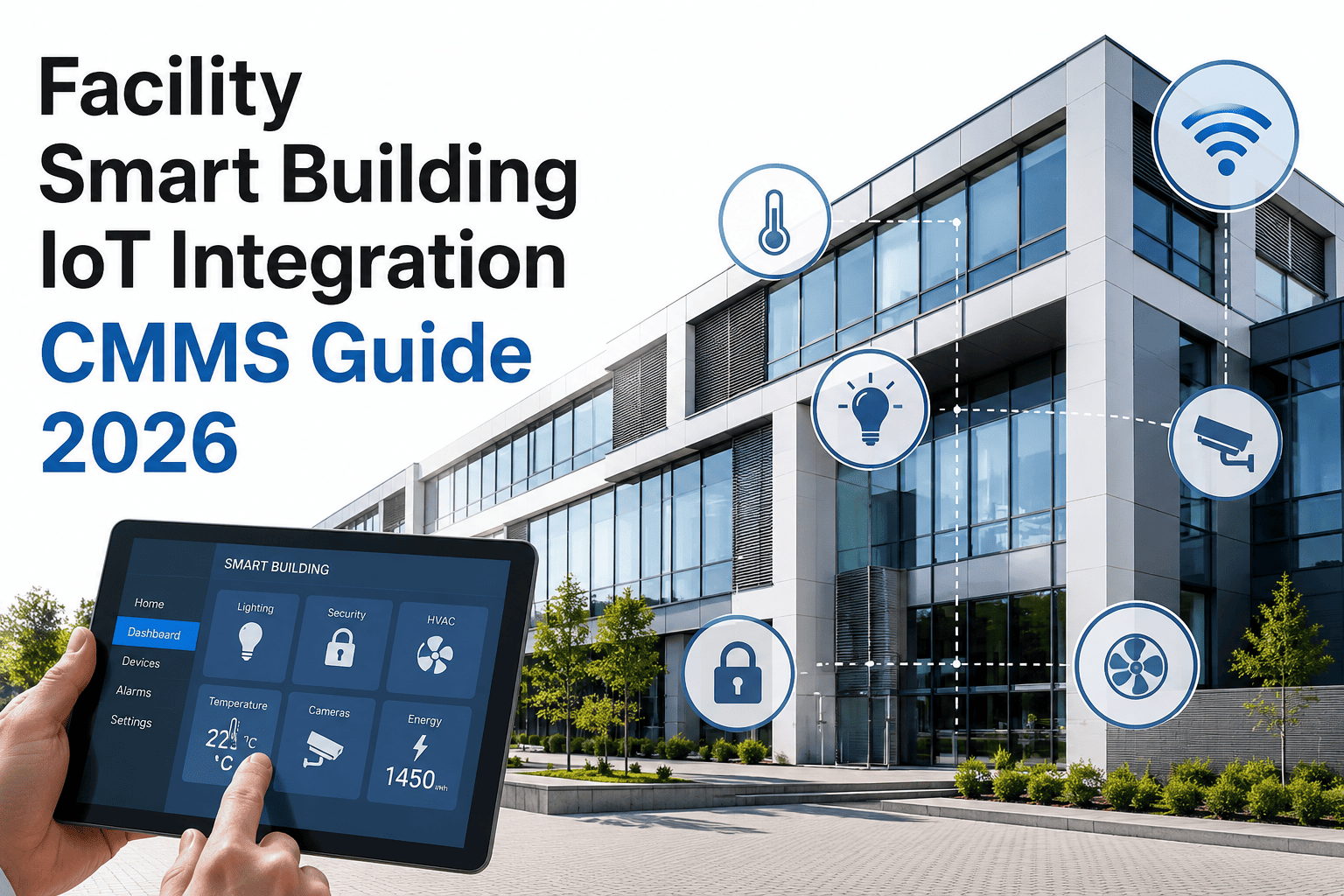
The building you manage is already generating thousands of data points every hour — from HVAC controllers cycling on occupancy schedules to meters logging kilowatt-hours in real time. The question in 2025 is no longer whether smart building technology works. It is whether you have the platform architecture to turn that raw signal volume into maintenance decisions, capital plans, and compliance records before your competitors do. The global smart building market reached $141.79 billion in 2025, growing at a CAGR above 10% through 2034. Ninety-one percent of commercial facility organizations surveyed in 2025 had already deployed smart building systems — spending an average of $550,000 per organization on connected infrastructure. The gap between facilities that capture that investment's full value and those that don't comes down to one integration: whether your IoT and BAS data flows into a CMMS that turns sensor readings into work orders, asset health scores, and capital forecasts. Start a free Oxmaint trial to connect your first building system in days, or book a demo to map a smart building integration plan to your specific portfolio.
Your Building Systems Are Generating Data. Is Your CMMS Doing Anything With It?
Oxmaint integrates IoT sensor data, BAS outputs, and real-time energy readings directly into work order automation, asset health tracking, and CapEx forecasting — one platform, every building system connected.
The Smart Building Technology Stack: Three Layers Facility Managers Must Understand
Smart building technology is not a single product — it is three interdependent infrastructure layers. Facility managers who understand how these layers connect — and where the value leaks when they don't — make better platform decisions and avoid expensive integration failures.
The Sensing Layer — IoT Devices and Sensor Networks
The sensing layer is the physical infrastructure of smart buildings: temperature sensors, occupancy detectors, vibration monitors, energy sub-meters, air quality sensors, water flow meters, and equipment runtime counters. These devices generate continuous data streams — some updating every second, others every 15 minutes — covering every building system from HVAC to electrical to plumbing. The 2025 Memoori IoT report tracked over 2.3 billion IoT device deployments in commercial buildings globally, up 40% from 2023. The sensing layer creates the raw data volume that every higher-order system depends on. Its reliability, coverage, and protocol compatibility determine the ceiling of everything built above it. Gaps in sensing coverage create blind spots in energy management, asset health monitoring, and compliance documentation — the operational equivalent of running a facility with half the lights off.
The Control Layer — Building Automation Systems (BAS)
The BAS sits above the sensing layer, receiving data from sensors and actuating physical responses — adjusting HVAC setpoints, dimming lighting circuits, triggering alarms, and sequencing equipment start-up. The global BAS market reached $87.85 billion in 2025, projected to grow to $184.42 billion by 2034 at 8.7% CAGR, according to Fortune Business Insights. Modern BAS platforms — from Siemens Desigo to Honeywell EBI to Johnson Controls OpenBlue — increasingly incorporate cloud connectivity and AI-driven optimization. In February 2025, Trane Technologies' BrainBox AI launched ARIA, an AI virtual engineer that performs real-time HVAC optimization across global building portfolios. The critical limitation of BAS as a standalone tool: it controls building systems but does not manage asset maintenance, work order execution, or capital lifecycle. That integration gap is where CMMS enters the stack.
The Intelligence Layer — CMMS and Maintenance Analytics
The intelligence layer converts BAS alerts and IoT sensor data into maintenance decisions, work orders, asset health records, and capital forecasts. Without this layer, a BAS alert that an HVAC unit is running outside its normal operating range generates a notification — and nothing else. With a CMMS integrated at the intelligence layer, that same alert automatically generates a prioritized work order with asset ID, fault description, recommended action, required parts, and assigned technician. Oxmaint occupies this layer, ingesting data from BAS platforms and IoT gateways via REST API, MQTT, OPC-UA, and direct sensor integrations — transforming real-time building data into structured maintenance intelligence that drives decisions at the asset, property, and portfolio level. Start a free trial to connect Oxmaint to your building systems, or book a demo to see the integration architecture mapped to your specific BAS platform.
6 IoT Sensor Types Powering Smart Building Maintenance in 2025
Not all IoT sensors deliver equal maintenance value. These six sensor categories generate the data most directly relevant to asset health monitoring, energy management, and compliance documentation in commercial facilities.
Monitor HVAC supply and return air temps, chilled water supply temperature, electrical panel thermal profiles, and refrigeration cabinet conditions. Thermal drift outside baseline triggers predictive maintenance alerts before equipment failure or compliance breach occurs.
PIR and ultrasonic occupancy sensors drive HVAC and lighting scheduling based on actual space utilization rather than fixed calendars. In commercial offices with variable occupancy patterns, occupancy-driven controls reduce HVAC energy consumption by 18–24% versus schedule-only systems.
Detect bearing wear, rotor imbalance, and mechanical loosening in rotating HVAC equipment, pumps, fans, and compressors. Vibration anomaly detection identifies degradation patterns 2–6 weeks before failure, converting emergency repairs into planned interventions at 4.8x lower cost.
Granular energy metering by circuit, tenant, floor, or equipment provides the consumption data that building-level utility meters cannot. Lawrence Berkeley National Laboratory research found buildings using sub-meter analytics reduced energy consumption by up to 50% by identifying waste at the equipment level.
Monitor CO₂ concentration, particulate matter, VOC levels, and relative humidity. Air quality data drives demand-controlled ventilation, reducing unnecessary outdoor air conditioning while maintaining ASHRAE 62.1 indoor air quality standards. Increasingly required for WELL Building certification compliance.
Sub-meter water consumption by floor, system, or fixture group. Pressure sensors detect supply pressure anomalies indicating pipe leaks, valve wear, or pump degradation. Facilities with real-time water monitoring reduce consumption by 20–30% compared to utility-bill-only tracking.
BAS vs. CMMS: What Each Does and Why Both Are Required
One of the most expensive misconceptions in facility management technology is treating BAS and CMMS as alternatives rather than complements. Understanding the precise boundary between them is the foundation of a smart building architecture that actually delivers on its ROI promise.
BAS-to-CMMS Integration: 4 Data Flows That Drive Maintenance Value
Integrating your BAS with Oxmaint creates four distinct operational improvements that neither platform delivers alone. Each integration point represents a direct line from real-time building intelligence to measurable maintenance outcome.
Automated Work Order Generation From BAS Alarms
When a BAS alarm fires — chiller leaving water temperature out of range, AHU fan speed deviation, cooling tower conductivity spike — Oxmaint receives the event via API and automatically creates a corrective work order with asset ID, alarm description, recommended action, and priority tier. The technician receives a push notification on mobile before the alarm has been acknowledged in the BAS console. Facilities using this integration eliminate the gap between alert generation and maintenance response that averages 4–6 hours in manual processes.
Production-Based PM Scheduling From Actual Runtime Data
Instead of scheduling HVAC filter changes, belt replacements, and coil cleaning on fixed calendar intervals, Oxmaint ingests actual equipment runtime hours from BAS metering data and triggers PM work orders when operational thresholds are reached. An AHU that runs 18 hours per day in summer reaches its 2,000-hour filter replacement threshold in 111 days — not the 180-day calendar interval that under-maintains high-load equipment while over-maintaining lightly used units. Production-based PM triggers eliminate both under-maintenance risk and unnecessary maintenance labor simultaneously.
Energy Anomaly Detection Linked to Asset Condition Scores
Energy consumption data from BAS sub-metering feeds Oxmaint's asset condition scoring. A chiller drawing 12% more energy than its baseline — with no change in load profile — is showing a mechanical efficiency loss that will manifest as a fault within weeks. Oxmaint flags the condition score deviation and generates an investigation work order while the asset is still running, rather than waiting for the trip fault that grounds the unit during peak demand. Buildings that track energy anomalies per asset detect degradation 3–5 weeks earlier than buildings tracking only system-level energy consumption.
Maintenance History Feeding Capital Replacement Forecasts
Every work order closed in Oxmaint against a BAS-connected asset — corrective repairs, PM completions, parts replaced, technician hours logged — accumulates as a maintenance cost and condition history record. When an asset's maintenance cost per year exceeds 30–40% of its replacement value, Oxmaint surfaces it in the CapEx forecasting dashboard with a repair-versus-replace analysis. Finance teams receive capital budget justifications backed by 3–5 years of actual asset performance data — not subjective maintenance manager estimates or simple age-based replacement rules.
Connect Your Building Automation System to Oxmaint in Days, Not Months
Oxmaint supports REST API, MQTT, OPC-UA, and direct sensor gateway integrations across all major BAS platforms — Siemens, Honeywell, Johnson Controls, Schneider Electric, and open-protocol BACnet/IP systems. No long implementation project. No dedicated IT resource required.
Smart Building ROI: What the Data Actually Shows
The ROI case for smart building technology is now well-documented across thousands of commercial deployments. The financial returns operate through five measurable value streams that compound across multi-site portfolios.
Implementation Roadmap: Deploying Smart Building Technology Across a Commercial Portfolio
Successful smart building deployments follow a phased architecture that prevents the most common failure modes: deploying sensors without integration, integrating BAS without CMMS connectivity, and pursuing analytics without the maintenance workflows to act on findings. Oxmaint supports every phase of this roadmap from day one.
Build a complete asset register in Oxmaint covering every BAS-connected system — HVAC units, electrical panels, plumbing infrastructure, lighting controls, and elevator systems. Map each asset to its BAS point name, sensor coverage status, and existing PM schedule. Establish baseline energy consumption per asset from available BAS historian data. This registry becomes the anchor point for all subsequent IoT and BAS integration — without it, sensor data has no maintenance context to connect to.
Configure the API integration between your BAS platform and Oxmaint. Define which alarm categories and priority levels generate automatic work orders versus informational notifications. Set threshold values for energy anomaly detection per asset class. Test the full alert-to-work-order pipeline on a pilot building before portfolio-wide rollout. 63% of commercial buildings already use BAS platforms as their primary smart building entry point — connecting this existing infrastructure to Oxmaint captures immediate value without new hardware investment.
Audit which critical assets fall outside BAS sensor coverage — common gaps include roof-mounted equipment, boiler room assets, parking structure electrical infrastructure, and older building systems pre-dating BAS installation. Deploy purpose-specific IoT sensors for vibration monitoring on HVAC rotating equipment, water sub-meters for high-consumption zones, and air quality monitors for occupied spaces without existing BAS monitoring. Connect all new sensor streams to Oxmaint via the IoT gateway integration layer, adding them to the same asset records established in Phase 1.
With 3–4 months of integrated operational data, Oxmaint's asset health scoring and condition trending produce reliable predictive maintenance signals. Activate CapEx forecasting models, configure portfolio-level KPI dashboards comparing energy intensity, PM compliance rates, and maintenance cost per square foot across all properties. Establish monthly portfolio review cadence using Oxmaint's automated reporting. Facilities that reach this phase typically achieve full platform ROI within 12–18 months from initial deployment — with compounding returns as asset history depth improves prediction accuracy year-over-year.
Cybersecurity Considerations for Smart Building Infrastructure
The same connectivity that makes smart buildings operationally intelligent creates attack surfaces that facility managers must address. Four in ten connected commercial buildings carry active cybersecurity vulnerabilities in their BAS or IoT infrastructure, according to Kaspersky research. In 2024, the US GSA launched a standardization initiative specifically targeting BAS cybersecurity across federal facilities. Managing this risk requires architectural decisions at every layer of the smart building stack.
BAS and IoT sensor networks must operate on segregated OT network segments separated from corporate IT infrastructure by firewall and DMZ architecture. Cross-segment data flows — such as BAS-to-CMMS API calls — traverse the DMZ with strict protocol and port filtering. Mixing OT and IT traffic exposes building control systems to lateral movement attacks entering via corporate endpoints.
IoT devices ship with default credentials that 70%+ of deployments never change, per industry surveys. Enforce unique device credentials, disable unused communication ports, and establish a firmware patching cadence for all BAS controllers and IoT gateways. Unpatched BAS controllers represent the most common entry point for building system compromises documented in 2024 incident reports.
IEC 62443 provides the international industrial cybersecurity standard most applicable to BAS environments. It defines security levels for OT components, network zones, and conduits — providing a structured framework for documenting your smart building cybersecurity posture for insurance, compliance, and due diligence purposes. Growing numbers of commercial real estate insurers now require IEC 62443-aligned documentation for cyber coverage on BAS-connected buildings.
Your CMMS is a high-value target: it contains asset inventories, maintenance histories, and building system access patterns that represent significant operational intelligence. Role-based access controls, multi-factor authentication, and audit logging for all system access events are required security baselines. Oxmaint provides all three, with full audit trail exports supporting insurance and compliance documentation requirements.
Frequently Asked Questions
What is the difference between a BAS, a BMS, and a CMMS — and which does a facility manager actually need?
Building Automation System (BAS) and Building Management System (BMS) are largely interchangeable terms — both refer to the integrated control platform that monitors and adjusts HVAC, lighting, access, and other building systems in real time based on sensor inputs and programmed rules. A CMMS (Computerized Maintenance Management System) is a separate category: it manages the maintenance activities, asset records, work orders, technician assignments, and compliance documentation that keep those building systems operational over their full lifecycle. Most facility managers need both. The BAS optimizes building system operation in real time. The CMMS ensures the assets the BAS controls are properly maintained, documented, and capital-planned over years and decades. The highest value in smart building technology comes from integrating both — where BAS alert data triggers CMMS work orders automatically, and CMMS maintenance history informs BAS configuration decisions. Start a free Oxmaint trial to see the CMMS side of this integration, or book a demo to see how Oxmaint connects to your existing BAS platform.
How much does it cost to implement smart building IoT and BAS integration — and what is the realistic ROI timeline?
BAS implementation costs range from $2.50 to $7.00 per square foot according to Technavio market data — meaning a 100,000 sq ft commercial building might invest $250,000 to $700,000 in BAS infrastructure. However, for facilities with an existing BAS, the incremental cost of connecting that infrastructure to a CMMS like Oxmaint via API integration is typically a fraction of the original BAS investment. The ROI timeline depends on building type, sensor coverage depth, and initial maintenance programme maturity. Facilities starting from a predominantly reactive maintenance position typically achieve measurable ROI within 12–18 months through reduced emergency repair costs alone — with energy savings and asset lifespan extension adding additional returns compounding over years 2–5. The highest documented ROI cases involve facilities that were spending 4.8x on emergency repairs before implementing connected maintenance programmes.
Which BAS platforms does Oxmaint integrate with — and what communication protocols are supported?
Oxmaint supports integration with all major BAS platforms through a combination of native API connections and standard industrial communication protocols. Supported protocols include REST API (for cloud-connected BAS platforms), MQTT (for IoT sensor gateways and edge devices), OPC-UA (for industrial SCADA and BAS controllers), BACnet/IP (the most widely deployed BAS communication standard), and Modbus TCP for legacy building system equipment. Platform-specific integrations include Siemens Desigo CC, Honeywell EBI, Johnson Controls Metasys, Schneider Electric EcoStruxure Building Operation, and open-protocol BACnet systems deployed by regional controls contractors. For facilities with IoT sensor hardware operating outside BAS coverage — vibration sensors, water sub-meters, air quality monitors — Oxmaint's IoT gateway integration layer handles direct device data ingestion without requiring BAS intermediation. Book a demo to confirm integration compatibility with your specific BAS configuration, or start a free trial and our integration team will assess your environment within 48 hours.
Can smart building technology and CMMS integration support multi-site commercial real estate portfolios — or is it primarily for single-building deployments?
Smart building technology and CMMS integration delivers disproportionately greater value at the portfolio level compared to single-building deployments. The reason is benchmarking: when every property in a portfolio runs the same IoT-connected CMMS platform, corporate operations teams can compare energy intensity per square foot, maintenance cost per asset, PM compliance rates, and equipment failure frequency across all buildings simultaneously — identifying which properties are underperforming and directing capital accordingly. Oxmaint's portfolio hierarchy — Portfolio, Property, System, Asset, Component — supports this cross-portfolio analytics layer natively. Properties share the same KPI definitions, asset classification standards, and reporting cadence, making the comparison meaningful rather than contaminated by site-specific reporting differences. The July 2025 Siemens-Microsoft partnership specifically targeted multi-building IoT data interoperability as the primary use case for enterprise portfolio operators — validating portfolio-scale smart building integration as the highest-value deployment context. Start a free trial and connect your first two properties, or book a demo to see portfolio-level analytics running across a live multi-site deployment.
Continue Reading: Energy & Sustainability for Facility Managers
Explore these guides to build a complete smart building and energy management programme across your facility portfolio.
Your Building Is Already Smart. Oxmaint Makes It Maintenance-Intelligent.
Connect your BAS alerts, IoT sensor streams, and energy data to Oxmaint's CMMS layer — and turn real-time building intelligence into work orders, asset health scores, compliance records, and capital forecasts that facility managers, operations directors, and investors can act on. Deploy across your first building in days, not months.