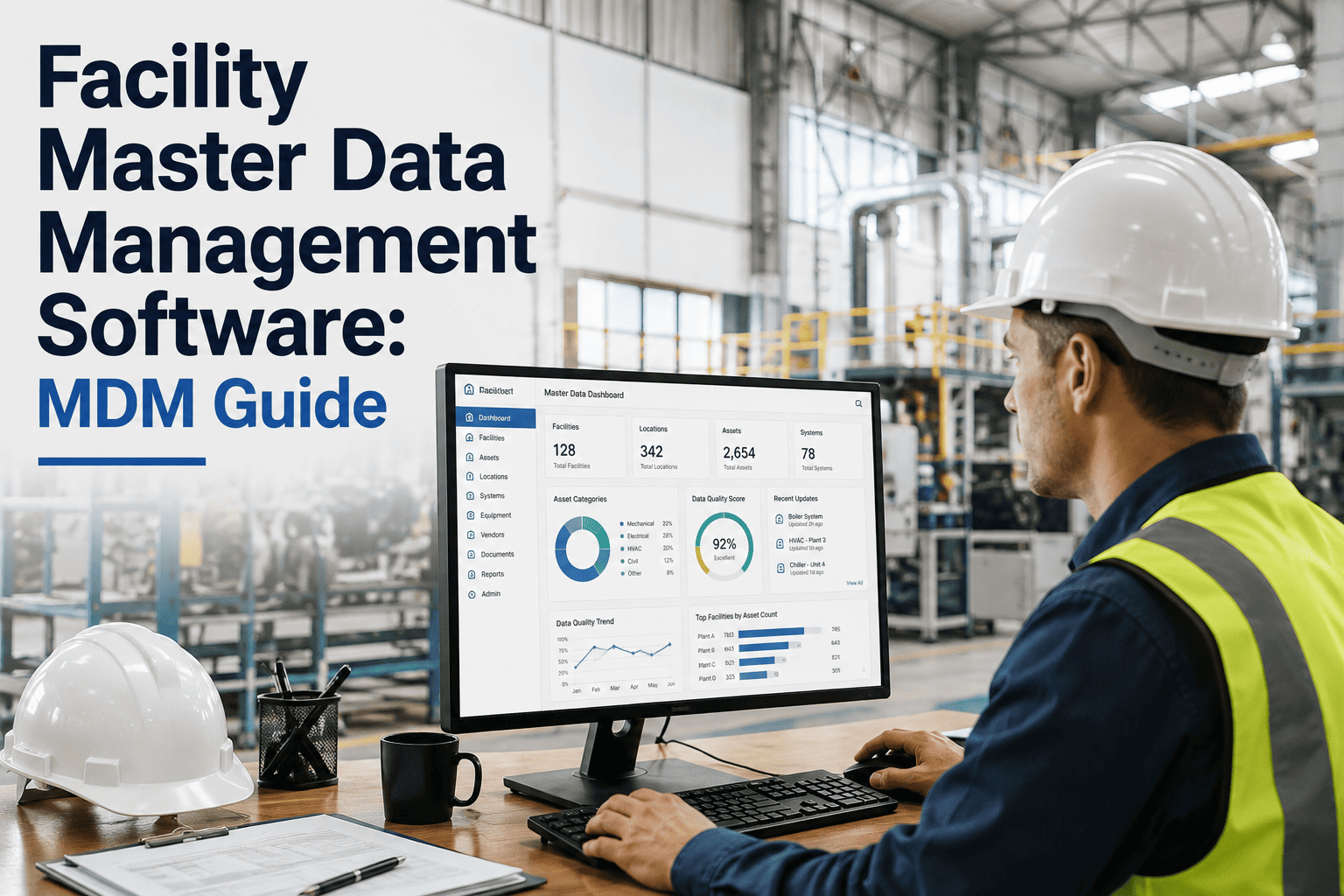
Facility Master Data Management Software: MDM Guide

By Corin Hale on August 22, 2026

facility-master-data-management-software-mdm-guide

Ask a facility team how many pumps they have, and you will usually get three different numbers depending on whether you check the CMMS, the spreadsheet the site manager keeps, or the vendor's service contract list. Organizations now manage facility data across an average of seventeen separate systems, and most admit their asset, location, and vendor records contain duplicates nobody has reconciled. Facility master data management fixes that by giving every asset, location, and vendor one authoritative record that every system — CMMS, IoT, ERP, and procurement — reads from and writes back to. Start a free OxMaint trial to see a clean asset master built from your existing records, or book a demo below.

The Data Problem

What Bad Master Data Is Actually Costing You

Nobody sets out to create duplicate asset records. They accumulate — a contractor tags a pump one way, a technician enters it another way in the CMMS, and a spreadsheet somewhere still calls it by its old name from three renovations ago. Left unmanaged, that drift becomes measurable operational risk.

92%
of organizations have duplicate asset, vendor, or location records somewhere in their systems
17
separate systems, on average, hold some version of the same facility data
$12.9M
average annual cost poor data quality creates across a mid-size organization
28%
fewer duplicate asset records once governed master data is in place

Give Every Asset One Authoritative Record

OxMaint builds a governed asset, location, and vendor master from your existing spreadsheets and systems — so every team works from the same source of truth.

Real-World Impact

One Plant's Spreadsheet Problem, Before and After

A 180-asset food-processing plant ran its entire equipment record on a shared spreadsheet for three years. A routine audit uncovered exactly the kind of drift most facilities are quietly carrying today.

Before: Spreadsheet Only
31 assets with no recorded location
14 duplicate pump entries under different names
$8,200 in warranty-eligible repairs paid out of pocket
6.2 hours average work order completion time
After: Governed Master Data
One tag ID per asset, recognized across every system
Full warranty tracking recovered within 90 days
3.8 hours average work order completion time
Roughly $61,000 recovered in the first year
The Structure

Four Layers of a Clean Asset Master Record

An ISO 55000-aligned asset hierarchy groups every piece of equipment into four nested tiers. Getting this structure right is what lets a single master record stay accurate as a portfolio grows from one site to fifty.

Portfolio
Every site, building, and facility the organization operates, rolled up under one naming standard.
Site
A single building, plant, or campus with its own address, layout, and responsible manager.
System
HVAC, electrical, water, or fire safety systems within that site, each with defined boundaries.
Component
The individual pump, chiller, valve, or panel — the level every work order actually attaches to.
Data Domains

What Master Data Management Standardizes

Data Domain Common Problem What Standardized Data Provides
Asset & Equipment Records Same pump saved under different names in different systems One tag ID recognized everywhere
Location & Site Hierarchy Assets with no recorded building, floor, or room Full parent-child location mapping
Vendor & Warranty Data Repairs paid out of pocket on covered equipment Contract terms linked directly to the asset
Spare Parts & Inventory Duplicate SKUs and inconsistent part numbers One standardized part record per component
Work Order & PM Templates Same preventive task recreated under different titles One template reused across every matching asset

Stop Paying for the Same Duplicate Twice

OxMaint reconciles asset, location, and vendor records into one governed master — closing the gap between what your spreadsheet says and what is actually on the floor.

Self-Check

Signs Your Facility Data Needs Governance

Most facilities do not realize how fragmented their master data has become until an audit, a warranty dispute, or a failed integration forces the question. These six patterns are the earliest and clearest warning signs.

Technicians keep a personal spreadsheet because they don't trust the CMMS
The same piece of equipment shows up twice under different names
Nobody can say how many assets a building has without counting
Warranty claims get missed because coverage terms live in someone's inbox
Audit prep takes days of manually cross-checking spreadsheets
Every new site gets onboarded with its own naming convention
Expert Review

What Data and Reliability Leaders Say

Predictive maintenance and reliability analytics are only as good as the asset record underneath them. An asset carrying two different IDs across the CMMS and the sensor platform produces two split histories, and no algorithm can reconcile that automatically. Master data has to be fixed before the analytics layer, not after.
HL
Helena Larsen
Reliability Engineering Lead, Asset-Intensive Operations
Every master data project I have run starts the same way: someone finally has to reconcile the spreadsheet against the CMMS against the vendor contracts, and the number of duplicates always surprises leadership. The fix is not more software licenses. It is one governed record per asset, with a clear owner for keeping it accurate.
OA
Omar Farouk Adeyemi
Master Data Governance Consultant, Facility & MRO Systems
Frequently Asked Questions

Facility Master Data Management — Common Questions

Master data covers the core records every other system depends on — assets and equipment, locations and site hierarchy, vendors and warranty terms, spare parts, and preventive maintenance templates. OxMaint centralizes all five domains under one governed structure.
If technicians keep personal spreadsheets, the same equipment appears twice under different names, or audit prep takes days of manual cross-checking, those are the clearest signals. Book a demo for a quick review of your current asset records.
No. A master data cleanup typically starts by importing and reconciling existing CMMS, spreadsheet, and vendor records into one governed structure, rather than replacing the system your team already uses day to day.
A single-site register with a few hundred assets is typically reconciled within a few weeks. Multi-site portfolios take longer, but most facilities see fewer duplicate records within the first month. Start a free trial to see a reconciliation pass on your own asset list.
A named data steward, usually a maintenance planner or reliability lead, should approve new asset records and merges. Without a defined owner, duplicate and inconsistent records return within months even after a clean initial migration.

Build the Asset Master Every Other System Depends On

OxMaint gives your assets, locations, and vendors one governed record — so your CMMS, IoT platform, and reporting finally agree with each other.


Share This Story, Choose Your Platform!