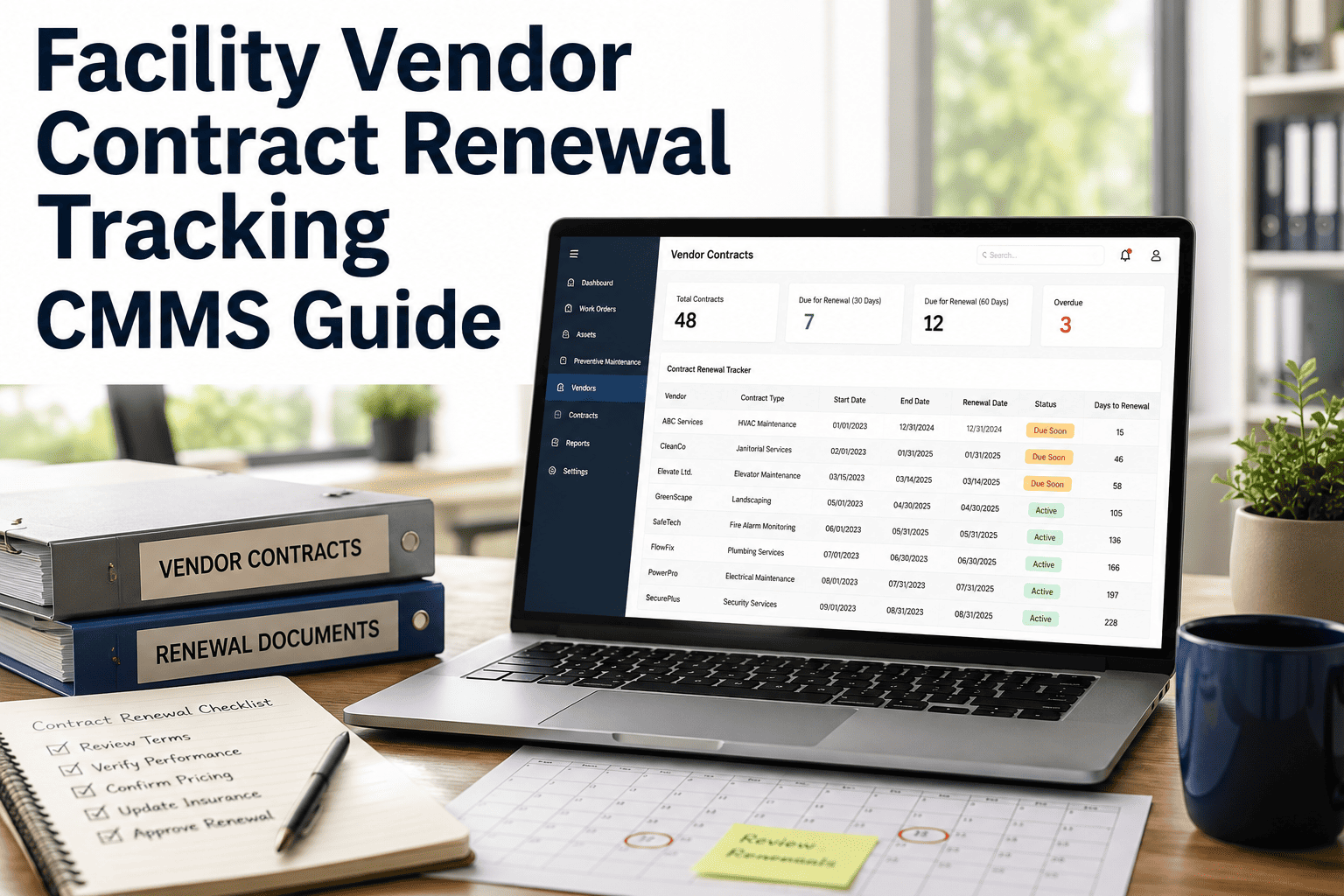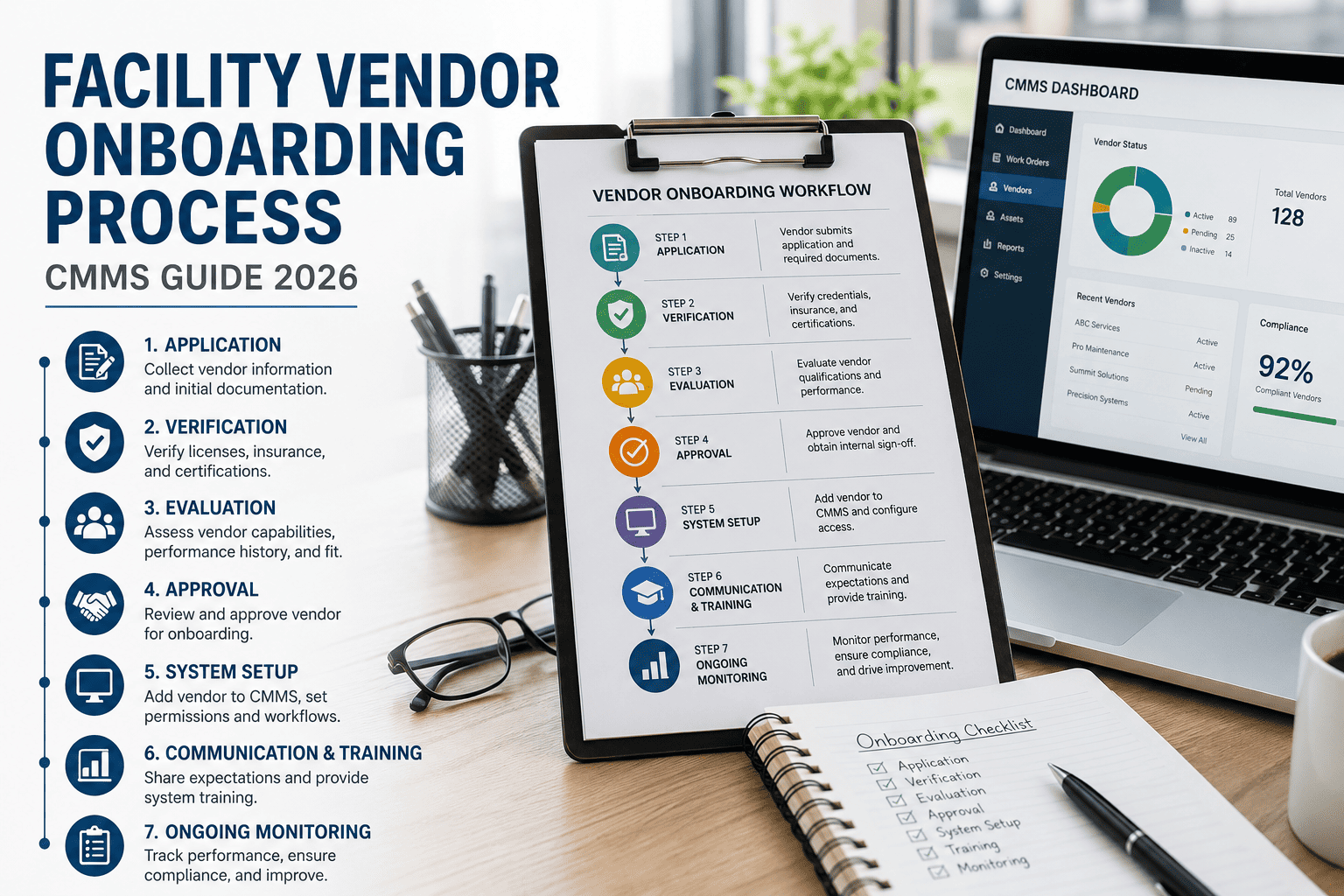
Facility vendor and contractor ecosystems now drive roughly 60% of reactive maintenance spend, yet most teams still manage them through email threads, spreadsheets, and paper COIs stuffed in a binder. A CMMS built for vendor management collapses that sprawl into a single auditable record: credentials, work orders, SLAs, and performance scores in one place. This guide walks through the architecture of a modern facility vendor program for 2026, from credential verification through contractor scorecards. Ready to operationalize it? Start Free Trial and configure your first vendor portal this week.
Are you tracking vendors in inboxes — or in a system of record?
The average facility team coordinates 40–120 outside vendors across HVAC, fire, electrical, landscaping, and specialized trades. Most still can't answer one question on demand: "Who is on-site right now, and are they cleared to be there?" A CMMS closes that gap — credential verification, work order issuance, and performance tracking in one place.
Four checkpoints every contractor must clear before stepping on-site
A defensible vendor program isn't one gate — it's four sequential checkpoints. Skipping any one transfers liability to the facility owner. The sequence below mirrors ISO 41001 facility management controls and OSHA 1910 General Duty Clause expectations.
Verify COI, W-9, and business entity
Collect a Certificate of Insurance showing General Liability ($2M aggregate), Workers' Comp, and Auto coverage. Auto-flag expiration dates 30/15/5 days out. A W-9 locks tax classification. Manual chase time drops from 14 hours per vendor per year to under 2.
Validate licenses, certifications, and trade scope
Match state contractor license numbers (e.g., C-10 electrical, C-20 HVAC) against issuing boards. Confirm EPA 608 for refrigerant handling, NFPA 70E for arc-flash work, OSHA 30 for construction trades. Store expiry dates — never re-issue a work order to a lapsed cert.
Site-specific JHA, SDS, and sign-off
Require a Job Hazard Analysis for high-risk scopes (hot work, confined space, work at height). Push safety data sheets into the vendor record. Capture electronic sign-off on site safety rules. This single step reduces OSHA recordable incidents involving contractors by up to 31%.
Score every closed work order
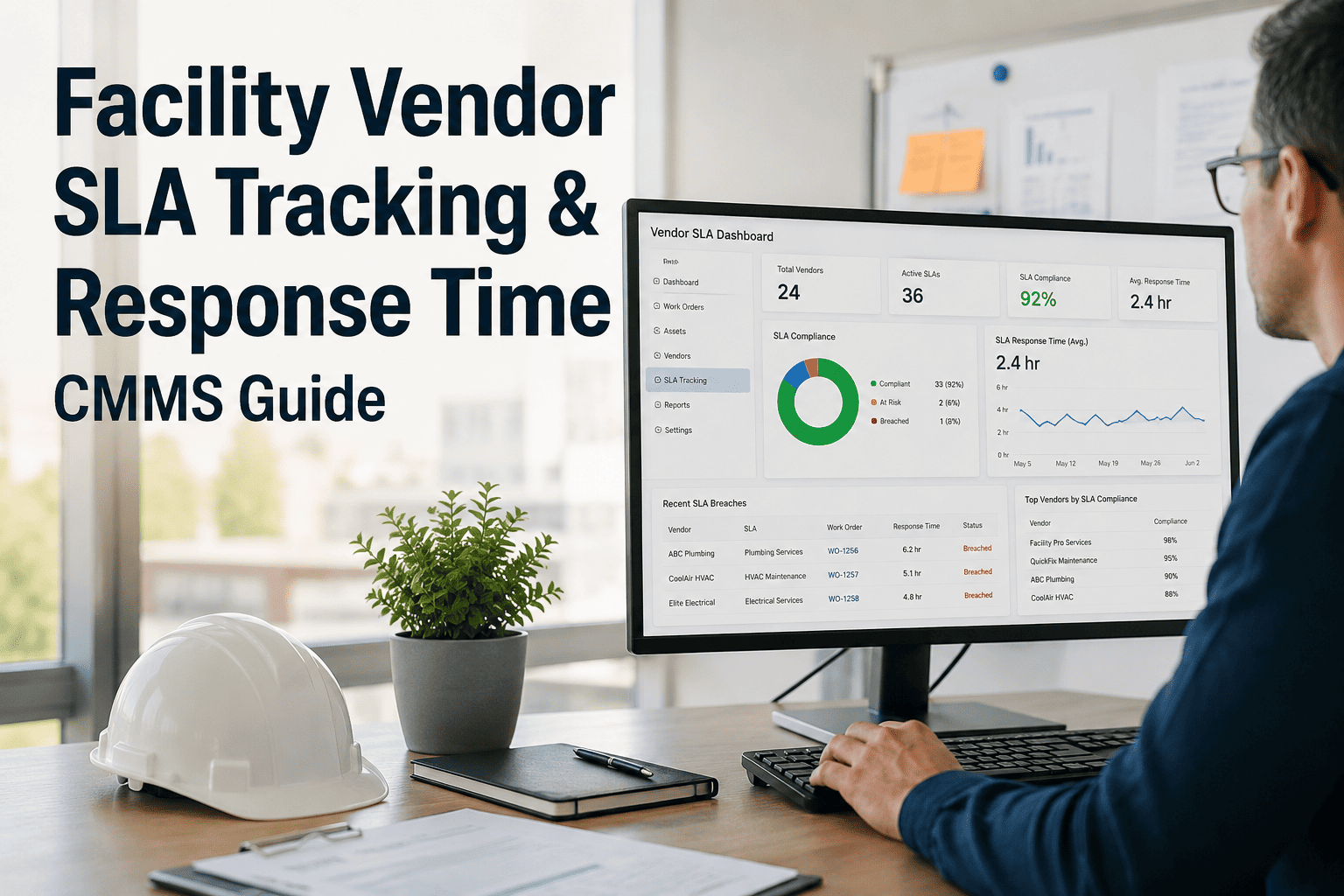
After each WO, auto-issue a 4-question scorecard to the issuing tech and facility manager: on-time arrival, scope completion, rework needed, communication. Aggregate into a rolling 90-day vendor score. Below 3.5/5 triggers a review — before the next contract renewal.
The vendor work order lifecycle — from request to scorecard
A vendor work order isn't just a task; it's a chain of custody for cost, safety, and compliance. Each stage generates an audit trail entry. Here's what a correctly configured CMMS enforces at every handoff.
Request & Approval
A technician or tenant submits a request. The facility manager approves scope and budget. The CMMS checks the vendor's credential status against the asset's risk class — blocked if any required doc is expired. Average cycle: 18 minutes vs. 3 days via email.
Scheduling & Dispatch
The system assigns the WO to a cleared vendor, pushes a notification with site access rules, parking, and PPE requirements. The vendor acknowledges via portal. SLA clock starts. Geofencing can confirm arrival within a configured radius.
Execution & Field Capture
Vendor logs labor hours, parts consumed, before/after photos, and digital sign-off on the mobile app. Floor supervisor countersigns. Any deviation from scope triggers a change-order workflow before additional cost is committed — not after.
Closeout & Scorecard
Invoice is matched against the approved PO and field-reported hours. Variance over 10% routes to a second approval. The scorecard fires automatically. Performance data rolls into the vendor master record and informs the next bid-cycle shortlist.
Vendor scorecard metrics that actually predict rework
Most teams track "did the job get done." That tells you nothing about whether the next job will go the same way. The four metrics below, weighted and rolled into a composite score, are what separates a vendor you renew from one you quietly drop.
| Metric | What it measures | Target | Weight |
|---|---|---|---|
| On-time arrival rate | % of WOs where vendor arrives within agreed window | ≥ 95% | 25% |
| First-time fix rate | % of WOs closed without a return visit within 30 days | ≥ 88% | 30% |
| Scope adherence | % of WOs completed within ±10% of approved estimate | ≥ 90% | 25% |
| Safety compliance | Zero safety violations, JHA on file, PPE observed | 100% | 20% |
What a spreadsheet-based vendor program actually costs you
Consider a 180-asset manufacturing facility coordinating 85 vendors across mechanical, electrical, fire, janitorial, and grounds. The team spends roughly 11 hours per week chasing COIs, reconciling invoices, and reconstructing "what happened" after a callback. Here's the math.
Stand up a vendor-ready CMMS in 14 days
This is the rollout sequence used by facility teams across manufacturing, healthcare, and commercial real estate. Each phase has a clear exit criterion — don't advance until the prior gate is closed.
Stop managing vendors in inboxes. Start managing them in a system of record.
Stand up your vendor portal, credential engine, and scorecard workflow in under two weeks. Your first 14 days are on us.
Vendor & contractor management, answered
How does the CMMS verify contractor insurance and licenses automatically?
The vendor uploads their COI and license numbers through the portal. The system parses coverage limits, effective dates, and expiration, then cross-references license numbers against state issuing boards where APIs are available. Expiry alerts fire at 30, 15, and 5 days out, and any expired credential automatically blocks new work order issuance to that vendor until renewed.
Can I customize the vendor scorecard to fit our facility's priorities?
Yes. The four default metrics — on-time arrival, first-time fix, scope adherence, and safety compliance — are fully editable. You can add metrics like communication quality, documentation completeness, or cost variance, and adjust the weighting on each. Scores recalculate in real time as new work orders close. You can Book a Demo to see a live scorecard configuration.
What happens if a vendor's credential expires mid-contract?
The system flags the vendor as non-compliant the moment a credential lapses. Open work orders remain visible but new ones cannot be issued until the vendor uploads a renewed document. The facility manager receives an alert with the vendor's contact info and a one-click reminder template, so renewal outreach takes seconds rather than surfacing during an audit.
How long does it take to migrate an existing vendor list into the CMMS?
Most teams complete a full vendor master import in one to three days using a CSV template. The platform maps fields automatically — name, trade, contact, insurance limits, license numbers, expiry dates. Once imported, the system runs a compliance sweep and flags every vendor missing a required document, giving you a prioritized cleanup list on day one.
Does the vendor portal work for subcontractors our primary contractors bring on-site?
Yes. Primary contractors can invite subcontractors through the portal, and the same credential, insurance, and safety onboarding requirements apply. The facility team maintains visibility into every tier of contractor on-site. You can require subcontractor pre-approval or allow auto-onboarding with post-arrival audit, depending on your risk tolerance. Start Free Trial to configure multi-tier vendor access today.
Your vendor program, operationalized by Friday.
Import your vendor list today, configure credential thresholds tomorrow, and issue your first compliant work order this week. The platform is live in under 14 days — no professional services required.
Free 14-day trial · No credit card