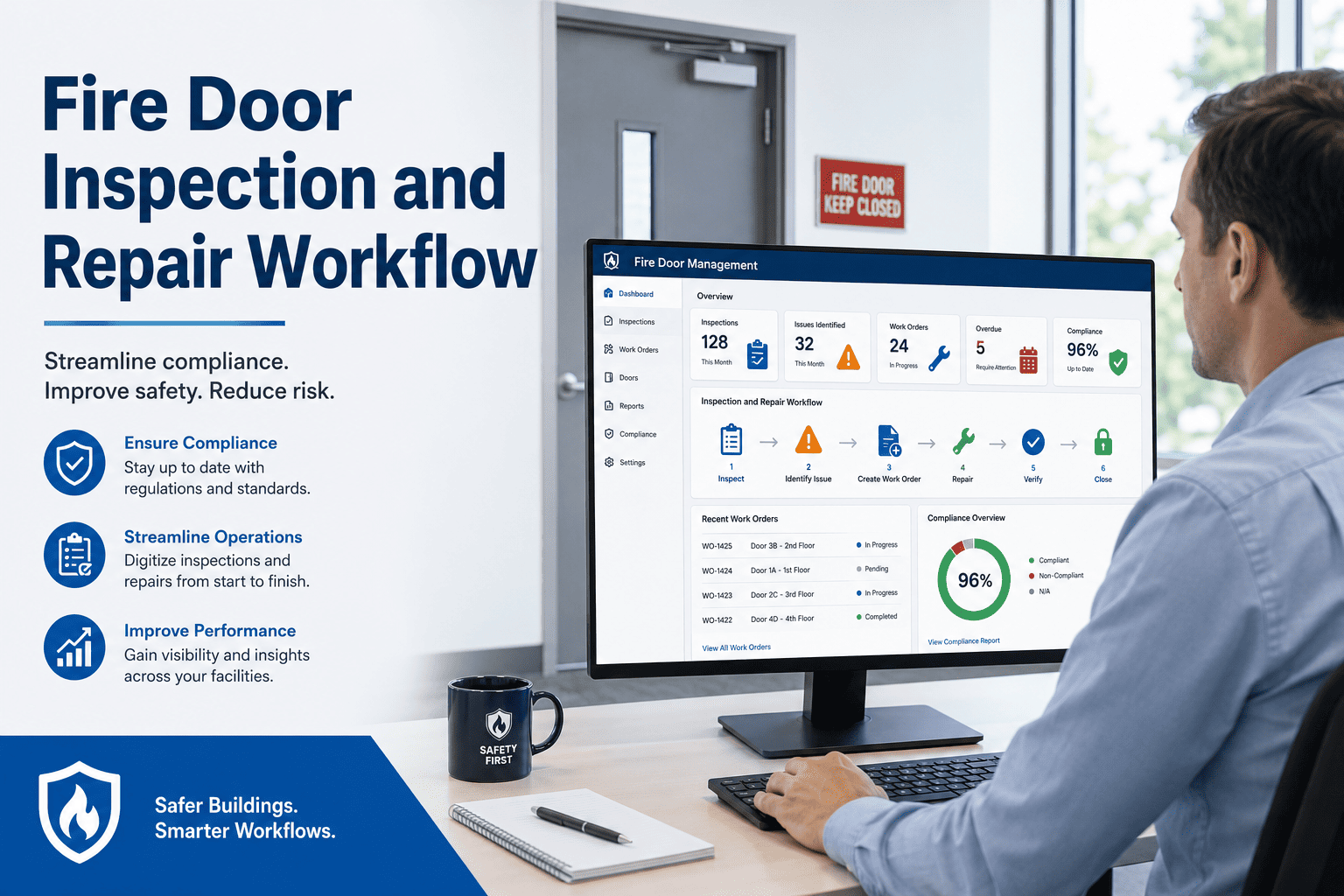
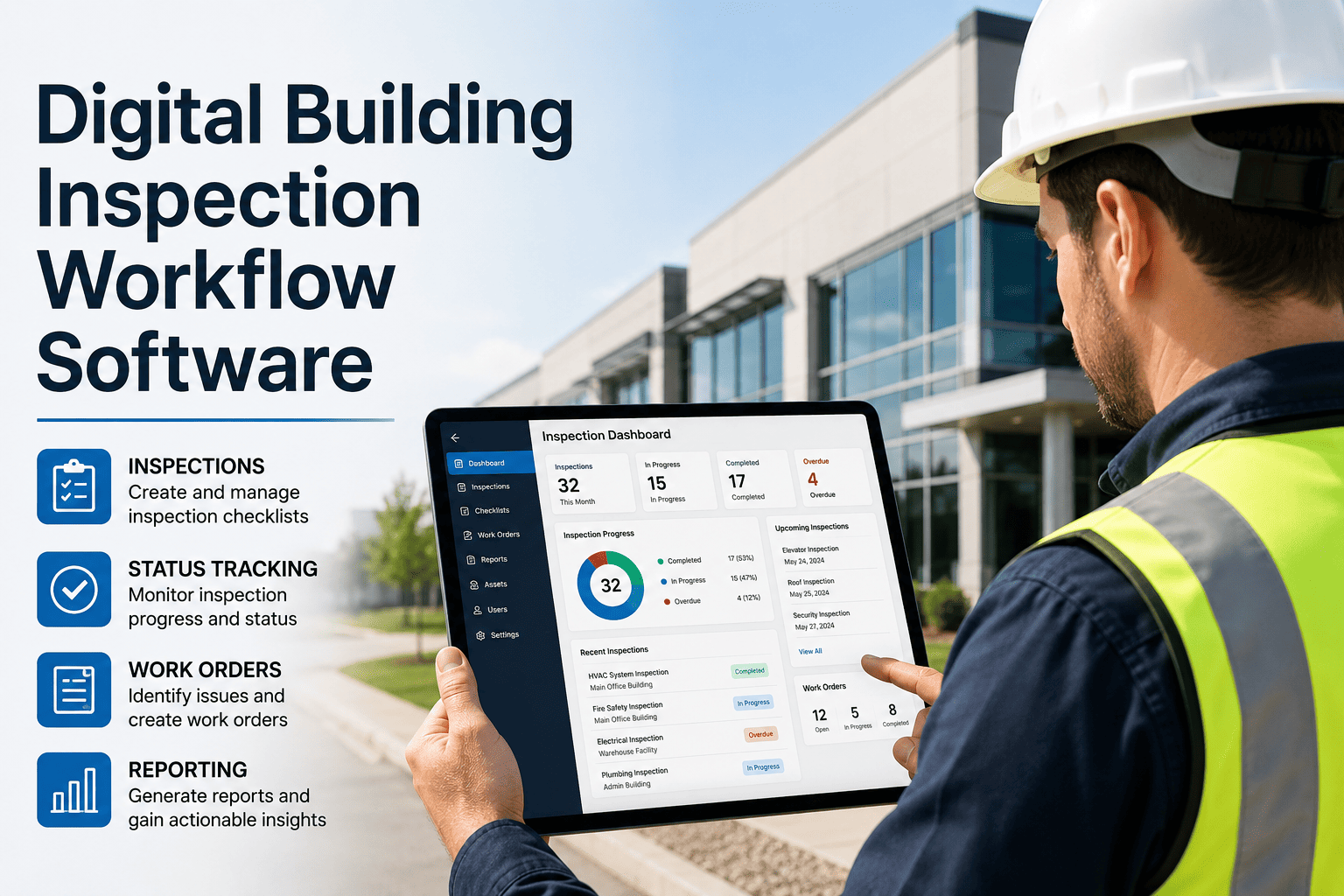
A fire door that fails to close fully, latch properly, or maintain its rating under heat can cost lives in a building emergency — yet most fire door inspection programs remain paper-based, inconsistent across floors, and unable to prove that identified defects were actually repaired. OxMaint digitizes every step of the fire door inspection and repair cycle — from initial visual check to defect assignment, photo-verified repair, and compliance record export — giving safety and facilities teams the audit trail NFPA 80 requires.
FIRE & LIFE SAFETY
Fire Door Inspection & Repair Workflow
Inspect every door, log every defect, assign every repair — with before-and-after photos and a compliance record ready for your AHJ.
NFPA 80
Annual inspection required for all fire doors
24%
of fire door inspections reveal at least one critical defect
$50K+
liability exposure per improperly maintained fire door assembly
NFPA 80 Fire Door Inspection Checklist
This checklist reflects the NFPA 80 annual inspection standard. OxMaint digitizes each item with door ID, photo capture, defect classification, and automatic repair work order generation for any item that fails.
DOOR LEAF & FRAME
Door leaf — no holes, breaks, or alterations to rated assembly
Any penetration, unauthorized cut-out, or modification to a rated door leaf voids the fire rating. Photograph the defect, log dimensions, and create a critical repair or replacement work order — this is a code violation requiring immediate corrective action.
Door frame — intact, no gaps at wall interface, rated glazing undamaged
Gaps between frame and wall allow fire and smoke to bypass the rated assembly. Inspect perimeter seal condition and note any crack, separation, or damaged glazing beads. Log findings with photo and flag for structural or glazing repair as appropriate.
LATCHING & HARDWARE
Positive latching — door latches fully when released from 1/3 open
NFPA 80 requires fire doors to latch under their own weight without manual assistance from 1/3 open. Any door that fails to positively latch is a code violation. Log failure in OxMaint with a high-priority hardware repair work order for same-day or next-day resolution.
Door closer — operational, controls speed and closing force per code
Test closer speed, closing force, and latching function. Closers adjusted too slowly fail to latch; too forcefully they become an ADA violation. Log closer model, arm condition, and adjustment status — replace if the unit cannot be adjusted to compliant operation.
Panic hardware / exit device — operational, no field modifications
Test push bar or paddle function on each cycle. Field-modified or tape-blocked exit devices on fire doors are immediate violations. Photograph any blocked or disabled hardware and create a critical work order for same-day correction.
SEALS & CLEARANCES
Smoke and intumescent seals — continuous, no gaps or deterioration
Inspect perimeter seals for missing sections, compression damage, or detachment. Intumescent seals expand to block fire spread when activated by heat — a gap in the seal is a direct fire pathway. Log condition, measure gap length, and create a seal replacement work order with urgency rating.
Door clearances — top, sides, and bottom within NFPA 80 tolerances
Measure top and side clearances (max 1/8 inch for non-rated pair; 3/4 inch for bottom). Record measurements in OxMaint — oversized clearances indicate door alignment or warping issues requiring adjustment, shimming, or assembly replacement.
SIGNAGE & DOCUMENTATION
Rated label — legible, present, unobstructed on door leaf and frame
Confirm the fire rating label is present, legible, and not painted over or obstructed. Missing labels require a manufacturer verification process — log with OxMaint and create a documentation work order to obtain label confirmation from the original manufacturer or a licensed inspector.
Fire Door Defect Classification and Response Times
| Defect Type |
NFPA 80 Classification |
Priority |
Corrective Window |
OxMaint Action |
| Door fails to latch positively |
Immediate Deficiency |
Critical |
Same day |
Urgent WO + supervisor alert |
| Door held open by wedge or device |
Immediate Deficiency |
Critical |
Immediate removal |
Photo log + urgent WO |
| Missing or damaged door closer |
Immediate Deficiency |
Critical |
24–48 hours |
Parts-linked repair WO |
| Damaged or missing seal |
Repair Required |
High |
7 days |
Seal replacement WO |
| Clearance out of tolerance |
Repair Required |
High |
14 days |
Adjustment or replacement WO |
| Missing rating label |
Documentation Required |
Medium |
30 days |
Document request WO |
1
Inspect
Inspector scans door QR code in OxMaint, works through NFPA 80 checklist on mobile, photographs defects at point of discovery
→
2
Auto-Assign
Each defect creates a prioritized work order — routed to the right trade, with due date and escalation threshold set automatically
→
3
Repair
Technician completes repair, submits after-photo and sign-off in OxMaint from the job site — no paper forms required
→
4
Compliance Record
Closed inspection log with all defects, corrective actions, photos, and technician sign-offs exports as PDF for AHJ submission
EXPERT REVIEW
Diana Forsythe, AHC, DHI
Architectural Hardware Consultant, Door and Hardware Institute — 17 Years Fire Door Compliance
"NFPA 80 is unambiguous: annual inspection is required, deficiencies must be repaired, and a written record must be maintained. What fire marshals find in practice is that annual inspections happen but the written record is a single date entry with no unit-level data. When a door fails in a fire event and there's no record that specific defects on that door were identified, assigned, and corrected, the liability exposure for the building owner is severe. Digital systems that capture per-door inspection results, defect photos, and repair closures give building owners the defensible documentation that meets both NFPA 80 and the legal standard of care."
One System for Every Fire Door in Your Building
Inspect, defect, assign, repair, and document — with a complete NFPA 80 compliance record that's ready when the AHJ walks in.
Frequently Asked Questions
Does OxMaint support fire door inspection programs across multi-building campuses?
Yes. OxMaint organizes fire doors by building, floor, and fire compartment — giving safety managers a portfolio-wide view of inspection status, open defects, and overdue corrective actions across every building in your program. Campus-wide reports can be exported by building or by fire compartment to match your AHJ's reporting structure.
Sign up free to start configuring your campus fire door register.
Can a third-party fire door inspection contractor use OxMaint to deliver inspection results?
Contractors can be granted access to OxMaint with permissions scoped to their assigned inspection area. They complete the inspection checklist on mobile, submit defect photos, and generate their own inspection record within your system — eliminating the PDF-to-spreadsheet transfer step that creates data gaps. All contractor inspection records become part of your permanent fire door compliance archive in OxMaint alongside internally managed repairs.
Book a demo to see contractor access configuration.
How does OxMaint handle fire doors that require replacement rather than repair?
When a technician determines that a fire door defect requires full assembly replacement, they log this in OxMaint as a capital replacement request — attaching the inspection photos, defect notes, and a cost estimate from the work order. The replacement request is visible to the facilities director on the asset dashboard with defect status, enabling budget prioritization alongside other deferred capital items. The door remains flagged as non-compliant until the replacement is completed and a re-inspection closes the corrective action record.
What documentation does OxMaint produce for NFPA 80 annual inspection records?
OxMaint generates a per-door inspection record for each annual inspection showing the door ID and location, each checklist item result, all defect photos with geo-tag and timestamp, corrective action work order references with closure dates, and the inspector's digital sign-off. The combined inspection and corrective action archive is exportable as PDF or CSV — formatted to meet the written record requirement under NFPA 80 §5.2 and accepted by most AHJs as the inspection log of record.
Make Fire Door Compliance Automatic
Replace paper inspection logs with a digital workflow that finds defects, creates repairs, and generates AHJ-ready compliance documentation — automatically.