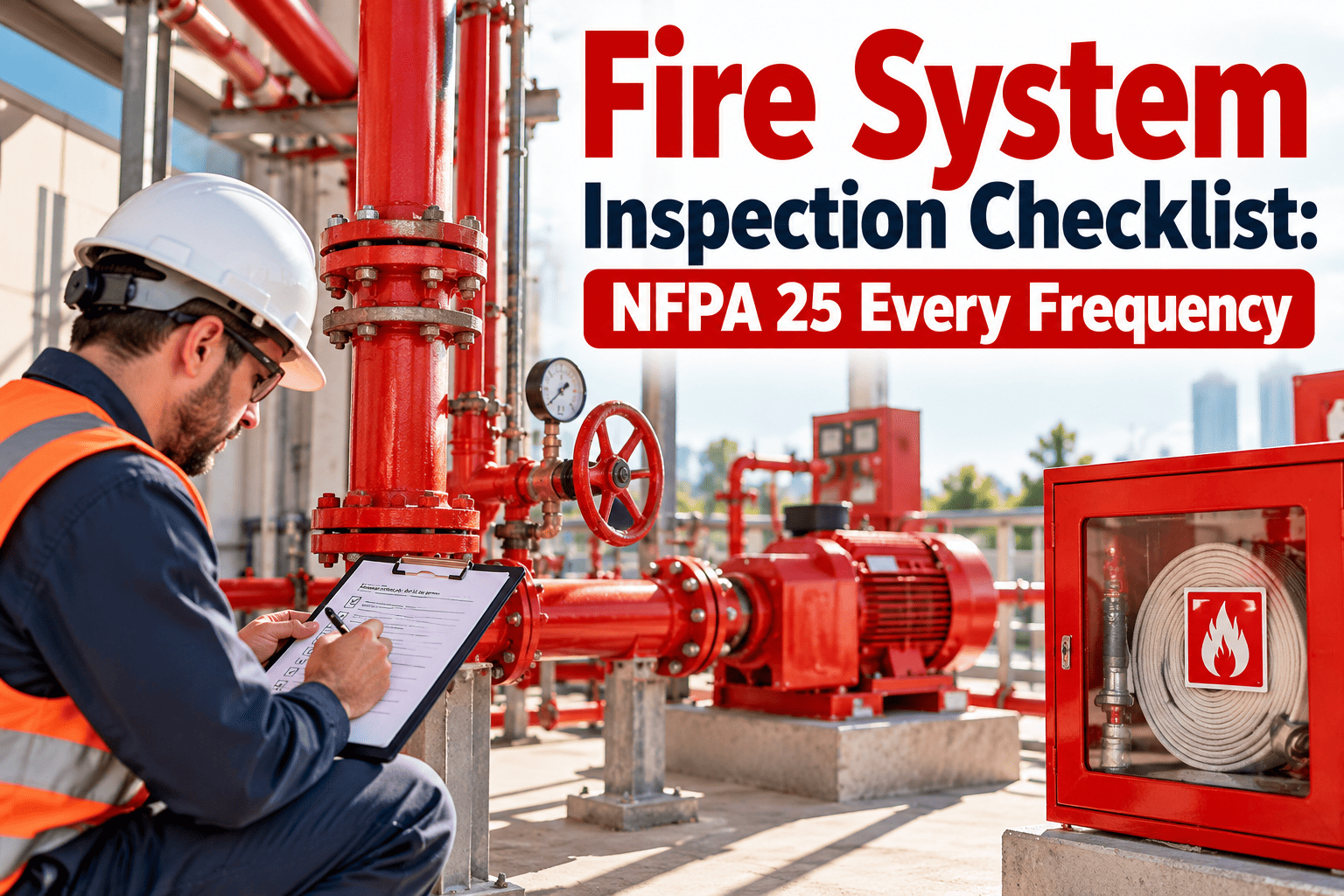
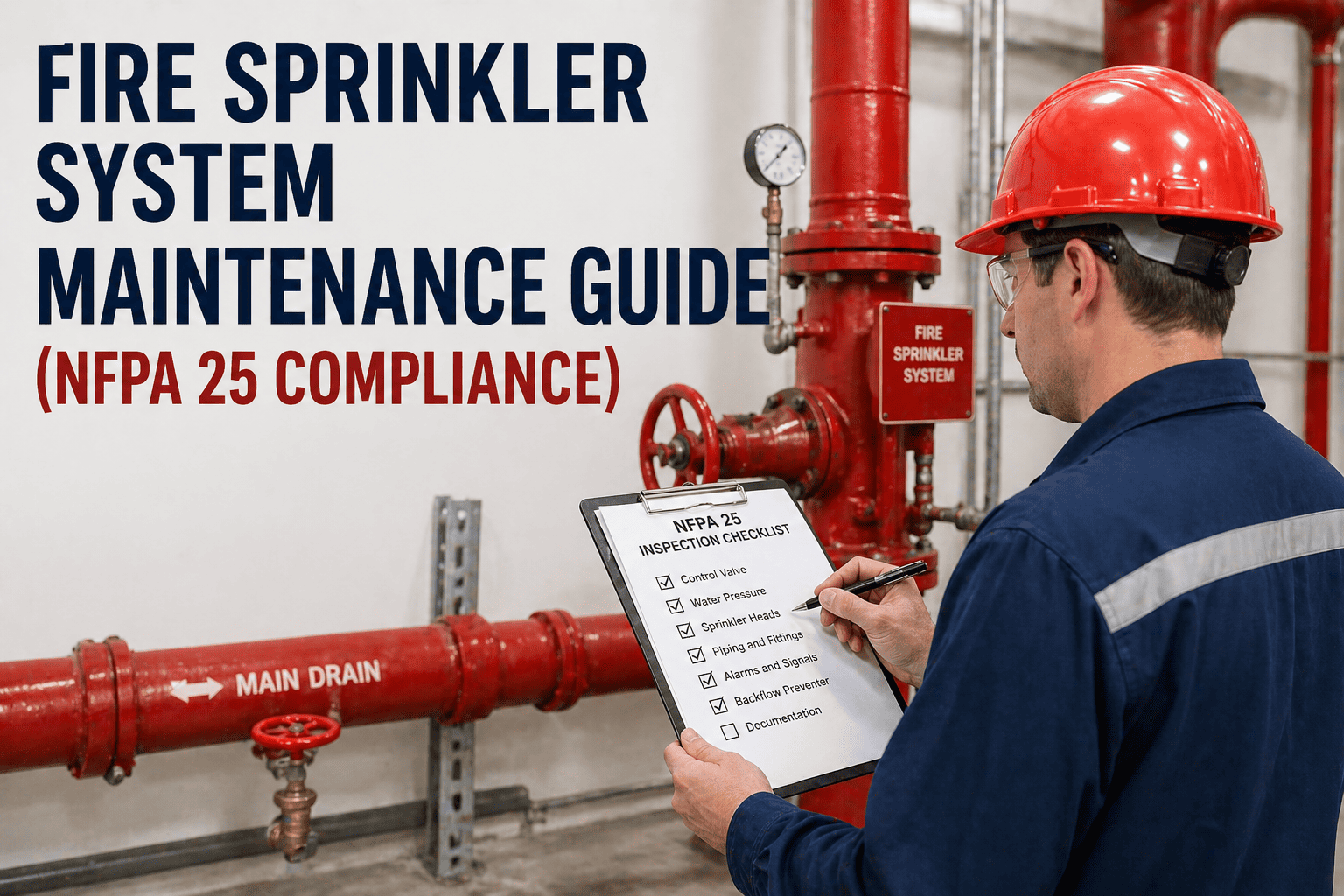
Fire protection systems that are not regularly inspected and documented do not just create compliance risk — they silently fail, and no one finds out until a fire reveals the gap. Oxmaint's compliance tracking platform helps facility managers, fire safety coordinators, and maintenance teams run structured inspection checklists aligned with NFPA 25, NFPA 72, and NFPA 10 — the three codes governing sprinklers, fire alarms, and extinguishers — and automatically turns every failed item into a prioritized corrective work order. This page covers every fire protection system type, the exact inspection frequency each requires, and what your team should be verifying at every interval to maintain AHJ-ready records and protect the people in your building.
NFPA 25 · NFPA 72 · NFPA 10 Aligned
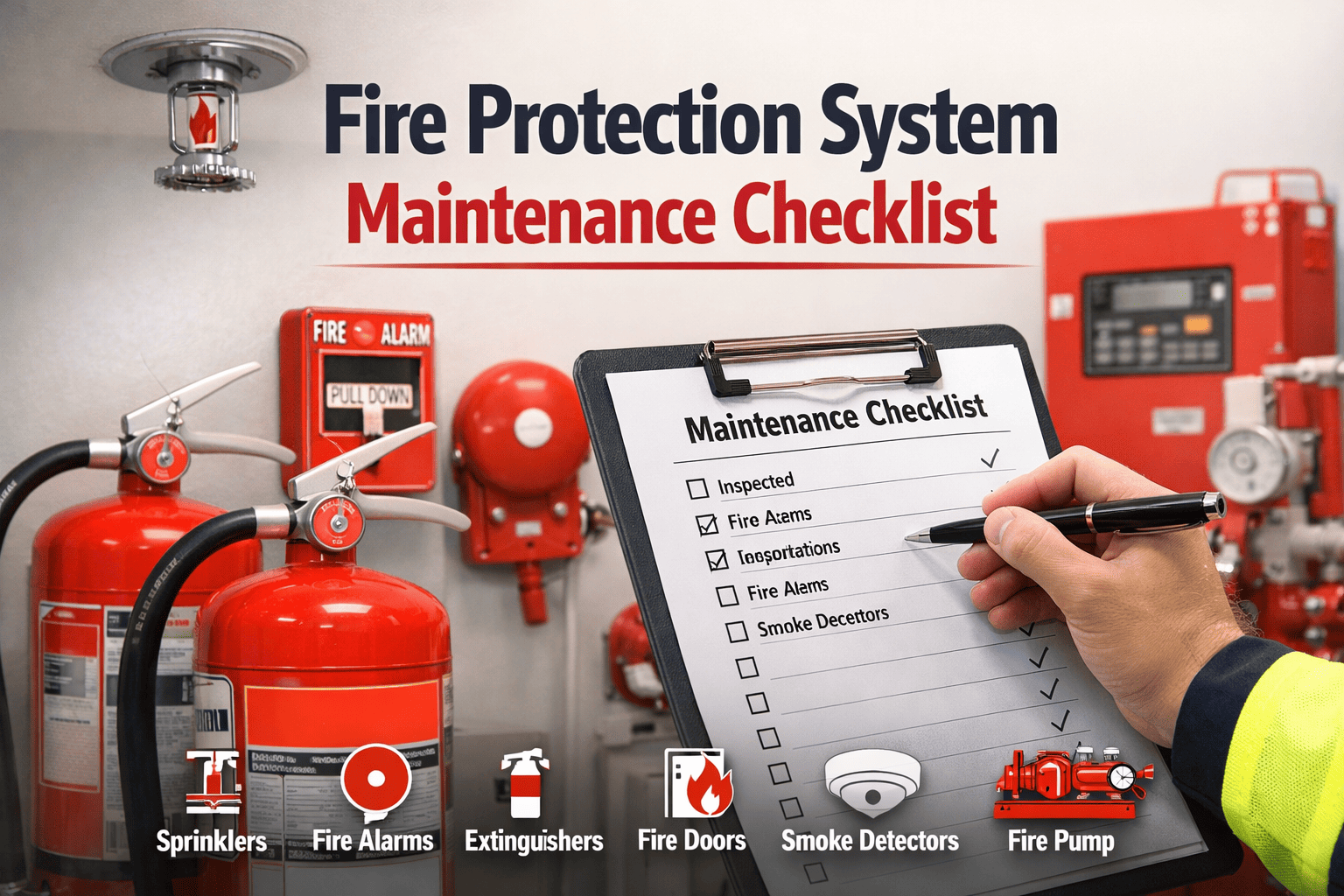
Fire Protection System Maintenance Checklist
A complete, code-referenced maintenance framework covering sprinklers, fire alarms, extinguishers, fire doors, smoke detectors, standpipes, and fire pumps — with inspection frequencies, test requirements, and corrective action guidance.
3
Primary NFPA codes governing fire protection ITM
Weekly
Minimum inspection interval for critical control valves
5-Year
Internal pipe inspection cycle under NFPA 25
System Status Overview
Sprinkler System — Building A
Quarterly test completed · Next: Annual due in 47 days
Compliant
Fire Alarm Panel — West Wing
Semi-annual test overdue by 12 days
Overdue
Fire Extinguishers — All Zones
Annual service tagged · 6-year check scheduled
Compliant
Fire Pump — Main Building
Annual performance test not on record
Work Order
Smoke Detectors — All Floors
Annual sensitivity test passed last month
Compliant
NFPA 25
Sprinklers, Standpipes & Fire Pumps — Inspection, Testing & Maintenance
NFPA 72
Fire Alarm & Signaling — Detection, Notification & Testing
NFPA 10
Portable Fire Extinguishers — Inspection, Maintenance & Recharging
NFPA 80
Fire Doors & Windows — Installation & Annual Inspection Requirements
7 System Types — Full Checklist
Fire Protection Maintenance Checklist by System
Each system below includes inspection items organized by frequency — weekly through 5-year cycles. Failed items must be corrected immediately and documented for AHJ review.
01
Fire Sprinkler Systems NFPA 25
Weekly
Control valves — verify open, sealed or locked, tamper switches in place
Air and water pressure gauges on dry/pre-action systems — within normal range
Monthly
Wet pipe system gauges — inspect and log readings
Alarm valves — no leaks, all trim and gauges functional
Quarterly
Water flow alarm devices — activate test, verify signal at panel
Valve alarm devices and signal devices — functional test
Fire department connections — visible, accessible, caps in place
Main drain test — verify control valves open and proper flow
Annual
All sprinkler heads — inspect for corrosion, paint, damage, or obstruction
Hangers, pipes, and fittings — no leaks, physical damage, or misalignment
Spare sprinklers — minimum 2 of each type and temperature rating on-site
Dry pipe / deluge valves — throttle trip test, clean and reset (licensed contractor required)
Backflow prevention assemblies — test and certify
Every 5 Years
Internal pipe inspection — check for rust, pitting, and obstructions per NFPA 25 §5.2
Pressure gauges — replace or calibrate against a certified reference gauge
Sprinkler heads in service 50+ years — replace or submit for thermal testing
02
Fire Alarm & Detection Systems NFPA 72
Monthly
Fire alarm control panel — no active faults or trouble indicators
Primary power supply — verified connected and charging backup battery
Semi-Annual
Initiating devices — test smoke detectors, heat detectors, and manual pull stations
Notification appliances — horns, strobes, and speakers activated and verified
Supervising station signal — confirm transmission to monitoring center
Annual
Smoke detector sensitivity — test all units, replace any out of listed sensitivity range
Backup battery — full load test, replace if below rated capacity
Duct smoke detectors — test activation, verify HVAC shutdown function
Emergency voice/alarm communications — full system test with occupant notification
03
Portable Fire Extinguishers NFPA 10
Monthly
Location — accessible, clearly visible, not blocked or relocated
Condition — no visible damage, corrosion, or nozzle obstruction
Pressure gauge — needle in operable (green) zone
Pull pin and tamper seal — intact, not activated
Annual
Full maintenance inspection by licensed technician — internal and external check
CO₂ hose assemblies — annual conductivity test, replace nonconductive hoses
Tamper seal replaced, new tag affixed — approved by local AHJ
Every 6 Years
Stored-pressure extinguishers — empty, internal inspection, full recharge, Verification of Service collar installed
Hydrostatic Retest
Dry chemical — every 12 years; CO₂ — every 5 years; Stored pressure water — every 5 years
Weekly / Visual
No obstructions — door path clear, not propped open
Hardware — closer, latches, hinges visible and undamaged
Annual
Self-closing function — door closes and latches from full open position
Positive latching — door latches without manual assistance
Label / listing plate — legible, not painted over
Frame, panel, and glazing — no gaps, holes, or damage that compromises integrity
05
Standpipe Systems NFPA 25
Quarterly
Hose cabinets — accessible, hose racks in place, nozzle attached
Control valves — open, sealed, no leaks at connections
Annual
Hose — inspected for damage, mildew, deterioration
Pressure reducing valves — tested for correct outlet pressure
Every 5 Years
Full flow test at hydraulically remote hose valve — verify required pressure and GPM per NFPA 25 §6.3.1.1
Weekly
Automatic start test — run pump for minimum 10 minutes, log pressure and RPM
Pump room — no water intrusion, proper temperature, power supply confirmed
Annual
Full performance test — verify rated pressure and GPM under load
Packing gland — adjust to allow slight drip, no excessive leakage
Transfer switch — test automatic transfer to emergency power
07
Emergency & Exit Lighting NFPA 101
Monthly
30-second test — activate emergency mode, verify all units illuminate
Exit signs — all legible, internally lit, no burned-out elements
Annual
90-minute full discharge test — battery holds load for 90 minutes minimum
Pathway illumination — minimum 1 foot-candle at floor level along egress path
From Failed Item to Closed Work Order
Automate Your Fire Protection Compliance Program with Oxmaint
Every failed checklist item in Oxmaint auto-generates a prioritized corrective work order — linked to the asset, the NFPA code reference, and the technician responsible. Your records are digital, searchable, and AHJ-ready at any time.
Quick Reference
Fire Protection Inspection Frequency Summary
Use this reference to schedule your inspection program. Systems with multiple frequency tiers require separate scheduling — missing any single tier is a compliance violation.
| System |
NFPA Code |
Weekly |
Monthly |
Quarterly |
Annual |
5-Year Cycle |
| Fire Sprinklers (Wet) |
NFPA 25 |
— |
Gauges, alarm valves |
Flow alarm, drain test |
Full inspection (licensed) |
Internal pipe inspection |
| Fire Sprinklers (Dry/Pre-action) |
NFPA 25 |
Gauges, control valves |
— |
Signal devices, FDC |
Valve trip test |
Obstruction investigation |
| Fire Alarm System |
NFPA 72 |
— |
Panel status, battery |
— |
Sensitivity test, full system |
Battery replacement (if applicable) |
| Fire Extinguishers |
NFPA 10 |
— |
Visual, pressure, seal |
— |
Full maintenance, tag |
6-yr internal; 12-yr hydrostatic |
| Fire Doors |
NFPA 80 |
Visual check |
— |
— |
Functional close/latch test |
— |
| Standpipe System |
NFPA 25 |
— |
— |
Cabinet, valve inspection |
Hose, PRV test |
Full flow test (§6.3.1.1) |
| Fire Pump |
NFPA 25 |
Auto-start run test |
— |
— |
Full performance test |
— |
| Emergency Lighting |
NFPA 101 |
— |
30-second test |
— |
90-minute full discharge |
— |
Where Facilities Fall Short
Top Compliance Failures in Fire Protection Programs
41%
Missing or Incomplete Records
NFPA 25, 72, and 10 all require records available to AHJ on demand. Paper logs are the most common documentation gap — lost, incomplete, or not reflecting the latest test cycle.
34%
Missed 5-Year Internal Pipe Inspection
The 5-year internal inspection is the most frequently skipped NFPA 25 requirement. Rust and pipe obstruction only reveal themselves internally — and a blocked sprinkler in a fire is catastrophic.
27%
Fire Pump Without Annual Performance Test
Fire pumps that pass weekly run tests can still fail under full load. Annual performance testing at rated pressure and GPM is the only way to confirm the pump will deliver adequate flow in an emergency.
22%
Smoke Detector Sensitivity Not Tested
Detectors that pass visual inspection can be operating outside their listed sensitivity range. NFPA 72 requires annual sensitivity testing — and detectors out of range must be replaced, not adjusted.
Expert Review
"
The number one mistake I see building owners make is treating NFPA compliance as an annual event. NFPA 25 has weekly tasks. NFPA 10 has monthly tasks. NFPA 72 has semi-annual tests. When a fire occurs between those missed intervals and the system fails, the documentation gap is the liability — not just the mechanical failure. Facilities that use a digital compliance platform like Oxmaint don't just have better records. They have a system that actively prevents intervals from being missed and closes the loop between inspection finding and corrective action. That is the difference between a compliant program and a paper compliance program.
Michael T. Dragan
Certified Fire Protection Specialist (CFPS) — 18 Years in Commercial & Industrial Fire Protection ITM, NFPA Member
Digital Compliance Tracking
Stop Managing Fire Protection Compliance with Spreadsheets
Oxmaint gives your team a digital inspection workflow — structured checklists, automated scheduling across weekly, monthly, quarterly, and annual cycles, and corrective work orders that tie every finding to a documented resolution. AHJ-ready records, always.
Start Free — No Credit Card
Book a 30-Minute Demo
Frequently Asked Questions
Fire Protection Maintenance — Common Questions
What NFPA codes govern fire protection system inspection and maintenance?
The three primary codes are NFPA 25 (Inspection, Testing, and Maintenance of Water-Based Fire Protection Systems — covering sprinklers, standpipes, and fire pumps), NFPA 72 (National Fire Alarm and Signaling Code — covering alarms, detectors, and notification systems), and NFPA 10 (Standard for Portable Fire Extinguishers). NFPA 80 governs fire door inspections and NFPA 101 addresses emergency lighting. All are adopted by state and local jurisdictions, and building owners are directly responsible for maintaining compliance with whichever edition is locally adopted.
Oxmaint's compliance tracking supports all NFPA inspection cycles in a single platform.
How often must fire sprinkler systems be inspected under NFPA 25?
NFPA 25 establishes a tiered inspection schedule: dry and pre-action system gauges and control valves must be checked weekly; wet pipe system gauges and alarm valves are checked monthly; water flow alarm devices, valve alarm devices, and fire department connections require quarterly inspection and testing; and a full system inspection including all sprinkler heads, hangers, pipes, and drain tests must be conducted annually by a licensed contractor. Every five years, an internal pipe inspection is required to check for rust and obstructions, and pressure gauges must be calibrated or replaced.
Book a demo to see how Oxmaint automates scheduling across all NFPA 25 intervals.
Who is responsible for fire protection inspection records, and what must be kept?
Under NFPA 25, 72, and 10, the building owner or designated responsible party is required to maintain all inspection, testing, and maintenance records and make them available to the Authority Having Jurisdiction (AHJ) on demand. Records must include the date, the name of the inspector or contractor, the results of each test, and any deficiencies identified along with corrective actions taken. Failure to produce records when requested can result in compliance citations, insurance claim denials, or the system being declared out of service — even if the system is mechanically functional.
Oxmaint stores every inspection record digitally, accessible anywhere at any time.
Can building staff perform fire protection inspections, or must a licensed contractor be used?
For most fire protection systems, weekly and monthly visual inspections can be performed by trained in-house staff. Quarterly functional tests — such as activating water flow alarms — can also be conducted by building staff who are properly trained on NFPA requirements. However, annual inspections for sprinkler systems, fire alarm sensitivity testing, fire pump performance testing, and any five-year or hydrostatic testing must be performed by licensed fire protection contractors. Most states require a licensed contractor for all annual NFPA 25 work. Always verify the requirements of your local AHJ, as state laws vary.
Oxmaint lets you assign inspections by role — in-house or contractor, with full digital records for both.
What happens if a fire protection system deficiency is found during inspection?
Any deficiency that impairs the system's function must be corrected immediately. If immediate repair is not possible, impairment procedures under NFPA 25 Chapter 15 must be followed — including notifying the AHJ and the building's insurance carrier, posting impairment tags, and implementing a fire watch where required. All deficiencies must be documented along with the corrective action taken and the date of resolution. Non-impairment deficiencies — items that don't immediately compromise operation — must still be documented and corrected within a reasonable time period.
Oxmaint auto-generates corrective work orders on every failed checklist item and tracks them to closure.
Built for Fire Safety Compliance Teams
Your Fire Protection Program Needs More Than a Checklist — It Needs a System
Oxmaint connects your inspection checklists to your maintenance workflow — so every missed interval sends an alert, every failed item becomes a tracked work order, and every AHJ visit is one you are prepared for. Start with your existing systems and scale across your full portfolio.